Hi phmaximus!
I also find suspension systems extremely interesting and keep learning as I do projects, and I enjoy reading and discussing the setups. Yes it makes perfect sense, actually I had a similar picture in mind when trying to explain how my setup would bind if the links are not parallel (when viewed from the side), here is the pic I was thinking of:

Below is another picture showing the parallelism and the effect on the instant center: In my setup they are parallel just like that. When I was saying distance between links I meant the vertical distance, in other words, the angle of the upper link relative to the lower link.
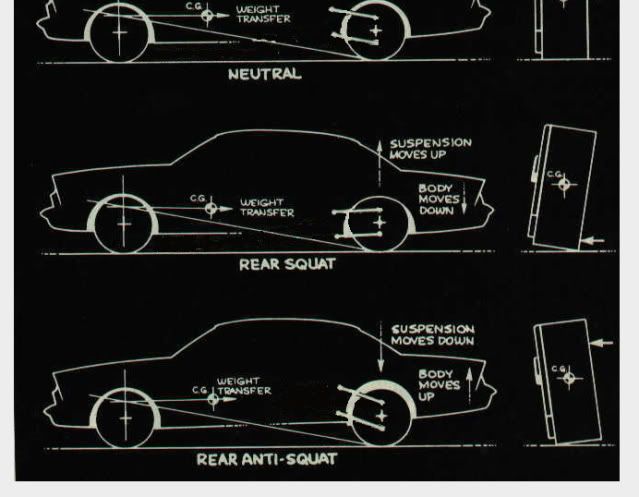
In my scenario (parallel links) the only parameter affecting the squat or lift seems to be the angle of the two parallel arms, and the instant center is not determined by the location where the arms axis extent because they never meet

but it still look like the same logic, if the arms point lower than the CG it squats, if they point higher it is anti squat. So in other words I would need to shift the chassis mounting points up or down to alter the anti squat or pro squat (or rise/lower the car ride height). Right now I do not have room to alter those positions because the two links are not close enough to each other. I would need to re-do the axle attachments to make them closer (maybe by bringing the links forward to the axle instead of top and bottom).
So the main reason for having the two links parallel is the binding. It is hard to explain, but the triangle the two links form also makes a solid triangle that prevent the axle from twisting because there is another triangle on the other end of the axle. I would have liked to have an angle because all race cars actually have one
but it binds quite a lot when you do. I'll try to find a link explaining the binding thing.
Pictures source:
http://motorsportsvillage.com/forum/...=5766&start=75
Fred