Originally Posted by
drac1
Top speed in level flight would depend on top RPM and pitch. I would say the speeds you are saying are too high.
In level flight through the pattern, I am at around 5/8 ths throttle which is about 4500 rpm. The pitch is 10", so doing the calculations speed is around 70 kmh.
Doing the calculations using my set up, ie. 7200 rpm, 10" pitch, top speed would be 110 kmh.
Just took the number provided added some assumption and here are the results
(any erros?):
- 5/8 throttle gives a rmp of 4500 on ground
- Assuming the propeller used is an APC 20.5x 10, this gives a power output of 1.43 hp
- Airframe characteristics:
- wing area = S = 65 dm[SUP]2[/SUP]
- total drag coefficient (includes everything C[SUB]D0[/SUB], induced drag, trim drag,,) = C[SUB]D[/SUB]=0.04 (SWAG)
- Standard day, sea level: density = rho =1.225 kg/m[SUP]3[/SUP].
For back of an envelope calculation set:
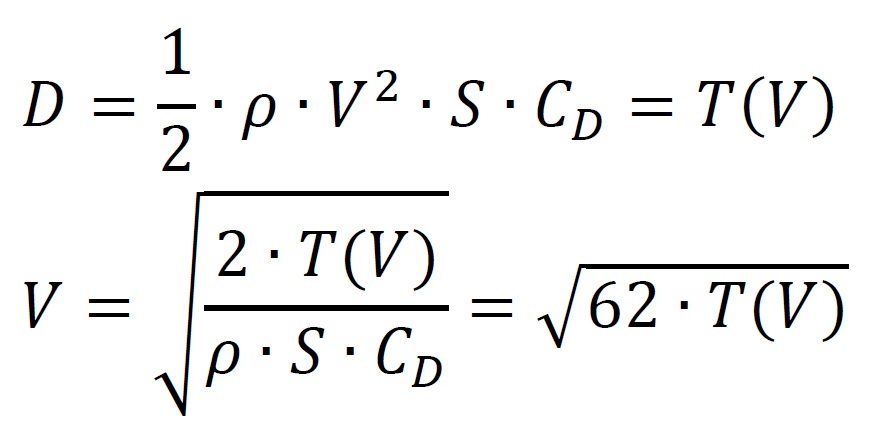
Since for a propeller the thrust is dependent on the flight speed, we end up with an equation as above, no closed form solution. But can be solved iteratively until thrust and speed matches.
- Assuming that the power output of the engine will be 1.43 hp, even if the rpm changes, note the throttle setting is not changed. Using the performance curves for the propeller an airspeed of 37 m/sec = 133 km/h = 83 mph is calculated. That is in straight and level flight at 5/8 throttle setting.
- The top speed is much higher than 37 m/sec. I plotted the hp output based on the data provided by UKpatternflyer in the thread “YS problem” and was scared. For a propeller with a pitch of 10” the top speed would be determined how fast the engine is able to rev. i.e. the power curve looks like. I does not have the performance deck of the engine.
DagtheElder: I know it does not answer your questions, you have to test (GPS) and do some reverse engineering . But our planes moves faster than we think.
Drac1: Assuming an advance ratio of 1.0 is very optimistic, at an advance ratio of about +/-0.75 the thrust is zero, please check APC's performance data.
Regards,
Arnstein