To answer your question, I am currently using a RimFire 50cc brushless motor at about 28.5 lbs. gross wt.
During WWll most fighter aircraft were built to withstand 7Gs because that was the max A pilot could stand without G suits which came very late in the war. The only plane able to take higher G forces was the Bearcat which was fitted with disposable wingtips that automatically blew off when overloaded. If you look at high res photo graphs of Unlimited Racers you will always see distorted sheet metal on the fuse and wings. The question is always "How much can it take?". When I flew in my Huey helicopter during Vietnam the tail-boom was always distorted as soon as the pilot pulled pitch for takeoff and stayed that way until landing. The sheet metal on aircraft is so thin it rivals beer cans, the underlying structure keeps the shape aerodynamic for minimum drag. If you don't like the idea of distorted metal don't look at the wing of the airliner you are riding in.
When I recently flew in the Collings Foundation's P 51 B "BettyJane" I looked for distortion but didn't see any, maybe because it was lightly loaded (only enough fuel for the particular flight I was on) and all the maneuvers we performed were low G".
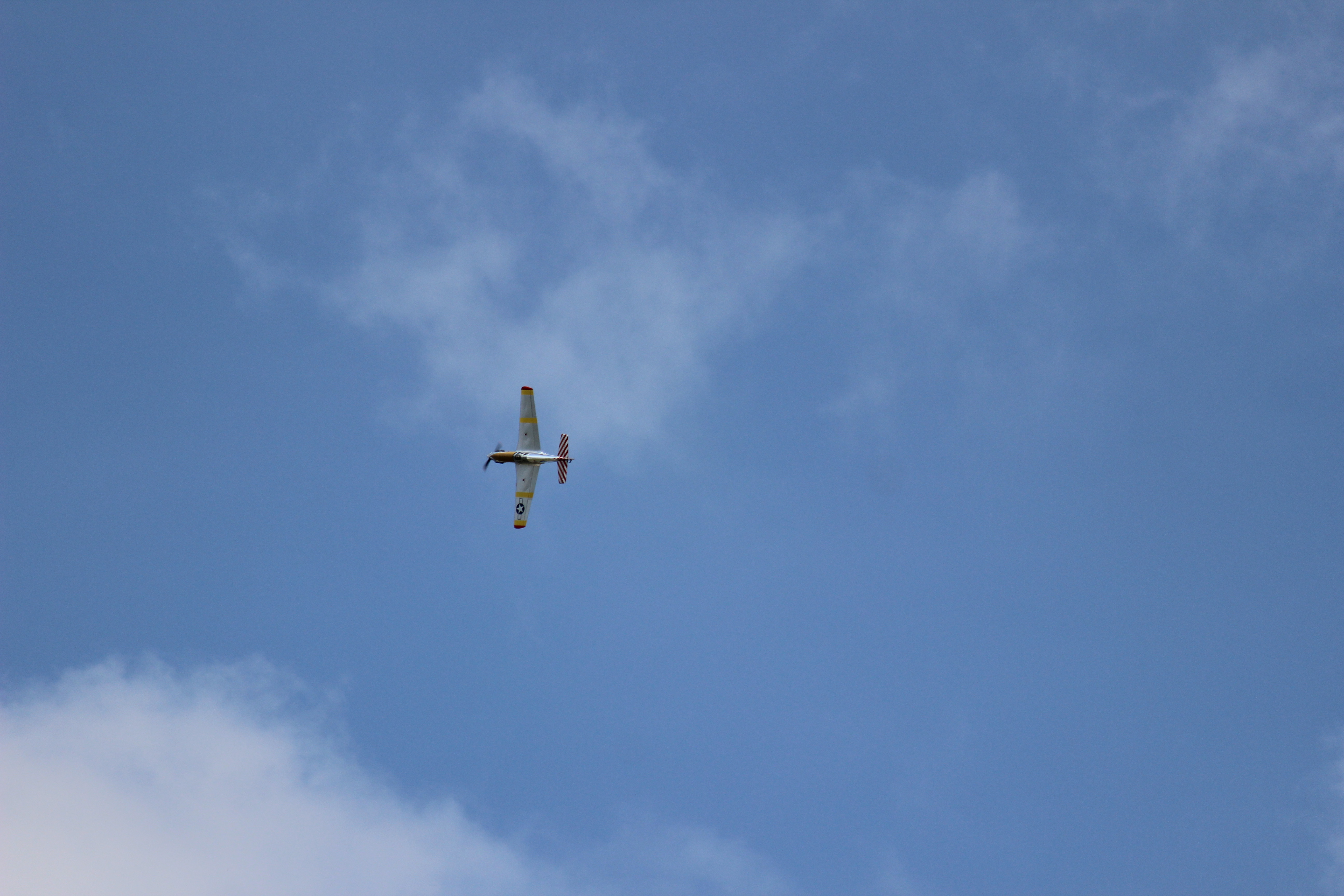
5/30/15 update- I have had time to pull all the hatches on the bottom of the wing to inspect for separated glue joints and cracked ribs and sheeting. I am happy to report that the distortion visible in this picture is most likely the covering being pulled away from the wing sheeting, I can fix this by ironing the film down on to the sheeting. A near 90 degree bank like this can generate as much as 9 g's so the weight of the airframe (28.5 Lbs. x 9)= as much as 256 lbs. It proves that the TF design with the reinforced wing and fuse is pretty tough. I did not intend to stress it this hard, what started as a wide radius turn was tightened up by flying into a strong gust of wind rolling off the nearby treeline. The turn started low below the treeline and as it turned and climbed higher the wind struck it in the belly. I noticed the turn tighten up and let off on the elevator but it was already into the gust by then. The runway conditions were almost dead calm at the time so it could have been strong thermal activity.