Originally Posted by
Top_Gunn
Surface area is not "just linear dimensions." A square 10 inches on a side has an area of 100 square inches. A square 5 inches on a side has an area of 25 square inches. So the larger square is twice the "size" of the smaller one if you just measure length, but it's four times the area. I'm inclined to think that scale speed ought to relate to the squares of the "scale," because, as you say, you don't fully see depth at a distance. But this is just a guess, not something I'd argue for. My point is just that we shouldn't assume that scale speed for a 1/4 scale model should be 1/4 the speed of the full scale just because of the number we use to label scales. "Quarter scale" is just what we call it; it could just as well be called "1/16 scale" or "1/64 scale." Picking length to compare scales is probably a good thing in the sense of simplifying what we do in building model, but it's not "right" in some "law of nature" sense. I'd bet that if we all built model hot-air balloons instead of airplanes we'd be naming scales by relative volumes. (And we wouldn't have to worry about scale speed.)
What you're saying is that it's related to what's called flux density in physics. Flux is easily explained with a flashlight casting a circular beam. That beam disperses with distance in two dimensions. The amount of light per unit area decreases as distance from the light increases. But flux impacts intensity, not size.
Your optical sensor is a simple convex lens and the retina, which function like the lens below. We have a circle of a certain size h0 at a distance d0 as depicted below. Light from it passes through the converging lens and focuses on your retina. The amount of area that subtends an area on the retina is directly related to the linear dimensions and the distance. Assuming both images are far field, meaning well beyond the focal point of the lens, the exact same shape, say 4 x h0 at a distance 4 x d0, subtends exactly the same area on the human retina through the same lens as the same shape of 1/4 size at 1/4 the distance. So if the area each occupies on the human retina is the same and they're moving at the same angular velocity (1/4 speed), with other factors excluded, the human retina cannot register a difference. Simple laws of optics.
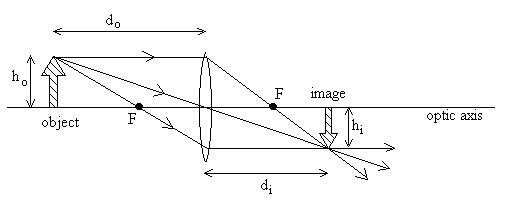
Assuming a 1/4 scale plane, at 1/4 scale distance, at 1/4 scale speed, where I think the perception of different speeds comes into it several ways. The easiest are that it's 1/4 scale at 1/4 speed, but not at 1/4 scale distance. The other is 1/4 scale at 1/4 scale distance, but not at 1/4 scale speed. The more complex one though how the brain interprets information based on what else is in the "frame" with the 1/4 scale plane. Relative speed across the ground and full scale objects in the same visual field greatly influence perception. And that perception is very powerful in aviation, all sorts of full scale mishaps due to how easily the brain can be fooled. One way of thinking of it is that when your eye registers full scale objects in the same field as the 1/4 scale plane, it "knows" that's not real. Hence the bias toward perception that it's not realistic. Again, the brain is very powerful in this equation - and I think the driver. The eye and the retina though, that's pure optics.