I saw Steve Rickett's Comet fly at several model shows and decided, "I want one. I want a big jet airliner show model."
I considered the options and, being a believer in KISS, decided on a trijet with one engine.
So there's the B727 - been done as a kit, not my scene, the L1011 Trisar, been done as a kit, nearly bought one.
Or the Hawker Siddeley HS-121 Trident. Now nobody has ever built and flown a model Trident.
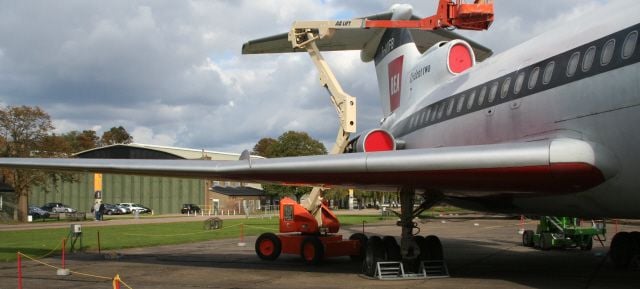
I obtained a small drawing off the internet, no detail shown, but I wasn't planning on detail just a big show model, not a scale competition type. I looked at various sizes and decided on a scale of 1/7.2 - just under seventh scale, same as Steve's Comet. I already had a Merlin 160 that should do. So I thought about it for about ten years, then went to photograph the Trident 2E at Duxford. I also had second thoughts on power and bought a Jets Munt 200.
A few more years of planning but no action went by, my age passed 70, so I'm on borrowed time, I realised that a big Trident was beyond capabilities so after taking advice from Steve Rickett I consulted a professional.
In an extensive discussion with Phil Clark of Fighteraces in October last year I explained what I wanted, he explained what was practical and he asked some difficult questions.
"What wing sections?"
"Duh! Dunno."
The Trident was designed to cruise at mach 0.9 so maybe the full size sections are not relevant.
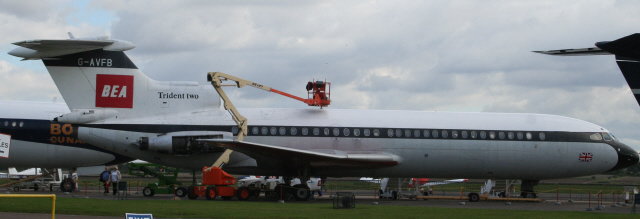 Trident in BEA introductory colour scheme
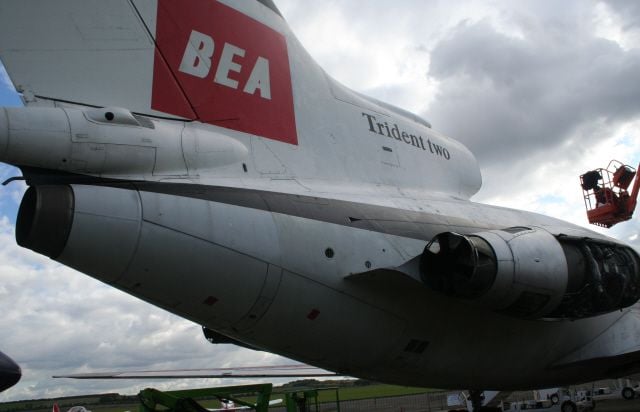 Will a model engine fit without a tailpipe?
 The wing has an obvious discontinuity on the top surface.
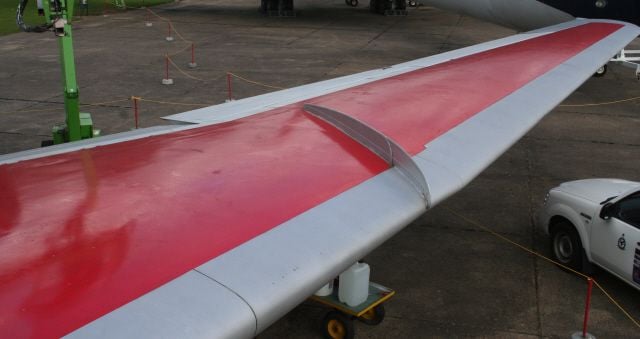 There is an odd change of section/taper/thickess a third of the way out.
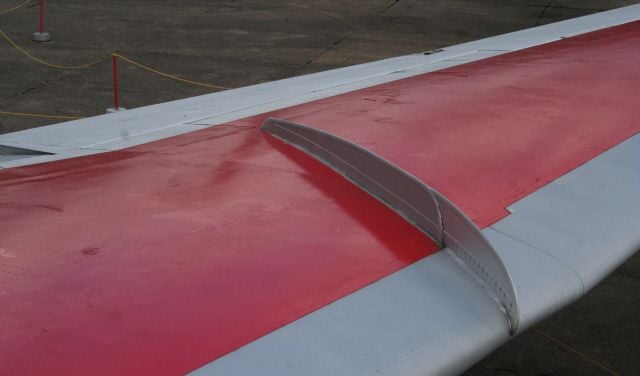 The discontinuity is at angle angle to the wing fence.
I went home to think about it, came up with an idea or two for building the wing, but would they work? One way to find out; build a test wing to a small scale.
I looked at the photos again and gave it some thought and decided that I could cut the inner panel from foam and sheet it, then add a built up outer panel.
I decided on NACA 0013 root section at the fuselage side, blended during foam cutting into NACA 33012 at the discontinuity. From there out would be a built up panel using laser cut ribs and spars with the same 33012 at its root, and the same section thinned to 10% thick at the tip rib. The NACA 5-digit section don't have much moment so don't load the tail too much.
So I could build a look-alike wing, maybe, but would it fly? I could find that out too if I added a representative tail and rudimentary fuselage, and an engine. That would tell me if it would fly, how it might handle, where a good CG might be, and many other answers.
Back in 1972 (while I was at college) G-ARPI crashed near Staines. It entered a deep stall due to premature droop retraction and could not recover.
My model, even the big one, would not have droop or slats as recommended by Phil Clark. So would the model deep stall?
Well the small proof-of-concept model might tell me that as well.
So I decided on a crude flying model to a scale of 1/20.
My scaling spreadsheet gave me a wing area of 3.5 sq ft and a target weight of 3 kg, 6.5 lb and a wingspan of 59 inches.
So that's what this thread is about. a twentieth scale Trident built as simply as possible, with no flaps, no moving tailplane, no retracts, and my latest new toy, an Xicoy X45 pushing it along.
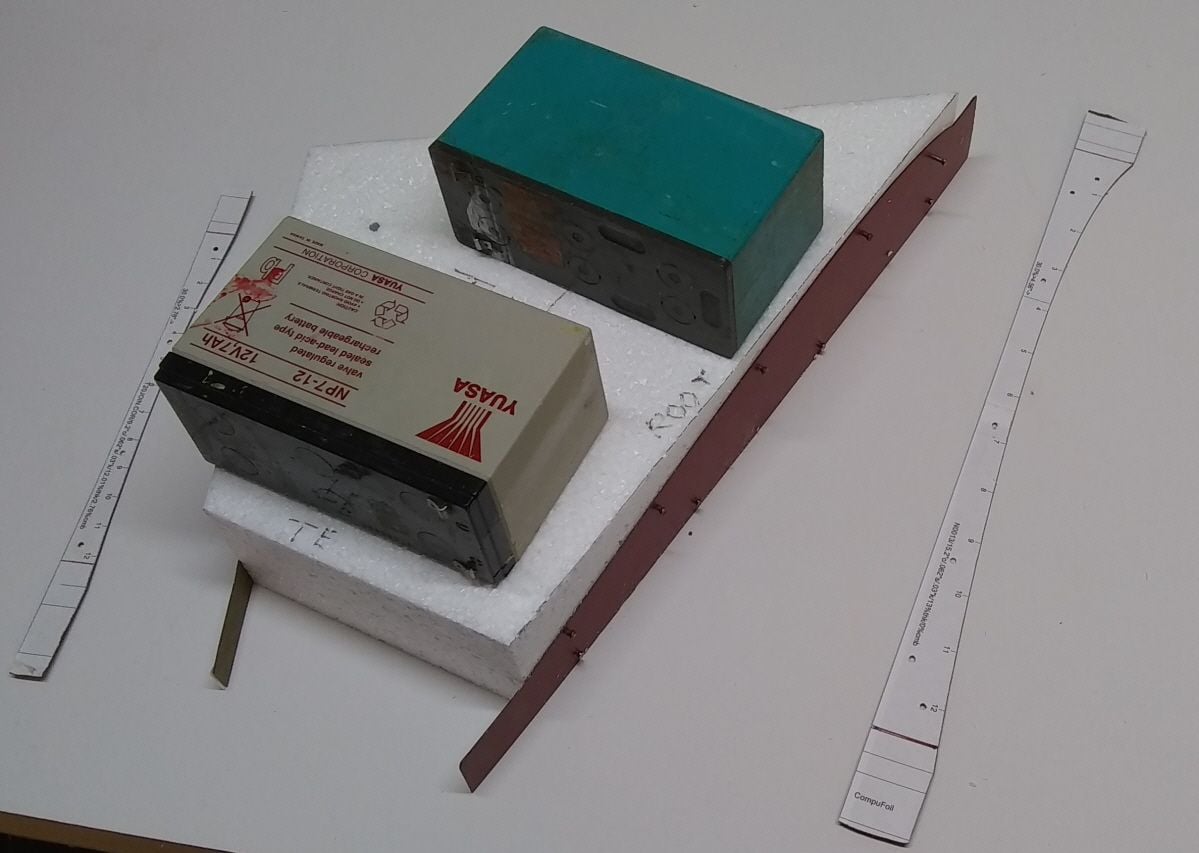
Here's the first stage, cutting a bit of foam to the trial sections.