Yet another guess on second (or third?) thought, to add to the confusion, just because it's so much fun (a fairy tale from One Thousand and One Nights, or my post #1001

):
Remembered that in 2004 I had calculated the prop with JavaProp (by Martin Hepperle) and there is even information about swirl. (Meanwhile there are even measurements by UIUC/Michael Selig but without swirl information.) The diagram is calculated for the assumed operating point (11 m/s, 6450 rpm, thrust and torque like above) and shows the swirl angle over the blade radius (r/R=0 is centerline, r/R=1 is blade tip). Shown are the angles at the propeller disc and far behind (far field ff):
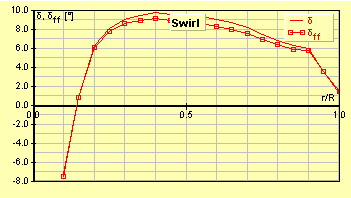
This latter swirl angle varies between 6 and 9 degrees and is here reduced by 2 degrees left-thrust to between 4 and 7 degrees. That's the angle at which the prop-wash hits the vertical tail's right side what makes for a right-yawing moment, adding to the right-yawing moment from propeller thrust and torque. Since the tail is above the datum line, there is a smaller left-rolling moment adding to the left-rolling moment from propeller side-thrust and torque.
Obviously, left-rolling and right-yawing effects cancel each other now, with 2 degrees left-thrust. To find that out theoretically, elaborate CFD calculations could be needed which might be fun but which are surely overkill for a cheap model airplane. There's nothing better than just finding out practically, by trial and error (or, put differently, by experience). Theory is too complicated and inefficient here.
P.S.: Forgot to mention that the airplane will probably sideslip a bit, its nose a bit turned right from flight direction (by the right-yawing moment) so dihedral produces a right-rolling moment cancelling the left-rolling moment. That throws the angle calculations out of the window, though.