The throttle openings at idle are indeed "ridiculously small" compared to when the engine is running glowfuel and plugs. That's OK, that basically means that you have your idle mixture pretty good. Take care that you don't lean out midrange too much (it is better to wait with finetuning that until you are actually flying and the engine is running "operational conditions" WRT unloading of the prop and additional cooling due to flight wind). Other than that, good job.
Indeed, that engine with the discoloured cylinder has had one cylinder running too hot. I would at least carefully inspect the combustion chamber for detonation damage.
On gas, your engine WILL discolour like that on both cylinders, and over the full length of the cylinder from footflange to top. On gasoline it is NOT a problem (the fuel runs that hot all by itself and the properties of the fuel as well as the oil do allow for that, and the materials used in the engine can handle it), but on glow, if it runs hot like that, that's a symptom of something being not right with the mixture to that cylinder.
It is not heat that kills an engine, it is the reason for that heat...
That amount of residue after 15 minutes seems reasonable to me, a bit depending on throttle setting (fuel consumption).
A good way to keep an eye on what is going on in the engine:
Cut a circle out of a regular coffee filter, and place a drop of crankcase residue in the middle. Place that circle on top of an old glass or coffeecup or whatever in an oven on 50~75 deg C for about 30 minutes.
Make sure that the oil spot does not have contact with the support.
The appearance of the spot after 15~30 minutes gives an indication of how much and what kind of dirt is in the oil.
The "fresher" the sample, the better the indication, I usually take that drop that is hanging off the nipple immediately after stopping the engine.
Looks a bit like this:
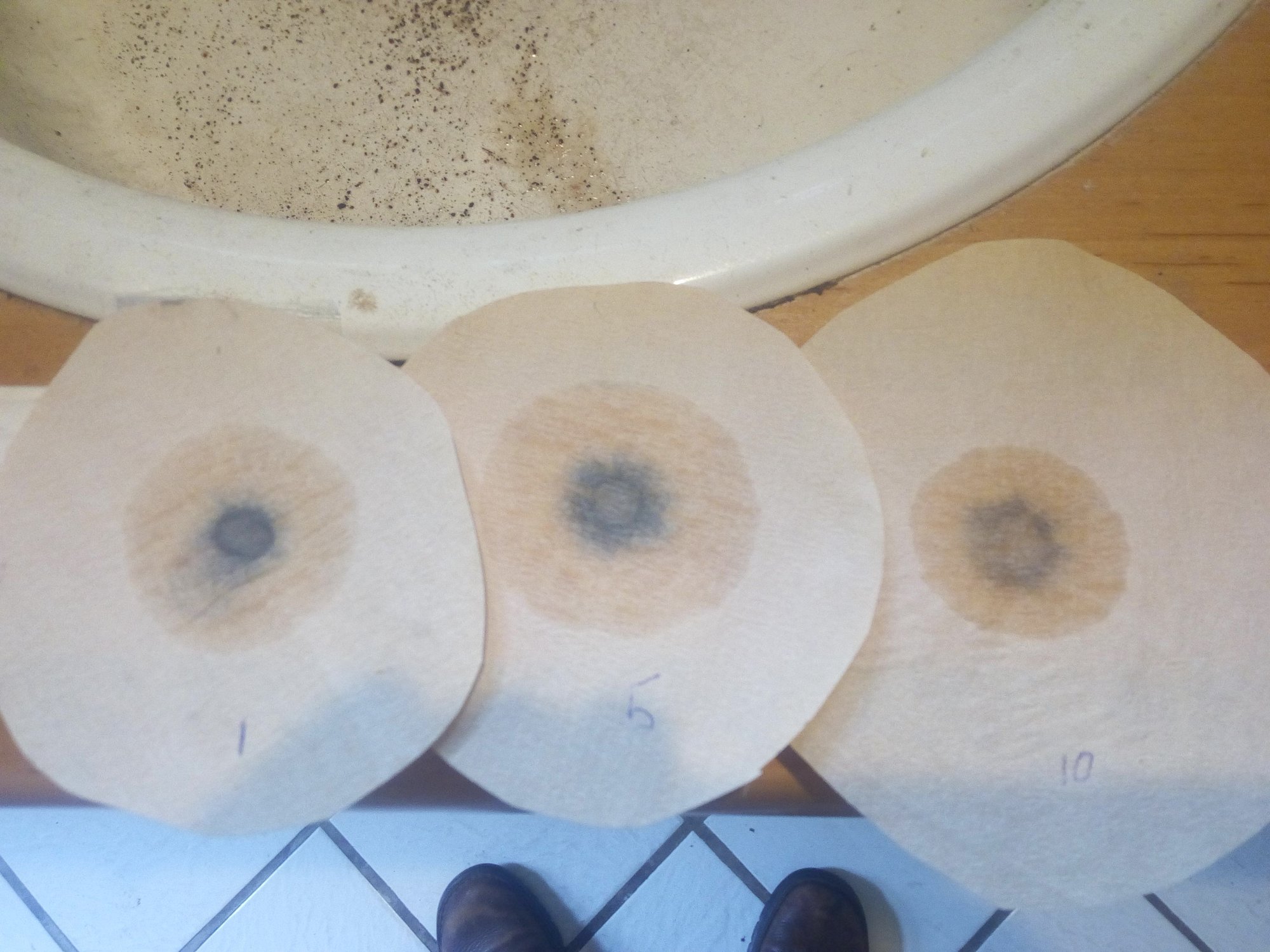 Spot-test ASP Radial running on gasoline, from left to right after first run, after 5th run and after 10th run. Runs were approximately 5~6 minutes, so those tests comprise roughly one hour of runtime. The difference in appearance shows progress of break-in. It is also very clear that break in takes MUCH longer than the 2 hours needed to allow the engine to accept full load.
It takes a bit of experience to read the spots, but one thing is easy to see: change in appearance means "something going on" (break in or breakdown) and vague outlines are good, sharp outlines are "bad" (either something going on, or a break in not yet complete). Grey is metal, black is soot.
I use this method quite a lot, just to have an idea of what is going on in an engine I am not yet familiar with. It is a simplified form of Chromatography but works pretty good.
You are, by the way, going to run into the problem of leaning out in flight versus running stationary on the ground, so chances are, you might want to change to muffler pressure. The muffler pressure rises with RPM, which counters the leaning out due unloading quite a bit.
It is in itself possible to find needle settings that work in flight not using muffler pressure, but the trouble is that normally those settings are too rich for stationary runs, meaning you loose a lot of power during take-off and the engine only clears once it is airborne. At least, that was my experience in the early days of gasoline conversions. Muffler pressure cures that because it makes fuel supply follow changes in RPM better. Carb suction alone is not enough to do that, fuel flow does not follow air ingestion 1:1.