


Flutter Horz. Stab
 07-05-2022 | 07:03 AM
#1
Thread Starter

My Feedback: (8)
Joined: Jun 2004
Posts: 27
Likes: 0
Received 0 Likes
on
0 Posts
From: Keller, TX
 Flutter Horz. Stab
When flying recently one of the guys came to the flight line and suggested I be careful as my horizontal stab. Is fluttering during low level mid-high-speed passes. What suggestions do you have to remediate this before I have an inflight break up?
Extreme Flight Extra 300, V1. 104" wing span. If it helps power is a DLE120.
Kind regards,
Eric
Extreme Flight Extra 300, V1. 104" wing span. If it helps power is a DLE120.
Kind regards,
Eric
 07-05-2022 | 08:07 AM
#2


My Feedback: (29)
It’s a little bit unusual to have flutter and survive, especially on an airplane built as lightly as ours. Some of the high performance servos tend to jitter after they get a bit of use and I have seen that mistaken as flutter on more then one occasion. That said, let’s dive into a few particulars. The first thing that I would like to know is your control horn length from hinge point to ball length. Then your servo arm from output shaft to ball link. Next is servo arm material?The servo brand and model number? What battery voltage and capacity? What brand of switch? How many voltage input connectors into the receiver. A bit of a lengthy list but all these items and a few more things do play a part in solving your issue.
07-05-2022 | 08:44 AM
#3
Thread Starter
My Feedback: (8)
Joined: Jun 2004
Posts: 27
Likes: 0
Received 0 Likes
on
0 Posts
From: Keller, TX
Impressive response - thanks much! Responses below. Photo attached.
control horn length from hinge point to ball length. 42mm
servo arm from output shaft to ball link. 40mm
Servo arm ball to control horn (lingage length) – 72mm
servo arm material? Aluminum, 2.5” (63mm) long, 4mm thick
servo brand and model number? Hitec 7955TG Titanium Gear
What battery voltage and capacity? 7.4v, 3600ma LiPo – dual packs feeding into Spektrum AR20120T receiver
What brand of switch? Soft switch
How many voltage input connectors into the receiver? 2
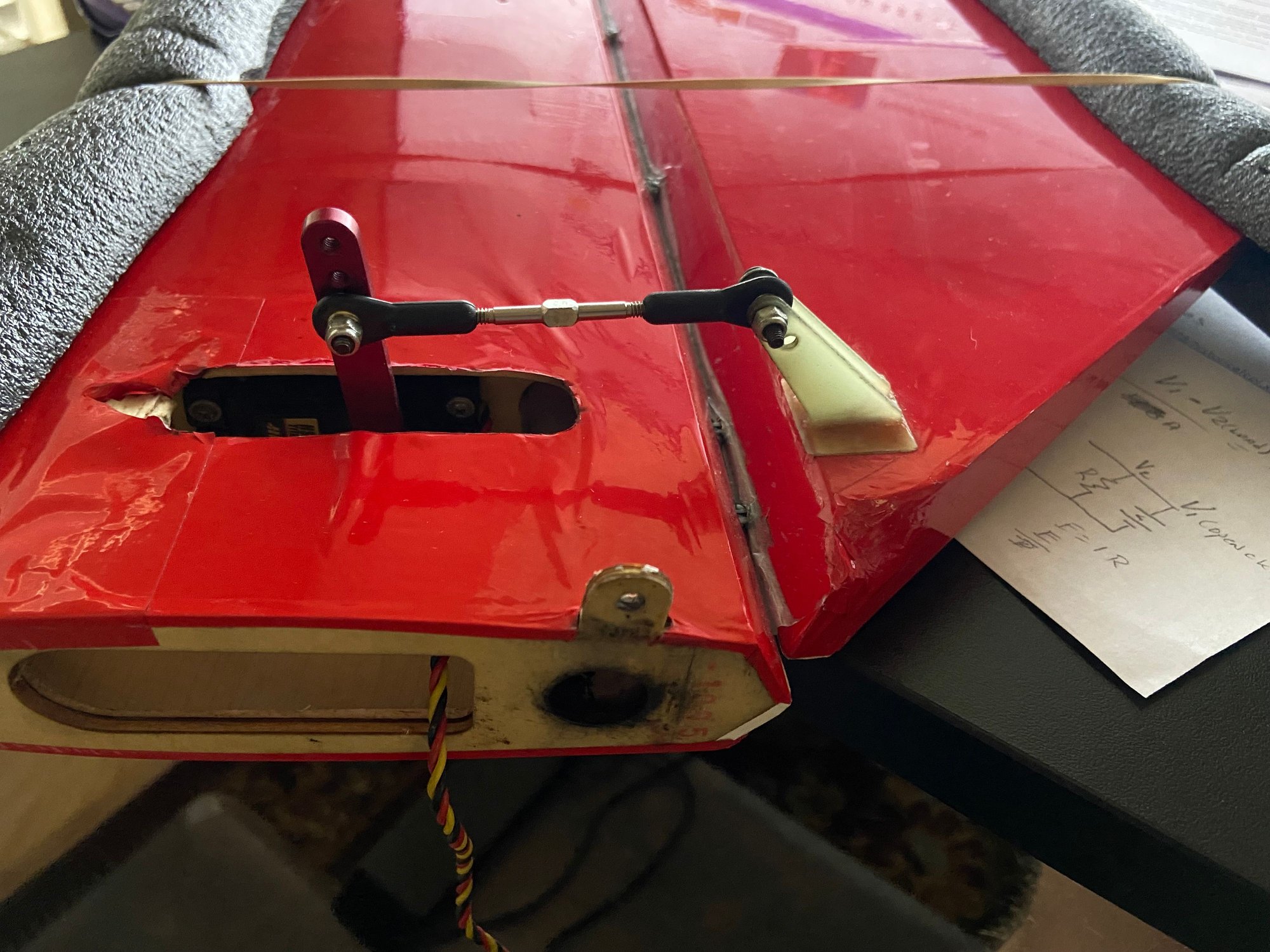
control horn length from hinge point to ball length. 42mm
servo arm from output shaft to ball link. 40mm
Servo arm ball to control horn (lingage length) – 72mm
servo arm material? Aluminum, 2.5” (63mm) long, 4mm thick
servo brand and model number? Hitec 7955TG Titanium Gear
What battery voltage and capacity? 7.4v, 3600ma LiPo – dual packs feeding into Spektrum AR20120T receiver
What brand of switch? Soft switch
How many voltage input connectors into the receiver? 2
07-05-2022 | 08:56 AM
#4
My Feedback: (29)
Ok, IMO it has nothing to do with your setup. Although I personally like to see a little better mechanical advantage in the arms then 1:1 that you essentially have, the 7955 should handle it just fine. I see that you have sealed the hinge line as well. We can rule out your setup. The next thing is to inspect the stabs and elevators for any damage. You most likely did that already. Check for any play in the stab tube/socket. As I said earlier, not very common to survive flutter. When it happens it’s a very distinctive sound that is hard to mistake for anything else. If you don’t recall hearing anything and your stabs install onto the fuselage without play then IMO you are good to go.
07-05-2022 | 09:03 AM
#5
Thread Starter
My Feedback: (8)
Joined: Jun 2004
Posts: 27
Likes: 0
Received 0 Likes
on
0 Posts
From: Keller, TX
Appreciate the dialogue! Interesting to note. I got a response from EF who's recommending moving up to at least 500 in/oz servos and replacing ball links!
Clear sky's and tail winds
Clear sky's and tail winds
07-05-2022 | 09:52 AM
#6
My Feedback: (29)
Interesting, I used JR 8611 servos in this without issues. Of course I was not doing any 3D besides some hovering and torque rolls. That is on a 40% with half the servo power they are recommending. I’m currently setting up a 35% Extra with a pair of MKS servos that are around 200oz.
07-10-2022 | 12:51 AM
#7
Joined: Nov 2010
Posts: 1,711
Likes: 0
Received 81 Likes
on
77 Posts
From: Coffs Harbour NSW, AUSTRALIA
Your control hook up seem reasonable solid, how solid are your Elevator stabs atachments to the fuse? If there is some play it would certainly exagurate the flutter especially with 120 size cheap motor creating lot of vibrations. What size prop do you spin? Just a thought.
07-12-2022 | 01:48 AM
#9
Joined: Nov 2010
Posts: 1,711
Likes: 0
Received 81 Likes
on
77 Posts
From: Coffs Harbour NSW, AUSTRALIA
Motor vibes can create all sorts of issue transfered to the control tabs via hinges.even if your stabs are firmly fitted. Upgrade to E-power, they run lot smoother, with out any neighbourhood disturbance, LOL.
Last edited by Joseph Frost; 07-12-2022 at 05:13 PM.
07-20-2022 | 12:17 PM
#10


Looking at pictures of the EF Extra I see that there are aerodynamic balance tab on the elevators. That's the part at the tips ahead of the hinge line. The actual fixed stab looks fairly small and likely pretty stiff... I would hope at least.... And often flutter occurs in the movable control surfaces. With the forward tabs you have an opportunity to alter the resonant frequency by adding some weight along the leading edge of that balance horn to shift the CG of the elevator towards the hinge line. If you needed some tail weight to trim the model anyway you could just move a little of it to the elevator horns. Adding the weight could be easily done by drilling through just a little behind the leading edge from the tip or the inside rib of the balance tab. Then stick in probably 1oz of lead round bar. You can buy the lead in 1/4" round from fishing supply outlets. Or flatten it and install it as a flat bar.
Ideally it would be enough that the elevators when not hooked to the servo balance on the hinges. But if you can at least move it some significant amount closer then that would be enough to damp out and avoid the resonance that caused the flutter.
Hope that helps.
Ideally it would be enough that the elevators when not hooked to the servo balance on the hinges. But if you can at least move it some significant amount closer then that would be enough to damp out and avoid the resonance that caused the flutter.
Hope that helps.
07-20-2022 | 04:43 PM
#11
Joined: Nov 2010
Posts: 1,711
Likes: 0
Received 81 Likes
on
77 Posts
From: Coffs Harbour NSW, AUSTRALIA
Motor vibration is the most likely cause of flatter with large gas engines. Adding extra weight to moving tabs with the hope to balance it, can actually make it lot worse, starting point try to fix it, is perfectly balanced prop and fine tune the engine run to minimize it. Unfortunately lot of these ARF balsa build models are very porly put together by cheap labor, with all the internal joints falling apart creating even more vibes.
Convert to E-power, another simple option.
Convert to E-power, another simple option.
Last edited by Joseph Frost; 07-21-2022 at 12:28 AM.

 09-16-2025 | 08:04 AM
#14

Given that this thread is a couple of years old I wonder if OP ever resolved his problem. An additional though for any one who stumbles across this is that I have seem flutter that was not aerodynamic. It was caused by gyros or other stability assist that had the gain turned up way too high. The controls over react and you get a high speed oscillation.


