


Sig Seniorita Kit
 01-22-2005 | 11:52 AM
#1

Thread Starter

My Feedback: (14)
Joined: Dec 2004
Posts: 839
Likes: 0
Received 0 Likes
on
0 Posts
From: New York,
NY
 Sig Seniorita Kit
Anyone know if the seniorita is a good trainer airplane, and if its a really easy build? I really like sailplanes, but feel that i really ought to have learned the basics with a glow trainer. I read all the posts in "jitters", and must say, that i think ill go with the durasticks or the sturdy burdy, because if i crach it, no biggie, just replace the wing and im set. I really dont know, please someone just give me some feedback, thanks.
Michal
Michal
 01-22-2005 | 08:54 PM
#2


My Feedback: (1)
RE: Sig Seniorita Kit
Michal The Seniorita in effect is just the baby sister to the Kadet Senior, arguably the most successful trainer since the introduction of proportional controls. Very light for its size it performs well with any .20 class engine. It is very close in size to more modern (read heavy) trainers and even heavier wing loadings of the so called durable airplanes. The down side is you will not feel comfortable with it intially in high winds, but then agine you probably won, t feel comfortable with any trainer in much wind initially.
I certainly can confirm that it is a very simple build and an ideal training ground for such. Sig manuals are among the best. This learning process will be of great benefit later with any airplane and actually be of great benefit to you. Its a bit depressing to think of so many pilots and good ones than cannot effect the simplest of repairs today. As far as crash survival goes, you have probably heard the old expression that "light flys better". Well their is another side of that "Light crashs better" also. This is the exact reason small park flyers tend to be so rugged, not because of great strength. With the Seniorita as well as the Kadet Senior the weak point (He, He all airplanes have one of these, Yup even the durables) is the point aft of the cabin area where the sheeting stops and will sometimes break there in hard end over end crashs. No worries, its a simple overnight fix and easier to do on this airplane than even more modern trainers. Well that is if you know how but hey you actually built it and guess what, know how.
It is designed without ailerons and yes you can learn to fly with it just fine, if you like its easy to add your own strip ailerons during the build or later.
If you get the idea that I think it is a great trainer the you are correct second only to the senior.
Best of luck
John
I certainly can confirm that it is a very simple build and an ideal training ground for such. Sig manuals are among the best. This learning process will be of great benefit later with any airplane and actually be of great benefit to you. Its a bit depressing to think of so many pilots and good ones than cannot effect the simplest of repairs today. As far as crash survival goes, you have probably heard the old expression that "light flys better". Well their is another side of that "Light crashs better" also. This is the exact reason small park flyers tend to be so rugged, not because of great strength. With the Seniorita as well as the Kadet Senior the weak point (He, He all airplanes have one of these, Yup even the durables) is the point aft of the cabin area where the sheeting stops and will sometimes break there in hard end over end crashs. No worries, its a simple overnight fix and easier to do on this airplane than even more modern trainers. Well that is if you know how but hey you actually built it and guess what, know how.
It is designed without ailerons and yes you can learn to fly with it just fine, if you like its easy to add your own strip ailerons during the build or later.
If you get the idea that I think it is a great trainer the you are correct second only to the senior.
Best of luck
John
01-22-2005 | 10:43 PM
#3
 RE: Sig Seniorita Kit
I would suggest getting a 4 channel trainer. If you start out with 3 channels then you will probably need to be retrained when you go to 4 channels. 4 channel planes don't require as much dihedral in the wings in order to make the plane turn and are therefore easier to fly if it gets windy. I prefer the trainers with the balsa sides with plywood reinforcing. I have watched them crash into a fence with litttle damage and were easy to repair. Other than that most of the 4 channel trainers out now work well. I suggest starting out with a kit over an arf. You really learn how a plane is built when you glue all the pieces together yourself. It also removes the fear of repairing a plane if it lands too hard or hits something. [8D]
01-22-2005 | 11:12 PM
#4
Senior Member
Joined: Oct 2002
Posts: 2,065
Likes: 0
Received 0 Likes
on
0 Posts
From: Philadelphia,
PA
RE: Sig Seniorita Kit
> If you start out with 3 channels then you will probably need to be retrained when you go to 4 channels <
This is a joke, right? I have flown 1 channel, 2 channel, 3 channel and 4 channel planes and there wasn't any "retraining" involved. To turn, you move the right stick to one side and give a bit of up elevator. Exactly the same in 3 channels or 4 channels. The only real difference in a trainer is remembering which stick to use to steer with on the ground. Not a big deal, even if a senior citizen like myself forgets sometimes. (G)
This is a joke, right? I have flown 1 channel, 2 channel, 3 channel and 4 channel planes and there wasn't any "retraining" involved. To turn, you move the right stick to one side and give a bit of up elevator. Exactly the same in 3 channels or 4 channels. The only real difference in a trainer is remembering which stick to use to steer with on the ground. Not a big deal, even if a senior citizen like myself forgets sometimes. (G)
01-22-2005 | 11:15 PM
#5
Senior Member
Joined: Oct 2002
Posts: 2,065
Likes: 0
Received 0 Likes
on
0 Posts
From: Philadelphia,
PA
RE: Sig Seniorita Kit
Dura-type planes are built to crash. The Seniorita is built to fly well. It is a great trainer but for most newcomers with no building experience it is a daunting project. If you don't mind the looks go for the Sig LT-25 which is, essentially, a simplified trainer kit of the same size which is very easy to build and flies just as nicely.
01-23-2005 | 07:13 AM
#6

My Feedback: (12)
RE: Sig Seniorita Kit
A few observations. As has been said, Sig kits are great. I think anyone who is interested in the building as well as flying aspect of the hobby would do well building a Sig trainer. I can speak from personal experience about learning on a 3 channel and then transitioning to 4 channels. There are positive as well as negative aspects to this. Since most people just use elevator and aileron during flight, with occasional changes to throttle, the actual flying of a 3 and a 4 channel is identical (ignoring aerobatics). The fourth channel only comes into play during taxi, takeoff, and perhaps landing. I did need to do a little "re-learning" to get used to steering my second plane (4 channels) with the left stick during takeoff and landing. However, it was not a big deal.
So, to Michal I would say, if you like the looks of the Seniorita, build it. It's best if you have someone local who can answer questions that come up during the build. Remember to keep it light. As has been mentioned, light planes fly better. If you crash as a beginner it should be when you are going slow, and are close to the ground. This means the damage, if any, should be minimal. Since you built the plane, you will be in a better position to fix it, even if it means ripping off a section of covering to do so. You'll have spare covering, that matches. Also remember to not go crazy covering. This is your first plane. Damage is very possible, and will be possible for every plane you build. Repairs will be easier if you don't have to deal with a complicated trim scheme. Go for something with good visibility. Here's a picture of my first plane, a Sig Scamp. It had 3 channels, the wing was foam. Flew great with an Enya .15.
So, to Michal I would say, if you like the looks of the Seniorita, build it. It's best if you have someone local who can answer questions that come up during the build. Remember to keep it light. As has been mentioned, light planes fly better. If you crash as a beginner it should be when you are going slow, and are close to the ground. This means the damage, if any, should be minimal. Since you built the plane, you will be in a better position to fix it, even if it means ripping off a section of covering to do so. You'll have spare covering, that matches. Also remember to not go crazy covering. This is your first plane. Damage is very possible, and will be possible for every plane you build. Repairs will be easier if you don't have to deal with a complicated trim scheme. Go for something with good visibility. Here's a picture of my first plane, a Sig Scamp. It had 3 channels, the wing was foam. Flew great with an Enya .15.
01-23-2005 | 09:55 AM
#7
My Feedback: (1)
Joined: Oct 2002
Posts: 931
Likes: 0
Received 0 Likes
on
0 Posts
From: Great Falls, MT
RE: Sig Seniorita Kit
I built the Senior with rudder only. I put a seperate servo on the front wheel and plugged into the rudder channel. I plugged the rudder into the aileron channel. When I built a wing with ailerons, they plugged into the aileron channel. The rudder went to the rudder channel wih the front wheel. That made for an easy transition to four channel.
Start building! Awesome feeling watching something that used to be a box of sticks take to the air.
Mike
Start building! Awesome feeling watching something that used to be a box of sticks take to the air.
Mike
01-23-2005 | 11:57 AM
#8

Member
Joined: Oct 2003
Posts: 62
Likes: 0
Received 0 Likes
on
0 Posts
From: Toronto, ON, CANADA
RE: Sig Seniorita Kit
I agree completely with JohnBuckner (above). Well said. I built my Seniorita last winter and found it a rewarding experience. Take your time to get each joint to fit well. And keep it light. The engine I chose is a Saito 30. I reduced the wing dihethral considerably and added ailerons. It wasn't that difficult to do. I also found that the 1/4 sq pushrods were too flexible, so I upgraded to 1/4 birch wood dowels. Much better.
Here is link to my gallery. http://www.rcuniverse.com/gallery/ga...memberId=73603
Here is link to my gallery. http://www.rcuniverse.com/gallery/ga...memberId=73603
01-24-2005 | 09:00 AM
#9
RE: Sig Seniorita Kit
Dave, I don't joke about newbie advice. If you can go from 1 channel to 2 to 3 then 4 with no problems thats great! However some new flyers don't have the instinct or whatever you might call it for the next step or if things change a bit. Thats why I suggest that new flyers get trained on a full 4 channel plane on the buddy box with a good instructor. He/she can get used to using the basic controls safely. A 2nd type planes almost always have 4 channels, more speed, and quicker response time. Just going by what I have observed, to go from a 3 channel trainer to a 4 channel sport plane with the extra speed and quick reponse times will most likely be too big a jump. [X(]
01-24-2005 | 02:02 PM
#10
My Feedback: (12)
RE: Sig Seniorita Kit
ORIGINAL: Fastsky
Just going by what I have observed, to go from a 3 channel trainer to a 4 channel sport plane with the extra speed and quick reponse times will most likely be too big a jump.
Just going by what I have observed, to go from a 3 channel trainer to a 4 channel sport plane with the extra speed and quick reponse times will most likely be too big a jump.
 Instructor shot it down with his transmitter, which was on the same frequency.
 Hmmm, in thinking about it, don't most people recommend help from an instructor when a beginner makes the jump from trainer to second plane? Thought so.
03-30-2023 | 11:58 PM
#11

Junior Member
Joined: Sep 2019
Posts: 1
Likes: 0
Received 0 Likes
on
0 Posts
Modern mixing fixes this.
Dave, I don't joke about newbie advice. If you can go from 1 channel to 2 to 3 then 4 with no problems thats great! However some new flyers don't have the instinct or whatever you might call it for the next step or if things change a bit. Thats why I suggest that new flyers get trained on a full 4 channel plane on the buddy box with a good instructor. He/she can get used to using the basic controls safely. A 2nd type planes almost always have 4 channels, more speed, and quicker response time. Just going by what I have observed, to go from a 3 channel trainer to a 4 channel sport plane with the extra speed and quick reponse times will most likely be too big a jump. [X(]
03-31-2023 | 04:44 AM
#12

I know this is almost 20 years on, but 20 years of advances in the hobby has brought us some great new technology. I built my Seniorita around 2000. I only flew it once with an instructor then things got in the way and it just sat. I learned to fly on other planes and now fly it for the enjoyment of a slow lazy Sunday vs the needs of a trainer. With modern radios mixing is easy to do, and my left thumb has been programmed for ground steering. I have a switched mix of my rudder to ailerons so that I can drive it on the ground with my left thumb and fly it normally on my right. No re-programming of my brain, I programmed the radio to think for me. An addendum to the original manual (which is still issued in the kit) should cover this mixing, as well as talk about the benefits of dual rates and expo, not like the Seniorita is all that twitchy but expo is more of a personal preference.
03-31-2023 | 07:49 AM
#13
My Feedback: (4)
18 year old thread, and no update from the OP?
Oh well, that happens even on busy forums.
I picked this up off RCGroups about 4 years ago, not as a trainer, but a relaxing plane, slow motion I call it. I don't like these bird cage kits though, a real pain to build.
Takes more patience than I want to put into it, having built an Elder 40 before, similar ladder of match sticks make up the fuselage. It is however much lighter, so that's the benefit. Construction reminds me of Guillow's kits when I was a kid.
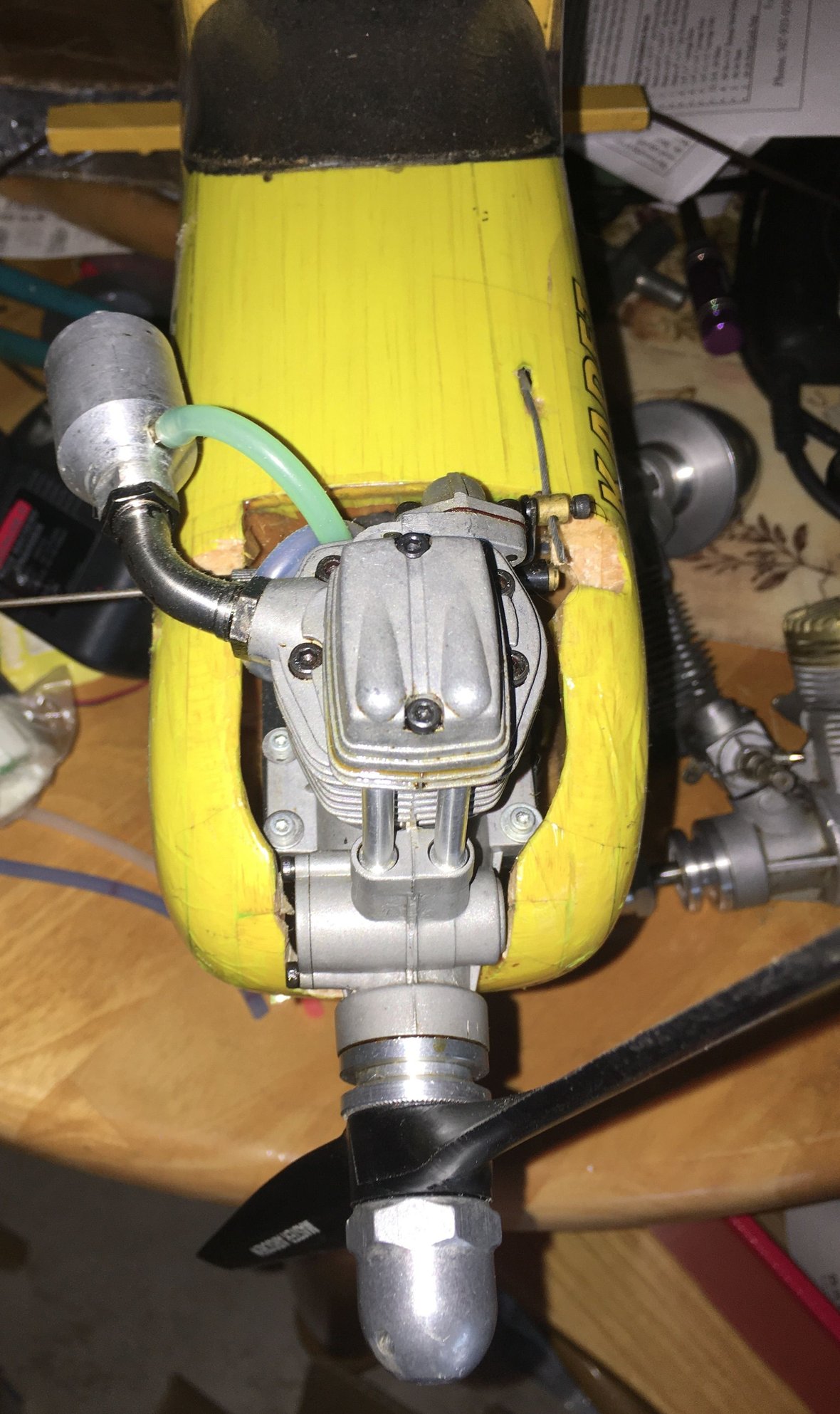
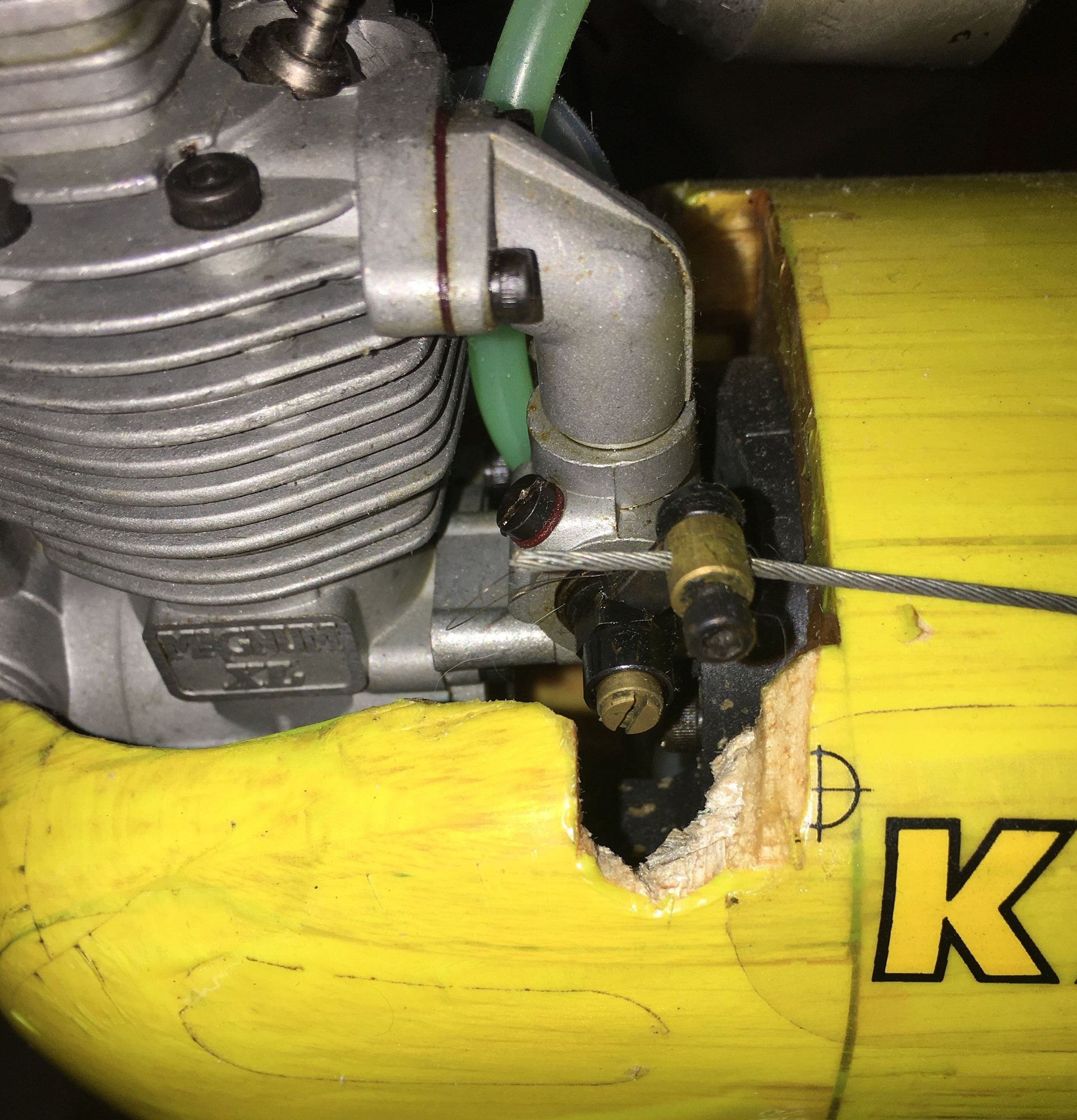
This yellow Seniorita is still in my hangar, I replaced an OS .48 Surpass, with this Magnum XL .52 4 stroke, dropped right in place. Flies great in spite of its aged look. They all look great in the air. The landing gear is held on with 1/4 - 20 nylon bolts. Only thing I want to do is replace those inconvenient dowels with 1/4 - 20 bolts and threaded hardwood mounts to secure the wing without messing with rubber bands. Being glow powered, the combination securing a wing down with #64 rubber bands is just messy.
It flies the same as a Kadet Senior or LT-40 really. Just a lot easier to transport and store. I replaced the servos, the ones shown in here are rather "crispy" and for the low cost of replacements these days its peace of mind knowing that won't be an issue to cause a crash. If I remember correctly this plane was $140 with engine, servos, receiver, just as you see it. When I sold the Surpass, that was $120, this Magnum was $60 and it runs as well as the OS did.
You can't get this kit from SIG at this time, and anyone selling one is going to gouge you good for it, you might do better finding one second hand. Most of my planes in the hangar are hand me down planes from locals advertising on the forums or other places online, cheap. Saves you a lot of money, and the less you invest in a trainer, the more fun you have flying it, at least that's my thought.
This Seniorita floats in about 15 mph, takes off in about 25 feet of runway. It's fun, even if it's a trainer.

Oh well, that happens even on busy forums.
I picked this up off RCGroups about 4 years ago, not as a trainer, but a relaxing plane, slow motion I call it. I don't like these bird cage kits though, a real pain to build.
Takes more patience than I want to put into it, having built an Elder 40 before, similar ladder of match sticks make up the fuselage. It is however much lighter, so that's the benefit. Construction reminds me of Guillow's kits when I was a kid.
This yellow Seniorita is still in my hangar, I replaced an OS .48 Surpass, with this Magnum XL .52 4 stroke, dropped right in place. Flies great in spite of its aged look. They all look great in the air. The landing gear is held on with 1/4 - 20 nylon bolts. Only thing I want to do is replace those inconvenient dowels with 1/4 - 20 bolts and threaded hardwood mounts to secure the wing without messing with rubber bands. Being glow powered, the combination securing a wing down with #64 rubber bands is just messy.
It flies the same as a Kadet Senior or LT-40 really. Just a lot easier to transport and store. I replaced the servos, the ones shown in here are rather "crispy" and for the low cost of replacements these days its peace of mind knowing that won't be an issue to cause a crash. If I remember correctly this plane was $140 with engine, servos, receiver, just as you see it. When I sold the Surpass, that was $120, this Magnum was $60 and it runs as well as the OS did.
You can't get this kit from SIG at this time, and anyone selling one is going to gouge you good for it, you might do better finding one second hand. Most of my planes in the hangar are hand me down planes from locals advertising on the forums or other places online, cheap. Saves you a lot of money, and the less you invest in a trainer, the more fun you have flying it, at least that's my thought.
This Seniorita floats in about 15 mph, takes off in about 25 feet of runway. It's fun, even if it's a trainer.
Last edited by J330; 03-31-2023 at 11:42 AM. Reason: Changed XL53 to XL52


