


What's the difference between engines?
 02-10-2008 | 04:22 PM
#1

Thread Starter
Senior Member
Joined: Jul 2007
Posts: 153
Likes: 0
Received 0 Likes
on
0 Posts
From: Littlestown,
PA
 What's the difference between engines?
ok, so I was wondering what the difference between all of these ABX, Ball Bearing, etc. engines and is any one better than the other?
 02-10-2008 | 04:36 PM
#2

Senior Member
My Feedback: (1)
Joined: Sep 2004
Posts: 2,114
Likes: 0
Received 0 Likes
on
0 Posts
From: FrederickMD
RE: What's the difference between engines?
ABX just means either Aluminum/Bronze/Chrome (ABC) or Aluminum/Bronze/Nickel means the engine has an Aluminum Piston, a Bronze sleeve, and either a Chrome or Nickel plating on the sleeve. This results in differential expansion of the piston and cylinder sleeve that causes the cylinder sleeve to expand more than the piston. The result is an engine that fits very tight when cold, has a low friction fit when hot, and tends to loose compression and stall if it overheats on a lean run. The other option for the cylinder and sleeve is a cast iron piston with a ring. This is more like the classic engine. The ring seals the piston.
ABC/ABN engines are cheaper to mass produce, but the parts will wear out quicker. Ringed engines take more machining, but will last longer.
As far a performance, with todays engineering, I don't think there is a huge performance difference.
As for Ball Bearing vs Bushing, now you're talking about the crankshaft support. A Bushing engine is lighter and cheaper to produce, but the bushing is by nature a higher friction part. A Ball Bearing requires more weight, but significantly reduces the friction lost in the crank. Consequently, equivalent size Ball Bearing engines (BB) will be more powerful than bushing engines, but you will eventually have to replace bearings.
To say that any engine is better than another depends highly on the application. Pylon racing engines are different from 3D engines are different from Pattern engines are different from Trainer engines.
Find the application, then look for the engine.
Brad
ABC/ABN engines are cheaper to mass produce, but the parts will wear out quicker. Ringed engines take more machining, but will last longer.
As far a performance, with todays engineering, I don't think there is a huge performance difference.
As for Ball Bearing vs Bushing, now you're talking about the crankshaft support. A Bushing engine is lighter and cheaper to produce, but the bushing is by nature a higher friction part. A Ball Bearing requires more weight, but significantly reduces the friction lost in the crank. Consequently, equivalent size Ball Bearing engines (BB) will be more powerful than bushing engines, but you will eventually have to replace bearings.
To say that any engine is better than another depends highly on the application. Pylon racing engines are different from 3D engines are different from Pattern engines are different from Trainer engines.
Find the application, then look for the engine.
Brad
02-10-2008 | 05:03 PM
#5
Thread Starter
Senior Member
Joined: Jul 2007
Posts: 153
Likes: 0
Received 0 Likes
on
0 Posts
From: Littlestown,
PA
RE: What's the difference between engines?
yes, that is what I'm talking about, is that a good engine for the Phoenix Models Extra 300s or not because they have a combo up for the plane with the OS .46LA http://www3.towerhobbies.com/cgi-bin/wti0001p?&I=LXGGV7
02-10-2008 | 05:45 PM
#6

Senior Member
Joined: Nov 2004
Posts: 571
Likes: 0
Received 0 Likes
on
0 Posts
From: london,
ON, CANADA
RE: What's the difference between engines?
Well based on the claimed weight of that plane as under 4 lbs the LA46 will be plenty of power for that plane, i have an OS .40la and while not very powerful i think it works good for sport planes around 3.5lbs or slow type fliers up to 5.5lbs. My .40 on a 11x5 prop was turning 10500rpm which by the thrustHP calulator is 4.84lbs of thrust and .605HP, the .46 will make more power so if the extra comes out around 4lbs you will have a good setup, the LA was my first engine and i will tell you it doesn't get any easier than a LA engine.
02-10-2008 | 06:50 PM
#7


Joined: Nov 2005
Posts: 12,624
Likes: 0
Received 0 Likes
on
0 Posts
From: Poolesville, MD
RE: What's the difference between engines?
LA's are the "low cost" line of engines that O.S. sells.
They have simpler carbs and cheaper components.
They also produce less power per CU than the other engines they sell.
They are NOT horrid however... but they may be a bit confusing for the novice who doesn't understand how a bleed carb system works... and has problems getting a decent tune on the engine.
You may however want to spend a bit more on one of the better engines. This will eliminate some of the initial struggles with tuning, etc.
They have simpler carbs and cheaper components.
They also produce less power per CU than the other engines they sell.
They are NOT horrid however... but they may be a bit confusing for the novice who doesn't understand how a bleed carb system works... and has problems getting a decent tune on the engine.
You may however want to spend a bit more on one of the better engines. This will eliminate some of the initial struggles with tuning, etc.
02-10-2008 | 07:25 PM
#8

 RE: What's the difference between engines?
The .46 LA is a great sport engine that is very easy to tune. It will also deliver plenty of power for a typical .40-size airframe as long as you're not attempting 3D-style hovering manuevers.
A plain bearing engine like the .46 LA will run best on fuel with castor oil or castor/synthetic blend lubrication. The castor oil will help seal up the crank case and provide for the smoothest operation of the engine. A fuel blended with 100% synthetic lubrication won't work as well.
The .46 LA should fly the Phoenix Extra 300S just fine. You might also consider the Magnum XLS .46A 2-stroke, which is very similarly priced to the .46 LA. It will be a little more finicky to tune, but should produce more power.
A plain bearing engine like the .46 LA will run best on fuel with castor oil or castor/synthetic blend lubrication. The castor oil will help seal up the crank case and provide for the smoothest operation of the engine. A fuel blended with 100% synthetic lubrication won't work as well.
The .46 LA should fly the Phoenix Extra 300S just fine. You might also consider the Magnum XLS .46A 2-stroke, which is very similarly priced to the .46 LA. It will be a little more finicky to tune, but should produce more power.
02-10-2008 | 08:37 PM
#9

Senior Member
Joined: Aug 2005
Posts: 1,333
Likes: 0
Received 0 Likes
on
0 Posts
From: Austin,
TX
RE: What's the difference between engines?
ORIGINAL: bkdavy
As for Ball Bearing vs Bushing, now you're talking about the crankshaft support. A Bushing engine is lighter and cheaper to produce, but the bushing is by nature a higher friction part. A Ball Bearing requires more weight, but significantly reduces the friction lost in the crank. Consequently, equivalent size Ball Bearing engines (BB) will be more powerful than bushing engines, but you will eventually have to replace bearings.
Brad
As for Ball Bearing vs Bushing, now you're talking about the crankshaft support. A Bushing engine is lighter and cheaper to produce, but the bushing is by nature a higher friction part. A Ball Bearing requires more weight, but significantly reduces the friction lost in the crank. Consequently, equivalent size Ball Bearing engines (BB) will be more powerful than bushing engines, but you will eventually have to replace bearings.
Brad
 02-11-2008 | 02:00 AM
#10
RE: What's the difference between engines?
ORIGINAL: B.L.E.
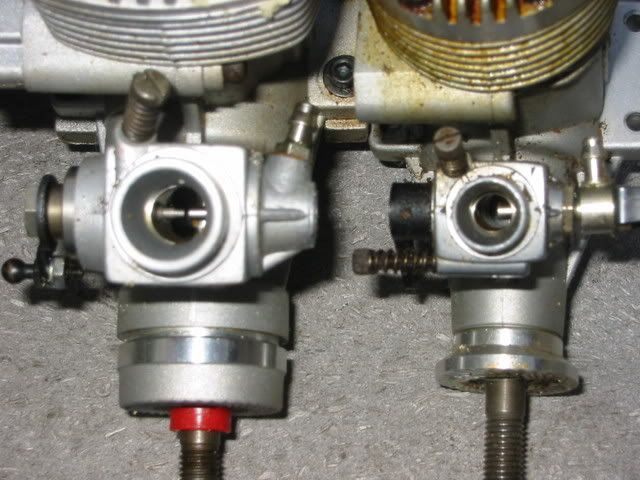
There isn't even close to enough extra friction in a bushing to account for the horsepower difference. Ball bearing engines make more power for a lot of other reasons. For example, compare venturi sizes of a bushing engine to a ball bearing engine of approximately the same size.
There isn't even close to enough extra friction in a bushing to account for the horsepower difference. Ball bearing engines make more power for a lot of other reasons. For example, compare venturi sizes of a bushing engine to a ball bearing engine of approximately the same size.
Plain bearing engines aren't inferior to ball-bearing engines, except perhaps when it comes to very high rpm flying like pylon racing. For general trainer, sport, and aerobatic flying, plain bearing engines work great.
02-11-2008 | 03:53 AM
#11
Senior Member
Joined: Jul 2007
Posts: 645
Likes: 0
Received 0 Likes
on
0 Posts
From: el centro, CA
RE: What's the difference between engines?
well...you'll save more wieght becuase the LA has plastic backplate....or at least the oncsI have do.
You can even go to a magnum .52 or tower .46...The ball bearing engine saves me money from having to buy weight
for the nose.
The TH .46 has a big muffeler..it bascailly gose right through if you take out the baffling..when noise is not a consern.
I don't really know what other people where talkingg about....saying TH engines are so and so.
If you know what you're doing and know what to look for. The tower .46 has plenty of power and will stay tuned.
I imagain the porting of the sleeving are different from manufactures to manufacturers. This too will also effect HP or performance.
I know. i got a stock T-maxx to pop wheelies by messing with the porting..it works..but i wouldn't recommend it unless the engine
is on it's way out. R/C car nitro engines has porting up the wazzoo compaired to airplanes.
A .15 or .18 car engine can produce 1HP...but they operate at higher RMPs . Up to 30000+
It is dangerouse to mount a prop to a r/c nitro car engine..becuase props are not designed to spin that fast.
It'll break apart and can posisbly killed.
You can even go to a magnum .52 or tower .46...The ball bearing engine saves me money from having to buy weight
for the nose.
The TH .46 has a big muffeler..it bascailly gose right through if you take out the baffling..when noise is not a consern.
I don't really know what other people where talkingg about....saying TH engines are so and so.
If you know what you're doing and know what to look for. The tower .46 has plenty of power and will stay tuned.
I imagain the porting of the sleeving are different from manufactures to manufacturers. This too will also effect HP or performance.
I know. i got a stock T-maxx to pop wheelies by messing with the porting..it works..but i wouldn't recommend it unless the engine
is on it's way out. R/C car nitro engines has porting up the wazzoo compaired to airplanes.
A .15 or .18 car engine can produce 1HP...but they operate at higher RMPs . Up to 30000+
It is dangerouse to mount a prop to a r/c nitro car engine..becuase props are not designed to spin that fast.
It'll break apart and can posisbly killed.
02-11-2008 | 06:57 AM
#12
Senior Member
Joined: Aug 2005
Posts: 1,333
Likes: 0
Received 0 Likes
on
0 Posts
From: Austin,
TX
RE: What's the difference between engines?
ORIGINAL: flyX
A .15 or .18 car engine can produce 1HP...but they operate at higher RMPs . Up to 30000+
It is dangerouse to mount a prop to a r/c nitro car engine..becuase props are not designed to spin that fast.
It'll break apart and can posisbly killed.
A .15 or .18 car engine can produce 1HP...but they operate at higher RMPs . Up to 30000+
It is dangerouse to mount a prop to a r/c nitro car engine..becuase props are not designed to spin that fast.
It'll break apart and can posisbly killed.
Not understanding the fact that it takes more torque to spin a 10x6 prop 13,500 rpm than it does to turn a 12x6 prop 9,500 rpm gives rise to the common misconception that 4 stoke engines make more torque than two stroke engines.


