


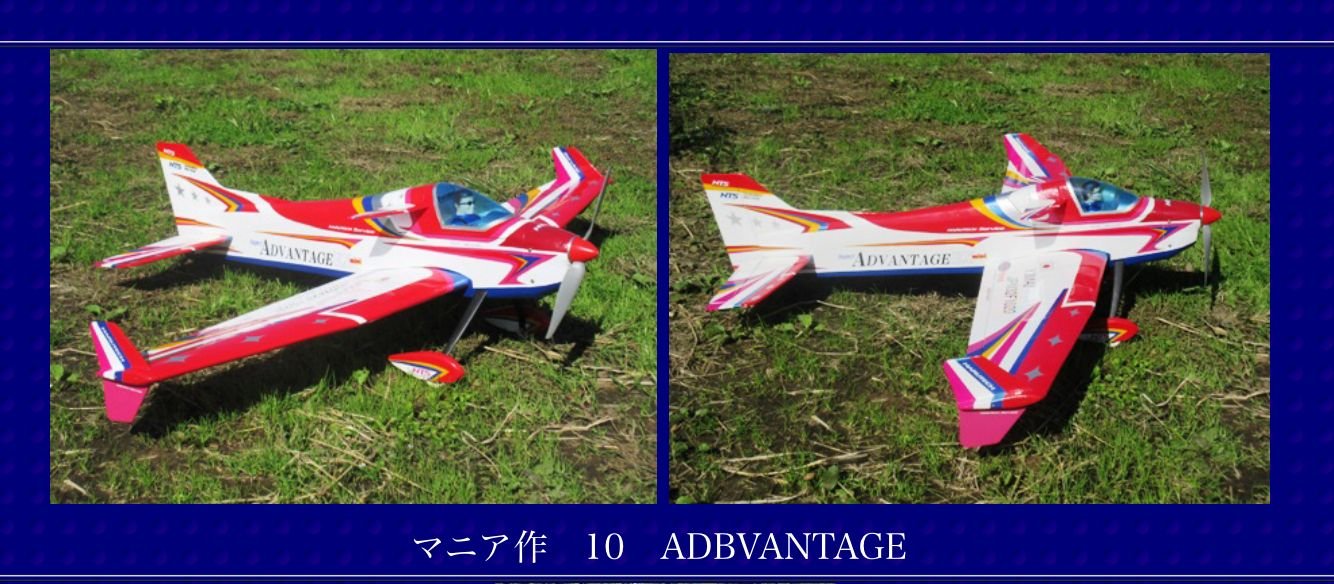
Naruke Advantage with winglets?


 11-15-2020 | 06:21 AM
#3
Thread Starter

My Feedback: (3)

I don’t know the intentions of people...
Pattern seems more active in Japan then here with regards to new designs and ideas.
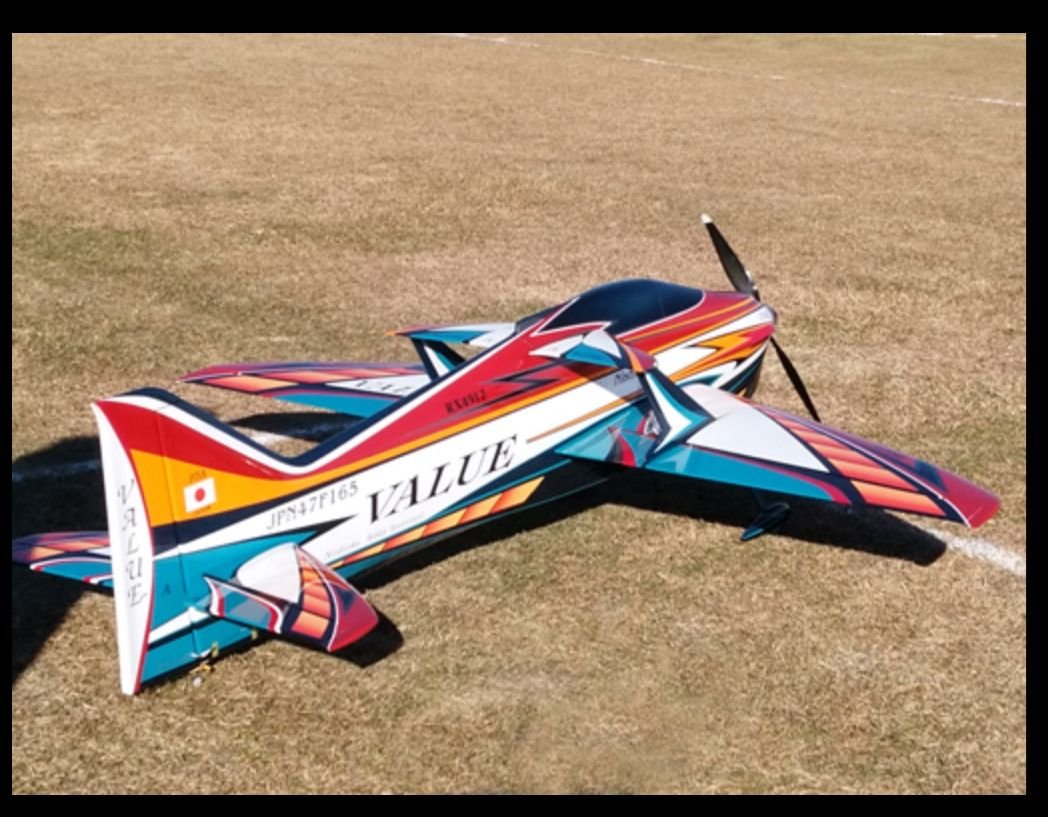
Ive also seen planes from Japan with canalyzers/ winglets that connect down to the wing from the canalyzer
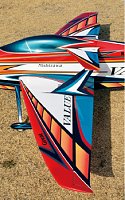
I think the name of that plane was Value?
So perhaps they’re just experimenting with better knife edge flight given the new or proposed sequences.
Pattern seems more active in Japan then here with regards to new designs and ideas.
Ive also seen planes from Japan with canalyzers/ winglets that connect down to the wing from the canalyzer
I think the name of that plane was Value?
So perhaps they’re just experimenting with better knife edge flight given the new or proposed sequences.
11-15-2020 | 02:59 PM
#5
I went back and looked at the "normal" Advantage and judging by irregularities in the canopy area/position, vertical fin and overall shape of the fuse, I think this is not a 2m airframe but actually something quite a bit smaller, perhaps even smaller than the "70" size. The APC prop, landing gear height and short coupled appearance also don't look right for anything larger than a "70". That's certainly not to say he isn't experimenting with SFG's. His designs are always elegant so this one looks off a bit.
 11-15-2020 | 05:21 PM
#8
Thread Starter
My Feedback: (3)
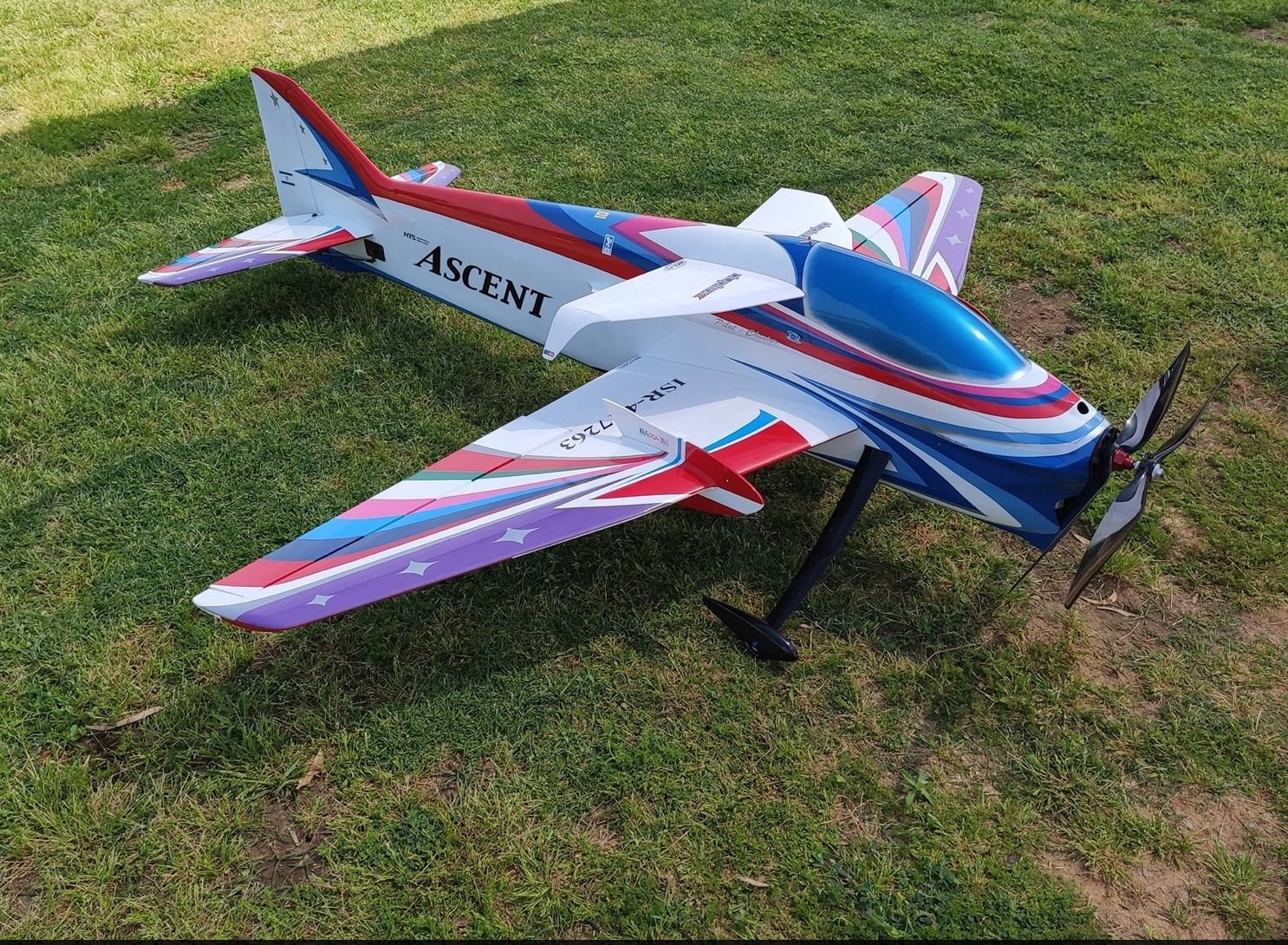
Found it ... but can’t remember the designer
Canalyzer to Wing Fairing design
canalyzer has vertical fences that attach directly to the wing
more pictures here
https://ameblo.jp/wing7go375/entry-12517335907.html
Canalyzer to Wing Fairing design
canalyzer has vertical fences that attach directly to the wing
more pictures here
https://ameblo.jp/wing7go375/entry-12517335907.html
Last edited by ltc; 11-15-2020 at 05:26 PM.
11-15-2020 | 05:29 PM
#9
Thread Starter
My Feedback: (3)
It’s designed by Nishioka ...
????????????? ??????????????????????????????
pictures and info here
http://www.nishioka-hobby.jp/value.html
Perhaps Naruke is investigating what this plane did ?
????????????? ??????????????????????????????
pictures and info here
http://www.nishioka-hobby.jp/value.html
Perhaps Naruke is investigating what this plane did ?
11-15-2020 | 06:16 PM
#10
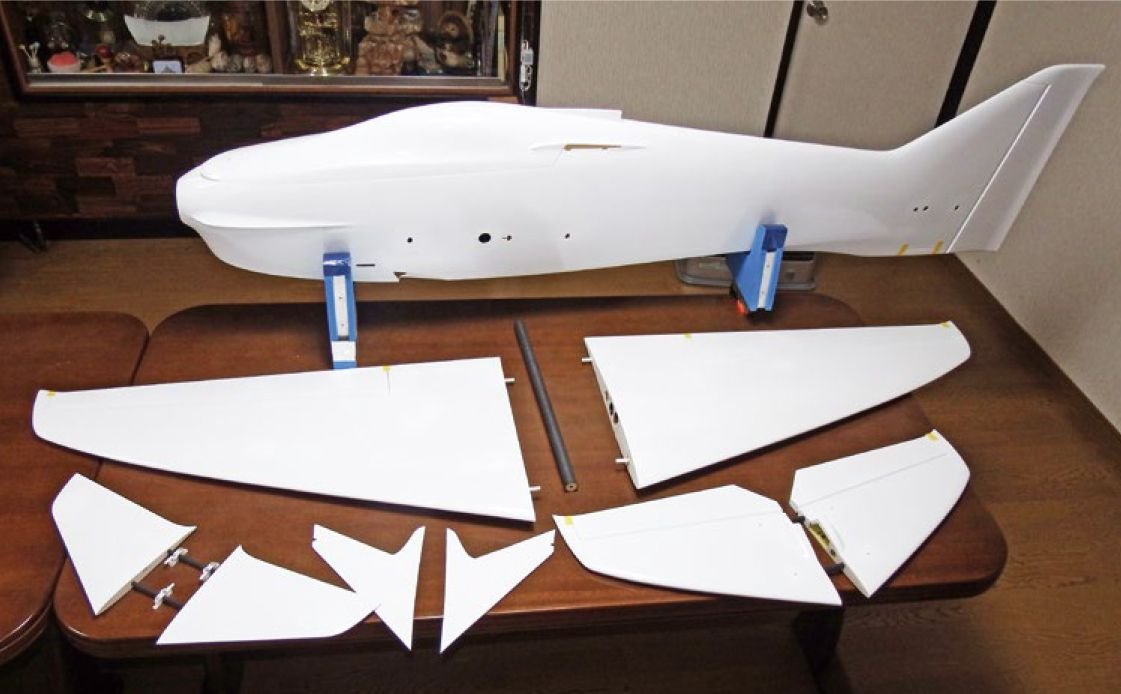
Yes, ITC, agreed on both counts. Good to see more of his design. Isn't he strictly IC, also nice to see he's doing a contra setup. As for that "Value" model, everytime I see one, my first thought is, wish I could see one without the funky paint. It looks to be a nicely shaped design but that paint, ugh.
 11-15-2020 | 06:27 PM
#12
Thread Starter
My Feedback: (3)
Translation
I made an aircraft that can look bigger in the 2m standard of F3A rules. It is a monoplane that is easy to handle, and we are aiming for a fuselage that has a large side lift comparable to that of a biplane.
When I made the pillars (side stays) that support the upper and lower wings thinner on the biplane, I found that there was a considerable difference in the floating of the knife edge. Therefore, we tested how effective a monoplane would be when a side stay like a biplane was attached. I tried installing it on the leading edge of the wing, in front of the canopy, under the nose, etc., but the directionality tends to be worse in front of the center of gravity, and when installed in front of the canopy, the aircraft swings left and right at low speed , I had a hard time landing.
Also, maintaining lift with the fuselage alone requires a fair amount of volume, and as a result, straight-line stability tends to be sacrificed unless the tail volume is also increased.
In order to develop "VALUE", we first changed the way of thinking, changed the mounting position of each part of the aircraft, changed the size, and as a result, we found that sufficient lift can be obtained even from the center of gravity to the rear part.
"Value" keeps its style, and without lowering the tail in the knife edge state, Square Eight etc. works as controlled by the ladder. The rudder responds better because the sides do not sink. As a result, the aircraft is easy to fly even at the front center of gravity. The responsiveness of the rudder leads to improved stallability, and the spin also rotates at a constant speed.
There is also a tail volume effect, and there is enough area to prevent the tail volume from becoming insufficient even when using contra (contra-rotating).
I made an aircraft that can look bigger in the 2m standard of F3A rules. It is a monoplane that is easy to handle, and we are aiming for a fuselage that has a large side lift comparable to that of a biplane.
When I made the pillars (side stays) that support the upper and lower wings thinner on the biplane, I found that there was a considerable difference in the floating of the knife edge. Therefore, we tested how effective a monoplane would be when a side stay like a biplane was attached. I tried installing it on the leading edge of the wing, in front of the canopy, under the nose, etc., but the directionality tends to be worse in front of the center of gravity, and when installed in front of the canopy, the aircraft swings left and right at low speed , I had a hard time landing.
Also, maintaining lift with the fuselage alone requires a fair amount of volume, and as a result, straight-line stability tends to be sacrificed unless the tail volume is also increased.
In order to develop "VALUE", we first changed the way of thinking, changed the mounting position of each part of the aircraft, changed the size, and as a result, we found that sufficient lift can be obtained even from the center of gravity to the rear part.
"Value" keeps its style, and without lowering the tail in the knife edge state, Square Eight etc. works as controlled by the ladder. The rudder responds better because the sides do not sink. As a result, the aircraft is easy to fly even at the front center of gravity. The responsiveness of the rudder leads to improved stallability, and the spin also rotates at a constant speed.
There is also a tail volume effect, and there is enough area to prevent the tail volume from becoming insufficient even when using contra (contra-rotating).
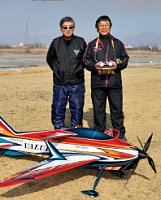
⬆ Kiyoshi Nishizawa (right, Nagano Flying Friend member) who skipped the final prototype before mass production, and Hajime Nishioka (Yamanashi) of Nishioka Seisakusho, the designer and manufacturer of this machine.
The aircraft is equipped with a German-made Amberdan AVR contra drive unit, propeller: Brenner 22 x 20 (front) / 22 x 22 (rear), Power Magic 5200mAh, Futaba 18MZ.
The characteristic of Contra is that the large propeller of 22 to 23 inches double-brake, which makes the direction worse.
Adding tail fins will improve the direction, but it cannot be suppressed when the wind is strong. Therefore, we have prepared an optional fin that is large enough to cover even strong winds.
It is a twin fin that is attached to the left and right elevators so that it can be attached to the rear position as much as possible. When installing the fins, you can apply resistance to your liking, and if you set it so that it looks like a "H" when viewed from above, the resilience of the aircraft will improve. You can also tape the fins to check the desired mounting angle before fixing.
This time, in addition to the pre-painted finished machine, we also prepared a finished machine that is still painted white. Just like the pre-painted finished machine, the linkage parts are included, just without the color paint, so you can fly it in white.
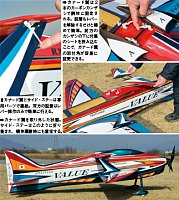
⬆ The aircraft "looks big" It features a fuselage volume not found in conventional aircraft. The amount of ladder at the time of knife edge is also minimal.
"VALUE" is also a big feature that you can attach and detach canard wings and side stays with one touch without using tools.
To that end, we have made many expensive custom parts.
You can also fly with the side stays removed. Since the aircraft with a high lateral effect has a good rudder response, it is also effective for practice to fly with it removed until you get used to the rudder operation.
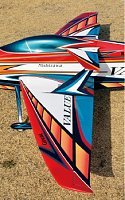
On the other hand, if the canard wing is removed, it will cause a slight nap when operating the rudder at the knife edge, so it will not cause "sleeping" if it is left attached.
Even if the side stays are removed, there is no peculiarity, but it is better to attach them for straightness and it is effective when rolling.
The appeal of "VALUE" is its high-quality painting and time-consuming design. Composites have evolved further and are now beyond the balsa machine.
It does not absorb water even on rainy days. Design is important for molding the machine, but we sent the wooden mold we made to the factory and made the mold with a 3D printer.
Innovative design creates value. As long as the 2m rule does not change, it is an aircraft that can be flown for many years over a long period of time.
⬅ The main tail is a "leading edge oval type" with an arc on the leading edge. Snap roll special inquiry: Nishioka Seisakusho The shape is designed with an eye on its characteristics.
[Technical data]
●
Overall length of the fuselage : 1992 mm
(at the time of 90 mm long spinner)
Overall height: 518 mm (Vertical tail wing height: 498 mm)
● Main wing (leading edge oval type)
Overall width: 1970 mm
Surface area: 66.52d ㎡ Wing
chord length: 518 mm ⇒ 150 mm
Wing thickness: 45 mm ⇒ 20 mm
● Horizontal tail wing (leading edge oval type)
Overall width: 850 mm
Surface area: 18.2
d㎡
Wing chord length: 310 mm ⇒ 128 mm Wing thickness: 27 mm ⇒ 17 mm
● Canard wing
total width: 640 mm
Surface area: 8.9 d㎡ Wing
chord length: 225 mm ⇒ 83 mm
● Side thrust
single propeller: Side 2.5 °
down 2.5 °
Contra propeller: Side 0 °
down 2.5 °
● Total weight of test machine (with side stay)
★ OS reduction unit
power magic 5200mAh: 4850g
Freemax 5500mAh: 4950g
★ Amberdan AVR contra unit
power magic 5200mAh: 4840g
Freemax 5500mAh: 4940g
I made an aircraft that can look bigger in the 2m standard of F3A rules. It is a monoplane that is easy to handle, and we are aiming for a fuselage that has a large side lift comparable to that of a biplane.
When I made the pillars (side stays) that support the upper and lower wings thinner on the biplane, I found that there was a considerable difference in the floating of the knife edge. Therefore, we tested how effective a monoplane would be when a side stay like a biplane was attached. I tried installing it on the leading edge of the wing, in front of the canopy, under the nose, etc., but the directionality tends to be worse in front of the center of gravity, and when installed in front of the canopy, the aircraft swings left and right at low speed , I had a hard time landing.
Also, maintaining lift with the fuselage alone requires a fair amount of volume, and as a result, straight-line stability tends to be sacrificed unless the tail volume is also increased.
In order to develop "VALUE", we first changed the way of thinking, changed the mounting position of each part of the aircraft, changed the size, and as a result, we found that sufficient lift can be obtained even from the center of gravity to the rear part.
"Value" keeps its style, and without lowering the tail in the knife edge state, Square Eight etc. works as controlled by the ladder. The rudder responds better because the sides do not sink. As a result, the aircraft is easy to fly even at the front center of gravity. The responsiveness of the rudder leads to improved stallability, and the spin also rotates at a constant speed.
There is also a tail volume effect, and there is enough area to prevent the tail volume from becoming insufficient even when using contra (contra-rotating).
I made an aircraft that can look bigger in the 2m standard of F3A rules. It is a monoplane that is easy to handle, and we are aiming for a fuselage that has a large side lift comparable to that of a biplane.
When I made the pillars (side stays) that support the upper and lower wings thinner on the biplane, I found that there was a considerable difference in the floating of the knife edge. Therefore, we tested how effective a monoplane would be when a side stay like a biplane was attached. I tried installing it on the leading edge of the wing, in front of the canopy, under the nose, etc., but the directionality tends to be worse in front of the center of gravity, and when installed in front of the canopy, the aircraft swings left and right at low speed , I had a hard time landing.
Also, maintaining lift with the fuselage alone requires a fair amount of volume, and as a result, straight-line stability tends to be sacrificed unless the tail volume is also increased.
In order to develop "VALUE", we first changed the way of thinking, changed the mounting position of each part of the aircraft, changed the size, and as a result, we found that sufficient lift can be obtained even from the center of gravity to the rear part.
"Value" keeps its style, and without lowering the tail in the knife edge state, Square Eight etc. works as controlled by the ladder. The rudder responds better because the sides do not sink. As a result, the aircraft is easy to fly even at the front center of gravity. The responsiveness of the rudder leads to improved stallability, and the spin also rotates at a constant speed.
There is also a tail volume effect, and there is enough area to prevent the tail volume from becoming insufficient even when using contra (contra-rotating).
⬆ Kiyoshi Nishizawa (right, Nagano Flying Friend member) who skipped the final prototype before mass production, and Hajime Nishioka (Yamanashi) of Nishioka Seisakusho, the designer and manufacturer of this machine.
The aircraft is equipped with a German-made Amberdan AVR contra drive unit, propeller: Brenner 22 x 20 (front) / 22 x 22 (rear), Power Magic 5200mAh, Futaba 18MZ.
The characteristic of Contra is that the large propeller of 22 to 23 inches double-brake, which makes the direction worse.
Adding tail fins will improve the direction, but it cannot be suppressed when the wind is strong. Therefore, we have prepared an optional fin that is large enough to cover even strong winds.
It is a twin fin that is attached to the left and right elevators so that it can be attached to the rear position as much as possible. When installing the fins, you can apply resistance to your liking, and if you set it so that it looks like a "H" when viewed from above, the resilience of the aircraft will improve. You can also tape the fins to check the desired mounting angle before fixing.
This time, in addition to the pre-painted finished machine, we also prepared a finished machine that is still painted white. Just like the pre-painted finished machine, the linkage parts are included, just without the color paint, so you can fly it in white.
⬆ The aircraft "looks big" It features a fuselage volume not found in conventional aircraft. The amount of ladder at the time of knife edge is also minimal.
"VALUE" is also a big feature that you can attach and detach canard wings and side stays with one touch without using tools.
To that end, we have made many expensive custom parts.
You can also fly with the side stays removed. Since the aircraft with a high lateral effect has a good rudder response, it is also effective for practice to fly with it removed until you get used to the rudder operation.
On the other hand, if the canard wing is removed, it will cause a slight nap when operating the rudder at the knife edge, so it will not cause "sleeping" if it is left attached.
Even if the side stays are removed, there is no peculiarity, but it is better to attach them for straightness and it is effective when rolling.
The appeal of "VALUE" is its high-quality painting and time-consuming design. Composites have evolved further and are now beyond the balsa machine.
It does not absorb water even on rainy days. Design is important for molding the machine, but we sent the wooden mold we made to the factory and made the mold with a 3D printer.
Innovative design creates value. As long as the 2m rule does not change, it is an aircraft that can be flown for many years over a long period of time.
⬅ The main tail is a "leading edge oval type" with an arc on the leading edge. Snap roll special inquiry: Nishioka Seisakusho The shape is designed with an eye on its characteristics.
[Technical data]
●
Overall length of the fuselage : 1992 mm
(at the time of 90 mm long spinner)
Overall height: 518 mm (Vertical tail wing height: 498 mm)
● Main wing (leading edge oval type)
Overall width: 1970 mm
Surface area: 66.52d ㎡ Wing
chord length: 518 mm ⇒ 150 mm
Wing thickness: 45 mm ⇒ 20 mm
● Horizontal tail wing (leading edge oval type)
Overall width: 850 mm
Surface area: 18.2
d㎡
Wing chord length: 310 mm ⇒ 128 mm Wing thickness: 27 mm ⇒ 17 mm
● Canard wing
total width: 640 mm
Surface area: 8.9 d㎡ Wing
chord length: 225 mm ⇒ 83 mm
● Side thrust
single propeller: Side 2.5 °
down 2.5 °
Contra propeller: Side 0 °
down 2.5 °
● Total weight of test machine (with side stay)
★ OS reduction unit
power magic 5200mAh: 4850g
Freemax 5500mAh: 4950g
★ Amberdan AVR contra unit
power magic 5200mAh: 4840g
Freemax 5500mAh: 4940g
11-15-2020 | 06:28 PM
#13
Thread Starter
My Feedback: (3)
made an aircraft that can look bigger in the 2m standard of F3A rules. It is a monoplane that is easy to handle, and we are aiming for a fuselage that has a large side lift comparable to that of a biplane.
When I made the pillars (side stays) that support the upper and lower wings thinner on the biplane, I found that there was a considerable difference in the floating of the knife edge. Therefore, we tested how effective a monoplane would be when a side stay like a biplane was attached. I tried installing it on the leading edge of the wing, in front of the canopy, under the nose, etc., but the directionality tends to be worse in front of the center of gravity, and when installed in front of the canopy, the aircraft swings left and right at low speed , I had a hard time landing.
Also, maintaining lift with the fuselage alone requires a fair amount of volume, and as a result, straight-line stability tends to be sacrificed unless the tail volume is also increased.
In order to develop "VALUE", we first changed the way of thinking, changed the mounting position of each part of the aircraft, changed the size, and as a result, we found that sufficient lift can be obtained even from the center of gravity to the rear part.
"Value" keeps its style, and without lowering the tail in the knife edge state, Square Eight etc. works as controlled by the ladder. The rudder responds better because the sides do not sink. As a result, the aircraft is easy to fly even at the front center of gravity. The responsiveness of the rudder leads to improved stallability, and the spin also rotates at a constant speed.
There is also a tail volume effect, and there is enough area to prevent the tail volume from becoming insufficient even when using contra (contra-rotating).
I made an aircraft that can look bigger in the 2m standard of F3A rules. It is a monoplane that is easy to handle, and we are aiming for a fuselage that has a large side lift comparable to that of a biplane.
When I made the pillars (side stays) that support the upper and lower wings thinner on the biplane, I found that there was a considerable difference in the floating of the knife edge. Therefore, we tested how effective a monoplane would be when a side stay like a biplane was attached. I tried installing it on the leading edge of the wing, in front of the canopy, under the nose, etc., but the directionality tends to be worse in front of the center of gravity, and when installed in front of the canopy, the aircraft swings left and right at low speed , I had a hard time landing.
Also, maintaining lift with the fuselage alone requires a fair amount of volume, and as a result, straight-line stability tends to be sacrificed unless the tail volume is also increased.
In order to develop "VALUE", we first changed the way of thinking, changed the mounting position of each part of the aircraft, changed the size, and as a result, we found that sufficient lift can be obtained even from the center of gravity to the rear part.
"Value" keeps its style, and without lowering the tail in the knife edge state, Square Eight etc. works as controlled by the ladder. The rudder responds better because the sides do not sink. As a result, the aircraft is easy to fly even at the front center of gravity. The responsiveness of the rudder leads to improved stallability, and the spin also rotates at a constant speed.
There is also a tail volume effect, and there is enough area to prevent the tail volume from becoming insufficient even when using contra (contra-rotating).
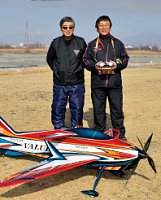
⬆ Kiyoshi Nishizawa (right, Nagano Flying Friend member) who skipped the final prototype before mass production, and Hajime Nishioka (Yamanashi) of Nishioka Seisakusho, the designer and manufacturer of this machine.
The aircraft is equipped with a German-made Amberdan AVR contra drive unit, propeller: Brenner 22 x 20 (front) / 22 x 22 (rear), Power Magic 5200mAh, Futaba 18MZ.
The characteristic of Contra is that the large propeller of 22 to 23 inches double-brake, which makes the direction worse.
Adding tail fins will improve the direction, but it cannot be suppressed when the wind is strong. Therefore, we have prepared an optional fin that is large enough to cover even strong winds.
It is a twin fin that is attached to the left and right elevators so that it can be attached to the rear position as much as possible. When installing the fins, you can apply resistance to your liking, and if you set it so that it looks like a "H" when viewed from above, the resilience of the aircraft will improve. You can also tape the fins to check the desired mounting angle before fixing.
This time, in addition to the pre-painted finished machine, we also prepared a finished machine that is still painted white. Just like the pre-painted finished machine, the linkage parts are included, just without the color paint, so you can fly it in white.

⬆ The aircraft "looks big" It features a fuselage volume not found in conventional aircraft. The amount of ladder at the time of knife edge is also minimal.
"VALUE" is also a big feature that you can attach and detach canard wings and side stays with one touch without using tools.
To that end, we have made many expensive custom parts.
You can also fly with the side stays removed. Since the aircraft with a high lateral effect has a good rudder response, it is also effective for practice to fly with it removed until you get used to the rudder operation.
On the other hand, if the canard wing is removed, it will cause a slight nap when operating the rudder at the knife edge, so it will not cause "sleeping" if it is left attached.
Even if the side stays are removed, there is no peculiarity, but it is better to attach them for straightness and it is effective when rolling.
The appeal of "VALUE" is its high-quality painting and time-consuming design. Composites have evolved further and are now beyond the balsa machine.
It does not absorb water even on rainy days. Design is important for molding the machine, but we sent the wooden mold we made to the factory and made the mold with a 3D printer.
Innovative design creates value. As long as the 2m rule does not change, it is an aircraft that can be flown for many years over a long period of time.
⬅ The main tail is a "leading edge oval type" with an arc on the leading edge. Snap roll special inquiry: Nishioka Seisakusho The shape is designed with an eye on its characteristics.
[Technical data]
●
Overall length of the fuselage : 1992 mm
(at the time of 90 mm long spinner)
Overall height: 518 mm (Vertical tail wing height: 498 mm)
● Main wing (leading edge oval type)
Overall width: 1970 mm
Surface area: 66.52d ㎡ Wing
chord length: 518 mm ⇒ 150 mm
Wing thickness: 45 mm ⇒ 20 mm
● Horizontal tail wing (leading edge oval type)
Overall width: 850 mm
Surface area: 18.2
d㎡
Wing chord length: 310 mm ⇒ 128 mm Wing thickness: 27 mm ⇒ 17 mm
● Canard wing
total width: 640 mm
Surface area: 8.9 d㎡ Wing
chord length: 225 mm ⇒ 83 mm
● Side thrust
single propeller: Side 2.5 °
down 2.5 °
Contra propeller: Side 0 °
down 2.5 °
● Total weight of test machine (with side stay)
★ OS reduction unit
power magic 5200mAh: 4850g
Freemax 5500mAh: 4950g
★ Amberdan AVR contra unit
power magic 5200mAh: 4840g
Freemax 5500mAh: 4940g
When I made the pillars (side stays) that support the upper and lower wings thinner on the biplane, I found that there was a considerable difference in the floating of the knife edge. Therefore, we tested how effective a monoplane would be when a side stay like a biplane was attached. I tried installing it on the leading edge of the wing, in front of the canopy, under the nose, etc., but the directionality tends to be worse in front of the center of gravity, and when installed in front of the canopy, the aircraft swings left and right at low speed , I had a hard time landing.
Also, maintaining lift with the fuselage alone requires a fair amount of volume, and as a result, straight-line stability tends to be sacrificed unless the tail volume is also increased.
In order to develop "VALUE", we first changed the way of thinking, changed the mounting position of each part of the aircraft, changed the size, and as a result, we found that sufficient lift can be obtained even from the center of gravity to the rear part.
"Value" keeps its style, and without lowering the tail in the knife edge state, Square Eight etc. works as controlled by the ladder. The rudder responds better because the sides do not sink. As a result, the aircraft is easy to fly even at the front center of gravity. The responsiveness of the rudder leads to improved stallability, and the spin also rotates at a constant speed.
There is also a tail volume effect, and there is enough area to prevent the tail volume from becoming insufficient even when using contra (contra-rotating).
I made an aircraft that can look bigger in the 2m standard of F3A rules. It is a monoplane that is easy to handle, and we are aiming for a fuselage that has a large side lift comparable to that of a biplane.
When I made the pillars (side stays) that support the upper and lower wings thinner on the biplane, I found that there was a considerable difference in the floating of the knife edge. Therefore, we tested how effective a monoplane would be when a side stay like a biplane was attached. I tried installing it on the leading edge of the wing, in front of the canopy, under the nose, etc., but the directionality tends to be worse in front of the center of gravity, and when installed in front of the canopy, the aircraft swings left and right at low speed , I had a hard time landing.
Also, maintaining lift with the fuselage alone requires a fair amount of volume, and as a result, straight-line stability tends to be sacrificed unless the tail volume is also increased.
In order to develop "VALUE", we first changed the way of thinking, changed the mounting position of each part of the aircraft, changed the size, and as a result, we found that sufficient lift can be obtained even from the center of gravity to the rear part.
"Value" keeps its style, and without lowering the tail in the knife edge state, Square Eight etc. works as controlled by the ladder. The rudder responds better because the sides do not sink. As a result, the aircraft is easy to fly even at the front center of gravity. The responsiveness of the rudder leads to improved stallability, and the spin also rotates at a constant speed.
There is also a tail volume effect, and there is enough area to prevent the tail volume from becoming insufficient even when using contra (contra-rotating).
⬆ Kiyoshi Nishizawa (right, Nagano Flying Friend member) who skipped the final prototype before mass production, and Hajime Nishioka (Yamanashi) of Nishioka Seisakusho, the designer and manufacturer of this machine.
The aircraft is equipped with a German-made Amberdan AVR contra drive unit, propeller: Brenner 22 x 20 (front) / 22 x 22 (rear), Power Magic 5200mAh, Futaba 18MZ.
The characteristic of Contra is that the large propeller of 22 to 23 inches double-brake, which makes the direction worse.
Adding tail fins will improve the direction, but it cannot be suppressed when the wind is strong. Therefore, we have prepared an optional fin that is large enough to cover even strong winds.
It is a twin fin that is attached to the left and right elevators so that it can be attached to the rear position as much as possible. When installing the fins, you can apply resistance to your liking, and if you set it so that it looks like a "H" when viewed from above, the resilience of the aircraft will improve. You can also tape the fins to check the desired mounting angle before fixing.
This time, in addition to the pre-painted finished machine, we also prepared a finished machine that is still painted white. Just like the pre-painted finished machine, the linkage parts are included, just without the color paint, so you can fly it in white.
⬆ The aircraft "looks big" It features a fuselage volume not found in conventional aircraft. The amount of ladder at the time of knife edge is also minimal.
"VALUE" is also a big feature that you can attach and detach canard wings and side stays with one touch without using tools.
To that end, we have made many expensive custom parts.
You can also fly with the side stays removed. Since the aircraft with a high lateral effect has a good rudder response, it is also effective for practice to fly with it removed until you get used to the rudder operation.
On the other hand, if the canard wing is removed, it will cause a slight nap when operating the rudder at the knife edge, so it will not cause "sleeping" if it is left attached.
Even if the side stays are removed, there is no peculiarity, but it is better to attach them for straightness and it is effective when rolling.
The appeal of "VALUE" is its high-quality painting and time-consuming design. Composites have evolved further and are now beyond the balsa machine.
It does not absorb water even on rainy days. Design is important for molding the machine, but we sent the wooden mold we made to the factory and made the mold with a 3D printer.
Innovative design creates value. As long as the 2m rule does not change, it is an aircraft that can be flown for many years over a long period of time.
⬅ The main tail is a "leading edge oval type" with an arc on the leading edge. Snap roll special inquiry: Nishioka Seisakusho The shape is designed with an eye on its characteristics.
[Technical data]
●
Overall length of the fuselage : 1992 mm
(at the time of 90 mm long spinner)
Overall height: 518 mm (Vertical tail wing height: 498 mm)
● Main wing (leading edge oval type)
Overall width: 1970 mm
Surface area: 66.52d ㎡ Wing
chord length: 518 mm ⇒ 150 mm
Wing thickness: 45 mm ⇒ 20 mm
● Horizontal tail wing (leading edge oval type)
Overall width: 850 mm
Surface area: 18.2
d㎡
Wing chord length: 310 mm ⇒ 128 mm Wing thickness: 27 mm ⇒ 17 mm
● Canard wing
total width: 640 mm
Surface area: 8.9 d㎡ Wing
chord length: 225 mm ⇒ 83 mm
● Side thrust
single propeller: Side 2.5 °
down 2.5 °
Contra propeller: Side 0 °
down 2.5 °
● Total weight of test machine (with side stay)
★ OS reduction unit
power magic 5200mAh: 4850g
Freemax 5500mAh: 4950g
★ Amberdan AVR contra unit
power magic 5200mAh: 4840g
Freemax 5500mAh: 4940g
11-16-2020 | 06:08 AM
#15
Veeerrrryyy interesting. Thanks so much for the article, ITC. Always good to hear the design theories direct from the man himself, very comprehensive approach. Yes, it is a very nice design in white, details remind me of Lassi Nurila's designs, which are awesome.
11-16-2020 | 06:17 AM
#16
Thread Starter
My Feedback: (3)
I went back and looked at the "normal" Advantage and judging by irregularities in the canopy area/position, vertical fin and overall shape of the fuse, I think this is not a 2m airframe but actually something quite a bit smaller, perhaps even smaller than the "70" size. The APC prop, landing gear height and short coupled appearance also don't look right for anything larger than a "70". That's certainly not to say he isn't experimenting with SFG's. His designs are always elegant so this one looks off a bit.
Plus the title / translation refers to “10”
So perhaps this is a smaller version that just shared the name?
In retrospect it looks similar in size to the old Brio 10 mini pattern plane (Older E-flite plane designed by QQ I think?)
I know that BJCraft brought back their smaller 70 size pattern planes, designed fir a single 5s pack
Perhaps this “10” size plane is for 3s packs and around 1m span?


