


Poulan 46cc conversion - cylinder work
 08-10-2014 | 02:10 PM
#1
Thread Starter
Junior Member
Joined: Dec 2013
Posts: 16
Likes: 0
Received 0 Likes
on
0 Posts
 Poulan 46cc conversion - cylinder work
Hi all. I have taken on a Poulan 46cc conversion (model 4620 avx, essentially same engine as the 295).
I'm new to gas (never done glow either, just electric) but have run chainsaws for some time.
I'm pretty new to this forum but It seems like the place for this stuff. I have many questions, but I'll try to limit them and search out most on my own.
A couple though... I decided to grind the fins down a bit, mostly for aesthetics. Should I and/or can I seal that exposed aluminum to prevent corrosion? I would like to avoid painting the whole head. Maybe some sort of bluing agent or real simple seal/oil?
I opened up the crankcase (clamshell) to install a Bowman ring. Anything special to resealing it? Yama bond perhaps?
Next will be figuring out the carb adapter and prob hub. Probably ordering the hub...
Here are some pics. I'll add as it comes along (weekend project ya know). I'll be using stock mag as my goal is really to have fun converting and to do it cheaply but hopefully as nicely as possible within technical and expenditure limits. Thanks for any help!
 Pre breakdown
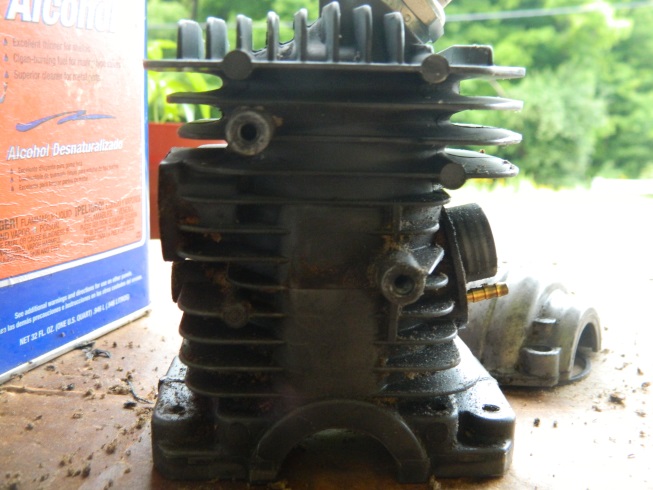 Pre fin grinding
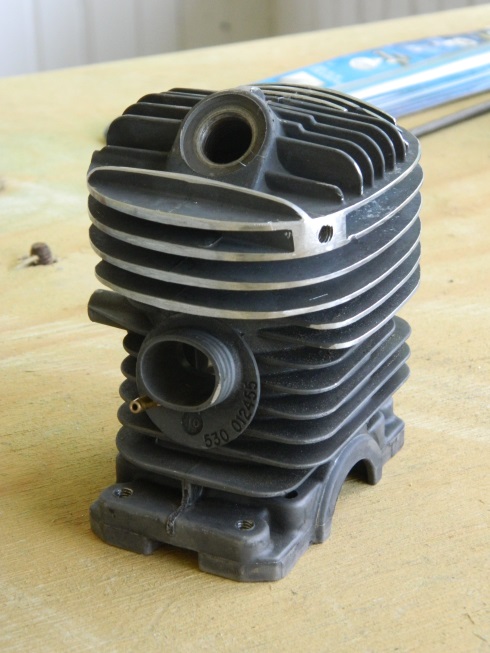 Ground. Waiting for porting and all the rest.
I'm new to gas (never done glow either, just electric) but have run chainsaws for some time.
I'm pretty new to this forum but It seems like the place for this stuff. I have many questions, but I'll try to limit them and search out most on my own.
A couple though... I decided to grind the fins down a bit, mostly for aesthetics. Should I and/or can I seal that exposed aluminum to prevent corrosion? I would like to avoid painting the whole head. Maybe some sort of bluing agent or real simple seal/oil?
I opened up the crankcase (clamshell) to install a Bowman ring. Anything special to resealing it? Yama bond perhaps?
Next will be figuring out the carb adapter and prob hub. Probably ordering the hub...
Here are some pics. I'll add as it comes along (weekend project ya know). I'll be using stock mag as my goal is really to have fun converting and to do it cheaply but hopefully as nicely as possible within technical and expenditure limits. Thanks for any help!
 08-11-2014 | 07:25 AM
#2


My Feedback: (6)
It isn't necessary to paint or "seal" the aluminum. It will be fine just the way it is now.
On any gasketed surface with these small two stroke engines I use no sealer at all. It's not necessary if the gaskets are good, and small bits of sealer can get into the carb pulse port, the spark plug gap, etc., so I don't recommend using sealer. The only time I use it is on some engines I leave out the base gasket to lower the cylinder for more compression and then I do use Yamabond in place of the gasket. It won't hurt though to carefully put a very thin layer of Yamabond on one of those crankcase halves of that Poulan.
Now that the prices have dropped to only around 45 bucks for electronic ignition, it is hard not to go that way and enjoy the benefits of lighter weight, more power, better idle, and easier starting. Try www.rcextremepower.net to have a look at the prices. They have an automatic advance on the timing that makes the engine start and run much smoother.
AV8TOR
On any gasketed surface with these small two stroke engines I use no sealer at all. It's not necessary if the gaskets are good, and small bits of sealer can get into the carb pulse port, the spark plug gap, etc., so I don't recommend using sealer. The only time I use it is on some engines I leave out the base gasket to lower the cylinder for more compression and then I do use Yamabond in place of the gasket. It won't hurt though to carefully put a very thin layer of Yamabond on one of those crankcase halves of that Poulan.
Now that the prices have dropped to only around 45 bucks for electronic ignition, it is hard not to go that way and enjoy the benefits of lighter weight, more power, better idle, and easier starting. Try www.rcextremepower.net to have a look at the prices. They have an automatic advance on the timing that makes the engine start and run much smoother.
AV8TOR
08-14-2014 | 08:22 PM
#3
Thread Starter
Junior Member
Joined: Dec 2013
Posts: 16
Likes: 0
Received 0 Likes
on
0 Posts
Thanks Av8tor.
As I ventured into porting and asking other people about its effects, I started wondering exactly how airplane engine demands differ from chainsaw engines. My understanding is that as an airplane we want it to run peak power at a lower rpm than a chainsaw (around 7,000 yeah?). I am still not quite clear on why exactly this is. I've seen "tip prop speed considerations" cited as the reason but I assume this means more than safety considerations? Is there simply an optimal rpm that a propeller will generate the most thrust?
I am also wondering if enlarging ports helps with the desired lowering of the power curve. Depends on the engine I'm sure. The Poulan does have a little crickety exhaust port so i figure smoothing it out some outta increase horsepower, but am I going to be pushing its peak rpm power outside of some ideal range?
If this info is sitting somewhere else on this forum, as i'm sure it is, feel free to just put up a 'this way dummy' sign.
As I ventured into porting and asking other people about its effects, I started wondering exactly how airplane engine demands differ from chainsaw engines. My understanding is that as an airplane we want it to run peak power at a lower rpm than a chainsaw (around 7,000 yeah?). I am still not quite clear on why exactly this is. I've seen "tip prop speed considerations" cited as the reason but I assume this means more than safety considerations? Is there simply an optimal rpm that a propeller will generate the most thrust?
I am also wondering if enlarging ports helps with the desired lowering of the power curve. Depends on the engine I'm sure. The Poulan does have a little crickety exhaust port so i figure smoothing it out some outta increase horsepower, but am I going to be pushing its peak rpm power outside of some ideal range?
If this info is sitting somewhere else on this forum, as i'm sure it is, feel free to just put up a 'this way dummy' sign.
08-15-2014 | 07:13 AM
#4
My Feedback: (6)
Generally, the only engines that benefit from porting are the smaller, weedeater type engines. The porting on most chainsaw engines is more than adequate for airplane use.
It is just an aerodynamic fact that a large diameter prop turning slower is more efficient than a small prop turning faster. One exception to this rule in a small way, would be a racing plane that benefits from a smaller diameter, but higher pitch prop. Your observations are correct; somewhere around 6500 to 7500 rpms is where most people run their gas engines in most airplanes nowadays. Part of this is the popularity of 3D flying, and the necessity for as much static or low speed thrust as possible for that type of flight, which of course a large diameter, lower pitch prop provides. Another couple of factors are, as you mentioned, prop tip speed, and noise. As the prop tips get closer to the speed of sound, they lose efficiency and get noisy. The faster the prop tips are going, the more noise they are likely to create. Most people don't realize how much prop noise contributes to the overall noise a plane generates, but it can be quite significant. Lastly, if the prop load is too small, as it might be when propping for higher rpms, the two stroke engines tend to have an annoying "four stroke" burble in the mid range throttle area that can be hard to tune out with the current Walbro or Zama carbs that don't have a midrange mixture adjustment available.
So the bottom line is, really, that your porting is fine as is, and only might benefit from a slight cleaning up of any casting flaws. The original carb will work fine as well. The two significant improvements you can make to the engine are to use a free flowing muffler, and install electronic ignition. Then you've got a fine airplane engine in that Poulan. And if noise in not a consideration in your case, and you don't want to fly 3D, you can always prop it to turn 8000 or so and it will be fine.
As an added note; most full size airplane engines only run around 2700 rpms at full throttle, and maybe 2500 rpms or less for cruising flight.
AV8TOR
It is just an aerodynamic fact that a large diameter prop turning slower is more efficient than a small prop turning faster. One exception to this rule in a small way, would be a racing plane that benefits from a smaller diameter, but higher pitch prop. Your observations are correct; somewhere around 6500 to 7500 rpms is where most people run their gas engines in most airplanes nowadays. Part of this is the popularity of 3D flying, and the necessity for as much static or low speed thrust as possible for that type of flight, which of course a large diameter, lower pitch prop provides. Another couple of factors are, as you mentioned, prop tip speed, and noise. As the prop tips get closer to the speed of sound, they lose efficiency and get noisy. The faster the prop tips are going, the more noise they are likely to create. Most people don't realize how much prop noise contributes to the overall noise a plane generates, but it can be quite significant. Lastly, if the prop load is too small, as it might be when propping for higher rpms, the two stroke engines tend to have an annoying "four stroke" burble in the mid range throttle area that can be hard to tune out with the current Walbro or Zama carbs that don't have a midrange mixture adjustment available.
So the bottom line is, really, that your porting is fine as is, and only might benefit from a slight cleaning up of any casting flaws. The original carb will work fine as well. The two significant improvements you can make to the engine are to use a free flowing muffler, and install electronic ignition. Then you've got a fine airplane engine in that Poulan. And if noise in not a consideration in your case, and you don't want to fly 3D, you can always prop it to turn 8000 or so and it will be fine.
As an added note; most full size airplane engines only run around 2700 rpms at full throttle, and maybe 2500 rpms or less for cruising flight.
AV8TOR
Last edited by av8tor1977; 08-15-2014 at 07:18 AM.
08-17-2014 | 12:23 PM
#8
My Feedback: (6)
If the mixture is set right, it will use approximately 1.5 ounces per minute at full throttle, so I'll let you figure what size you might want from there. Keep in mind though, that with these big gas engines they are rarely flown at full throttle all the time. A 16 ounce tank works fine in most installations with this size engine. That would theoretically give you a 10 minute flight at full throttle, or a really long flight just putting around....
AV8TOR
AV8TOR
08-17-2014 | 01:18 PM
#9
My Feedback: (6)
Just an anecdote: I have a Super Tiger .90 (15cc) converted to run on gasoline. The other day I was flying it and I did a bunch of aerobatics, then about 20 touch and go landings, and then a bunch more aerobatics. I don't know how long I flew, but it was a long time. My brother said "That thing has GOT to be getting low on fuel." (It has a 12 oz. tank, just because that's what came with the plane.) When I checked, I had only used half of the tank of gas. Quite a difference, (and savings) from Glow Fuel!!
AV8TOR
AV8TOR
08-29-2014 | 11:44 AM
#10
Thread Starter
Junior Member
Joined: Dec 2013
Posts: 16
Likes: 0
Received 0 Likes
on
0 Posts
Ok so I'm having one of those moments where all the info I swear I've already read about somewhere on the internet is lost from my mind and new search attempts.
Where to get a prop hub made? I am not up for machining that particular piece. I know I've seen a few options posted somewhere, but I can't seem to find them now and/or the business no longer is around. (Carr is one I do still remember).
I will be using stock magneto if that makes a difference. (I know lots of people reccomend to just go electric, but I would like to go through the experience of the magneto; ater perhaps I can know the difference in performance first hand... and I have a very tight budget)
Where to get a prop hub made? I am not up for machining that particular piece. I know I've seen a few options posted somewhere, but I can't seem to find them now and/or the business no longer is around. (Carr is one I do still remember).
I will be using stock magneto if that makes a difference. (I know lots of people reccomend to just go electric, but I would like to go through the experience of the magneto; ater perhaps I can know the difference in performance first hand... and I have a very tight budget)
08-29-2014 | 03:30 PM
#11
My Feedback: (6)
There is really no money to be made in manufacturing conversion parts, so businesses come and go. Wacker Engines used to be a good source, but as far as I know he is no longer doing parts. I believe Carr Precision is still going, as is www.lambertsrc.com. Can't think of any others at the moment....
AV8TOR
AV8TOR
10-23-2014 | 11:38 AM
#12
Thread Starter
Junior Member
Joined: Dec 2013
Posts: 16
Likes: 0
Received 0 Likes
on
0 Posts
Thanks AV8TOR for all the replies!
I am currently building the carb adapter. I've gotten a little discouraged discovering how expensive the recommended materials are (G10, or 1/2" stock aluminum). I think I am going with aluminum, being cheaper, with a separate 1/8" or so insulator. I like the sounds of wood due to cost and insulating properties. But yet again finding high quality plywood of 1/8" or so thickness would probably mean ordering it on-line, paying for shipping and all that jazz. Could I either use just solid wood or laminate my own perhaps. I'm all set up with a wood shop so working with the raw stuff is no prob. Hard or soft wood? What is best to coat the wood with to protect against gas (epoxy?)
I am currently building the carb adapter. I've gotten a little discouraged discovering how expensive the recommended materials are (G10, or 1/2" stock aluminum). I think I am going with aluminum, being cheaper, with a separate 1/8" or so insulator. I like the sounds of wood due to cost and insulating properties. But yet again finding high quality plywood of 1/8" or so thickness would probably mean ordering it on-line, paying for shipping and all that jazz. Could I either use just solid wood or laminate my own perhaps. I'm all set up with a wood shop so working with the raw stuff is no prob. Hard or soft wood? What is best to coat the wood with to protect against gas (epoxy?)
11-13-2014 | 05:42 PM
#15
Thread Starter
Junior Member
Joined: Dec 2013
Posts: 16
Likes: 0
Received 0 Likes
on
0 Posts
So here are some photo updates.
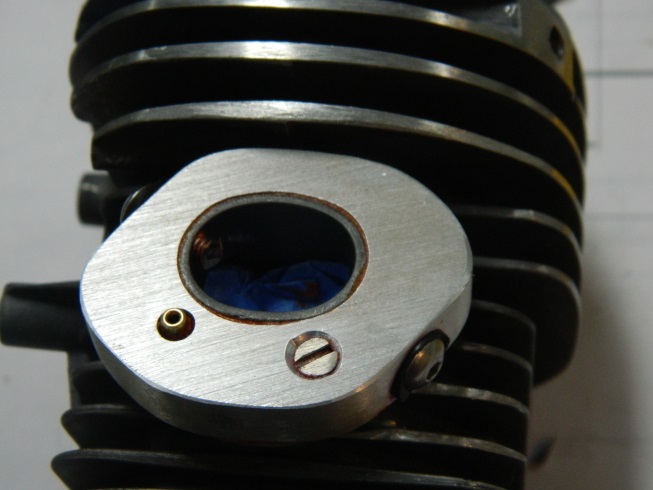
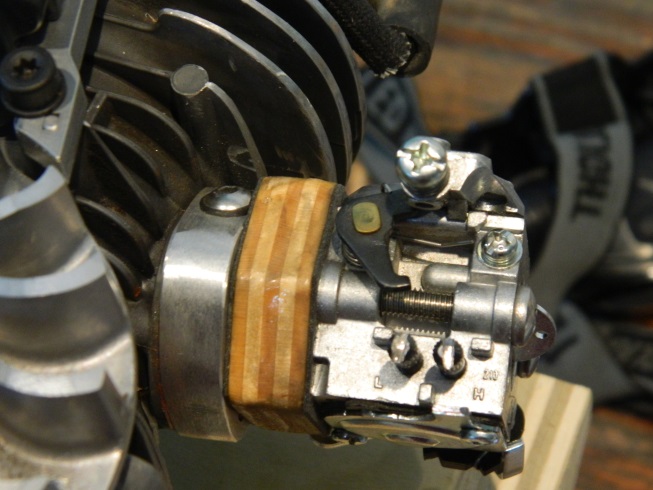

I had a quick chance to attempt at fire up, but to no avail! It is not pumping fuel. I have some thoughts but not sure what the exact problem is.
It was a quick attempt a fire up, didn't pre-fill the fuel line with fuel or anything.
--Can these types of impulse driven carb pumps pump fuel a decent way (say a foot) through a dry line, or will I need to pre-fill the line? (no primer bulb on this carb)
--Will rather gentle turns of the prop pump fuel or will I need to get a starter on there. (as an aside, how does a starter not simply unscrew the prop hub (rh threaded) as opposed to turn over the engine?)
-- The saw did fire before break down, but the carb sat dry in-doors for maybe a month or two. Would that be enough to warrant the pumps drying up and needing a rebuild kit? I would rather trouble shoot to see if the issue is my carb adapter, the carb, or the tank plumbing, but I am not sure of ways to know if the carb pump is receiving impulse and/or is pumping... Anyone got any good tests to see where the breakdown is happening?
I had a quick chance to attempt at fire up, but to no avail! It is not pumping fuel. I have some thoughts but not sure what the exact problem is.
It was a quick attempt a fire up, didn't pre-fill the fuel line with fuel or anything.
--Can these types of impulse driven carb pumps pump fuel a decent way (say a foot) through a dry line, or will I need to pre-fill the line? (no primer bulb on this carb)
--Will rather gentle turns of the prop pump fuel or will I need to get a starter on there. (as an aside, how does a starter not simply unscrew the prop hub (rh threaded) as opposed to turn over the engine?)
-- The saw did fire before break down, but the carb sat dry in-doors for maybe a month or two. Would that be enough to warrant the pumps drying up and needing a rebuild kit? I would rather trouble shoot to see if the issue is my carb adapter, the carb, or the tank plumbing, but I am not sure of ways to know if the carb pump is receiving impulse and/or is pumping... Anyone got any good tests to see where the breakdown is happening?
11-14-2014 | 12:59 PM
#16
My Feedback: (6)
With the throttle open and the choke tight shut, you should see fuel move through the fuel line towards the carb with each hand flip of the prop. The pump should be capable of pumping fuel 3 feet straight up if all is working properly. To answer your questions, yes, sometimes dry carbs are difficult to get moving the fuel again, and yes, your carb might need a rebuild. The diaphragms inside can dry out and get stiff in a short amount of time, especially if left dry. Also, these systems will not tolerate even a tiny air leak in the supply lines. A slide on connection can seem fine, but leak air and then the pump will not work. You also need to be sure that your pulse hole in your carb adapters are lined up. That is where/how the fuel pump in the carb gets it's impulse to move the diaphragm and pump fuel. Your adapters look nice, but you may still have a problem. I made up a similar setup on a Stihl 62cc chain saw engine that I converted. I had problems with the carb mounting screws transmitting too much heat to the carb. It made overall tuning and hot re-starts difficult to impossible. I had to redesign my carb mounting so that there was no metal to metal contact anywhere to transmit engine heat to the carb.
Good luck and have fun,
AV8TOR
Good luck and have fun,
AV8TOR
Last edited by av8tor1977; 11-14-2014 at 01:44 PM.
11-22-2014 | 02:05 PM
#17
Thread Starter
Junior Member
Joined: Dec 2013
Posts: 16
Likes: 0
Received 0 Likes
on
0 Posts
well i put in a carb rebuild. I am getting fuel now (I needed to put a thumb over the choke area to get it to start pulling). Now i'm not sure I am getting spark. I am attempting to hand start it. Could it be that it isn't turning over rapidly enough to see spark. I am turning it pretty quick (especially when i take the plug out to check for spark and there is no compression). The air gap is set to 0.012. New spark plug...
11-22-2014 | 02:28 PM
#18
My Feedback: (6)
You often can't see spark in the daylight. You need a dark room to check. You can spin it over with a drill if you don't have a starter. A magneto needs to turn pretty fast/hard to make spark and it is difficult to see the spark while you are trying to flip the engine over sometimes. The only wire that should be connected is the spark plug wire. Any other wire(s) coming from the coil or mag should not be hooked to anything. The regular size wire coming off the magneto is grounded to stop the spark and therefore the engine.
Do you know that it had spark when it was in the chainsaw? Or was the chainsaw not running and retired for that reason??
Also, I make the air gap on the mag the thickness of a regular business card. Try with a new plug gapped to .025".
AV8TOR
Do you know that it had spark when it was in the chainsaw? Or was the chainsaw not running and retired for that reason??
Also, I make the air gap on the mag the thickness of a regular business card. Try with a new plug gapped to .025".
AV8TOR
Last edited by av8tor1977; 11-22-2014 at 02:31 PM.
11-23-2014 | 06:53 AM
#19
Thread Starter
Junior Member
Joined: Dec 2013
Posts: 16
Likes: 0
Received 0 Likes
on
0 Posts
It did fire as a chainsaw. Perhaps I am just not seeing the spark, or perhaps I need to turn it over faster.
For using a starter or drill: will I need a spinner for this or can I use a socket right on the prop nut (actually a bolt in the case of my adapter). My concern would be that the drill would just loosen the prop nut or the adapter itself rather than turning the engine over (seeing as they are right hand threaded and the engine turns ccw.)
For using a starter or drill: will I need a spinner for this or can I use a socket right on the prop nut (actually a bolt in the case of my adapter). My concern would be that the drill would just loosen the prop nut or the adapter itself rather than turning the engine over (seeing as they are right hand threaded and the engine turns ccw.)
11-23-2014 | 11:14 AM
#20
My Feedback: (6)
Put your bolt in with some blue Loctite. Then wait overnight. Then it should work. This probably won't work to start the engine, but will do for checking the spark because you will be turning it over without the spark plug in place so there will be no compression resistance. (Actually just installing the bolt tight without the Loctite will probably work, but it would work for sure with Loctite).
Numerous times I have not been able to see a spark because of the day light, but when I went into a semi-dark room the spark was immediately evident. This very thing happened to my brother just last week. He was checking for spark in the shade of his front porch and it appeared there was no spark. But when I told him to wait until nearly dark to try it again, he saw that it had good spark.
Also, for the spark to occur at the plug gap, the plug shell needs to make good contact against the engine. I have a wire with a large alligator clip on one end and a smaller one on the other end. I use the large clip on the shell of the plug, then connect the other end of the wire with the smaller alligator clip to one of the cooling fins. Then you know you have a good ground and the spark should show at the plug gap.
Good luck and let us know. How about some recent pics??
AV8TOR
Numerous times I have not been able to see a spark because of the day light, but when I went into a semi-dark room the spark was immediately evident. This very thing happened to my brother just last week. He was checking for spark in the shade of his front porch and it appeared there was no spark. But when I told him to wait until nearly dark to try it again, he saw that it had good spark.
Also, for the spark to occur at the plug gap, the plug shell needs to make good contact against the engine. I have a wire with a large alligator clip on one end and a smaller one on the other end. I use the large clip on the shell of the plug, then connect the other end of the wire with the smaller alligator clip to one of the cooling fins. Then you know you have a good ground and the spark should show at the plug gap.
Good luck and let us know. How about some recent pics??
AV8TOR
Last edited by av8tor1977; 11-23-2014 at 11:31 AM.


