


CS .30 Twin
 04-14-2012 | 09:05 PM
#1
Thread Starter

My Feedback: (2)
Joined: Feb 2002
Posts: 2,995
Received 0 Likes
on
0 Posts
From: Hervey Bay Queensland, AUSTRALIA
 CS .30 Twin
On the bench: New CS .30 inline twin.
Propeller: RAM 10 x 6
Fuel mix: None specified. I used my standard sport diesel brew; 25% castor oil, 35% ether, 38.5% kerosene, and 1.5% IPN.
First fire up: The needle was wound out 2 1/2 turns. It actually fired 3rd flick after choke priming. It starved for fuel and stopped. It hand started easily after I wound the needle out to 4 1/2 turns. The spray bar inlet orifice is only 1/64 " (0.4 mm) diameter. I conclude this is why the needle has to be well backed out. Well filtered fuel will be essential.
Subsequent re-starts were acheived within a few vigorous flicks of a good choked prime. In all, a real possecat. The aficionados in the "club gallery" were impressed.
Six five minute runs were completed. Setting was very rich and undercompressed. Complete cool down between runs. Exhaust efflux was light honey in colour. No signs of distress. Session ended when rain closed in.
Running in will be completed when time and weather permit. If all progresses as anticipated I will post rpm performance. Short iPhone video link of engine running:
http://www.youtube.com/watch?v=PVhav...zdopfsyRcOSiY=
Propeller: RAM 10 x 6
Fuel mix: None specified. I used my standard sport diesel brew; 25% castor oil, 35% ether, 38.5% kerosene, and 1.5% IPN.
First fire up: The needle was wound out 2 1/2 turns. It actually fired 3rd flick after choke priming. It starved for fuel and stopped. It hand started easily after I wound the needle out to 4 1/2 turns. The spray bar inlet orifice is only 1/64 " (0.4 mm) diameter. I conclude this is why the needle has to be well backed out. Well filtered fuel will be essential.
Subsequent re-starts were acheived within a few vigorous flicks of a good choked prime. In all, a real possecat. The aficionados in the "club gallery" were impressed.
Six five minute runs were completed. Setting was very rich and undercompressed. Complete cool down between runs. Exhaust efflux was light honey in colour. No signs of distress. Session ended when rain closed in.
Running in will be completed when time and weather permit. If all progresses as anticipated I will post rpm performance. Short iPhone video link of engine running:
http://www.youtube.com/watch?v=PVhav...zdopfsyRcOSiY=

 04-15-2012 | 03:19 PM
#4
Senior Member
Joined: Oct 2009
Posts: 1,346
Likes: 0
Received 5 Likes
on
5 Posts
From: SydneyNew South wales, AUSTRALIA
RE: CS .30 Twin
ORIGINAL: Mr Cox
Looks cute, would be nice with a little video of running.
How is the internal design made, do the two cylinders fire simultaneously?
Looks cute, would be nice with a little video of running.
How is the internal design made, do the two cylinders fire simultaneously?
04-27-2012 | 12:44 PM
#6
Thread Starter
My Feedback: (2)
Joined: Feb 2002
Posts: 2,995
Received 0 Likes
on
0 Posts
From: Hervey Bay Queensland, AUSTRALIA
RE: CS .30 Twin
I had a problem with my CS Twin while completing running in. Email below explains resolution. I am impressed that CS are standing behind the one year no-quibble warranty they offer on their web site.
************************************************** *********
Dear Derek,
I am so sorry for late reply cause I am just came back form travelling.Please send this engine to Zhengzhou and we will repair it for you free charger.
Yours
Hans
在 2012年4月22日 下午2:09,Derek James Butler
cc. email below
From: derek butler
To: [email protected]
Subject: CS OT .30 Twin
Date: Sun, 22 Apr 2012 16:08:04 +1000
Dear Mr Peng
The OT Twin engine I recently bought from you has been damaged. I need to return it for service.
I believe I have sheared the drive from rear crankshaft, to the coupler which engages the front crankshaft.
This occurred possibly due to over compression of one cylinder. I will exercise great care in future.
Please reply to this email and advise whether I should send the engine to your Zhengzhou office, or to your Shanghai office.
I look forward to hearing from you.
Regards
************************************************** *********
Dear Derek,
I am so sorry for late reply cause I am just came back form travelling.Please send this engine to Zhengzhou and we will repair it for you free charger.
Yours
Hans
在 2012年4月22日 下午2:09,Derek James Butler
cc. email below
From: derek butler
To: [email protected]
Subject: CS OT .30 Twin
Date: Sun, 22 Apr 2012 16:08:04 +1000
Dear Mr Peng
The OT Twin engine I recently bought from you has been damaged. I need to return it for service.
I believe I have sheared the drive from rear crankshaft, to the coupler which engages the front crankshaft.
This occurred possibly due to over compression of one cylinder. I will exercise great care in future.
Please reply to this email and advise whether I should send the engine to your Zhengzhou office, or to your Shanghai office.
I look forward to hearing from you.
Regards
05-01-2012 | 07:27 AM
#7
Senior Member
Joined: May 2010
Posts: 166
Likes: 0
Received 0 Likes
on
0 Posts
From: , BC, CANADA
RE: CS .30 Twin
<span style="font-size: larger"><span style="font-family: Arial">Good for CS in standing behind their product. Note that there's now an in-depth review of this engine on Ron Chernich's Model Engine News website. Derek's problem is noted there along with Ron's suggested fix. Once sorted, the engine is quite a powerhouse!</span></span>
07-22-2012 | 03:00 PM
#9
Thread Starter
My Feedback: (2)
Joined: Feb 2002
Posts: 2,995
Received 0 Likes
on
0 Posts
From: Hervey Bay Queensland, AUSTRALIA
RE: CS .30 Twin
A further run of my CS twin .30. No problems experienced post re-build.
Easy starting, and good performance on a RAM 10x6 propeller.
My thanks to Adrian Duncan and Maris Dislers for their insight on how to get the best from the engine. The advice about checking the exhaust efflux with fingers was particularly helpful.
http://www.youtube.com/watch?v=x_rYS...hannel&list=UL
Easy starting, and good performance on a RAM 10x6 propeller.
My thanks to Adrian Duncan and Maris Dislers for their insight on how to get the best from the engine. The advice about checking the exhaust efflux with fingers was particularly helpful.
http://www.youtube.com/watch?v=x_rYS...hannel&list=UL
07-22-2012 | 04:11 PM
#10
My Feedback: (1)
RE: CS .30 Twin
ORIGINAL: fiery
A further run of my CS twin .30. No problems experienced post re-build.
Easy starting, and good performance on a RAM 10x6 propeller.
My thanks to Adrian Duncan and Maris Dislers for their insight on how to get the best from the engine. The advice about checking the exhaust efflux with fingers was particularly helpful.
http://www.youtube.com/watch?v=x_rYS...hannel&list=UL
A further run of my CS twin .30. No problems experienced post re-build.
Easy starting, and good performance on a RAM 10x6 propeller.
My thanks to Adrian Duncan and Maris Dislers for their insight on how to get the best from the engine. The advice about checking the exhaust efflux with fingers was particularly helpful.
http://www.youtube.com/watch?v=x_rYS...hannel&list=UL
What's the black gunk pouring out from near the carburetor on the video?
What are you using as oil in the fuel that makes it that dark colour? It doesn't look like castor.
So many questions!
07-22-2012 | 06:11 PM
#11
Thread Starter
My Feedback: (2)
Joined: Feb 2002
Posts: 2,995
Received 0 Likes
on
0 Posts
From: Hervey Bay Queensland, AUSTRALIA
RE: CS .30 Twin
Very astute observation Ray.
Oil? Combatkid's castor at 25% b/v. More than required, but the engine is young, and I still do not fully trust it. That said, it does run well.
I noticed the blackish ooze. It did that on the first fast run during the first session as well.
I think the light colour of the bench laminate makes it look worse than it is. It is more dark blue/green (dye in the KCB kero?).
If you look at the side of the fuel tank the true colour of the exhaust oil is more akin to "dark honey".
It did seem to clean up in the run after the one I video'd and posted.
Oil? Combatkid's castor at 25% b/v. More than required, but the engine is young, and I still do not fully trust it. That said, it does run well.
I noticed the blackish ooze. It did that on the first fast run during the first session as well.
I think the light colour of the bench laminate makes it look worse than it is. It is more dark blue/green (dye in the KCB kero?).
If you look at the side of the fuel tank the true colour of the exhaust oil is more akin to "dark honey".
It did seem to clean up in the run after the one I video'd and posted.
07-22-2012 | 06:41 PM
#12
My Feedback: (1)
RE: CS .30 Twin
ORIGINAL: fiery
Very astute observastion Ray.
Oil? Combatkid's castor at 25% b/v. More than required, but the engine is young, and I still do not fully trust it. That said, it does run well.
I noticed the blackish ooze. It did that on the first fast run during the first session as well.
I think the light colour of the bench laminate makes it look worse than it is. It is more dark blue/green (dye in the KCB kero?).
If you look at the side of the fuel tank the true colour of the exhaust oil is more akin to ''dark honey''.
It did seem to clean up in the run after the one I video'd and posted.
Very astute observastion Ray.
Oil? Combatkid's castor at 25% b/v. More than required, but the engine is young, and I still do not fully trust it. That said, it does run well.
I noticed the blackish ooze. It did that on the first fast run during the first session as well.
I think the light colour of the bench laminate makes it look worse than it is. It is more dark blue/green (dye in the KCB kero?).
If you look at the side of the fuel tank the true colour of the exhaust oil is more akin to ''dark honey''.
It did seem to clean up in the run after the one I video'd and posted.
Costs about the same as Castrol M though so it's not worth changing.
Is the discharge raw fuel coming out of the carby screw? I'm guessing that it screws into the crankcase like the single version. CS are notorious for sloppy venturi threads amongst other things.
May need a gasket?
What a pity Tom Ridley doesn't make an Oliver twin.
Oh well.
 07-22-2012 | 06:50 PM
#13
Thread Starter
My Feedback: (2)
Joined: Feb 2002
Posts: 2,995
Received 0 Likes
on
0 Posts
From: Hervey Bay Queensland, AUSTRALIA
RE: CS .30 Twin
I'd say you have nailed it Ray.
Dark kero, plus a darkish castor oil.
As a natural product there is seasonal variation to the castor oil. I did hear that veterinarial grade castor oil has a darker tinge to it than pharmaceutical or cosmetic grades. It does seem to be very good oil. I have a dry patch on one hand and it always seems to improve when I rub it with the oily rag after a session!
Kerosene. Is there such a thing as undyed, unadulterated kerosene any more?
There are a lot of things about the engine that could be improved. That said, for what it cost, it does perform well. On mine, one pot has a little SPI going on as well!
The intake venturi does screw in to the crankcase. Just like the CS .15 OT. Next time I run it I will look more closely to see if there is leakage from the thread on the venturi boss or the spraybar mounting holes.
I wonder if Tom Ridley has run his hands over one?
Dark kero, plus a darkish castor oil.
As a natural product there is seasonal variation to the castor oil. I did hear that veterinarial grade castor oil has a darker tinge to it than pharmaceutical or cosmetic grades. It does seem to be very good oil. I have a dry patch on one hand and it always seems to improve when I rub it with the oily rag after a session!
Kerosene. Is there such a thing as undyed, unadulterated kerosene any more?
There are a lot of things about the engine that could be improved. That said, for what it cost, it does perform well. On mine, one pot has a little SPI going on as well!
The intake venturi does screw in to the crankcase. Just like the CS .15 OT. Next time I run it I will look more closely to see if there is leakage from the thread on the venturi boss or the spraybar mounting holes.
I wonder if Tom Ridley has run his hands over one?
07-22-2012 | 06:58 PM
#14
My Feedback: (1)
RE: CS .30 Twin
ORIGINAL: fiery
I'd say you have nailed it Ray.
Dark kero, plus a darkish castor oil. As a natural product there is seasonal variation to the oil. Is there such a thing as undyed unadulterated kerosene any more?
There are a lot of things about the engine that could be improved. That said, for what it cost, it does perform well.
On mine, one pot has a little SPI going on as well!
The intake venturi does screw in to the crankcase. Just like the .15. Next time I run it I will look more closely to see if there in leakage from the thread, or the spraybar holes.
I wonder if Tom Ridley has run his hands over one?
I'd say you have nailed it Ray.
Dark kero, plus a darkish castor oil. As a natural product there is seasonal variation to the oil. Is there such a thing as undyed unadulterated kerosene any more?
There are a lot of things about the engine that could be improved. That said, for what it cost, it does perform well.
On mine, one pot has a little SPI going on as well!
The intake venturi does screw in to the crankcase. Just like the .15. Next time I run it I will look more closely to see if there in leakage from the thread, or the spraybar holes.
I wonder if Tom Ridley has run his hands over one?
Last I heard Tom was very busy keeping up with the demand for hot .19 diesel combat motors so there probably isn't a twin on the drawing board.
The Olivers did produce some twins though, I'll see if I can find some pictures.
07-22-2012 | 08:09 PM
#15
Joined: Jul 2005
Posts: 1,605
Likes: 0
Received 1 Like
on
1 Post
From: Upper HuttWellington, NEW ZEALAND
RE: CS .30 Twin
FWIW I believe PAW are considering an in-line twin. Don't know what capacity, and whether it will be a regular production item, or only available to order...............
ChrisM
'ffkiw'
ChrisM
'ffkiw'
 07-23-2012 | 01:08 AM
#18

Joined: Apr 2007
Posts: 393
Likes: 0
Received 0 Likes
on
0 Posts
From: Wollongong, AUSTRALIA
RE: CS .30 Twin
ORIGINAL: ffkiwi
FWIW I believe PAW are considering an in-line twin. Don't know what capacity, and whether it will be a regular production item, or only available to order...............
FWIW I believe PAW are considering an in-line twin. Don't know what capacity, and whether it will be a regular production item, or only available to order...............
Good to see your CS running so nicely, Derek.
07-23-2012 | 12:16 PM
#19
Joined: Jul 2005
Posts: 1,605
Likes: 0
Received 1 Like
on
1 Post
From: Upper HuttWellington, NEW ZEALAND
RE: CS .30 Twin
ORIGINAL: steve111
I don't know about inline twins, but they were playing around with a flat twin made from a couple of .19s. Not aware of any plans for production though.[&o]
Good to see your CS running so nicely, Derek.
ORIGINAL: ffkiwi
FWIW I believe PAW are considering an in-line twin. Don't know what capacity, and whether it will be a regular production item, or only available to order...............
FWIW I believe PAW are considering an in-line twin. Don't know what capacity, and whether it will be a regular production item, or only available to order...............
Good to see your CS running so nicely, Derek.
That's probably what I vaguely remembered then-there was a fleeting reference somewhere in one of the UK magazines about a possible PAW twin, and now that I think about it-I think they did mention .19 in the text-that would make for a .38-which might be a very useable sizes..........
That being said-there WAS an in-line twin using two PAW 19 cylinder assemblies featured in the 'Latest Engine News' in Aeromodeller sometime in the late 70s or early 80's-a homebuilt job by a Mr Turner (rather appropriate surname when you think about it.........)
ChrisM
'ffkiwi'
03-01-2014 | 07:29 PM
#21
Thread Starter
My Feedback: (2)
Joined: Feb 2002
Posts: 2,995
Received 0 Likes
on
0 Posts
From: Hervey Bay Queensland, AUSTRALIA
CS Twin .30 back on the stand after internal overhaul and R/C carb intake by Jon Fletcher.
The engine runs very well wide open throttle. It turns the RAM 10 x 6 propeller fitted at over 10,000 RPM. Minimal vibration. The noise is most impressive. I should have worn ear protection.
The twin needle R/C carb works well. However there is a problem. Unequal mixture distribution through the rotary intake valve causes the front cylinder to run leaner than the rear cylinder, and the front cylinder quits below 1/2 throttle.
Modification to even out mixture distribution between the cylinders will be undertaken.
The engine runs very well wide open throttle. It turns the RAM 10 x 6 propeller fitted at over 10,000 RPM. Minimal vibration. The noise is most impressive. I should have worn ear protection.
The twin needle R/C carb works well. However there is a problem. Unequal mixture distribution through the rotary intake valve causes the front cylinder to run leaner than the rear cylinder, and the front cylinder quits below 1/2 throttle.
Modification to even out mixture distribution between the cylinders will be undertaken.
03-03-2014 | 02:46 AM
#22
Joined: Jul 2005
Posts: 1,605
Likes: 0
Received 1 Like
on
1 Post
From: Upper HuttWellington, NEW ZEALAND
The twin needle R/C carb works well. However there is a problem. Unequal mixture distribution through the rotary intake valve causes the front cylinder to run leaner than the rear cylinder, and the front cylinder quits below 1/2 throttle.
Modification to even out mixture distribution between the cylinders will be undertaken.
ChrisM
'ffkiwi'
03-03-2014 | 02:41 PM
#23
Thread Starter
My Feedback: (2)
Joined: Feb 2002
Posts: 2,995
Received 0 Likes
on
0 Posts
From: Hervey Bay Queensland, AUSTRALIA
All true Chris, however Messrs. JAO and JSO Oliver made a series of in-line twins, and they run. Have you a copy of the book 'Two Olivers and a Tiger" by John Goddall? Lots of shots of the Oliver twins (mostly based on Majors) with R/C carbs powering large Vintage ships.
At full blatt the CS twin runs fine. The only indication of mixture disparity is that the front cylinder exhaust is slightly darkened, to a honey colour, while the rear is light amber. No doubt due to the leaner fuel/air mix.
Jon is working on another CS .30 twin and after some sleuthing advises there is disparity in the shaft bore diameters:
"checked the bores at either end of the central shaft which to my surprise, are different dias. Front hole is 0.205” dia. and rear is 0.213” dia."
Sleeving down the rear shaft bore to 'even' the diameters appears to be the best way to proceed.
At full blatt the CS twin runs fine. The only indication of mixture disparity is that the front cylinder exhaust is slightly darkened, to a honey colour, while the rear is light amber. No doubt due to the leaner fuel/air mix.
Jon is working on another CS .30 twin and after some sleuthing advises there is disparity in the shaft bore diameters:
"checked the bores at either end of the central shaft which to my surprise, are different dias. Front hole is 0.205” dia. and rear is 0.213” dia."
Sleeving down the rear shaft bore to 'even' the diameters appears to be the best way to proceed.
03-03-2014 | 03:25 PM
#24
Joined: Jul 2005
Posts: 1,605
Likes: 0
Received 1 Like
on
1 Post
From: Upper HuttWellington, NEW ZEALAND
Yes I have the Oliver book-a great effort by John Goodall. My observations from the various reports is that it never seems to be a problem at full throttle, only at fractional throttle settings and especially at idle. I am only speculating but it would seem that smaller fuel charge volumes at restricted throttle settings seem to lack the gas momentum to maintain correct proportionality to each cylinder....but in some cases you get a rich cut, and in others a lean cut-depending on which way the gas flow asymmetry goes....one could almost argue that some form of restriction of the transfer ports or passages would assist throttling. ......didn't Oliver experiment with this approach once-via a lever projecting through the crankcase wall that allowed the liner to be rotated through an arc of a few degrees partially occluding or opening the transfer ports....
ChrisM
'ffkiwi'
ChrisM
'ffkiwi'
03-04-2014 | 11:59 AM
#25
Senior Member
Chris & Derek,
I have quite a bit of experience of running three types of twin, but not those you mention...
First of all, all the original Taplin Twins. Derek commented kindly on my video. The engine simply runs perfectly, and so do all my other TTs.
Secondly, I've run a Micron flat twin quite a lot. Again, it runs perfectly. The comment in Mike Clanford's book is totally unjustified concerning the Micron flat twin. It's a super engine.
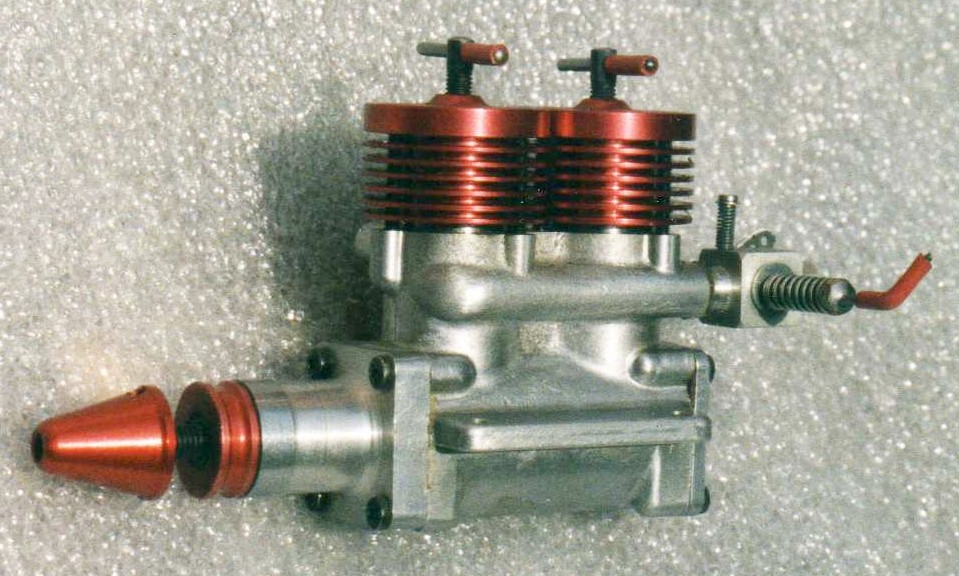
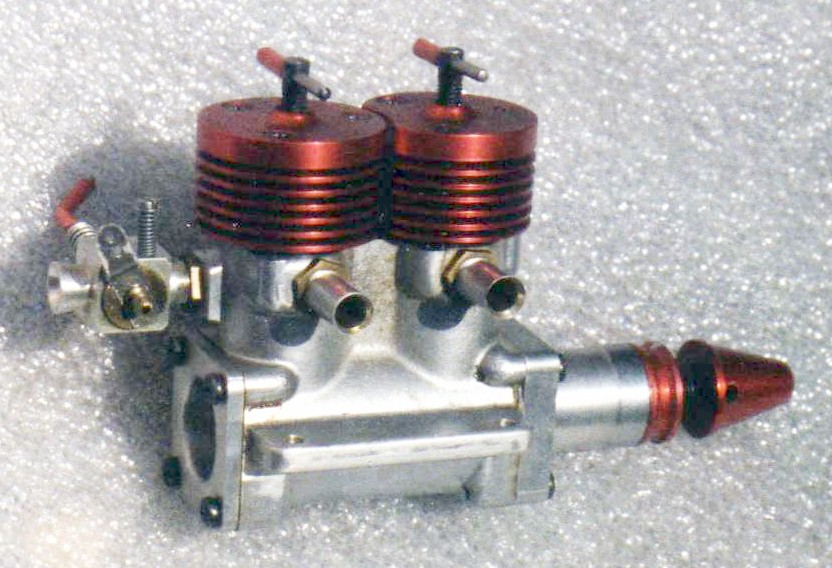
Lastly, the best of all was the Retro Twin, made by André Demesse. These were the best twins I've ever seen and, strangely, you'll see that the (PAW) carburettor is "at one end", and not between the cylinders. Operating the throttle on this engine was like blipping the throttle on a Ferrari. There was no audible acceleration phase, just "instant rpm"!
Unfortunately, I stupidly traded this engine, certain that I could get André to make me another one and, sadly, he died...
Oh I forgot, I also had a Delmo twin, but could never get it to run properly... and an inline Ross Twin that I never tried to run.
However, the Taplin, Micron and Retro were/are "no problem" super runners, so all model engine twins certainly don't have problems.
Here's the Retro (5cc) - Excuse the photo quality, they're scans of 20-year old prints:
I have quite a bit of experience of running three types of twin, but not those you mention...
First of all, all the original Taplin Twins. Derek commented kindly on my video. The engine simply runs perfectly, and so do all my other TTs.
Secondly, I've run a Micron flat twin quite a lot. Again, it runs perfectly. The comment in Mike Clanford's book is totally unjustified concerning the Micron flat twin. It's a super engine.
Lastly, the best of all was the Retro Twin, made by André Demesse. These were the best twins I've ever seen and, strangely, you'll see that the (PAW) carburettor is "at one end", and not between the cylinders. Operating the throttle on this engine was like blipping the throttle on a Ferrari. There was no audible acceleration phase, just "instant rpm"!
Unfortunately, I stupidly traded this engine, certain that I could get André to make me another one and, sadly, he died...
Oh I forgot, I also had a Delmo twin, but could never get it to run properly... and an inline Ross Twin that I never tried to run.
However, the Taplin, Micron and Retro were/are "no problem" super runners, so all model engine twins certainly don't have problems.
Here's the Retro (5cc) - Excuse the photo quality, they're scans of 20-year old prints:
Last edited by brokenenglish; 03-04-2014 at 12:03 PM.

