


DLE 85 carb issues
 01-09-2015 | 09:56 PM
#1
Thread Starter

My Feedback: (19)
 DLE 85 carb issues
I'm in the process of installing for evaluation a new DLE 85 on an older Lanier Staudacher. I thought this would be a good test bed to see how the engine runs before installing it in a Ziroli Skyraider. In short, if it runs well I'll move it to the Skyraider, if it doesn't run up to expectations I will look for some other similar sized engine and try again.
I had read in multiple forums about carb problems on the DLE 85 and the 111. Usually the symptoms were the same with gas dripping out of the carb and any associated problems that might cause. As I do with any new Chinese engine, I looked the engine over very carefully including timing, reed block inspection, carb check, etc. Everything looked very good for the most part with timing spot on 28 degrees, reed block was Ok but surfacing the plastic mating surfaces improved the sealing surface a bit. In general the overall fit, finish and compression of the engine was very good.
I inspected the Walbro WJ clone inside and out and it also looked very good so I just reassembled it with no changes other than adding a bit of oil on the pump petals to improve the first start. Out came the pop-off tester and the fun started! I couldn't get above 10 pounds pressure and it would immediately leak down to "0" ! Hmmm, never had that happen before. So off comes the regulator diaphragm cover to inspect the metering needle. Yup ..... close inspection showed a problem here. The shoulder on the needle where the fork contacts the needle and exerts pressure to hold the needle closed was at exactly the same level as the surrounding housing. As a result, the fork contacts the needle and housing at the same time preventing the needle from fully closing. Clearly a defect! The clone needle and a genuine Walbro needle measure and fit exactly the same and the clone and Walbro metering forks are also exactly interchangeable so the problem isn't with those parts. I've attached a photo to show the needle in the housing and the problem is clearly visible. Note the shoulder on the needle and the surrounding housing at the same level.
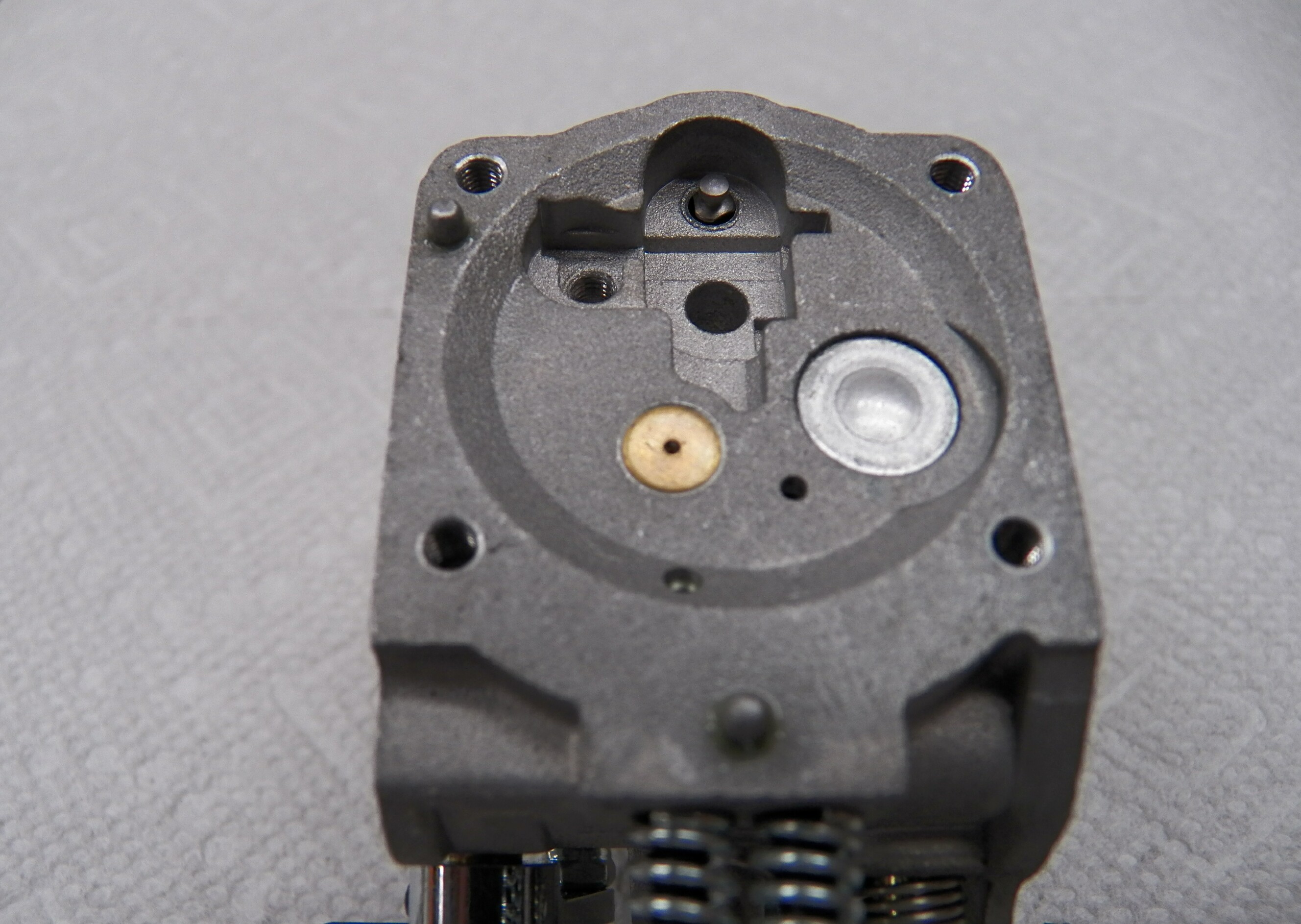
I could send the thing back for warranty repair but as is usual for me, I'll just machine a small clearance relief in the housing around the needle and see if the problem is resolved. I see no reason this shouldn't cure the problem.
I always wondered what the problem was with these carbs and now I know, at least for my example. For the record I have several other DLE engines that use Walbro WT clones and these have all been flawless. I'm not posting this to blast DLE in any way but I thought that some people that have had problems with these WJ clones might want to know what was going on, at least in this one case.
I had read in multiple forums about carb problems on the DLE 85 and the 111. Usually the symptoms were the same with gas dripping out of the carb and any associated problems that might cause. As I do with any new Chinese engine, I looked the engine over very carefully including timing, reed block inspection, carb check, etc. Everything looked very good for the most part with timing spot on 28 degrees, reed block was Ok but surfacing the plastic mating surfaces improved the sealing surface a bit. In general the overall fit, finish and compression of the engine was very good.
I inspected the Walbro WJ clone inside and out and it also looked very good so I just reassembled it with no changes other than adding a bit of oil on the pump petals to improve the first start. Out came the pop-off tester and the fun started! I couldn't get above 10 pounds pressure and it would immediately leak down to "0" ! Hmmm, never had that happen before. So off comes the regulator diaphragm cover to inspect the metering needle. Yup ..... close inspection showed a problem here. The shoulder on the needle where the fork contacts the needle and exerts pressure to hold the needle closed was at exactly the same level as the surrounding housing. As a result, the fork contacts the needle and housing at the same time preventing the needle from fully closing. Clearly a defect! The clone needle and a genuine Walbro needle measure and fit exactly the same and the clone and Walbro metering forks are also exactly interchangeable so the problem isn't with those parts. I've attached a photo to show the needle in the housing and the problem is clearly visible. Note the shoulder on the needle and the surrounding housing at the same level.
I could send the thing back for warranty repair but as is usual for me, I'll just machine a small clearance relief in the housing around the needle and see if the problem is resolved. I see no reason this shouldn't cure the problem.
I always wondered what the problem was with these carbs and now I know, at least for my example. For the record I have several other DLE engines that use Walbro WT clones and these have all been flawless. I'm not posting this to blast DLE in any way but I thought that some people that have had problems with these WJ clones might want to know what was going on, at least in this one case.
Last edited by Truckracer; 01-09-2015 at 09:58 PM.
 01-09-2015 | 10:13 PM
#2

There are many manufacturers of those clones, and the local small engine shop near me carries three of them, with one being the most preferred brand, hands down. Some of the companies must just make a copy and start selling it with no testing based on what you found there.
01-10-2015 | 12:36 PM
#3


My Feedback: (6)
Nice catch and nice post Truckracer. If other people were as good with engines, this forum wouldn't exist huh?
It's too bad that Chinese quality control is so bad. I'm with you though. I wouldn't bother with a warranty claim and the time and hassle that entails. I would just fix it and "keep on truckin'".
AV8TOR
It's too bad that Chinese quality control is so bad. I'm with you though. I wouldn't bother with a warranty claim and the time and hassle that entails. I would just fix it and "keep on truckin'".
AV8TOR
Last edited by av8tor1977; 01-10-2015 at 12:38 PM.
01-10-2015 | 01:53 PM
#4
Thread Starter
My Feedback: (19)
Overall the carb looks very good. The problem could be attributed to a tolerance stackup and my bet is the needle seats OK when the carb is produced. After a time, the soft needle tip takes a set and the needle travels a few thousands further towards the seat. The fork can no longer travel far enough to maintain seat pressure ....... because the housing is in the way.
I rectified the problem by simply using a new 3/16" or slightly larger ball end mill just twisted in my fingers and centered over the needle opening to remove enough material to allow the necessary fork and needle travel. The end mill easily and cleanly cut away enough material to do the job. Sadly, after cleanup, reassembly and pressure testing, I didn't want to disassemble the carb again so there is no "after" photo. Pop off pressure is now somewhere north of 25 pounds and reseat about 20 where it holds. This is typical pop-off for these carbs and is not critical for our use unless it is low.
Looking back, if just that little ridge on the housing around the top of the needle was removed, I think the carb would be OK though with needle and seat wear, even removing that might not be enough for a long term repair. Sadly with all the cold and snow outside, I won't know whether my fix was completely successful until sometime next spring! Oh well, such is life in snow country.
I rectified the problem by simply using a new 3/16" or slightly larger ball end mill just twisted in my fingers and centered over the needle opening to remove enough material to allow the necessary fork and needle travel. The end mill easily and cleanly cut away enough material to do the job. Sadly, after cleanup, reassembly and pressure testing, I didn't want to disassemble the carb again so there is no "after" photo. Pop off pressure is now somewhere north of 25 pounds and reseat about 20 where it holds. This is typical pop-off for these carbs and is not critical for our use unless it is low.
Looking back, if just that little ridge on the housing around the top of the needle was removed, I think the carb would be OK though with needle and seat wear, even removing that might not be enough for a long term repair. Sadly with all the cold and snow outside, I won't know whether my fix was completely successful until sometime next spring! Oh well, such is life in snow country.
 01-10-2015 | 06:57 PM
#6
Thread Starter
My Feedback: (19)
I'm old and don't care for the cold. Winter is building time and I've always enjoyed that part of the hobby as much as flying. So except for rare occasions when I might go out and watch someone else fly, I prefer to stay in my nice warm shop during the winter.
01-10-2015 | 07:32 PM
#7
My Feedback: (6)
Yeah, unfortunately I'm with you on this one as well. I used to love to go to the mountains, rent a cabin and enjoy the snow. (That's the only place to see it in Arizona!) But now that I've gotten older, the cold really bothers me too. Ah man, it really does suck getting older. Actually here in the desert our seasons are reversed. It is too hot for man or beast here in the summer, and that is OUR building season.
AV8TOR
AV8TOR
01-13-2015 | 04:35 AM
#8

My Feedback: (11)
I got my DLE85 from TBM and when I discivered this problemb they sent me a new carb, it was a bit different then the stock one, mostly in the throttle arm. So maybe it was not a clone. Once I replaced the stock carb I no longer had flooding issues.
Thanks for for the info on the carb.
TB
Thanks for for the info on the carb.
TB
 07-10-2015 | 02:28 PM
#10
Junior Member
Joined: Apr 2011
Posts: 1
Likes: 0
Received 0 Likes
on
0 Posts
From: , AR
Tried to start my new DLE 85 and guess what, same problem, engine flooding out. Contacted Tower they referred me to the service and after three tries and over sixty min wait time they told me they would send a new carb when they come in, the 85 carbs are on back order. What a way to run a business. To bad Dle cut Valley View out of the picture.
07-10-2015 | 07:51 PM
#11
Thread Starter
My Feedback: (19)
Tried to start my new DLE 85 and guess what, same problem, engine flooding out. Contacted Tower they referred me to the service and after three tries and over sixty min wait time they told me they would send a new carb when they come in, the 85 carbs are on back order. What a way to run a business. To bad Dle cut Valley View out of the picture.
01-26-2016 | 08:43 AM
#13

I recently bought a new DLE 85 (Tower Hobbies had a $90 discount) as a replacement engine for my old Wild Hare edge. I'm wondering if anyone has bought and ran one recently, have the carb issues been fixed? I can't run mine for another couple of months, and I don't want to take it apart if the problem has been taken care of...
01-26-2016 | 10:10 AM
#14
Thread Starter
My Feedback: (19)
Yes the problems have been fixed in later engines. The question though is how old is Tower's DLE 85 inventory? I'm thinking the only way to know if your carb has the problem is to remove the cover plate and inspect the needle. The problem will be clearly visible if it is there. With the engine out of the plane, the inspection should take all of maybe 5 minutes to perform.
Since the last time I posted in this thread, I have run the 85 quite a bit. It remains a very good engine with extremely good power, manners and low vibration even w/o the special mount. I have also experimented with changing the carb to a Walbro WJ-71 which is the same carb used by DA on their 85, 100 and 120 and its also used on most other singles and twins in that size range. I flew the plane two outings with the WJ-71 then changed back to the DLE carb as I prefer it. My DLE clone has much better midrange transition than the WJ-71. Overall, a darn nice engine!
Since the last time I posted in this thread, I have run the 85 quite a bit. It remains a very good engine with extremely good power, manners and low vibration even w/o the special mount. I have also experimented with changing the carb to a Walbro WJ-71 which is the same carb used by DA on their 85, 100 and 120 and its also used on most other singles and twins in that size range. I flew the plane two outings with the WJ-71 then changed back to the DLE carb as I prefer it. My DLE clone has much better midrange transition than the WJ-71. Overall, a darn nice engine!
01-26-2016 | 11:28 AM
#15
 01-26-2016 | 01:01 PM
#19
Truckracer; Sounds good! I'll report back when our flying season starts! The muffler is a Bisson, got it on ebay.
Dan; That's masking tape. The old spinner back plate I used to line up the prop shaft with the cowl was drilled to large, the tape is temporary so the back plate fits the shaft. Just need a new one and and we'll be good to go!
Dan; That's masking tape. The old spinner back plate I used to line up the prop shaft with the cowl was drilled to large, the tape is temporary so the back plate fits the shaft. Just need a new one and and we'll be good to go!
01-27-2016 | 12:38 PM
#20

My Feedback: (2)
Yes the problems have been fixed in later engines. The question though is how old is Tower's DLE 85 inventory? I'm thinking the only way to know if your carb has the problem is to remove the cover plate and inspect the needle. The problem will be clearly visible if it is there. With the engine out of the plane, the inspection should take all of maybe 5 minutes to perform.
Since the last time I posted in this thread, I have run the 85 quite a bit. It remains a very good engine with extremely good power, manners and low vibration even w/o the special mount. I have also experimented with changing the carb to a Walbro WJ-71 which is the same carb used by DA on their 85, 100 and 120 and its also used on most other singles and twins in that size range. I flew the plane two outings with the WJ-71 then changed back to the DLE carb as I prefer it. My DLE clone has much better midrange transition than the WJ-71. Overall, a darn nice engine!
Since the last time I posted in this thread, I have run the 85 quite a bit. It remains a very good engine with extremely good power, manners and low vibration even w/o the special mount. I have also experimented with changing the carb to a Walbro WJ-71 which is the same carb used by DA on their 85, 100 and 120 and its also used on most other singles and twins in that size range. I flew the plane two outings with the WJ-71 then changed back to the DLE carb as I prefer it. My DLE clone has much better midrange transition than the WJ-71. Overall, a darn nice engine!
01-27-2016 | 02:11 PM
#21
Thread Starter
My Feedback: (19)
Edit: I cleaned up the housing by removing a bit of metal from the needle opening with a ball end mill turned with my finders. I stated in an earlier post that a 3/16" or so tool would work but realized mine was closer to 1/4" or 5/16". Even a good sharp drill bit would do the job and again just hand turned.
Last edited by Truckracer; 01-27-2016 at 02:17 PM.
02-29-2016 | 06:31 AM
#23
My Feedback: (45)
Joined: Sep 2003
Posts: 58
Likes: 0
Received 0 Likes
on
0 Posts
From: Colorado Springs,
CO
Hi - I was just reading your link about the DLE-85, Good info to know. I just bought my first DLE-85, however the manual is very vague! The carb has two nipples on it. The manual does not say which one is for the fuel intake what the other nipple is for. Can you enlighten me on the proper fuel line setups for the carb?
02-29-2016 | 09:39 AM
#24
Thread Starter
My Feedback: (19)
The fuel line connects to the fitting on the main body on the carb. The remaining fitting on the regulator cover plate may be used or not, depending on your installation. In some cases, excessive cowl pressure caused by poor cooling airflow will make the engine go rich at certain airplane attitudes and airspeeds. Connecting that fitting through a line routed back in the fuselage and connected to something like a balsa box or pill bottle can eliminate the effects of that cowl pressure.
03-02-2016 | 06:17 AM
#25
Hi - I was just reading your link about the DLE-85, Good info to know. I just bought my first DLE-85, however the manual is very vague! The carb has two nipples on it. The manual does not say which one is for the fuel intake what the other nipple is for. Can you enlighten me on the proper fuel line setups for the carb?

