


Engine/cowl cooling question
 11-11-2009 | 05:53 PM
#1

 Engine/cowl cooling question
Hey guys,
I'm working on my first 50cc gasser (30% Edge 540 w/ DLE 55) and need your opinions as I know everyone building giant scale must work through this! I'm wondering about how to allow for sufficient cooling to the engine with regards to cutting the cowl. I know you're supposed to have 2-4 times the exit area with regards to intake air to allow for sufficient cooling. I realize that I'm going to have to hack up my cowl quite a bit on the bottom in order to achieve this and also not sure would look good. My question is, how to achieve this best? How do you all do it? I would like to use the stock DLE 55 exhaust, and not tuned/cans.
My plane has cannister tunnels built into it, but the covering is obviously still intact on the bottom of the plane where the cannister exhaust would normally exit. Is the best standard method to assist exit air flow to cut open that ultracote covering anyway, even if not using cans to allow sufficient airflow?
Or do I leave the tunnel covering intact and just cut large holes or some type of pattern in the bottom of the cowl that still look good but don't compromise it's strength?
Or do I partially block off (like 30%) intake area so I don't have the need for so much exhaust area?
What do you guys all do for cooling your engines? I want to hack up the cowl as little as possible and make the plane look good obviously. Anyone have any nice pics of patterns?
Thanks!
I'm working on my first 50cc gasser (30% Edge 540 w/ DLE 55) and need your opinions as I know everyone building giant scale must work through this! I'm wondering about how to allow for sufficient cooling to the engine with regards to cutting the cowl. I know you're supposed to have 2-4 times the exit area with regards to intake air to allow for sufficient cooling. I realize that I'm going to have to hack up my cowl quite a bit on the bottom in order to achieve this and also not sure would look good. My question is, how to achieve this best? How do you all do it? I would like to use the stock DLE 55 exhaust, and not tuned/cans.
My plane has cannister tunnels built into it, but the covering is obviously still intact on the bottom of the plane where the cannister exhaust would normally exit. Is the best standard method to assist exit air flow to cut open that ultracote covering anyway, even if not using cans to allow sufficient airflow?
Or do I leave the tunnel covering intact and just cut large holes or some type of pattern in the bottom of the cowl that still look good but don't compromise it's strength?
Or do I partially block off (like 30%) intake area so I don't have the need for so much exhaust area?
What do you guys all do for cooling your engines? I want to hack up the cowl as little as possible and make the plane look good obviously.
Anyone have any nice pics of patterns?Thanks!
 11-11-2009 | 06:23 PM
#2
Senior Member
Joined: Dec 2002
Posts: 695
Likes: 0
Received 0 Likes
on
0 Posts
From: San Antonio, TX
RE: Engine/cowl cooling question
One of the best things to do to keep a cowled engine cool is to use an airdam.
Make a 1/2 to 3/4 inch hi lip in front of the cowl air outflow hole, this will generate a low pressure area that will draw the hot air out of the cowl.
MR G
Make a 1/2 to 3/4 inch hi lip in front of the cowl air outflow hole, this will generate a low pressure area that will draw the hot air out of the cowl.
MR G

 11-11-2009 | 06:38 PM
#4
Senior Member
RE: Engine/cowl cooling question
And how do you suppose the air gets out?
More air blowing into the opening than air extraction!
Only pressure difference will cause airflow. See to it that you create a low pressure air zone in aereas that you want air to flow out. Like airdams and/or louvres, or plain low pressure zones, where the flow curves towards the fuselage.
Now, if you place an airdam halfway that huge cut-out, some serious things will happen. Like it is now, your cooling looks good, but does not work as intended.
More air blowing into the opening than air extraction!
Only pressure difference will cause airflow. See to it that you create a low pressure air zone in aereas that you want air to flow out. Like airdams and/or louvres, or plain low pressure zones, where the flow curves towards the fuselage.
Now, if you place an airdam halfway that huge cut-out, some serious things will happen. Like it is now, your cooling looks good, but does not work as intended.
11-11-2009 | 07:53 PM
#5


My Feedback: (98)
Joined: Feb 2002
Posts: 4,677
Likes: 0
Received 0 Likes
on
0 Posts
From: The Villages, Florida NJ
RE: Engine/cowl cooling question
I'd use the tunnel with it's exit, the exit is in the best area on the plane+ a low pressure area. I would baffle the air inlet, so that all the air that gets in blows on the engine. I'd cut the cowl as little as possible.
My @60's setup like this and it's worked great.
My @60's setup like this and it's worked great.
11-11-2009 | 08:13 PM
#6
Senior Member
Joined: Jun 2007
Posts: 774
Likes: 0
Received 0 Likes
on
0 Posts
From: Egg Harbor City,
NJ
RE: Engine/cowl cooling question
Think twice cut once,i couldnt get a cowl from peak for mine,had 0 to minumum out let on mine w/no trouble 7300 after landing for 4 gallons until {well you know} got some good parts if you need them,good luck http://www.rcuniverse.com/gallery/ga...memid%3D354396
11-11-2009 | 08:25 PM
#7
 RE: Engine/cowl cooling question
Hi Eganwp.
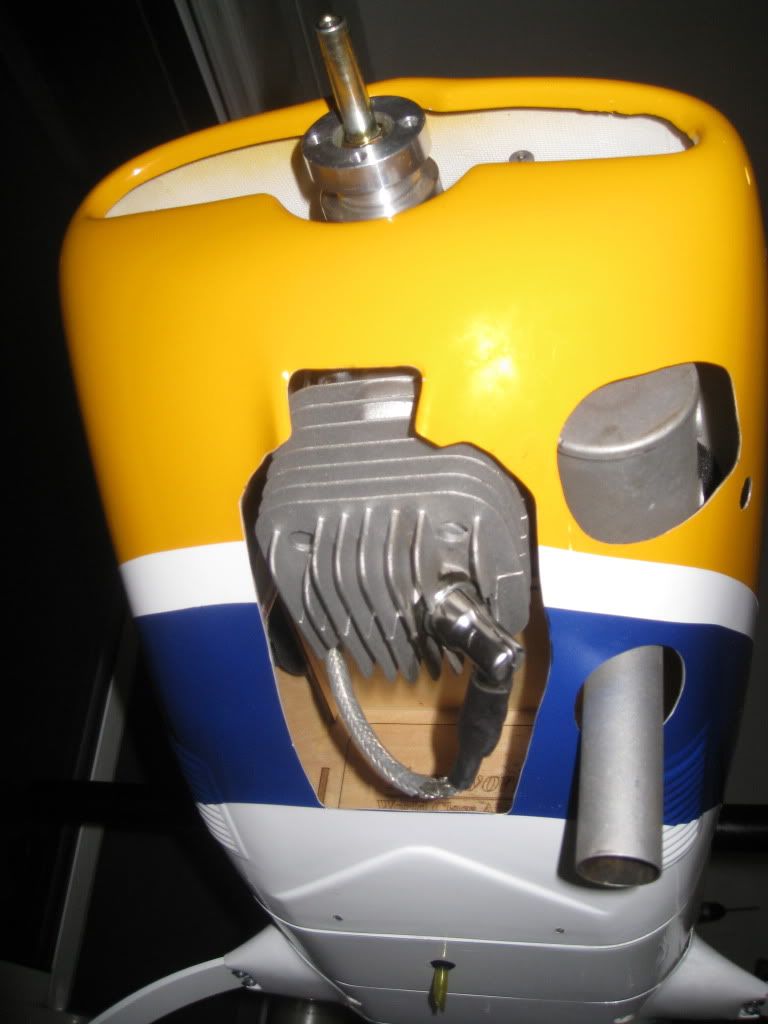
You'll get lots of advice on this one. Here's mine...Sounds like I'm running something similar to you (GP 27% Extra, DL50). The head protrudes from the cowl enough that no air dam or baffling is required. The cowl on my Extra has that scale, square-like cutout a few inches below the spinner (must be the carb intake I guess), but when you cut the cowl for the engine that opening gets cut out. What I did was just make a new scale intake opening above the original, thus preserving (partially) the scale affect and allowing more air to flow. The cowl on the GP Extra has a large cutout around the bottom for the landing gear creating a natural air exit.
The way I cut my cowl is initially without the muffler and spark plug. Cut barely enough to clear the engine until you are able to bolt the cowl into position. Then perfect the cut once the cowl is bolted on. Then, remove the cowl and mount the muffler. Make a template from thin cardstock (manilla folder) for the muffler. Remove the muffler, but leave the template taped to your fuselage. Mount the cowl. Transfer the muffler cutouts in your template to the cowl, then cut. Finally, cut for the spark plug and plug wire.
If you want to get crazy, add some aluminum duct tape inside the cowl around the engine cutout.
You'll get lots of advice on this one. Here's mine...Sounds like I'm running something similar to you (GP 27% Extra, DL50). The head protrudes from the cowl enough that no air dam or baffling is required. The cowl on my Extra has that scale, square-like cutout a few inches below the spinner (must be the carb intake I guess), but when you cut the cowl for the engine that opening gets cut out. What I did was just make a new scale intake opening above the original, thus preserving (partially) the scale affect and allowing more air to flow. The cowl on the GP Extra has a large cutout around the bottom for the landing gear creating a natural air exit.
The way I cut my cowl is initially without the muffler and spark plug. Cut barely enough to clear the engine until you are able to bolt the cowl into position. Then perfect the cut once the cowl is bolted on. Then, remove the cowl and mount the muffler. Make a template from thin cardstock (manilla folder) for the muffler. Remove the muffler, but leave the template taped to your fuselage. Mount the cowl. Transfer the muffler cutouts in your template to the cowl, then cut. Finally, cut for the spark plug and plug wire.
If you want to get crazy, add some aluminum duct tape inside the cowl around the engine cutout.
11-11-2009 | 09:35 PM
#8

My Feedback: (1)
Joined: Apr 2003
Posts: 4,890
Likes: 0
Received 0 Likes
on
0 Posts
From: Left Coast ,
CA
RE: Engine/cowl cooling question
Well since Pe didn't put up a link I will. This is a pictorial with explanations, read it, follow it, and you will be golden. The old 3 or 4 to one ratio mache nix, extraction and directed flow is what you are after
http://www.prme.nl/forum/viewtopic.php?p=506#506
http://www.prme.nl/forum/viewtopic.php?p=506#506
11-12-2009 | 09:36 AM
#9

Joined: Jan 2006
Posts: 2,517
Likes: 0
Received 0 Likes
on
0 Posts
From: Kalona,
IA
RE: Engine/cowl cooling question
Here is an example using the low pressure lip. The inlets on the sides of the spinner (better suited for cooling a twin) have been blocked. The lip, is fitted up close behind the cylinder of the engine, and draws air coming through the cylinder out the bottom. This is a very happy G62.
11-12-2009 | 03:46 PM
#10
RE: Engine/cowl cooling question
Thanks for all the replies guys. Lots of good ideas here. When you first mentioned the air dam I thought you meant it goes inside the cowling? But I see in the last post you've mounted it outside. The aluminum tape is a great idea that I think I'll also do for strength and heat reflection. I really do like the idea opening up the cannister tunnel exit covering as that way I don't have to cut up the cowl hardly at all, and still allows me to run cans later on without any changes to the cowl.
I may go ahead and block off the 2 intake holes for a twin like you've mentioned as well, just depends on my final setup. BTW, in skip1320's post link above, that is the EXACT plane and cowl I'm building for reference. Thanks btw skip, I didn't realize the DLE 55 head stuck out the cowling that much as I haven't mounted mine yet. If it does protrude that much I should have little to no issues with cooling. Skip by your comment did you end up crashing yours? If so how come?
Keep any other ideas and or pics coming. Has anyone done any testing with different setups to measure actual temp drop? Or any real life numbers associated?
I may go ahead and block off the 2 intake holes for a twin like you've mentioned as well, just depends on my final setup. BTW, in skip1320's post link above, that is the EXACT plane and cowl I'm building for reference. Thanks btw skip, I didn't realize the DLE 55 head stuck out the cowling that much as I haven't mounted mine yet. If it does protrude that much I should have little to no issues with cooling.
Skip by your comment did you end up crashing yours? If so how come?Keep any other ideas and or pics coming. Has anyone done any testing with different setups to measure actual temp drop? Or any real life numbers associated?
02-07-2011 | 10:56 PM
#11
RE: Engine/cowl cooling question
Hey guys,
I realize this is an older thread I started, but I figured I'd update it for anyone else looking into cowl cooling on their gasser. Anyway tonight I was bored so I decided to try out building an air dam with louvers for fun. Never had a problem with cooling at all last year by venting the cowl and 2 places in the empty cannister tunnel, but I wanted it for the 33% Yak I just picked up to aid in cooling with no tunnels to vent.
Pics here: [link=http://www.rcuniverse.com/forum/fb.asp?m=10320208]http://www.rcuniverse.com/forum/fb.asp?m=10320208[/link]
Thanks again for the louvers idea everyone! I do a lot of work on custom PC cooling for overclocking (yes my PC next to me is fully water cooled, and I've custom designed a few peltier coolers too), but never really thought about the air dam idea for a plane. I can't wait to see the temps on the DL-100 & DLE-55 as I plan on installing temp sensors with the Aurora 9 on them.
Egan
I realize this is an older thread I started, but I figured I'd update it for anyone else looking into cowl cooling on their gasser. Anyway tonight I was bored so I decided to try out building an air dam with louvers for fun. Never had a problem with cooling at all last year by venting the cowl and 2 places in the empty cannister tunnel, but I wanted it for the 33% Yak I just picked up to aid in cooling with no tunnels to vent.
Pics here: [link=http://www.rcuniverse.com/forum/fb.asp?m=10320208]http://www.rcuniverse.com/forum/fb.asp?m=10320208[/link]
Thanks again for the louvers idea everyone! I do a lot of work on custom PC cooling for overclocking (yes my PC next to me is fully water cooled, and I've custom designed a few peltier coolers too), but never really thought about the air dam idea for a plane. I can't wait to see the temps on the DL-100 & DLE-55 as I plan on installing temp sensors with the Aurora 9 on them.
Egan


