


How to advance ignition timing with glow engine?
 06-14-2023 | 06:34 AM
#26


Quote:
"I gave up, they are inferior to my corded current source glow stick"
In what way(s) are the pocket glow drivers "inferior"?
Is it lighter?
Does it effectively limit peak inrush current and voltages to prolong plug life?
You tossed in the term "current source" is your source actually a constant current ? Is it pulse width modulated to an average current?
How much does it, along with the lead acid battery COST?
Inferior?
Any pics of your setup?
"I gave up, they are inferior to my corded current source glow stick"
In what way(s) are the pocket glow drivers "inferior"?
Is it lighter?
Does it effectively limit peak inrush current and voltages to prolong plug life?
You tossed in the term "current source" is your source actually a constant current ? Is it pulse width modulated to an average current?
How much does it, along with the lead acid battery COST?
Inferior?
Any pics of your setup?
 06-14-2023 | 07:48 AM
#27
Thread Starter
Senior Member
The batteries go flat whilst in use.
The constant current glo stick connects to the same 12V 7Ah lead acid battery that powers the Hanger 9 power pro starter motor
The way it works is with pwm step down buck converter arranged for constant current mode, this current is minimal adjustable by way of a pot+-20%. The constant current is dc being smoothed(averaged) out using a lc tank (double time integrator)
A constant current will prolong plug life. I did think about making one but they are so darn cheap it's hardly worth trying.
Note, the lead acid battery is used primary to drive the Hangar 9 starter motor, the battery can be bought for less than £20 and a charger to suit about £10
Here is a link, you can get them even cheaper of ebay
https://www.modelshopleeds.co.uk/cat...hoCH7UQAvD_BwE
Is it lighter?
Does it effectively limit peak inrush current and voltages to prolong plug life?
You tossed in the term "current source" is your source actually a constant current ? Is it pulse width modulated to an average current?
How much does it, along with the lead acid battery COST?
Does it effectively limit peak inrush current and voltages to prolong plug life?
You tossed in the term "current source" is your source actually a constant current ? Is it pulse width modulated to an average current?
How much does it, along with the lead acid battery COST?
The way it works is with pwm step down buck converter arranged for constant current mode, this current is minimal adjustable by way of a pot+-20%. The constant current is dc being smoothed(averaged) out using a lc tank (double time integrator)
A constant current will prolong plug life. I did think about making one but they are so darn cheap it's hardly worth trying.
Note, the lead acid battery is used primary to drive the Hangar 9 starter motor, the battery can be bought for less than £20 and a charger to suit about £10
Here is a link, you can get them even cheaper of ebay
https://www.modelshopleeds.co.uk/cat...hoCH7UQAvD_BwE
Last edited by 2W0EPI; 06-14-2023 at 09:07 AM.
06-14-2023 | 10:18 AM
#28
Yes, pulse duration. Actually average current, not constant current. I have observed the wave form of the same unit on an oscilloscope.
BTW , pulsed high voltages in order to set an average current is not always kind to resistace heated loads.
At any rate, cannot support claims like "inferior" in either direction.
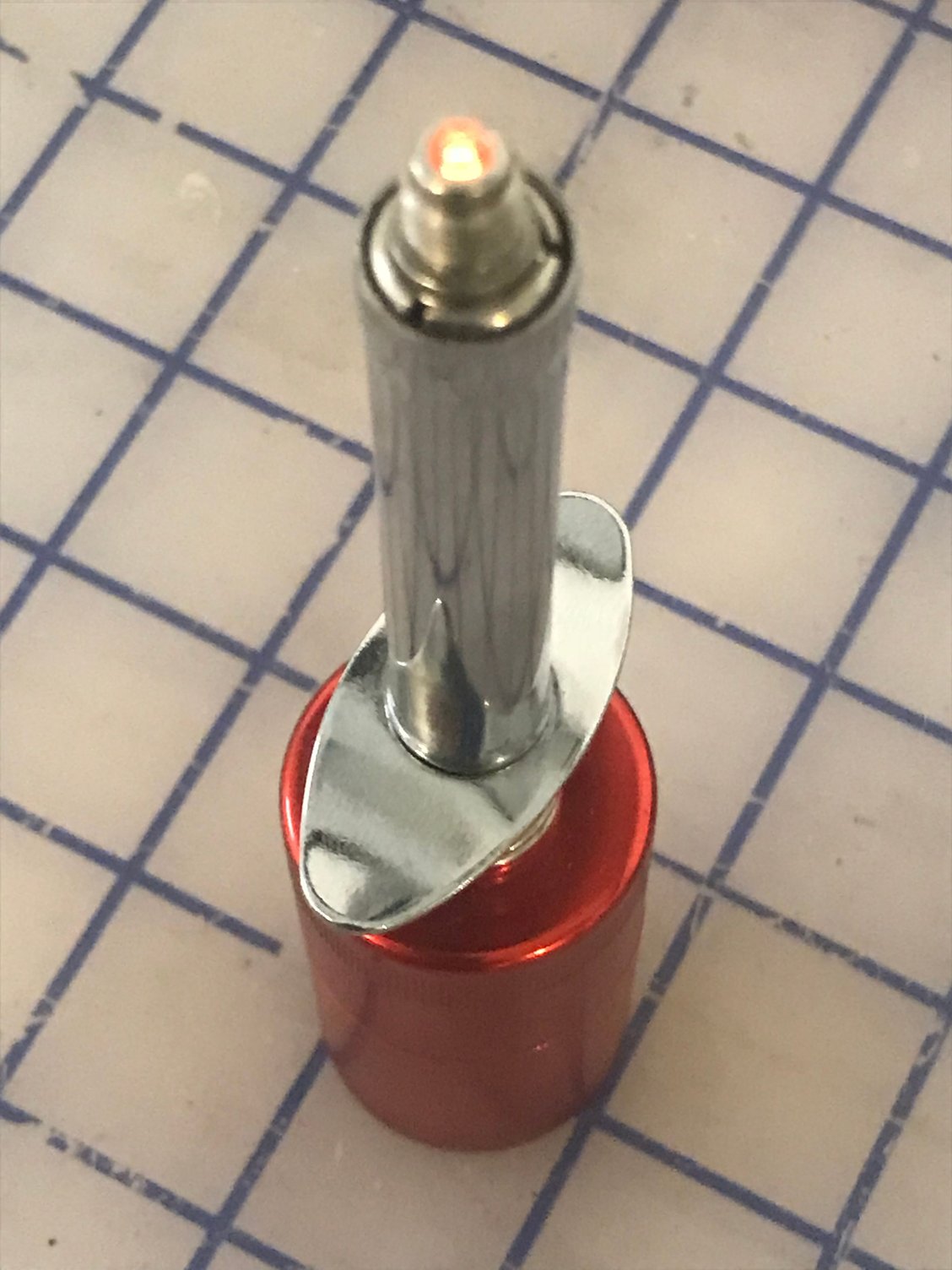
At no time will the plug ever see above 1.4 volts with this,NiCd equipped, self contained driver. Actually more typically 1.1 volts under initial load. Inrush current is absolutely limited well below levels that are seen by typical 12 volt PWM sources.
Average plug life is extended.
BTW , pulsed high voltages in order to set an average current is not always kind to resistace heated loads.
At any rate, cannot support claims like "inferior" in either direction.
At no time will the plug ever see above 1.4 volts with this,NiCd equipped, self contained driver. Actually more typically 1.1 volts under initial load. Inrush current is absolutely limited well below levels that are seen by typical 12 volt PWM sources.
Average plug life is extended.
06-14-2023 | 11:04 AM
#29
Thread Starter
Senior Member
Jesse, I measured the voltage at no load and it is near as dam it 12V (actually 11V) connected to a 12 V 7Ah battery typical of constant current source and under load conditions the voltage remains low across the element constant current dc. If you feed the pwm signal with no filter, then the peak currents would be very high with the possibility of burning out the plug. If the pwm switching waveform is fed directly to the output or plug then how does the pwm control error amplifier circuit control the pulse width voltage or current to the output? you need dc output to feedback to the error amplifier.
With pwm, followed by a freewheeling diode and an LC tank the designer can use constant current mode in the negative feedback loop to produce a dc constant current with about 80% efficiency. Additionally, with 80% efficiency the glow circuit is only drawing about 1 amp@12V to produce 4~5 Amp constant current at the plug with about 1.3 V drop.
With pwm, followed by a freewheeling diode and an LC tank the designer can use constant current mode in the negative feedback loop to produce a dc constant current with about 80% efficiency. Additionally, with 80% efficiency the glow circuit is only drawing about 1 amp@12V to produce 4~5 Amp constant current at the plug with about 1.3 V drop.
Last edited by 2W0EPI; 06-14-2023 at 11:53 AM.
06-14-2023 | 12:27 PM
#30
Jesse, I measured the voltage at no load and it is near as dam it 12V (actually 11V) connected to a 12 V 7Ah battery typical of constant current source and under load conditions the voltage remains low across the element constant current dc. If you feed the pwm signal with no filter, then the peak currents would be very high with the possibility of burning out the plug. If the pwm switching waveform is fed directly to the output or plug then how does the pwm control error amplifier circuit control the pulse width voltage or current to the output? you need dc output to feedback to the error amplifier.
With pwm, followed by a freewheeling diode and an LC tank the designer can use constant current mode in the negative feedback loop to produce a dc constant current with about 80% efficiency. Additionally, with 80% efficiency the glow circuit is only drawing about 1 amp@12V to produce 4~5 Amp constant current at the plug with about 1.3 V drop.
With pwm, followed by a freewheeling diode and an LC tank the designer can use constant current mode in the negative feedback loop to produce a dc constant current with about 80% efficiency. Additionally, with 80% efficiency the glow circuit is only drawing about 1 amp@12V to produce 4~5 Amp constant current at the plug with about 1.3 V drop.
Theo- rhetorical attempts aside

Your glow driver delivers a raw, unfiltered variable width, rectangular wave. Putting 12 watts in and getting less than 6 watts out is not exactly high efficiency.
I would like to see you driving a typical RC plug with 1.3 volts (at the plug tip) and drawing 4 to 5 Amps. 6.5 Watts is plain abuse!
Real world, at the plug; 1.1 volts @ 2 amps is just about average for every engine I run. (2.2 Watts)
Could be why so many folks complain about plug life(?)
Thanks anyhow Stephen
06-14-2023 | 12:40 PM
#31
Thread Starter
Senior Member
06-14-2023 | 01:03 PM
#32
That is for you to explain.
You haven't yet addressed your "efficiency" assertions.( Less than 50%, not 80%.)
Nor the 1.3 volts at 5 amps!
(Among a few other issues)
Maybe ask John?
You haven't yet addressed your "efficiency" assertions.( Less than 50%, not 80%.)
Nor the 1.3 volts at 5 amps!
(Among a few other issues)
Maybe ask John?
Last edited by Jesse Open; 06-14-2023 at 01:06 PM.
06-14-2023 | 01:35 PM
#33
Thread Starter
Senior Member
Don't have a logical explanation for your assertions?
Please forgive me, I took those figures of the top of my head, assuming 5 Amps and the filament is 0.4 Ohms 2 Volts across the filament that equates to 10 watts dissipation and if the pwm is 83% efficient we arrive at 12 Volts @ 1amp from the battery, maybe a little high but there you go as an example.
I am still curios on how you control filament current using straight 'variable' pulse width without any filter and negative feedback?
Who is John?
I am still curios on how you control filament current using straight 'variable' pulse width without any filter and negative feedback?
Who is John?
Last edited by 2W0EPI; 06-14-2023 at 02:23 PM.


