


L.E. flaps-do they work?
 08-25-2003 | 01:31 PM
#1
Thread Starter
Senior Member
My Feedback: (6)
 L.E. flaps-do they work?
Building an SU 27 and wanted to build in L.E. flaps, like the full size. Question is do they work well enough to make the effort. For example, I have flaperons on a plane and notice no effect at all. Any experience out there? This will be a twin turbine, fuse is 108" long if any of that matters, w.s. about 68".
 08-25-2003 | 01:43 PM
#2
Senior Member
My Feedback: (12)
Joined: Nov 2002
Posts: 630
Likes: 0
Received 0 Likes
on
0 Posts
From: Madison, WI,
LE flaps
You say flaperons don't help. You don't think they provide additional lift? I think the LE flaps and trailing edge flaps would provide should provide extra lift .
08-25-2003 | 06:19 PM
#3
Senior Member
Joined: May 2002
Posts: 624
Likes: 0
Received 0 Likes
on
0 Posts
From: Cornelius,
OR
L.E. flaps-do they work?
We have full size air and scale size airplanes, I don't think you can tell the difference. You can save weight and leave them off.
Have a friend with a BVM F-100 and one came off in flight and he didn't see it. Did not notice a trim change and landed flaps out.
He removed them.
Darryl Usher
Have a friend with a BVM F-100 and one came off in flight and he didn't see it. Did not notice a trim change and landed flaps out.
He removed them.
Darryl Usher
08-25-2003 | 07:51 PM
#5


Joined: Jan 2002
Posts: 1,998
Likes: 0
Received 0 Likes
on
0 Posts
From: Sydney, , AUSTRALIA
Slats...
Darryl- re F100 loosing single slat in flight? do you know weather they were extended or retracted when this occured? I often wonder how dramatic the effect would be with miss matched slats actually extending while in flight and if results would cause total loss of control??? anyone had this happen?
I have operational slats fitted to my F/C F86 although I have not used them as yet.....
I have operational slats fitted to my F/C F86 although I have not used them as yet.....
09-03-2003 | 08:27 PM
#6

My Feedback: (8)
Joined: Aug 2003
Posts: 50
Likes: 0
Received 0 Likes
on
0 Posts
From: Troy, MO
L.E. flaps-do they work?
Leading edge slats(flaps) allow thin wing supersonic airfoils become fat wings for slow or landing speeds. If you lost one it would not totally disable the aircraft but the trim COULD change and you would have to land at a faster speed.
tetons9
tetons9
09-03-2003 | 10:28 PM
#7
Senior Member
Joined: Jan 2002
Posts: 267
Likes: 0
Received 0 Likes
on
0 Posts
From: Stokke, NORWAY
L.E. flaps-do they work?
I do recall reading about a fullsize Sabre here in Norway that landed with extended slats on one wing, and retracted ones on the other, many many years ago... That worked out just fine...
tetons9: Don't forget that many airliners use slats as well, so the "thin supersonic wing" thing doesn't really work that well...
With the exception of Boeing 707 and 727, and the excellent Fokker's, most jet airliners have slats...
tetons9: Don't forget that many airliners use slats as well, so the "thin supersonic wing" thing doesn't really work that well...
With the exception of Boeing 707 and 727, and the excellent Fokker's, most jet airliners have slats...
09-03-2003 | 11:24 PM
#8
My Feedback: (8)
Joined: Aug 2003
Posts: 50
Likes: 0
Received 0 Likes
on
0 Posts
From: Troy, MO
L.E. flaps-do they work?
What power settings did the full sized Sabre land at? The use of the word supersonic was intended to include transonic and just below sonic which is what airliners fly at. Besides that there is the particulars of the wing design and the aircraft design to consider. I have worked 40 years with a BS in Aerospaace Engineering and know that you can't apply speciific ideas to all aircraft in general. The "thin supersonic wing" concept is a fact and not a theory.
09-03-2003 | 11:40 PM
#9
My Feedback: (8)
Joined: Aug 2003
Posts: 50
Likes: 0
Received 0 Likes
on
0 Posts
From: Troy, MO
L.E. flaps-do they work?
as an adendum, L. E flaps are powered up and down either hydraulicaly or electrically where slats are designed to be extended and retracted by airloads depending on the airspeed and the angle of attack.
09-04-2003 | 12:29 AM
#10

Senior Member
Joined: Jan 2002
Posts: 2,565
Likes: 0
Received 0 Likes
on
0 Posts
From: Anchorage,
AK
High Lift Devices
The topic of high lift devices keeps coming up in the "Aerodynamics" forum too, so I've started hosting a "High Lift" (non-commercial) set of pages on my web site, at http://homepage.mac.com/mikejames/rc...ite/index.html
All contributions (articles and drawings, not money) are welcome, and if you send something for me to post, I will credit you as the author. Hopefully, as it grows, it will become a reference we can all use. Just email me the files and info, and I will usually post them the same day.
Thanks.
PS> There's an article by Larry Wolfe, in a 1993 issue of Model Airplane News on how to construct leading edge flaps, and Bob Fiorenze also did an article on implementing them on his F-18. (Sorry, don't remember exactly where that was.)
All contributions (articles and drawings, not money) are welcome, and if you send something for me to post, I will credit you as the author. Hopefully, as it grows, it will become a reference we can all use. Just email me the files and info, and I will usually post them the same day.
Thanks.
PS> There's an article by Larry Wolfe, in a 1993 issue of Model Airplane News on how to construct leading edge flaps, and Bob Fiorenze also did an article on implementing them on his F-18. (Sorry, don't remember exactly where that was.)
09-04-2003 | 12:39 AM
#11
Senior Member
Joined: Jan 2002
Posts: 267
Likes: 0
Received 0 Likes
on
0 Posts
From: Stokke, NORWAY
L.E. flaps-do they work?
Originally posted by tetons9
What power settings did the full sized Sabre land at?
What power settings did the full sized Sabre land at?
I have worked 40 years with a BS in Aerospaace Engineering and know that you can't apply speciific ideas to all aircraft in general. The "thin supersonic wing" concept is a fact and not a theory.
Originally posted by tetons9
as an adendum, L. E flaps are powered up and down either hydraulicaly or electrically where slats are designed to be extended and retracted by airloads depending on the airspeed and the angle of attack.
as an adendum, L. E flaps are powered up and down either hydraulicaly or electrically where slats are designed to be extended and retracted by airloads depending on the airspeed and the angle of attack.
Here's the basic definitions:
Slot:
A permanent slot in the L.E. of the wing. The slot is designed to energize the boundary layer, delaying the stall. By delaying the stall the wing is able to fly at a greater angle of attack thus achieving a greater CLmax.
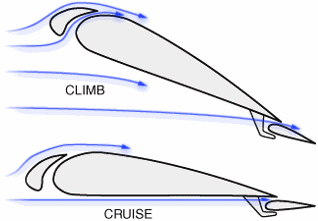
Slats:
Slats give the same advantages as the Slot, but can be extended for takeoff and landing, either mechanically or aerodynamically, to achieve the same effect as the fixed slot shown above, but to still have the advantage of a "clean" wing during cruise.

L.E. Flaps:
L.E. Flaps perform a similar function to Slats. The difference is that leading edge flaps increase the camber of the wing, and do not create a slot. As a result LE flaps increase lift at all angles of attack, and do not delay the stall as effectively as slats.


Based on these definitions, i give you this list of examples:
Aircrafts with Slots:
Saab MFI-15 Safari
Zenithair STOL CH701
Dornier DO.27
Dornier DO.28
Aircrafts with Slats:
Aerospatiale Rallye (Actuated aerodynamically)
DC-9
MD-80
A320
Boeing 737 (has L.E. Flaps between the fuselage and the engine)
Boeing 767
Panavia Tornado
Aircrafts with L.E. Flaps:
Boeing 707
Boeing 727
F-16
F-18
Hope this will help you understand the difference....
 09-04-2003 | 12:54 AM
#12
My Feedback: (8)
Joined: Aug 2003
Posts: 50
Likes: 0
Received 0 Likes
on
0 Posts
From: Troy, MO
L.E. flaps-do they work?
I understand the difference very clearly. Here are some examples for you:
Slots (on leading edge of stabilator)
McDonnel Douglas F-4E
Slats
North American F-100
L. E. Flaps
McDonnell Douglas F-4
In contrast the McDonnell Douglas F-15 has a fixed leading edge because of the type of airfoil used for the wing. The McDonnell Douglas F-18 also has a fixed leading edge because the fuselage is a part of the wing as is the SU 29.
Slots (on leading edge of stabilator)
McDonnel Douglas F-4E
Slats
North American F-100
L. E. Flaps
McDonnell Douglas F-4
In contrast the McDonnell Douglas F-15 has a fixed leading edge because of the type of airfoil used for the wing. The McDonnell Douglas F-18 also has a fixed leading edge because the fuselage is a part of the wing as is the SU 29.
09-04-2003 | 01:04 AM
#13
Senior Member
My Feedback: (12)
Joined: Nov 2002
Posts: 630
Likes: 0
Received 0 Likes
on
0 Posts
From: Madison, WI,
Leading edge devices
The statement that the 727 and 707 have leading edge flaps was correct BUT they also have leading edge slats on the outboard sections of the wing. They are both hydraulically actuated. There is another leading edge device that has been used called a leading edge droop. The Navy FJ-4 had them. All these devices were installed to lower stall speeds and increase lift at lower airspeeds. Landing airspeeds had to be increased without the leading edge devices extended.
09-04-2003 | 01:16 AM
#14
My Feedback: (8)
Joined: Aug 2003
Posts: 50
Likes: 0
Received 0 Likes
on
0 Posts
From: Troy, MO
L.E. flaps-do they work?
HalH,
You are right about the F-4J having the leading edge high lift devices but McDonnell Douglas designated them as L. E. Flaps. The F-4B, F-4C, F-4D, F-4K and F-4M also had them. The F-4E had a fixed L. E. and a SLOTTED L. E. on the stabilator and on the outer wing panel.
You are right about the F-4J having the leading edge high lift devices but McDonnell Douglas designated them as L. E. Flaps. The F-4B, F-4C, F-4D, F-4K and F-4M also had them. The F-4E had a fixed L. E. and a SLOTTED L. E. on the stabilator and on the outer wing panel.
09-04-2003 | 01:19 AM
#15
Senior Member
Joined: Jan 2002
Posts: 267
Likes: 0
Received 0 Likes
on
0 Posts
From: Stokke, NORWAY
L.E. flaps-do they work?
Originally posted by tetons9
I understand the difference very clearly. Here are some examples for you:
I understand the difference very clearly. Here are some examples for you:
Doesn't seem like it to me.. In post #9 in this thread you say something that indicate that you believe the difference between L.E. Flaps and Slats is the way they are actuated.
In contrast the McDonnell Douglas F-15 has a fixed leading edge because of the type of airfoil used for the wing. The McDonnell Douglas F-18 also has a fixed leading edge because the fuselage is a part of the wing as is the SU 29.
 09-04-2003 | 01:22 AM
#16
Senior Member
Joined: Jan 2002
Posts: 267
Likes: 0
Received 0 Likes
on
0 Posts
From: Stokke, NORWAY
Re: Leading edge devices
Originally posted by HalH
The statement that the 727 and 707 have leading edge flaps was correct BUT they also have leading edge slats on the outboard sections of the wing. They are both hydraulically actuated.
The statement that the 727 and 707 have leading edge flaps was correct BUT they also have leading edge slats on the outboard sections of the wing. They are both hydraulically actuated.
09-04-2003 | 01:36 AM
#17
My Feedback: (8)
Joined: Aug 2003
Posts: 50
Likes: 0
Received 0 Likes
on
0 Posts
From: Troy, MO
L.E. flaps-do they work?
ramprat,
The between LE edge flaps and slats is precisely in the way they are actuated. I stand corrected on the F-18 LE flaps. I have ran many wind tunnel tests on all types of these devices, I guess the problem is in ourn terminolgy. You are right. For model aircraft and aircraft that don't approach the speed of sound, it doesn't matter.
Larry
The between LE edge flaps and slats is precisely in the way they are actuated. I stand corrected on the F-18 LE flaps. I have ran many wind tunnel tests on all types of these devices, I guess the problem is in ourn terminolgy. You are right. For model aircraft and aircraft that don't approach the speed of sound, it doesn't matter.
Larry
09-04-2003 | 01:49 AM
#18
Senior Member
Joined: Jan 2002
Posts: 267
Likes: 0
Received 0 Likes
on
0 Posts
From: Stokke, NORWAY
L.E. flaps-do they work?
Well... I can not find a single piece of information anywhere that supports your statement....
I can however find plenty that supports the description i gave earlier... Including pictures of the MD-80 cockpit where the word "Slats" are clearly seen on the flap-indicator and next to the flap-selector...
I'm quite sure that McDD knew what they put in their aircrafts, and i'm even more sure that the slats on the MD-80 are actuated mechanically, not aerodynamically...
And again: All wings can benefit from slats, not just near-supersonic wings... As i mentioned, the Aerospatiale/Socata Rallye has slats, and this is a out-of-production four-seat sport-aircraft with superb STOL-qualities....
I can however find plenty that supports the description i gave earlier... Including pictures of the MD-80 cockpit where the word "Slats" are clearly seen on the flap-indicator and next to the flap-selector...
I'm quite sure that McDD knew what they put in their aircrafts, and i'm even more sure that the slats on the MD-80 are actuated mechanically, not aerodynamically...
And again: All wings can benefit from slats, not just near-supersonic wings... As i mentioned, the Aerospatiale/Socata Rallye has slats, and this is a out-of-production four-seat sport-aircraft with superb STOL-qualities....
09-04-2003 | 02:28 AM
#19
My Feedback: (8)
Joined: Aug 2003
Posts: 50
Likes: 0
Received 0 Likes
on
0 Posts
From: Troy, MO
L.E. flaps-do they work?
Well we can argue about this all day, however I work for Boeing/McDonnell Douglas and I am sure of what their designations are. One final thing, for boundary layer control on the F-4 there were a series of small holes that were exposed when the leading edge flaps were extended that blew engine bleed air into the boundary layer to reinforce it to help prevent separation.
Just another item to help keep the discusion interesting.
Larry
Just another item to help keep the discusion interesting.
Larry
09-04-2003 | 02:39 AM
#20
My Feedback: (8)
Joined: Aug 2003
Posts: 50
Likes: 0
Received 0 Likes
on
0 Posts
From: Troy, MO
L.E. flaps-do they work?
Ramprat,
You misunder stood me about slat,slot,le flaps being used on near or supersonic aircraft. At those speed these devices are out of the picture as far as performance goes. It is only at the low or landing speeds that these devices are used to provide more lift at lower speeds.
Larry
You misunder stood me about slat,slot,le flaps being used on near or supersonic aircraft. At those speed these devices are out of the picture as far as performance goes. It is only at the low or landing speeds that these devices are used to provide more lift at lower speeds.
Larry
09-04-2003 | 03:24 AM
#21
Member
Joined: Feb 2003
Posts: 70
Likes: 0
Received 0 Likes
on
0 Posts
From: Maracas Valley, TRINIDAD AND TOBAGO
L.E. flaps-do they work?
well.....i flew md-83's for 5 years, and let me tell you.....they do have slats. they are normally extended manually, although they come out automatically as a last ditch attempt to avoid an impending stall. they are hydraulically powered, and they decrease the stall speed when used alone by about 30 kts.
the first position of flap selection is "flap 0", which is half slat extension, and no flap. when the trailing edge flaps start to come down, the slats go to the full extended position......and, yes, i do think slats would make a big difference on a model
virus.
the first position of flap selection is "flap 0", which is half slat extension, and no flap. when the trailing edge flaps start to come down, the slats go to the full extended position......and, yes, i do think slats would make a big difference on a model
virus.
09-04-2003 | 03:24 AM
#22
Senior Member
Joined: May 2002
Posts: 624
Likes: 0
Received 0 Likes
on
0 Posts
From: Cornelius,
OR
L.E. flaps-do they work?
The question was do they work on a model aircraft. I would rather be a pound lighter with out LE devices.
Scale LE devices I don't carry there own weight.
Darryl Usher
Scale LE devices I don't carry there own weight.
Darryl Usher
09-04-2003 | 03:36 AM
#24
Member
Joined: Feb 2003
Posts: 70
Likes: 0
Received 0 Likes
on
0 Posts
From: Maracas Valley, TRINIDAD AND TOBAGO
L.E. flaps-do they work?
i haven't tried it on a model jet yet, but i've put them on a trainer years ago....the whole plane came out less than half pound heavier than before, and the landing speed was half the speed as before. it was a trainer .60 i think...and it had inboard trailing edge flaps, and full span leading edge slats.
i definately want to put them on my next jet
virus.
i definately want to put them on my next jet
virus.
09-04-2003 | 08:48 AM
#25
Senior Member
Joined: Jan 2002
Posts: 267
Likes: 0
Received 0 Likes
on
0 Posts
From: Stokke, NORWAY
L.E. flaps-do they work?
Originally posted by tetons9
Well we can argue about this all day, however I work for Boeing/McDonnell Douglas and I am sure of what their designations are.
Well we can argue about this all day, however I work for Boeing/McDonnell Douglas and I am sure of what their designations are.
...and again, i see no evidence of this...
One final thing, for boundary layer control on the F-4 there were a series of small holes that were exposed when the leading edge flaps were extended that blew engine bleed air into the boundary layer to reinforce it to help prevent separation.
Just another item to help keep the discusion interesting.
Larry
Just another item to help keep the discusion interesting.
Larry
Originally posted by tetons9
Ramprat,
You misunder stood me about slat,slot,le flaps being used on near or supersonic aircraft. At those speed these devices are out of the picture as far as performance goes. It is only at the low or landing speeds that these devices are used to provide more lift at lower speeds.
Larry
Ramprat,
You misunder stood me about slat,slot,le flaps being used on near or supersonic aircraft. At those speed these devices are out of the picture as far as performance goes. It is only at the low or landing speeds that these devices are used to provide more lift at lower speeds.
Larry
I did write the definitions of the three devices earlier in this topic, so i'm quite sure what they're there for... ...and only one of them help provide more lift at lower speeds, the L.E. Flap... The two others delay the separation of the boundary layer, thus allowing the wing to have a higher AOA without stalling.
I could have sworn that this is kindergarden-material when it comes to aerodynamics, so i simply do not believe you're working with aerodynamics for Boeing...
Sorry Larry, but claiming to work for Boeing/ McDD doesn't impress me....

