


Help needed: engine quits on idle
 09-19-2022 | 12:02 PM
#1

Thread Starter

 Help needed: engine quits on idle
Engine in question is a Wren 44 gold (10 lb thrust) that I bought in 2007 for a model that I was planning, a delta-wing seaplane, a sort of cross between a Northstar and a CARF New Rookie (both of which I had at the time).
Finished the model this year (slow builder) and it flew well. My problem is that on every landing, and sometimes just on a low slow pass, the engine would quit. Deadstick landing, retrieved by rescue boat, no problem really. But why does the engine quit when pulled back to idle every single time?
Yes, I tried increasing the idle revs from 55 to 60k. I tried increasing the deceleration delay by 4, then another 4. It would never do it on land when I tested it, no matter how sharp I was with the throttle. It only happened on landing, or low slow passes with throttle closed, even when still airborne (so not a water splash).
The only "different" thing about this model was that, since it was a flying boat, the tank vent could not be the usual nipple on the fuselage floor, it stuck out forwards, like a pitot tube or a refueling probe. I wondered if the engine quit when pitot pressure applied to the vent reduced as speed bled off. I tried simulating that by applying pressure to the vent pipe (and the idle rpm increased sure enough) but when I released the vent over-pressure the engine settled to idle rpm quite nicely.
So, just out of interest, can anyone suggest why this was happening?
Just out of academic interest, as I removed my problem by hitting a tree on a low pass. But it might be nice to know if there is a next time.
Alasdair
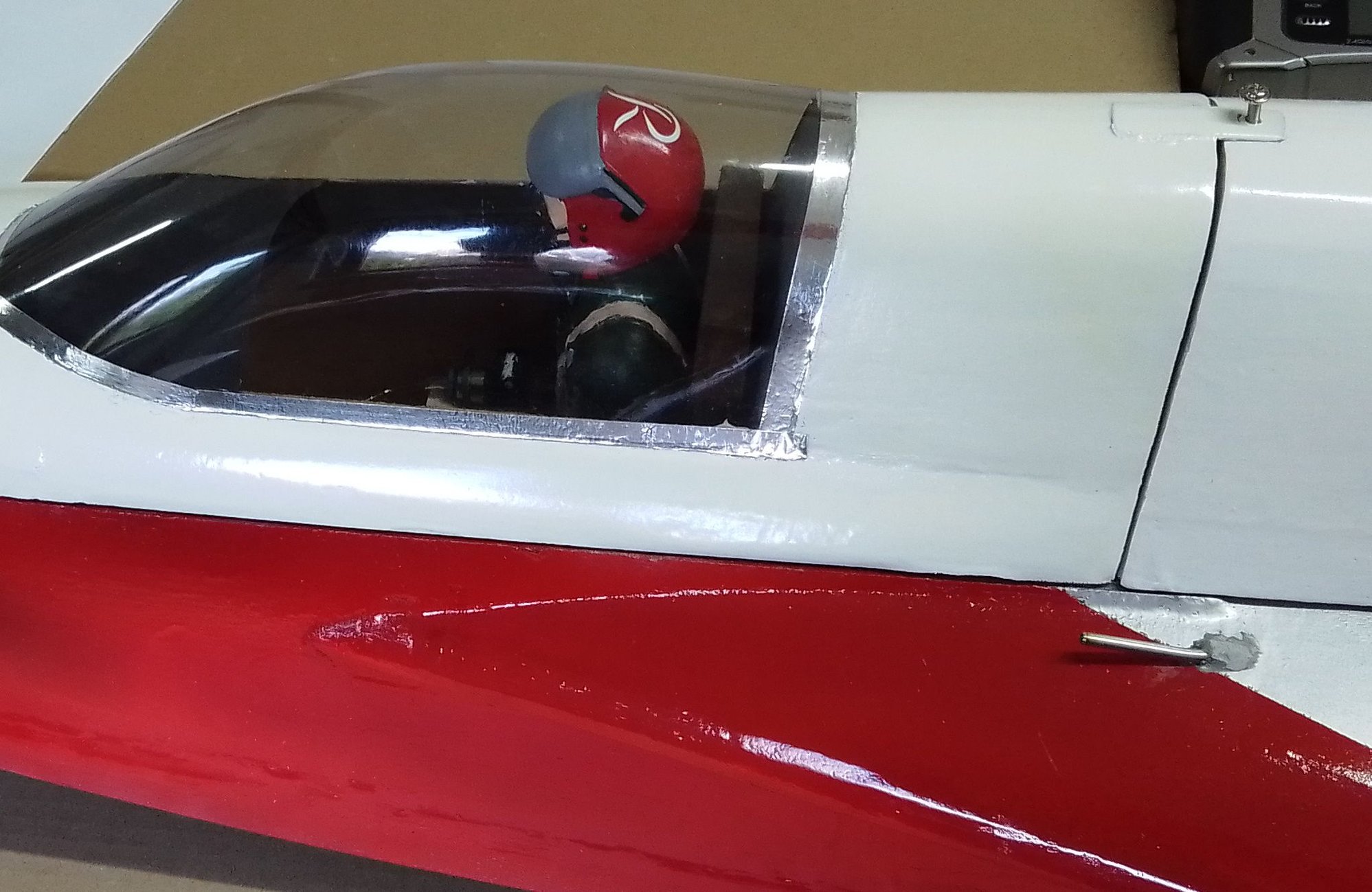
That's the vent pipe just below the canopy/hatch rear corner.
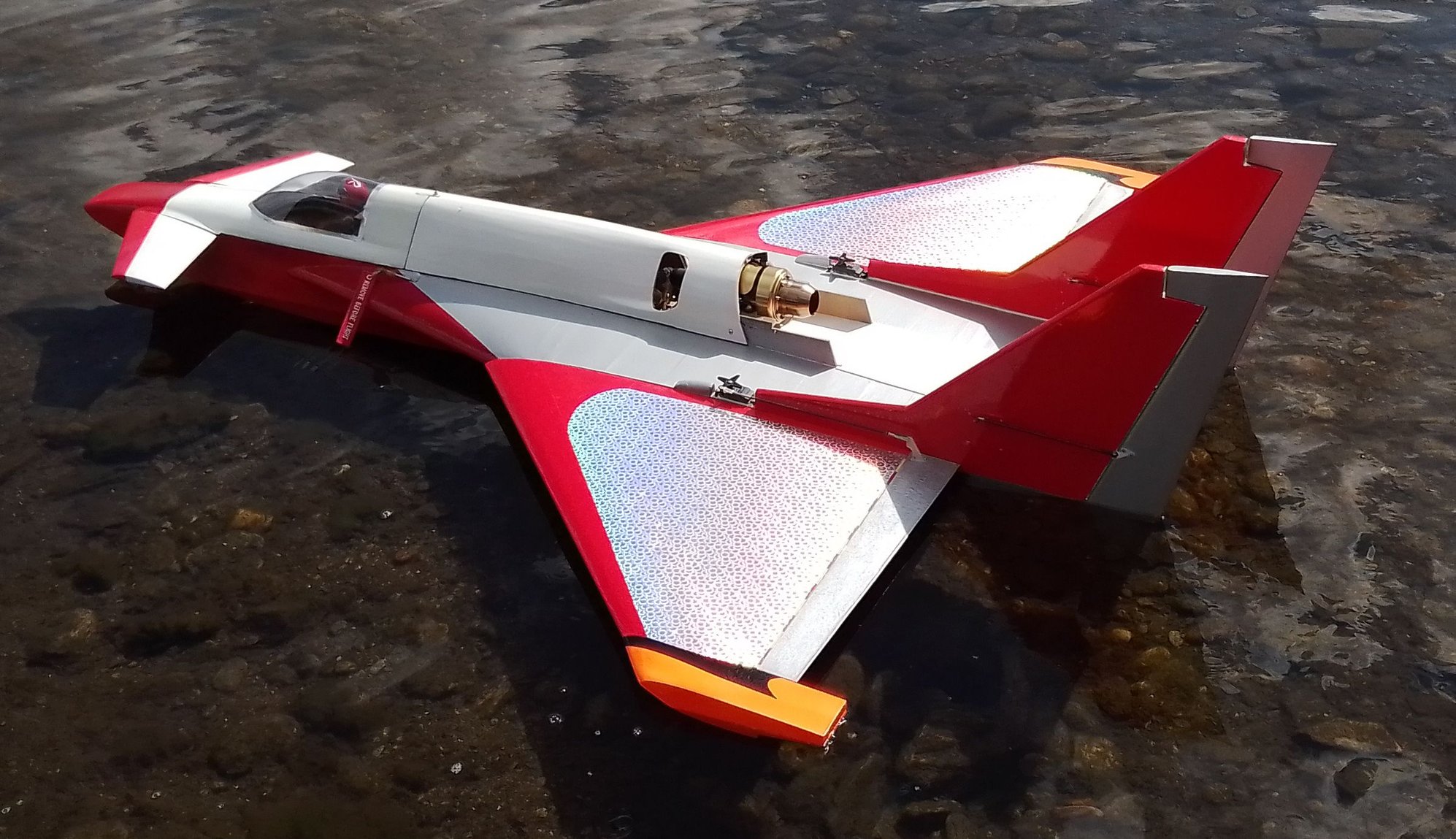
Model flew really well, and I had just settled on my ideal CG position when the tree got it.
Finished the model this year (slow builder) and it flew well. My problem is that on every landing, and sometimes just on a low slow pass, the engine would quit. Deadstick landing, retrieved by rescue boat, no problem really. But why does the engine quit when pulled back to idle every single time?
Yes, I tried increasing the idle revs from 55 to 60k. I tried increasing the deceleration delay by 4, then another 4. It would never do it on land when I tested it, no matter how sharp I was with the throttle. It only happened on landing, or low slow passes with throttle closed, even when still airborne (so not a water splash).
The only "different" thing about this model was that, since it was a flying boat, the tank vent could not be the usual nipple on the fuselage floor, it stuck out forwards, like a pitot tube or a refueling probe. I wondered if the engine quit when pitot pressure applied to the vent reduced as speed bled off. I tried simulating that by applying pressure to the vent pipe (and the idle rpm increased sure enough) but when I released the vent over-pressure the engine settled to idle rpm quite nicely.
So, just out of interest, can anyone suggest why this was happening?
Just out of academic interest, as I removed my problem by hitting a tree on a low pass. But it might be nice to know if there is a next time.
Alasdair
That's the vent pipe just below the canopy/hatch rear corner.
Model flew really well, and I had just settled on my ideal CG position when the tree got it.
 09-19-2022 | 12:11 PM
#2
Thread Starter
By the way, I did get ONE flight with the engine running so that I could taxy back to shore, the flight before the tree got it.
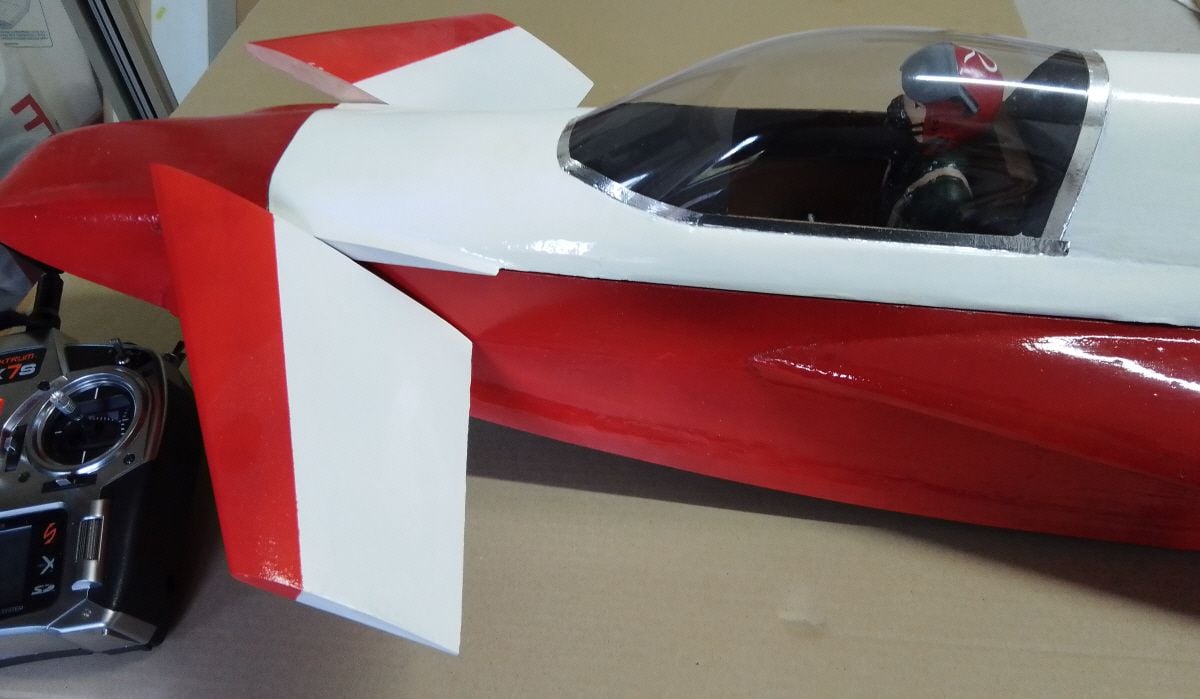
I flew the whole flight without ever closing the throttle completely. Even for the touchdown I kept a trickle of power on, and used the airbrake to get it down (photo of airbrake deployed).
The canard (foreplane) is flicked up to a totally stalled angle and the drag gives a nice descent angle even with a trickle of power on. Works a treat.
Alasdair
I flew the whole flight without ever closing the throttle completely. Even for the touchdown I kept a trickle of power on, and used the airbrake to get it down (photo of airbrake deployed).
The canard (foreplane) is flicked up to a totally stalled angle and the drag gives a nice descent angle even with a trickle of power on. Works a treat.
Alasdair
09-19-2022 | 12:28 PM
#3


Hi Alasdair,
Given your vent is fairly close to the wing leading edge and also close to the wing root/fuselage junction I wouldn’t be surprised if the turbulent air in this region was leading to pressure variations in the vent. These are just as likely to be negative as positive. Also on a low pass or landing you are likely to be flying with the wing at a higher angle of attack which again could change the turbulence in the vicinity of the vent. Given that you have already proved that pressure variations in the vent affect the ECU’s ability to control the idle Im fairly certain this is what’s happening.
If the tree hadn’t severely modified the aeroplane I’d have suggested adding a U bend to the vent so it was facing backwards. This would be much less likely to see pressure changes even if the effect is to reduce the pressure in the vent.
Hopefully, you will build another and take less time to do it!
Malcolm
Given your vent is fairly close to the wing leading edge and also close to the wing root/fuselage junction I wouldn’t be surprised if the turbulent air in this region was leading to pressure variations in the vent. These are just as likely to be negative as positive. Also on a low pass or landing you are likely to be flying with the wing at a higher angle of attack which again could change the turbulence in the vicinity of the vent. Given that you have already proved that pressure variations in the vent affect the ECU’s ability to control the idle Im fairly certain this is what’s happening.
If the tree hadn’t severely modified the aeroplane I’d have suggested adding a U bend to the vent so it was facing backwards. This would be much less likely to see pressure changes even if the effect is to reduce the pressure in the vent.
Hopefully, you will build another and take less time to do it!
Malcolm


 09-20-2022 | 10:19 AM
#8
Thread Starter
Well, this IS a new pump. The engine and all ancillaries lay new-in-box from 2007 until spring this year. And the problem started on flight one and has persisted.
I wondered if maybe the pump was too new, and would settle in. But after several flights the problem was still there.
If it's a faulty pump, why doesn't it do it on ground runs? It quits only in the air and with throttle closed. It will idle as long as you like on the ground.
Anyone think a squirt of WD40 in the pump would help?
I wondered if maybe the pump was too new, and would settle in. But after several flights the problem was still there.
If it's a faulty pump, why doesn't it do it on ground runs? It quits only in the air and with throttle closed. It will idle as long as you like on the ground.
Anyone think a squirt of WD40 in the pump would help?
09-20-2022 | 11:49 PM
#10


Alisdair, , my take during coffee time!
If it happens ONLY in the air then the difference is ram pressure in the intake ( P1 in RR terminology) in flight.
Perhaps that ram rise is resulting in too much air for the fuel being supplied when idle is selected and low fuel delivery is demanded causing too “lean” mixture and flameout.
As you know, fullsize engines have AFRCUs to manage this, we don,t.
My only suggestion is to arrange a slow function, via your transmitter, on throttle for the last quarter or so of the rpm range, a bit like the flight idle setup on the JT 8 on the 737 when in landing config.
Anyway , good luck with finding the problem !
PS of course you could arrange a spill door to open to dump excess air in the intake at low rpm, works on Concorde !
Coffee finished !
If it happens ONLY in the air then the difference is ram pressure in the intake ( P1 in RR terminology) in flight.
Perhaps that ram rise is resulting in too much air for the fuel being supplied when idle is selected and low fuel delivery is demanded causing too “lean” mixture and flameout.
As you know, fullsize engines have AFRCUs to manage this, we don,t.
My only suggestion is to arrange a slow function, via your transmitter, on throttle for the last quarter or so of the rpm range, a bit like the flight idle setup on the JT 8 on the 737 when in landing config.
Anyway , good luck with finding the problem !
PS of course you could arrange a spill door to open to dump excess air in the intake at low rpm, works on Concorde !
Coffee finished !
09-21-2022 | 01:26 AM
#11
Thread Starter
09-21-2022 | 02:17 AM
#12
Thread Starter
Alisdair, , my take during coffee time!
If it happens ONLY in the air then the difference is ram pressure in the intake ( P1 in RR terminology) in flight.
Perhaps that ram rise is resulting in too much air for the fuel being supplied when idle is selected and low fuel delivery is demanded causing too “lean” mixture and flameout.
As you know, fullsize engines have AFRCUs to manage this, we don,t.
My only suggestion is to arrange a slow function, via your transmitter, on throttle for the last quarter or so of the rpm range, a bit like the flight idle setup on the JT 8 on the 737 when in landing config.
Anyway , good luck with finding the problem !
PS of course you could arrange a spill door to open to dump excess air in the intake at low rpm, works on Concorde !
Coffee finished !
If it happens ONLY in the air then the difference is ram pressure in the intake ( P1 in RR terminology) in flight.
Perhaps that ram rise is resulting in too much air for the fuel being supplied when idle is selected and low fuel delivery is demanded causing too “lean” mixture and flameout.
As you know, fullsize engines have AFRCUs to manage this, we don,t.
My only suggestion is to arrange a slow function, via your transmitter, on throttle for the last quarter or so of the rpm range, a bit like the flight idle setup on the JT 8 on the 737 when in landing config.
Anyway , good luck with finding the problem !
PS of course you could arrange a spill door to open to dump excess air in the intake at low rpm, works on Concorde !
Coffee finished !
I take you point about full size practice, but they are squeezing the boundaries of what is possible to eek out another half percent of efficiency.
Model jets are more like the old Nene or Derwent.
But, it is LACK of ram air that seems to be the problem. I don't think my intake configuration is much different to most other model jets. It is neither full-on ram air intake nor convoluted suck-it from where you can. It should act like any other model turbine.
09-21-2022 | 08:47 AM
#13

Immediately after the shutdown have you tried a start on the ground? If it does run try tipping the plane fore or aft to mimic your landing attitude to eliminate a fuel tank issue.
09-21-2022 | 03:38 PM
#14
It sounds like the UAT is under a lot of suction due to restriction in the fuel system (it includes everything ... from the vent all the way to the pump suction nipple).
When you cut the power and the pump voltage drops, the pump may not be able continue sucking fuel at that voltage for a short period of time ... until the pressure from the vent builds up again in the system.
In my experience, rigid UAT's are much more susceptible to cause your issue.
If your UAT isn't rigid, check how much it collapses at high power. That will give you an indication of the amount of restriction.
Jack
When you cut the power and the pump voltage drops, the pump may not be able continue sucking fuel at that voltage for a short period of time ... until the pressure from the vent builds up again in the system.
In my experience, rigid UAT's are much more susceptible to cause your issue.
If your UAT isn't rigid, check how much it collapses at high power. That will give you an indication of the amount of restriction.
Jack
09-22-2022 | 03:15 PM
#15
Thread Starter
Yes, it started up right away, no problem with the model in a level attitude, just like when it flamed out.
09-22-2022 | 03:24 PM
#16
Thread Starter
It sounds like the UAT is under a lot of suction due to restriction in the fuel system (it includes everything ... from the vent all the way to the pump suction nipple).
When you cut the power and the pump voltage drops, the pump may not be able continue sucking fuel at that voltage for a short period of time ... until the pressure from the vent builds up again in the system.
In my experience, rigid UAT's are much more susceptible to cause your issue.
If your UAT isn't rigid, check how much it collapses at high power. That will give you an indication of the amount of restriction.
Jack
When you cut the power and the pump voltage drops, the pump may not be able continue sucking fuel at that voltage for a short period of time ... until the pressure from the vent builds up again in the system.
In my experience, rigid UAT's are much more susceptible to cause your issue.
If your UAT isn't rigid, check how much it collapses at high power. That will give you an indication of the amount of restriction.
Jack
If the vent were restricted, and the engine on power were sucking in the header tank and main tank, then when closing the throttle I would get that result, flameout. Now that you mention it, that happened on another model once when I forgot to remove the bung on the vent pipe.
The time it didn't happen on this seaplane was the second last flight when I very very slowly reduced power, and landed with just a trickle of power, and airbrake deployed.
However it didn't happen when I tried to reproduce the fault on the ground, even snapping the throttle shut from high power.
But still, I'll check the vent.
Thanks,
Alasdair
09-22-2022 | 04:19 PM
#17
Yes Jack, that's a possibility. And yet it happened only when airborne.
If the vent were restricted, and the engine on power were sucking in the header tank and main tank, then when closing the throttle I would get that result, flameout. Now that you mention it, that happened on another model once when I forgot to remove the bung on the vent pipe.
The time it didn't happen on this seaplane was the second last flight when I very very slowly reduced power, and landed with just a trickle of power, and airbrake deployed.
However it didn't happen when I tried to reproduce the fault on the ground, even snapping the throttle shut from high power.
But still, I'll check the vent.
Thanks,
Alasdair
If the vent were restricted, and the engine on power were sucking in the header tank and main tank, then when closing the throttle I would get that result, flameout. Now that you mention it, that happened on another model once when I forgot to remove the bung on the vent pipe.
The time it didn't happen on this seaplane was the second last flight when I very very slowly reduced power, and landed with just a trickle of power, and airbrake deployed.
However it didn't happen when I tried to reproduce the fault on the ground, even snapping the throttle shut from high power.
But still, I'll check the vent.
Thanks,
Alasdair
Alasdair, I didn't point out specifically the vent as the source of the restriction . I meant that the restriction could be anywhere between the vent and the pump.
It is a system made by components connected in series; so, the restriction can be anywhere (or everywhere
 )
)The amount of collapse of the UAT will give you an indication of how much flow resistance you have.
Jack
09-22-2022 | 04:45 PM
#18
One of the reasons why sometimes you can't replicate on the ground the flame out after rapidly cutting the power, is due to the fact that while flying the engine is receiving ram air. As a consequence, the fuel to air ratio required for combustion becomes even more precarious.
Again: very low pressure in the UAT .... pump goes back to the calibrated (at a higher pressure) idle voltage when cutting the power ... pump flow unable to reach the stoichiometric amount needed for combustion (ram air making the situation worse).
Solution: reduce the system fuel flow resistance.
Jack
Again: very low pressure in the UAT .... pump goes back to the calibrated (at a higher pressure) idle voltage when cutting the power ... pump flow unable to reach the stoichiometric amount needed for combustion (ram air making the situation worse).
Solution: reduce the system fuel flow resistance.
Jack
09-23-2022 | 02:16 AM
#19
Thread Starter
One of the reasons why sometimes you can't replicate on the ground the flame out after rapidly cutting the power, is due to the fact that while flying the engine is receiving ram air. As a consequence, the fuel to air ratio required for combustion becomes even more precarious.
Again: very low pressure in the UAT .... pump goes back to the calibrated (at a higher pressure) idle voltage when cutting the power ... pump flow unable to reach the stoichiometric amount needed for combustion (ram air making the situation worse).
Solution: reduce the system fuel flow resistance.
Jack
Again: very low pressure in the UAT .... pump goes back to the calibrated (at a higher pressure) idle voltage when cutting the power ... pump flow unable to reach the stoichiometric amount needed for combustion (ram air making the situation worse).
Solution: reduce the system fuel flow resistance.
Jack
When I build another model suitable for that engine I will keep your words in mind when setting up the fuel system.
Thanks,
Alasdair


