


P-51A build
 12-24-2007 | 01:55 PM
#1
Thread Starter
Member
My Feedback: (70)
Joined: Oct 2004
Posts: 98
Likes: 0
Received 0 Likes
on
0 Posts
From: Port Isabel,
TX
 P-51A build
Hey Guys,
I'm building the P-51A "Polar Bear" and I thought you'd enjoy seeing the plans and progress. The P-51A is so seldom modelled or seen and it's really different, in many respects to the "B" model. It's got a fully articulated pilot, (Hand moves with the stick/controls) and a full cockpit. The bulkheads are corrugated composite construction and the skinning is aluminum over balsa/Mylar with all the panel lines/rivets, etc. (I wrote an article for MAN last year on these techniques called "Skinning RC Aircraft With Aluminum" which became a two-part online article.) It's amazing how realistic yet light this type of construction is. If anyone's built an "A", or has one, let's see some photos.
Any comments or snide remarks are gladly accepted
Hope you enjoy!
I'm building the P-51A "Polar Bear" and I thought you'd enjoy seeing the plans and progress. The P-51A is so seldom modelled or seen and it's really different, in many respects to the "B" model. It's got a fully articulated pilot, (Hand moves with the stick/controls) and a full cockpit. The bulkheads are corrugated composite construction and the skinning is aluminum over balsa/Mylar with all the panel lines/rivets, etc. (I wrote an article for MAN last year on these techniques called "Skinning RC Aircraft With Aluminum" which became a two-part online article.) It's amazing how realistic yet light this type of construction is. If anyone's built an "A", or has one, let's see some photos.
Any comments or snide remarks are gladly accepted
Hope you enjoy!
 12-25-2007 | 01:05 PM
#4
Thread Starter
Member
My Feedback: (70)
Joined: Oct 2004
Posts: 98
Likes: 0
Received 0 Likes
on
0 Posts
From: Port Isabel,
TX
RE: P-51A build
Tim,
Awesome airplanes! I'd like to know which plans/kits they were from as they're some of the best "A" 's I've ever seen. I was thinking about putting some 500 lb.'ers on mine but I've already gone way over the line (Yes, I need a life!)
Mine began life as a desire to build a "throw in the car, go fly cheap" aircraft but it's evolved into such a detailled, extraordinary ship that I'd fly it, maybe, once a year for fear of dumb thumbing it. "Gravity always wins, it's just a matter of when"
I'm enclosing some pics in progress. The static, struts/wheels are hand-made of balsa with the outer rims Dremelled beer can bottoms. The doors are of aluminum inside and out and the links made from styrene. (No! I'll never do that again!) The mains as well as tail gear/doors assembly come off for flight with pop in doors for where the main strut covers go. So far she weighs 14.5 oz. w/all aboard but I'm shooting for 16 oz., once "aluminized", for a wing loading of around 10.75 oz./sq.ft. We'll see?! It's got an .049 mounted but I've got a .10 that's dying to go in her. With Mylar, (32,000 psi tensile strength), she's stout!
"Charlie" was to be the subject of an article for MAN on building fully articulated pilots and connecting controls to the throttle, stick and rudder pedals. He's carved from foam, jointed with thread and dressed in Saran Wrap which gives it the scale wrinkles.
Awesome airplanes! I'd like to know which plans/kits they were from as they're some of the best "A" 's I've ever seen. I was thinking about putting some 500 lb.'ers on mine but I've already gone way over the line
(Yes, I need a life!)Mine began life as a desire to build a "throw in the car, go fly cheap" aircraft but it's evolved into such a detailled, extraordinary ship that I'd fly it, maybe, once a year for fear of dumb thumbing it. "Gravity always wins, it's just a matter of when"
I'm enclosing some pics in progress. The static, struts/wheels are hand-made of balsa with the outer rims Dremelled beer can bottoms. The doors are of aluminum inside and out and the links made from styrene. (No! I'll never do that again!) The mains as well as tail gear/doors assembly come off for flight with pop in doors for where the main strut covers go. So far she weighs 14.5 oz. w/all aboard but I'm shooting for 16 oz., once "aluminized", for a wing loading of around 10.75 oz./sq.ft. We'll see?! It's got an .049 mounted but I've got a .10 that's dying to go in her. With Mylar, (32,000 psi tensile strength), she's stout!
"Charlie" was to be the subject of an article for MAN on building fully articulated pilots and connecting controls to the throttle, stick and rudder pedals. He's carved from foam, jointed with thread and dressed in Saran Wrap which gives it the scale wrinkles.
12-28-2007 | 12:31 AM
#5
Thread Starter
Member
My Feedback: (70)
Joined: Oct 2004
Posts: 98
Likes: 0
Received 0 Likes
on
0 Posts
From: Port Isabel,
TX
RE: P-51A build
Hey, it's not as big as yours but the detailing reflects my MADNESS!
Here's pics of the stbd. wing covering and the static tailwheel.
Here's pics of the stbd. wing covering and the static tailwheel.
12-29-2007 | 02:45 AM
#6
 RE: P-51A build
ORIGINAL: themadmax
Hey Guys,
I'm building the P-51A "Polar Bear" and I thought you'd enjoy seeing the plans and progress. The P-51A is so seldom modelled or seen and it's really different, in many respects to the "B" model. It's got a fully articulated pilot, (Hand moves with the stick/controls) and a full cockpit. The bulkheads are corrugated composite construction and the skinning is aluminum over balsa/Mylar with all the panel lines/rivets, etc. (I wrote an article for MAN last year on these techniques called "Skinning RC Aircraft With Aluminum" which became a two-part online article.) It's amazing how realistic yet light this type of construction is. If anyone's built an "A", or has one, let's see some photos.
Any comments or snide remarks are gladly accepted
Hope you enjoy!
Hey Guys,
I'm building the P-51A "Polar Bear" and I thought you'd enjoy seeing the plans and progress. The P-51A is so seldom modelled or seen and it's really different, in many respects to the "B" model. It's got a fully articulated pilot, (Hand moves with the stick/controls) and a full cockpit. The bulkheads are corrugated composite construction and the skinning is aluminum over balsa/Mylar with all the panel lines/rivets, etc. (I wrote an article for MAN last year on these techniques called "Skinning RC Aircraft With Aluminum" which became a two-part online article.) It's amazing how realistic yet light this type of construction is. If anyone's built an "A", or has one, let's see some photos.
Any comments or snide remarks are gladly accepted
Hope you enjoy!
Good luck with your project. I hope you know that "Polar Bear" is not a true "A" model, but a mix of A, B C and D model parts. So I call it a P-51ABCD In reality, the only thing on her that looks like an "A" model is the firewall forward.
12-29-2007 | 08:11 PM
#7


My Feedback: (11)
RE: P-51A build
Im glad to see someone puts some effort in detailing small planes too. These planes came fom the idea to make nice every day fun flying scale planes at about 40 to 60 size but in an 1/8 scale format so when you have a p 47 next to mustang you can see the true size difference. These are and were drawn with my friend Mark they fly great. We had hoped on making kits from them but there are many obstcals in doing so. we have been working on bearcats as of now to be as scale as we can get them for the average modeler. keep up the good work. Tim
12-30-2007 | 12:25 AM
#11
Thread Starter
Member
My Feedback: (70)
Joined: Oct 2004
Posts: 98
Likes: 0
Received 0 Likes
on
0 Posts
From: Port Isabel,
TX
RE: P-51A build
Hey Warbird51!
You're pretty sharp! Not many P-51A officianados know that. You're correct...the full scale "Polar Bear" is a conglomerate of "A","B", and "D" parts. (As a P-51 officianado you know the only difference between the "B" and "C" variants were their place of manufacture.) To really get an A+, can you tell us some of the most significant differences between the "A" and "B" variants?
I love to learn...keeps me humble.
You're pretty sharp! Not many P-51A officianados know that. You're correct...the full scale "Polar Bear" is a conglomerate of "A","B", and "D" parts. (As a P-51 officianado you know the only difference between the "B" and "C" variants were their place of manufacture.) To really get an A+, can you tell us some of the most significant differences between the "A" and "B" variants?
I love to learn...keeps me humble.
12-30-2007 | 12:39 AM
#13
Thread Starter
Member
My Feedback: (70)
Joined: Oct 2004
Posts: 98
Likes: 0
Received 0 Likes
on
0 Posts
From: Port Isabel,
TX
RE: P-51A build
YOU GUYS ROCK!!!
I agree with you on the obstacles of kitting. However, I believe if an idea's time has come...you can't stop it. Your concept is valid.
I'm curious, do the inner doors on your P-51's cycle (Per full scale) and what type of engineering went into that?
(Incidentally, for the uninformed, the "A" variant inner doors locked in the up position when finishing cycling and the flaps/inner doors didn't droop from oil pressure drop as they did on all later variants.) Many modellers miss that small, albeit very important, static detail.
I agree with you on the obstacles of kitting. However, I believe if an idea's time has come...you can't stop it. Your concept is valid.
I'm curious, do the inner doors on your P-51's cycle (Per full scale) and what type of engineering went into that?
(Incidentally, for the uninformed, the "A" variant inner doors locked in the up position when finishing cycling and the flaps/inner doors didn't droop from oil pressure drop as they did on all later variants.) Many modellers miss that small, albeit very important, static detail.
12-30-2007 | 01:20 PM
#14
RE: P-51A build
themadmax,
Of course the major difference is the Merlin replaced the Allison in the B and C. The C was built in Dallas and the B was in So. Cal. The fuselage was deepened to accept the larger radiator that the Merlin required. I do believe the fuselage is also deepend as well in the cockpit area as well. When the D was introduced the wing was thickened to allow the 50 cal machine guns to be mounted apright to rectify the jamming problem that the B and C had and go to 3 guns per wing side.
I have an old red box P-51B that's framed up in the garage that's been converted to an "A" model. I need to get it in line to finish it. I also have a VL ARC kit of a 1/7 P-51B/C that has a Malcom hood canopy. That's another one to do.
Of course the major difference is the Merlin replaced the Allison in the B and C. The C was built in Dallas and the B was in So. Cal. The fuselage was deepened to accept the larger radiator that the Merlin required. I do believe the fuselage is also deepend as well in the cockpit area as well. When the D was introduced the wing was thickened to allow the 50 cal machine guns to be mounted apright to rectify the jamming problem that the B and C had and go to 3 guns per wing side.
I have an old red box P-51B that's framed up in the garage that's been converted to an "A" model. I need to get it in line to finish it. I also have a VL ARC kit of a 1/7 P-51B/C that has a Malcom hood canopy. That's another one to do.
12-30-2007 | 07:00 PM
#15
My Feedback: (60)
RE: P-51A build
When the D was introduced the wing was thickened to allow the 50 cal machine guns to be mounted apright to rectify the jamming problem that the B and C had and go to 3 guns per wing side.
The leading edge extension was increased on the D wing and the inner gear doors are slightly different as well as the revised armament to round out the changes to the wing.
12-30-2007 | 07:58 PM
#16
Thread Starter
Member
My Feedback: (70)
Joined: Oct 2004
Posts: 98
Likes: 0
Received 0 Likes
on
0 Posts
From: Port Isabel,
TX
RE: P-51A build
Warbird51,
You get a B- on this pop quizzy You're correct on the firewall forward area and the depth of the "belly" line to accommodate a larger radiator. The wing, however, remained the same airfoil/structure from the NA-73X until the "H" variant. What changed was the leading edge extension to conform to the different inner door shape of the "B" variant. The ony other significant visual change was the scoop shape. (See attached.) The cockpit was the same dimensions from the NA-73X through to the "H" model which was so significantly different that it's definitely the b------ child of the P-51 lineage, in my humble opinion.
You get a B- on this pop quizzy
You're correct on the firewall forward area and the depth of the "belly" line to accommodate a larger radiator. The wing, however, remained the same airfoil/structure from the NA-73X until the "H" variant. What changed was the leading edge extension to conform to the different inner door shape of the "B" variant. The ony other significant visual change was the scoop shape. (See attached.) The cockpit was the same dimensions from the NA-73X through to the "H" model which was so significantly different that it's definitely the b------ child of the P-51 lineage, in my humble opinion.
12-30-2007 | 08:04 PM
#17
My Feedback: (101)
RE: P-51A build
OK guys , I have a Brian Taylor P51 B with the vertical stab extension. What is the story behind this model? The kit is pretty old and the fiberglass fuse is pretty heavy. It is a 60 size plane, Any interesting pics of thismodel out there?
12-30-2007 | 08:13 PM
#19
Thread Starter
Member
My Feedback: (70)
Joined: Oct 2004
Posts: 98
Likes: 0
Received 0 Likes
on
0 Posts
From: Port Isabel,
TX
RE: P-51A build
Ram-bro,
LET'S SEE IT! No fair talking about a kit that sounds that good without showing us a pic.
The later model "B" and "C"'s had these ventral fin extensions but I'm not sure what year that started doing that. My old memory says sometime late '44.
LET'S SEE IT! No fair talking about a kit that sounds that good without showing us a pic.
The later model "B" and "C"'s had these ventral fin extensions but I'm not sure what year that started doing that. My old memory says sometime late '44.
12-30-2007 | 08:57 PM
#20
My Feedback: (11)
RE: P-51A build
inner gear doors are activated manually with seperate chanel on my 10 x with a speed delay. the A model was 4" thiner in fusalage height and had fabric coverd tail control surfaces much stream lined belly scoop. (shown on pic) ( fiberglass door layup)
 e pic of the P51B with the vert stab extension. hey dont I get any grade for my trivial pursuit answers
12-30-2007 | 10:54 PM
e pic of the P51B with the vert stab extension. hey dont I get any grade for my trivial pursuit answers
12-30-2007 | 10:54 PM
#22
My Feedback: (60)
RE: P-51A build
ORIGINAL: themadmax
Chad,
You get an A- the inner doors and LEX's were changed after the "A" model.
Chad,
You get an A-
the inner doors and LEX's were changed after the "A" model.
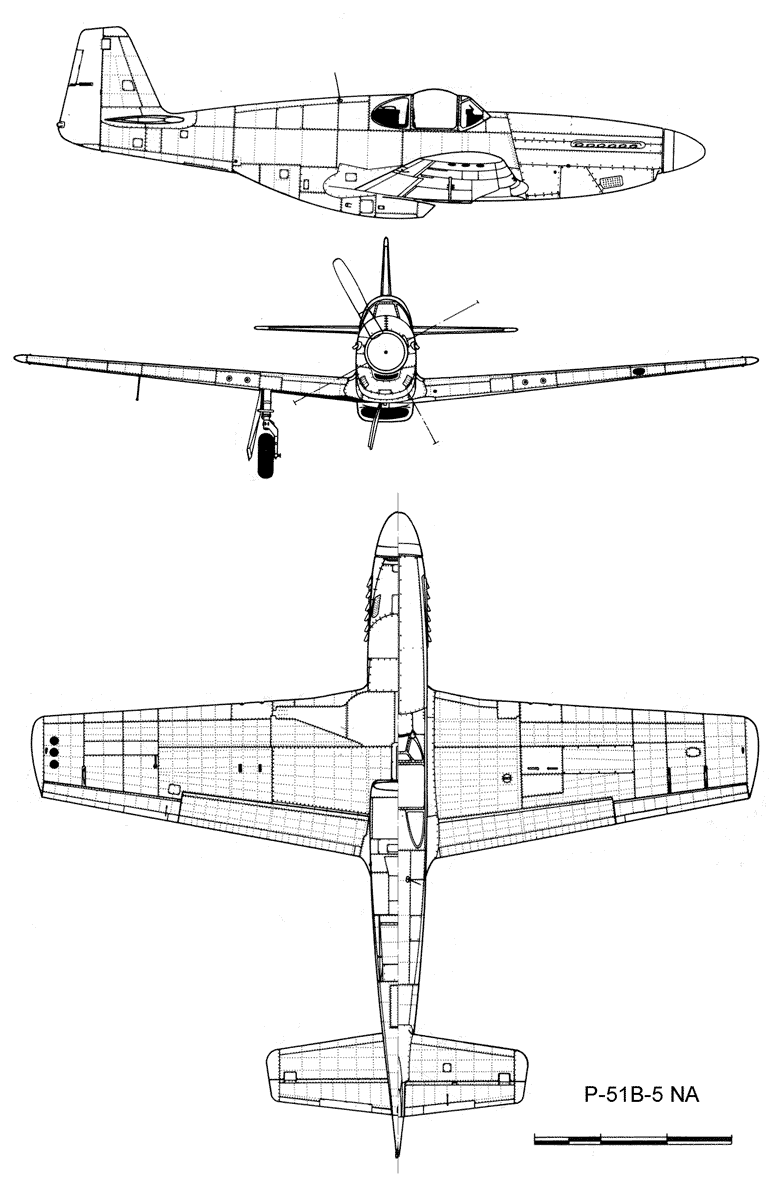
Sorry madmax, you get a C+ because the doors remained the same on the B/C and did not change until the D model Mustang. The Squadron Signal 3-views you posted are notoriously wrong in that respect!
 12-31-2007 | 12:55 AM
#23
RE: P-51A build
The dorsal fin you are refering to was an addition to the early D models to correct the loss of stability when the rear fuselage was cut down for the bubble canopy. Some B's and C's were retrofitted in the field with the dorsal fin. That's why you see some with the modification. BTW, the razorback B and C were faster than the D because of that. Apparently the B and C had less drag with the turtledeck.
12-31-2007 | 03:25 PM
#25
Thread Starter
Member
My Feedback: (70)
Joined: Oct 2004
Posts: 98
Likes: 0
Received 0 Likes
on
0 Posts
From: Port Isabel,
TX
RE: P-51A build
Chad,
You may want to reassess my grade Sometimes your sources should be questioned. According to my sources, the B doors were changed because the area at the leading edge of the inner doors had to be deepened in order to properly meet the deeper sheet metal of the Merlin engine's installation. (That's also the reason the LEX were changed.) Notice on the attached photos where the leading edge intersects the fuse. on the XP-51...also notice where the leading edge appears to "break" downward, relative to the gear leg. The "B" wing breaks immediately inboard of the main strut and angles more downward. Now look at the depth difference of the fuselages where the leading edges intersect the fuselages. (A Picture's worth a 1,000 words.)
Learning's a wonderful experience, isn' it?
You may want to reassess my grade
Sometimes your sources should be questioned. According to my sources, the B doors were changed because the area at the leading edge of the inner doors had to be deepened in order to properly meet the deeper sheet metal of the Merlin engine's installation. (That's also the reason the LEX were changed.) Notice on the attached photos where the leading edge intersects the fuse. on the XP-51...also notice where the leading edge appears to "break" downward, relative to the gear leg. The "B" wing breaks immediately inboard of the main strut and angles more downward. Now look at the depth difference of the fuselages where the leading edges intersect the fuselages. (A Picture's worth a 1,000 words.)Learning's a wonderful experience, isn' it?

