<span style="font-size: small">Here is a systematic and rigorous test of the Hacker motor:</span></p>
<u><span style="font-size: medium">MOTOR TEST:</span></u> <span style="font-size: medium">Hacker A30-12 L, </span>Kv 1000 Supplied by: West London Models Price £66.20 ( =$ 101.53)
<span style="font-size: xx-small">(-price is same all over Europe; in USA is much cheaper $66.99 -only 2/3 of price in Europe)</span></p>
Motor Weight:143g (Hacker data)
Rated Kv: 1000 (Hacker data)
Operating current: 40A; Max current: 50A; Max power: 500W; Internal resistance: 30 milliOhm; (Aeromodel / Hacker data)
External dimensions:diam 37mm, length 42.8mm (Hacker data)<span style="font-size: small">(-some same-size motors are called
“3742” on basis of external dimension)
</span>Stator size:diam 30mm, length 20mm <span style="font-size: small">(-some same-size motors are called
“3020”on basis of stator size)
</span>No. wire turns: 12 (12T); Stator arms: 12; Magnet poles: 14; Length of magnets: 20mm (i.e. same as stator length)
Shaft diam:5mm
X-Mount (black) weight: 5.1g; Prop adaptor (bolts to hub on rear housing) weight: 17.9g; Prop driver (collet-type which attaches round shaft) weight: 16.0g</p>
MANUFACTURED BY: SUNRAY TECHNOLOGY:
http://sunraytechnology.com/
Retailer / Re-seller website:
http://www.hacker-motor-shop.com/e-v...514&p=6514
&
https://www.aero-model.com/8_66_879/...-12L%20V2.html</p>
<span style="font-size: xx-small">Measuring equipment used: Eagle Tree V4 data logger with brushless RPM sensor and micro-thermistor temperature sensors (for measuring voltage, current, motor RPM and motor temperature); Additional optical tachometer; Additional infra-red thermometer. ABCON Digital scales for measuring thrust.
I used a GT-Power Watt Meter to check the current readings on the Eagle Tree data logger, especially for low currents <1A. A GT-Power Servo tester device was used to control a ZTW 70A S-BEC speed controller, which was connected to motor.
I used fully charged, 30C to 45C, 2S and 3S LiPo packs as the power source.
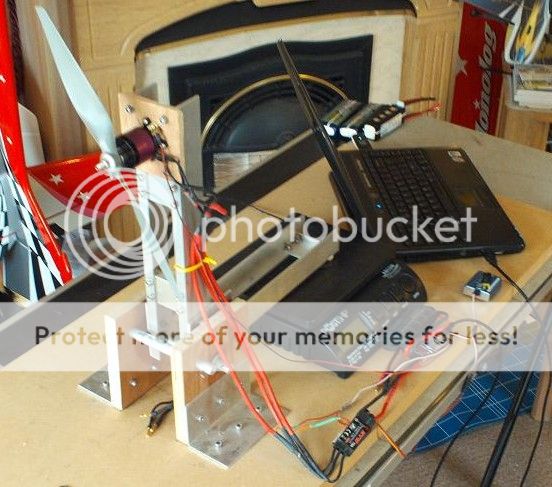
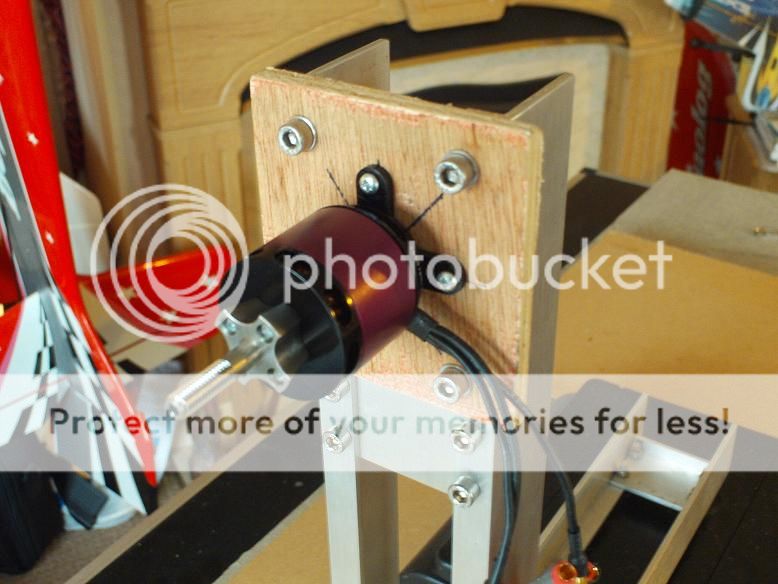
</span>On the Motor Thrust test stand used, the lower horizontal arm pushes on the scales to measure grams of thrust (see photo). The props are therefore mounted on motor so that thrust is generated in a direction away from motor and stand (i.e. with front face of prop facing the motor and test stand).</p>
Description of motor:
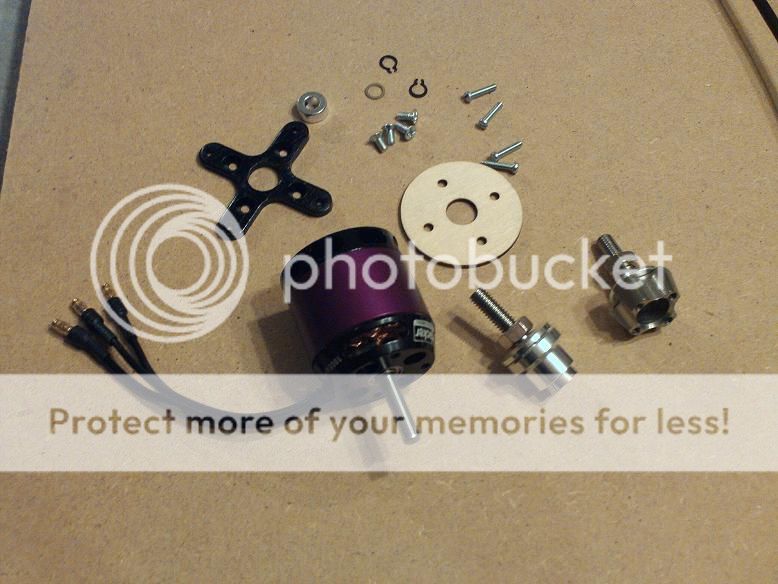
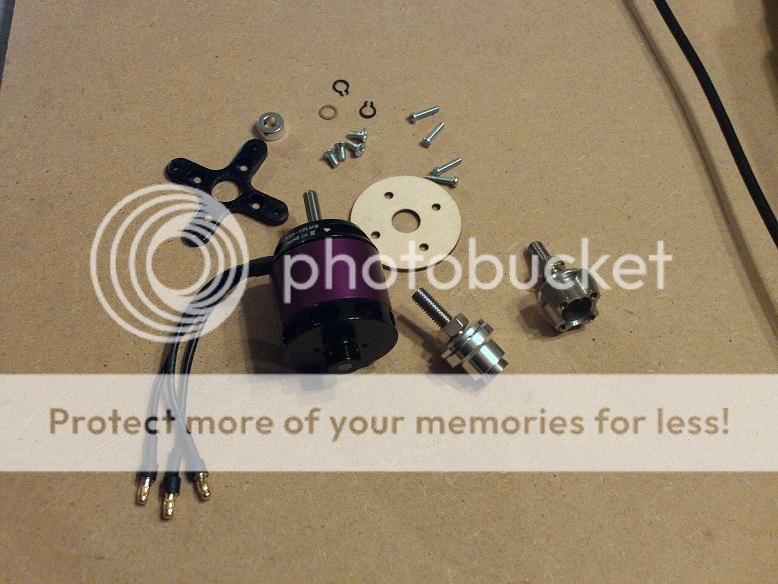
The Hacker A30-12 L motor, with wires and 3.5mm connectors, weighed 150.3g. The motor has a 12-arm stator (Retailer states: wound with 12 turns, 12T) and 14-magnet poles. Externally, it is 37mm diameter; the main motor body is 39mm long, and with the 11mm diam hub on the rear housing, it is a total of 49mm long (see pics). The supplied hub prop adaptor fixes around this rear hub with 4 small cross-head bolts (also supplied). The actual rotating can (i.e. the purple cylindrical part with magnets fixed to its internal face)is 22mm long, and the black rear motor housing extends backwards from this for 7mm. Motor came fitted with 3.5mm male connectors. The 4 mounting holes on what I will call the "front" motor housing are 3mm thread at 25mm centers (these are for fixing the X-mount). The motor has a 5mm shaft, of which 19mm protruded from the "front housing" and on which the supplied collet-type prop adapter can be fitted.
-One of the "give aways" of being a Sunray Technology-made motor is a brass washer and retaining black horse-shoe circlip on the shaft just outside the front housing -and of course this motor has this feature.</p>
Standard procedure:I mounted this motor using its black aluminium X-mount (which was bolted to the "front" motor housing) onto the 8mm plywood plate of my motor test stand (see photo). I bolted the supplied hub prop adaptor to the rear housing of the motor (this has a threaded 6mm shaft) -see pics.</p>
Standard Motor Test Procedure:
First, I ran no-loads at 11.1V (3S Li-Po) and at 14.8V (4S Li-Po), at full speed, and measured current (I), voltage (V) and RPM (no prop adaptor was attached).
I then ran 6 different props at full speed, in ascending order of size, using both 3S LiPo and 4S LiPo, and measured I, V, RPM and Thrust.
After charging the LiPo's back up again, I then ran the same 6 props, now in descending order of size, to check that the results were reproducible. The second run gave almost identical values. I wanted to get this completely right, with no errors -and so I actually made 4 runs in total; The results of each run were almost identical to each other.
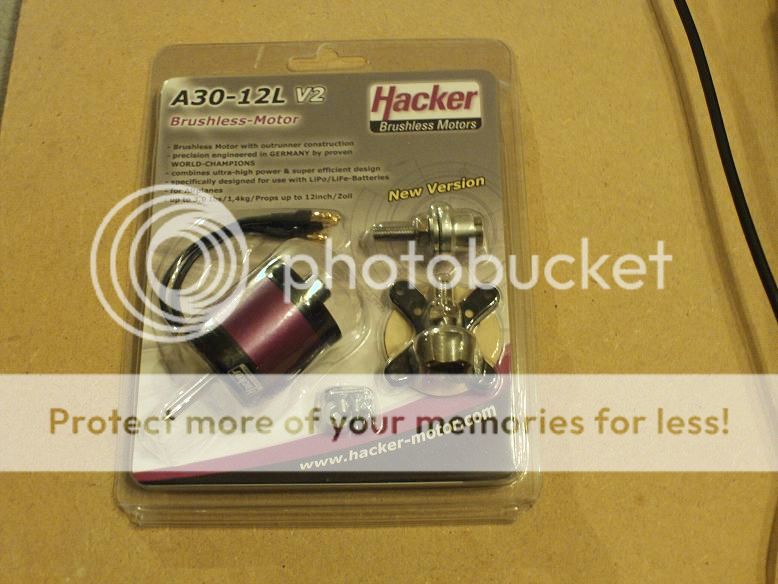
Pics show:1, Motor Thrust Test Stand used; 2, Hacker A30 motor packaging; 3, Hacker A30-12 L motor and accessories; 4, Hacker motor mounted on Test Stand; 5, Rear housing of Hacker A30 motor, showing hub and 4 mounting holes for hub prop adaptor 6, props used for this motor test

</p>