<span style="font-size: medium">Results: for Turnigy SK3 3542-1000Kv
</span>The Turnigy SK3 3542-1000Kv motor ran smoothly with all the props tested (even though current and power, in some cases, certainly exceeded the 45A / 670W max rating given by the retailer, HK).
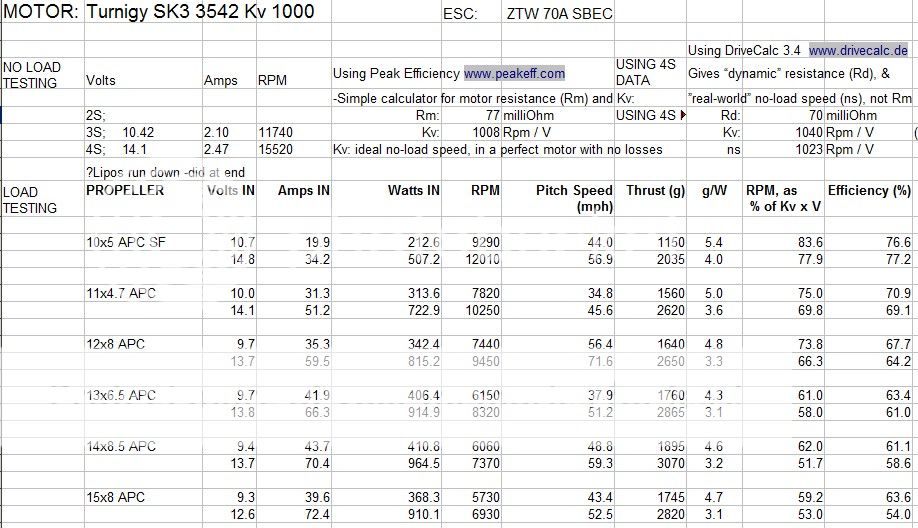
Results are shown on the attached data sheet.
-For each prop, the lower voltage reading is for 3S LiPo, and the higher one is for 4S LiPo as the voltage source.</p>
Kv: As before, I used both
www.peakeff.com and DriveCalc to calculate Kv, Rm ("static" motor resistance) and Rd ("dynamic" motor resistance).
-PeakEff gave a Kv of 1008; DriveCalc gave a Kv of 1040, and an ns of 1023 -all these values were very close indeed. PeakEff and DriveCalc gave values for Rm and Rd, of 77 and 70 milliohms respectively. These were also close.</p>
I am not going to describe the results of testing the Turnigy SK3 3542-1000K in any detail. There is just no point, because this Turnigy SK3 motor gave ALMOST IDENTICAL RESULTS to the Hacker A30-12 L motor. And I have already described the results for the Hacker motor (in posts #7, 8 & 9 of this thread).
Therefore, I am just going to focus on the great similarities, and also a few minor differences between these two motors:</p>
MOTOR PERFORMANCE ON THE TEST STAND:
a. If we compare the datasheets for the Turnigy SK3 3542-1000Kv and the Hacker A30-12 L motor, we can easily pick out some values for comparison:</p>
Current A) RPMThrust (g)
For the 10x5 prop with 3S LiPo:
Turnigy SK3: 19.9 9290 1150
Hacker: 20.9 9390 1190</p>
For the 11x4.7 prop with 4S LiPo:
Turnigy SK3: 51.2 10250 2620
Hacker: 51.5 10180 2650</p>
For the 12x8 prop with 4S LiPo:
Turnigy SK3: 59.5 9450 2650
Hacker: 61.4 9480 2760</p>
<span style="font-size: small"> -Very obviously, there is no need for us to go on; It is very clear that within the limits of experimental error, </span>
<span style="font-size: small">the performance of these two motors is is COMPLETELY IDENTICAL.
</span><span style="font-size: medium"> -For each prop tested, the current, input power, RPM and Thrust readings were almost identical for the two motors.
</span><span style="font-size: x-small">
</span></p>