Schweighofer Alpha Jet Project (Part 27)
Printing of the prototype undercarriage legs of the Alpha Jet.
MoLoTEC Modellbau und Elektronik, Markus Lützenburger
3D Printing is a technique to produce 3-dimensional items which are created in a CAD program in a fast and cheap way. The advantage of 3D printing is the possibility to create complex parts without building a mould and without having a lot of waste material.
The area of application is creating prototypes and small series. In the aviation and aerospace industry 3D printed parts are used in large numbers. For example in a F18 Hornet ou can find 86 laser sintered parts.
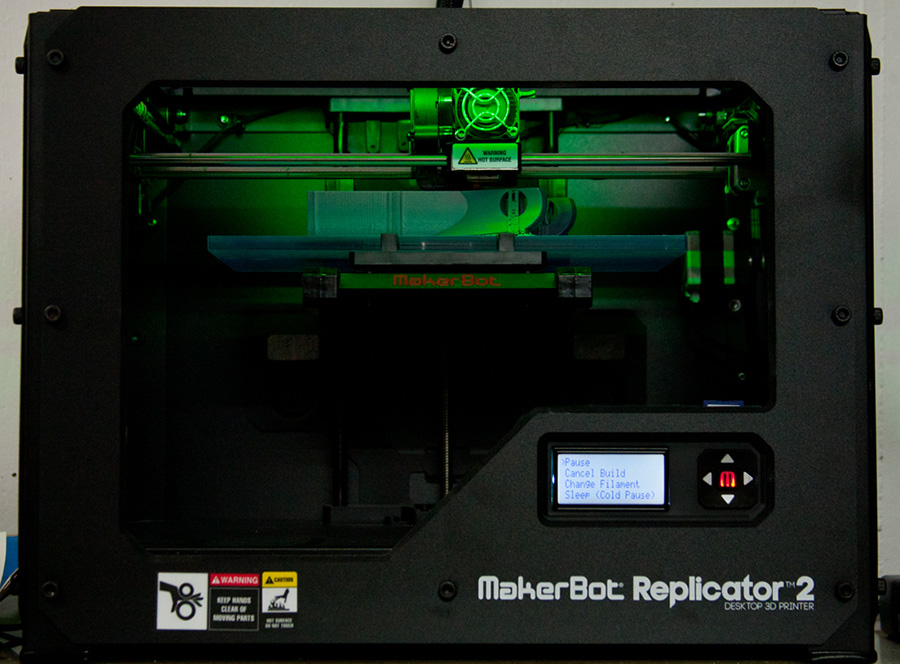
There are several different printing techniques. For example, stereolithography and laser sintering. The technique used here, Fused Deposition Modeling (FDM) based on the melting layers of a plastic material through an extruder nozzle. The material is supplied in the form of a wire from the top. The 3D printer model is the Replicator2 from MakerBot, USA. The material used is PLA (polylactide). A report based on lactic acid plastic with excellent features. PLA is also often referred to as bioplastics. The material has a very low moisture absorption, is very good UV resistant and has a high color fastness. Of the mechanical properties it resembles the PET and can stick well with superglue and epoxy resin.
To print an object at all you need a solid in file form. To create such a body 3D CAD drawing programs are required to spend the body in the STL file format and can export. Parts in STL format to be read and processed by the printer software.
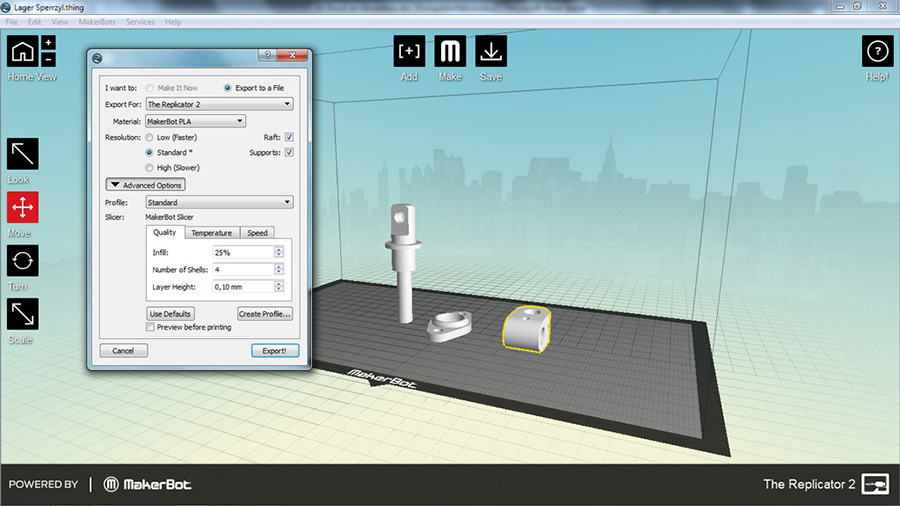
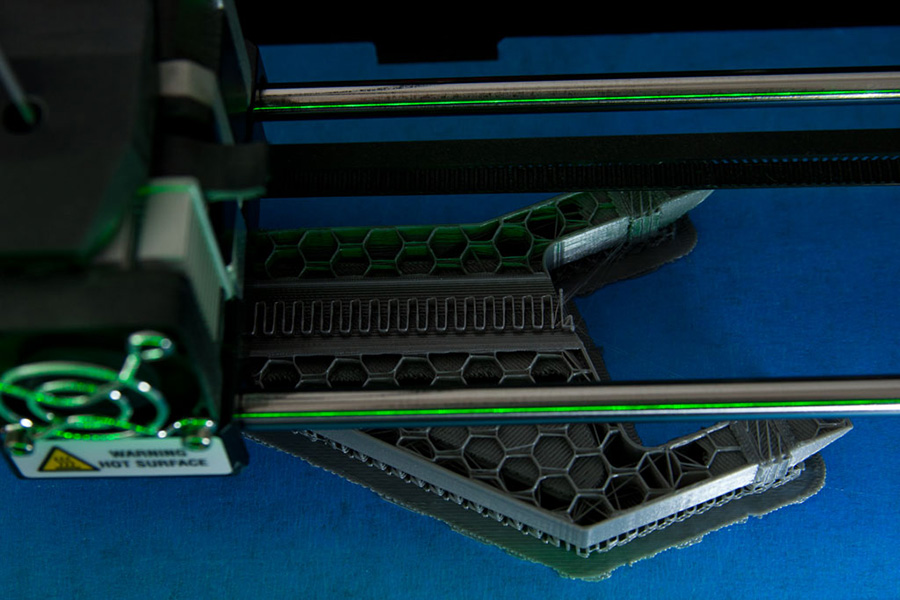
Since the 3D plotting printer material has to the body in the printer software will "cut slices" in the first place. This is also where the technical term. This software is called a slicer. Similarly, the CAM software generates the G codes for CNC milling machine as in milling, the slicer generates the codes for the printer. The maximum resolution or the lowest layer thickness is 0.01 mm for this printer. And filling the contour of the body is calculated in each slice layer. This is important for the 3D printer, because the body is not completely filled with material. This would unnecessarily consume a lot of material and increase the pressure times tremendously. The software calculates a "skin" and fill in the form of a honeycomb structure. The thickness of the "skin", and the density of the filling is set by the user.
Depending on the size of the part, intended use and required surface quality, the layer thicknesses are determined. Here was worked with a dissolution of the layer thickness of 0.3 mm. Of this very much depends on the pressure of time. The lower arm of the Alpha Jet landing gear needed 4 hours with a resolution of 0.3 mm. If you were this body print at a resolution of 0.1 mm, the pressure would increase duration to 12 hours. At the maximum resolution of 0.01 mm to 120 hours. In addition to the layer thickness or dissolution, the overall quality of the component nor the printer you are using, the exact extruder temperature and print speed is dependent. This must be set individually for each component and is usually based on previous experience.
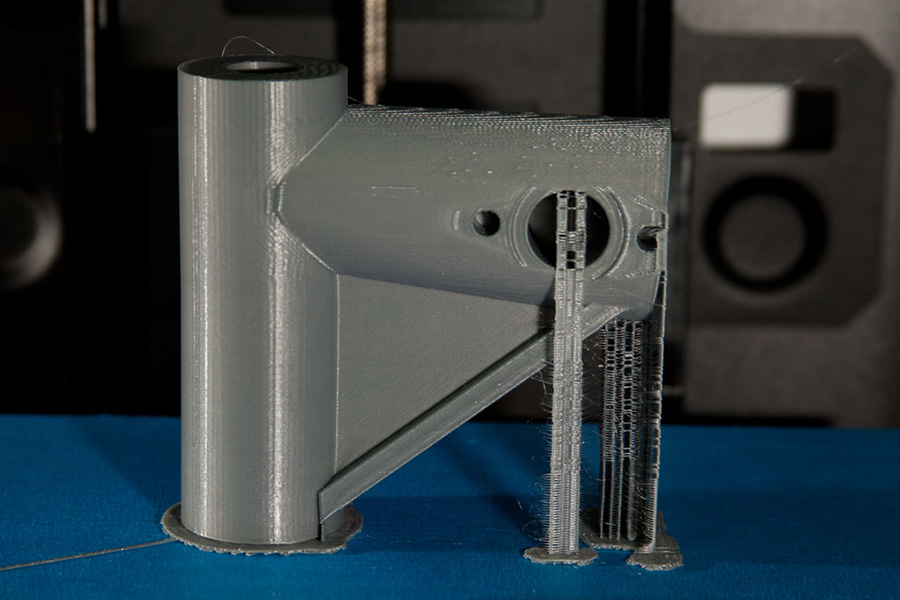
Since the 3D printer the body overhangs are built in layers only partially printable without support. From a certain angle of the sprayed plastic would only fall into the void. This can be explained Slicer a function name "Support". This support also be printed to support overhangs. These supports are like a skeleton and to be necessary if, for example within a body larger holes or openings are present. The exact position of the support is automatically set by the slicer. The plastic is sprayed so that the body is indeed supported, but the support can only slightly be liable and easy to remove.
Here, the supports are good to see. The inclined surface at the base could create even without support of the printer.
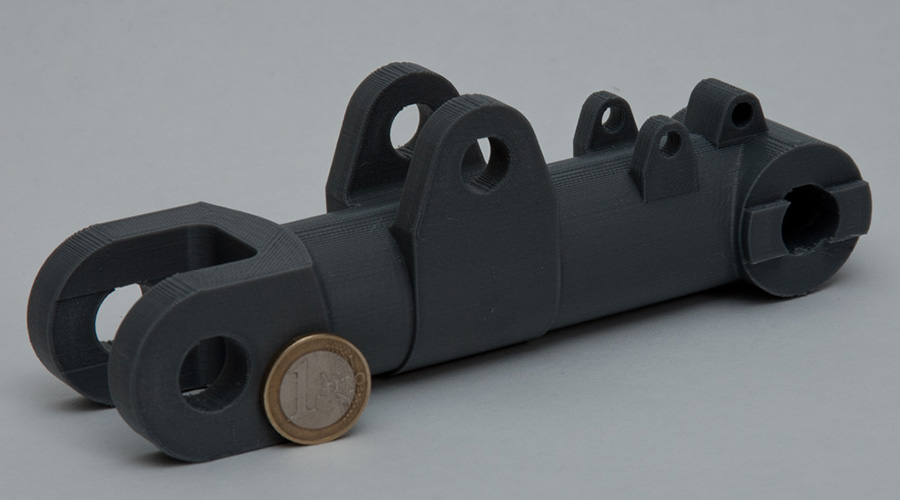
The finished parts of the Alpha Jet landing gear, main landing gear leg with the lower wing. All parts together weigh 250 g and required a total of 12 hours printing time.
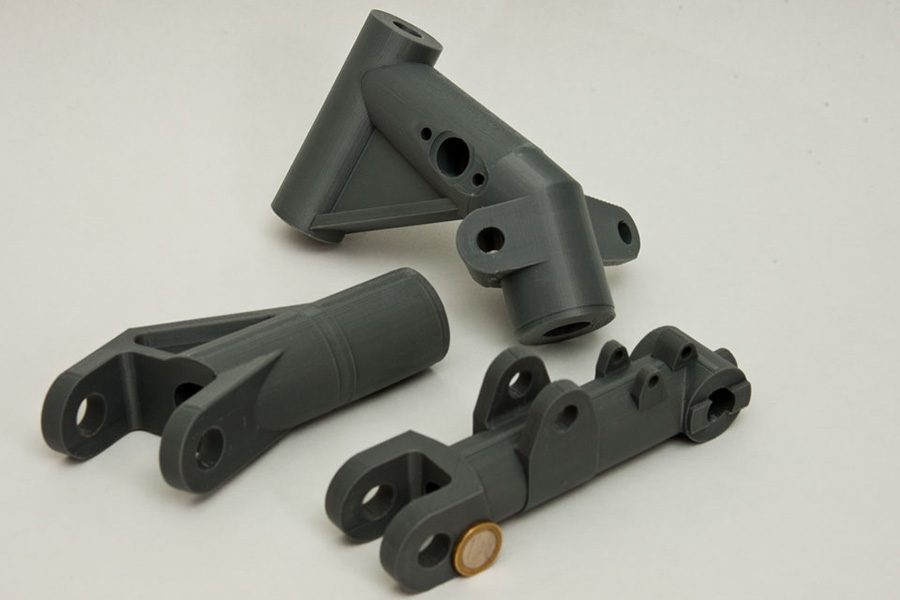
Based on this prototype parts, you can now easily verify the correct functioning of the model. In this stage of development necessary changes to the design would be considerably - cheaper than at the final fully-milled parts.
If you have further questions about 3D printing, you may like to look at
http://www.molotec.de
M
odellsport Schweighofer
Wirtschaftspark 9 • 8530 Deutschlandsberg
[email protected]