According to their website, the RAF Benevolent Fund “
has been supporting members of our RAF Family through thick and thin providing practical, emotional, and financial support whenever they need us” for more than 100 years. To help fund their efforts, William Piper built a special Cub in 1941, painted silver instead of the customary yellow and carrying RAF livery. Dubbed the Flitfire by factory workers, they went on to produce 48 similar aircraft, all of which were donated to raise money for the RAF charity.
(If you are further interested in the Flitfires’ unique history, there are multiple online resources, including Wikipedia.)
One of those Flitfire airframes, the very first one actually, ended up at the North Carolina Aviation Museum in nearby Asheboro. A month or so ago, a friend of mine and I visited the restored airplane and took some documentation photos. Then, another friend decided to sell a NIB Goldberg Anniversary Cub and, when he found out what I had in mind for the kit, sold it and a bunch of accessories to me for a price well below market value.
So, what did I have in mind? In the fall, our club holds a fundraiser for our local food bank in which every dollar as well as can or box of food goes straight to the food bank. In other words, the club picks up all event expenses, including raffle prizes. What better way to raise money than to give away a flying model of a local airplane that itself raised money during WWII?
As a result, I am attempting to construct a Goldberg Cub dressed up as the Flitfire at the Asheboro museum. I will not obsess over scale perfection, so this build should proceed fairly quickly. I will use donated parts and labor wherever possible and plan to have this model flying early this summer so that I can showcase it at local fly-ins to promote our September 10 Winston-Salem Miniature Airshow to collect food and raise money for the Second Harvest Food Bank of Northwest North Carolina.
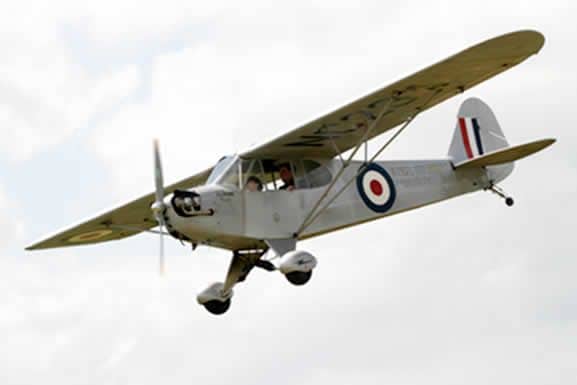 The North Carolina Aviation Museum's Flitfire Cub in flight.