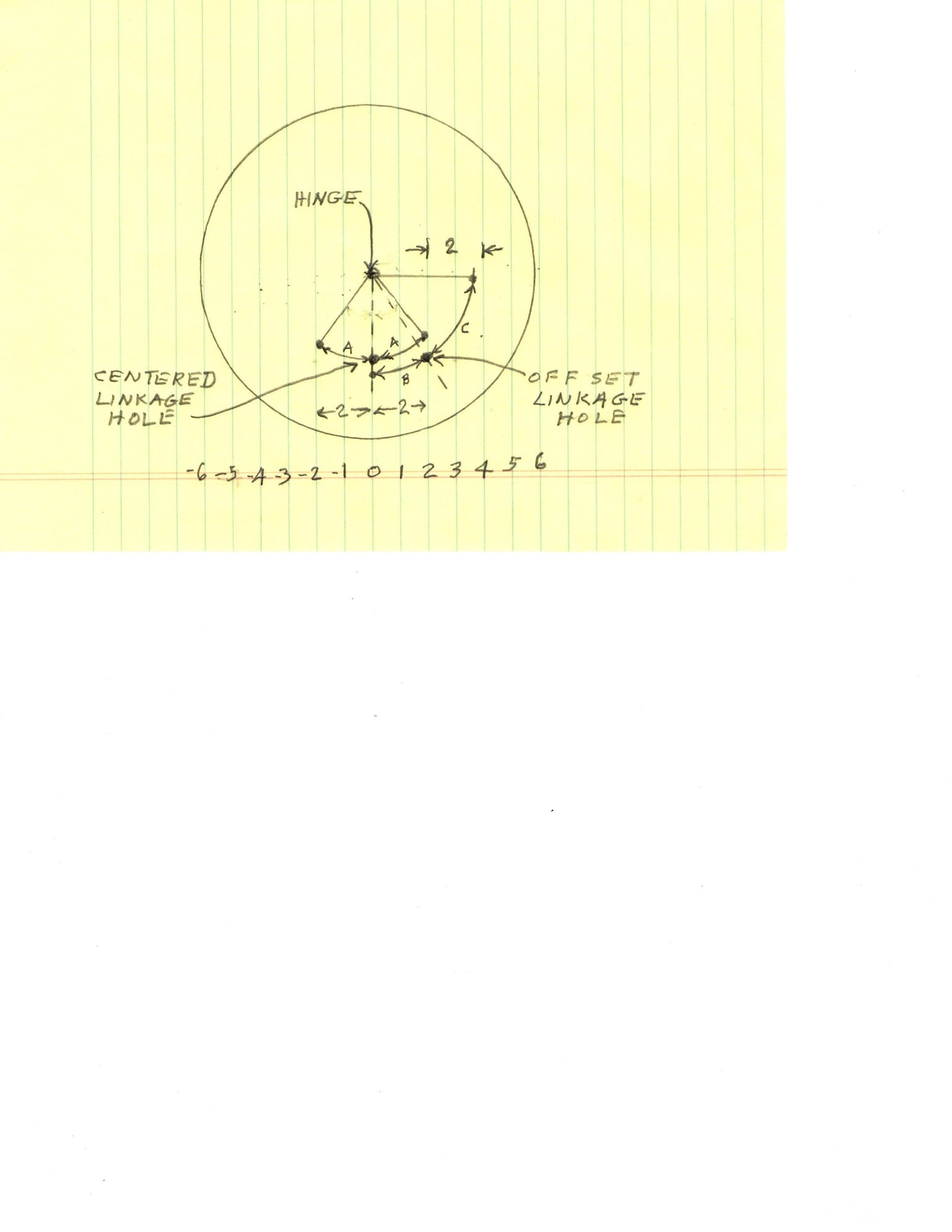
I will start by assuming the driver (servo or 90 degree bell crank) is a rotary output and is centered to provide equal throws in each direction. For illustration purposes, envision the control surface and the control horn hole locations being projected onto a wheel that rotates about the hinge line (See the illustration). The wheel will rotate until the hole has moved a lateral displacement equal to the linkage movement. The illustration shows the amount of wheel rotation (A) in each direction by a displacement of 2 lateral units is equal when the linkage hole is directly below the hinge (axle) line. However, when the linkage hole is offset an extreme amount to the right of the hinge line as shown on the illustration, it can be seen that the same linkage displacement of 2 units to the left causes less angular displacement (B) and that it can be impossible to get a full 2 unit displacement to the right because now the rod is pulling directly against the hinge line. It can be seen that the angular rotation (C) is much greater from the linkage displacement to the right than it is to the left.
This same effect is also used to provide differential aileron movement to get more up aileron than down to correct for adverse aileron yaw. They do this by using 60 degree bell cranks instead of 90 degree bell cranks.
To know exactly how much differential movement will result from a displaced control horn location would require pulling out your old high school geometry and trigonometry books and doing the math, but for practical purposes, the differential throws will become noticeable when the linkage holes are off by about 1/8 inch and will become quite noticeable by 1/4" offset when using a standard 3/4" control horn. The easiest thing is to continue mounting the control horn hole locations directly under the hinge line and use end point adjustments on the transmitter to produce any desired differential throws.