Mark:
Documentation is the most important element to a successful Flite-Metal project. Documentation
provides the level of expectation to which you work surface appearance of your project. It must
parallel the level of finishing you desire to be observed from...X feet or X inches away.
Replicating surface finishing documentation is not as difficult as creating the many mechanical
attributes found on our customer's aircraft. For the best results, replicating the surface of any
project's documentation is best achieved off of the model...on an aluminum plate so there is a
consistant surface texture and patina.
After achieving replication of the documentation the application process typically takes between
30 sec and 1 minute. There are areas that require more and those requiring less time. By far a
majority of the panels take less than one minute to apply after identification of the contact patch.
As is always the case, its how and not how much that provides the greatest speed of application
be it paint or real aluminum.
Joe Gice's, George Maiorana's, and Terry Nitsch's projects are typically thought of as more OCD
than the normal modeler. In reality these are artists with everything they use in their projects.
Each is not afraid to explore and experiment in replicating documentation.
Taping a length of Flite-Metal to a smooth aluminum plate with 3M Painter's Tape at each end is
going to permit you to quickly replicate your documentation. Wet sanding the surface using 400
grit wet/dry mounted on a hardwood sanding block for 15 seconds wet then moving to 600 grit
wet/dry will work harden the surface of Flite-Metal rapidly.
All aluminum has surface grain it acquires during the linear calendaring process of reducing its
thickness from the pig or ingot it started from. The surface grain "scale" and patina contribute
to matching your documentation. The finer the grit used in wet dry sanding results in a harder
surface and a darker patina.
This appearance would be considered a natural war weary condition as exemplified by Joe's
F-100, and George's AEW Tu-4 or his new Tu-95. Permitted to naturally oxidize this looks as
it is a neglected airframe. Here again, your task is to match documentation.
On the other end of the scale is Flite-Metal applied right off the roll to replicate documentation.
Two examples of that are found in Rod Snyder's F-100 at Top Gun and the World Jet Meet and
Ted Zaborski's L-19, both of which are featured in our gallery. Both replicated documentation
to achieve their personal mind's eye level of expectation.
Looking across our gallery you quickly come to realize every model looks "different". If you
were to compare each to documentation it looks like the modeler wanted it to. This is one of
the most important elements in a decision to use paint or the real thing.
Les, is very experienced with the traditional lacquer, epoxy, and poly urethane routines that
come close to looking like aluminum...but are paint. The closest you will come to replicating
a metal surface with paint is with Bob's excellent MetalKote II product. Here again, the end
result is an expression of modeling skill as much as it is baseline product attribute.
Finger prints are not an issue with use of a ph adjusted cleaner like Simple Green and use
of a proper polish that instantly removes smudges and finger prints in addition to retarding
tarnish on a polished airframe like Terry Nitsch's F-100. Terry's F-100 sat in his basement
over the winter before he took it to Top Gun where it won along with Scale Masters and AMA
NATs that year. All Terry did was wipe off the dust and the mirror polished F-100 was good
to go.
Preparing the surface of aluminum to receive paint is typically a wet sanding task or using a
Scotch Brite pad. In rare cases, use of a rattle can metal primer bought at Home Depot or
Lowe's is chosen before the application of paint. 100% of our gallery is composed of painted
projects.
Hope this has helped explain how to apply and finish "any" adhesive backed aluminum foil.
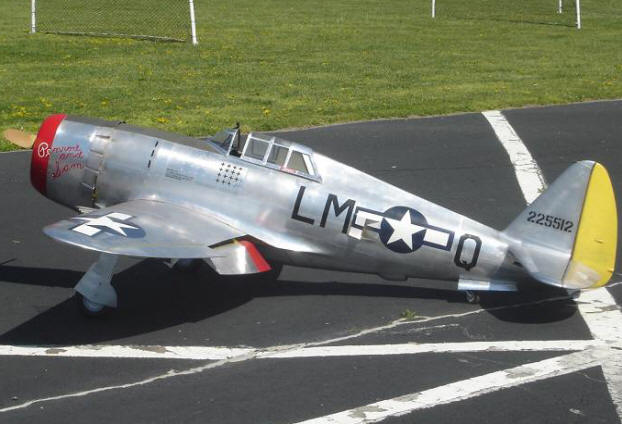
Richard McFarland's P-47 post within RCU has just shown wing repair after he had a landing
mishap with his Flite-Metal covered P-47.