


Scale speed
 10-02-2020 | 01:36 PM
#26


My Feedback: (29)

I would strongly suggest you go back and look at most of your posts. Not just this thread but any thread you have contributed to in the last 6 months. Take a good look at how you interact with others. Take note that when people start acting badly towards you, it's usually in reaction to something you have said.
 10-02-2020 | 01:56 PM
#27

My Feedback: (1)
I would strongly suggest you go back and look at most of your posts. Not just this thread but any thread you have contributed to in the last 6 months. Take a good look at how you interact with others. Take note that when people start acting badly towards you, it's usually in reaction to something you have said.
I was hoping you might be able to point to something specific, but I guess you couldn’t really find anything...
For instance, in this thread, I post the information the OP has asked for, and am called “rediculous”.
It still baffles me that you try and make me out to be the ogre, when it is you that have been on the attack, continually name-calling and actually threatening physical harm to me, not to mention your constant snarky remarks like the one above that you made about the graph I posted.
speed, you really should look in the mirror and realize that you live in a glass house and should not throw stones.
Life is a two-way street; you get what you give.
Astro
10-02-2020 | 02:08 PM
#29
My Feedback: (29)
I don't think anyone actually believes your story that I threatened you. I simply asked if you spoke to people face to face the same as you do online and if so how do you avoid not getting knocked on your butt. Sorry if you took that as a threat. Nothing more then an attempt to help you realize that you need to chill. Of course as a human being I am far from perfect as well, like I said earlier, my negative comments are usually reactionary. Your last comment I certainly agree with 100% and that in a nutshell is exactly why you have such issues in every single thread you show up in.
10-02-2020 | 02:52 PM
#30
Senior Member
CLEARLY! LOL
Scale Time; TIME has been made to run faster in our model than in real life. The model’s clock is ticking at a faster rate than ours. This is an exact truth, if a model clock were make at exact quarter scale it would tick exactly twice as fast as the original clock. This same scaling law explains why the humming bird’s wings beat so much faster than the wings of an eagle.
Pretty ridiculous, huh?
Astro
Scale Time; TIME has been made to run faster in our model than in real life. The model’s clock is ticking at a faster rate than ours. This is an exact truth, if a model clock were make at exact quarter scale it would tick exactly twice as fast as the original clock. This same scaling law explains why the humming bird’s wings beat so much faster than the wings of an eagle.
Pretty ridiculous, huh?
Astro
10-02-2020 | 04:26 PM
#31
My Feedback: (1)
2. That is not what you said and you know it. It was a direct threat that if you ever met me in person that you would knock me on my ass.
Not sure why I take the heat for defending myself from your crap, but that is the way it is. I guess I was never interested in learning the secret RCU handshake...
Astro
10-03-2020 | 12:33 PM
#35

A number of us gathered with social distancing to talk about scale models. Almost the first topic was scale speed it turned into a shouting match as we tried to maintain the distance and keep tempered in the aneling range. So assume we are watching an F8F Bearecat practicing for the Reno air races. He flies by at 500 mph or 4000 feet per second. One of the guys has a 1/4 scale model of the plane. How fast in real world terms does this model have to fly at to represent scale speed?
- Approximate problem by imagining an observer is standing at middle of circle of radius "R" (in feet)
- Full scale plane has length "L" (in feet)
- Full scale plane flying at speed of "X" (in feet per second)
Knowns:
- Distance along circumference of a circle S = Radius * Angle (in radians)
- Angular velocity, in radians / second = Velocity along circumference in ft/sec divided by Radius in feet
- An object of length L at a distance of R subtends an angle (to the eye) = 2 * arctan[(L/2)/R]
So now it's an issue of deciding your distance and speed for the full scale plane, then calculating at what distance a model 1/4 size subtends the same angle to the eye and travels at the same angular velocity (to the observer). As it turns out, the distance is scale factor times distance from full scale observation. Same for speed.
So an F4U Corsair flying at 400 mph on a circular path of radius 5280 feet around the observer. For a 1/4 model to appear the same, it has to be at both 1/4 the distance AND 1/4 the speed.
Another way, a 1/8 scale turbine model of an F/A-18C 500 feet away from the observer travelling at 200 MPH would appear the same as a full scale Hornet 4000 feet away at 1600 MPH. With the ground and plane visible to the observer for the model, the relative velocity doesn't look right because you don't see many Hornets that close to the ground going that fast.
Last edited by franklin_m; 10-03-2020 at 01:50 PM.
10-03-2020 | 01:11 PM
#36
My Feedback: (6)
The argument that the "scale speed" should be 1/4 of the speed of the full size plane seems obvious at first, but is it? A quarter scale model has (roughly?) 1/16 of the surface area of the full-scale plane and 1/64 the volume. A quarter scale plane sitting on the runway next to the full-scale version looks tiny in comparison. I suspect that a quarter-scale model flying at a quarter of the speed of the full-scale version would seem to someone on the ground to be going unreasonably fast. I don't have a solution, but it does seem that picking the linear dimension as the standard is arbitrary.
10-03-2020 | 01:55 PM
#37
The argument that the "scale speed" should be 1/4 of the speed of the full size plane seems obvious at first, but is it? A quarter scale model has (roughly?) 1/16 of the surface area of the full-scale plane and 1/64 the volume. A quarter scale plane sitting on the runway next to the full-scale version looks tiny in comparison. I suspect that a quarter-scale model flying at a quarter of the speed of the full-scale version would seem to someone on the ground to be going unreasonably fast. I don't have a solution, but it does seem that picking the linear dimension as the standard is arbitrary.
I don't know that volume makes sense, since at any distance we don't "see" the depth of the object.
Last edited by franklin_m; 10-03-2020 at 02:02 PM.
10-03-2020 | 05:12 PM
#38
My Feedback: (6)
I would argue the model looks tiny next to the full scale because for the very reason I explained above. As for the other example, it's got to be at both 1/4 the speed AND 1/4 the distance to appear correct. At a distance the eye sees everything as an outline. And surface area is just linear dimensions. Let me do some thinking on that. The other very big factor in vision and perception is what else is in the field of view.
I don't know that volume makes sense, since at any distance we don't "see" the depth of the object.
I don't know that volume makes sense, since at any distance we don't "see" the depth of the object.
10-03-2020 | 06:58 PM
#39
Surface area is not "just linear dimensions." A square 10 inches on a side has an area of 100 square inches. A square 5 inches on a side has an area of 25 square inches. So the larger square is twice the "size" of the smaller one if you just measure length, but it's four times the area. I'm inclined to think that scale speed ought to relate to the squares of the "scale," because, as you say, you don't fully see depth at a distance. But this is just a guess, not something I'd argue for. My point is just that we shouldn't assume that scale speed for a 1/4 scale model should be 1/4 the speed of the full scale just because of the number we use to label scales. "Quarter scale" is just what we call it; it could just as well be called "1/16 scale" or "1/64 scale." Picking length to compare scales is probably a good thing in the sense of simplifying what we do in building model, but it's not "right" in some "law of nature" sense. I'd bet that if we all built model hot-air balloons instead of airplanes we'd be naming scales by relative volumes. (And we wouldn't have to worry about scale speed.)
Your optical sensor is a simple convex lens and the retina, which function like the lens below. We have a circle of a certain size h0 at a distance d0 as depicted below. Light from it passes through the converging lens and focuses on your retina. The amount of area that subtends an area on the retina is directly related to the linear dimensions and the distance. Assuming both images are far field, meaning well beyond the focal point of the lens, the exact same shape, say 4 x h0 at a distance 4 x d0, subtends exactly the same area on the human retina through the same lens as the same shape of 1/4 size at 1/4 the distance. So if the area each occupies on the human retina is the same and they're moving at the same angular velocity (1/4 speed), with other factors excluded, the human retina cannot register a difference. Simple laws of optics.
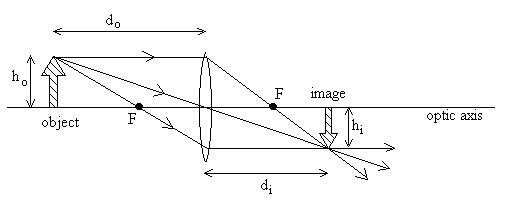
Assuming a 1/4 scale plane, at 1/4 scale distance, at 1/4 scale speed, where I think the perception of different speeds comes into it several ways. The easiest are that it's 1/4 scale at 1/4 speed, but not at 1/4 scale distance. The other is 1/4 scale at 1/4 scale distance, but not at 1/4 scale speed. The more complex one though how the brain interprets information based on what else is in the "frame" with the 1/4 scale plane. Relative speed across the ground and full scale objects in the same visual field greatly influence perception. And that perception is very powerful in aviation, all sorts of full scale mishaps due to how easily the brain can be fooled. One way of thinking of it is that when your eye registers full scale objects in the same field as the 1/4 scale plane, it "knows" that's not real. Hence the bias toward perception that it's not realistic. Again, the brain is very powerful in this equation - and I think the driver. The eye and the retina though, that's pure optics.
Last edited by franklin_m; 10-04-2020 at 02:41 AM.
10-04-2020 | 05:43 AM
#40
My Feedback: (6)
I do think (but I'm not sure) that you may be right about one thing: whether a model in flight looks like a full-scale plane flying depends at least in part on how far away it is. That seems reasonable, but there may be other things that matter, too. When a model is just sitting on the runway and not moving, it seems clear enough that "scale speed" is zero: exactly the same as the speed of a full-scale plane sitting still. So if there really such a thing as "scale speed" for a model in flight, how does it go from zero to that particular fraction? Does it suddenly jump to 1/4 or 1/16 or whatever as soon as it starts moving, does it increase gradually, or what? I doubt that the answer is something we can simply calculate.
10-04-2020 | 06:33 AM
#41
I am not saying any such thing. I'm not even saying anything much about what "scale speed" should be. I don't know the answer to that question; I could make guesses, but what would be the use of that? All I'm saying is that many people are assuming that it must be 1/4 of something or some combination of things for a quarter-scale model because that kind of model is 1/4 "the size" of the original, and that is wrong: it's 1/4 the length, 1/16 of the surface area, and 1/64 of the volume. There is no one number that measures "the size" of an object of more than one dimension.
I do think (but I'm not sure) that you may be right about one thing: whether a model in flight looks like a full-scale plane flying depends at least in part on how far away it is. That seems reasonable, but there may be other things that matter, too. When a model is just sitting on the runway and not moving, it seems clear enough that "scale speed" is zero: exactly the same as the speed of a full-scale plane sitting still. So if there really such a thing as "scale speed" for a model in flight, how does it go from zero to that particular fraction? Does it suddenly jump to 1/4 or 1/16 or whatever as soon as it starts moving, does it increase gradually, or what? I doubt that the answer is something we can simply calculate.
I do think (but I'm not sure) that you may be right about one thing: whether a model in flight looks like a full-scale plane flying depends at least in part on how far away it is. That seems reasonable, but there may be other things that matter, too. When a model is just sitting on the runway and not moving, it seems clear enough that "scale speed" is zero: exactly the same as the speed of a full-scale plane sitting still. So if there really such a thing as "scale speed" for a model in flight, how does it go from zero to that particular fraction? Does it suddenly jump to 1/4 or 1/16 or whatever as soon as it starts moving, does it increase gradually, or what? I doubt that the answer is something we can simply calculate.
Physiology. Relevant to this discussion, your only transducer able to sense the environment is your retina. What is senses is a combination of physics and optics. The mathematics of this is easy. We know that the light reflected off any object is bent by the convex lens of the eye and an image forms on the retina.
Optics. That image size is determined by the mathematics of the lens, focal length, position of the object in space (near field or far field), etc. And in the case of a single convex lens, that math is pretty easy. The size of the image in two dimensions on the retina is determined entirely by the size of the object and the distance. Assuming both are in the eye's far field vision, an object of size X & Y at distance D creates an image on the retina of size X' and Y'. Optics tells us that if you place an object 0.25X & 0.25Y at a distance 0.25D, the image on the retina is exactly the same size X' and Y'.
Physics. Since optics tells us that under the conditions above, the images on the retina are exactly the same size, then we turn to Newtonian physics and more math for speeds. Fortunately, the math there is straightforward as well. Using the observer at the center of a circle, the full scale object moves around the circle at angular velocity of Theta/second (in radians) = velocity along the circumference of the circle in feet per second divided by the radius of the circle in feet. Since we know the distance at which the 0.25 model creates the exact same size image on the retina, the radius of the model's circle is now known. All we have to do is solve for model velocity.
So a 1/4 size model at 1/4 the distance from the observer moving at 1/4 size the full scale velocity creates an image of the exact same size moving at the exact same rate on the observer's retina. As you've said people still don't perceive these as the same, so there must be other factors in play (assuming both speed and distance are correct). And I submit that it's what's happening between the ears. Namely, how the brain interprets the information fed to it by the transducer. I forget where I read it, probably in aviation safety training, but the brain processes an immense amount of other information in the "snapshot" of what the retina sends to it. You may be focused on the model, but the eye (and thus brain) are still seeing everything else in the background. Full scale items in the background of a 1/4 scale model are still perceived by the brain whether one knows it or not. And those subconscious inputs are incredibly powerful in forming the thought about whether the speed "looks scale."
10-04-2020 | 07:07 AM
#42
My Feedback: (29)
Franklin and Topgunn, I am glad that the two of you joined in on this conversation. It has certainly helped me to understand the perspectives in what we may or may not perceive as accurate while flying our models. I have for several years been adjusting my flying based on perception. A couple examples of this would be when establishing a 45 degree upline at the end of the aerobatic box. If it were a true 45 degrees it would actually appear to be shallow so in reality it is actually closer to 50-55 degrees. Another example is an upline at center if in closer then 100 yards ( and of course model size defendant). The line has to fade slightly away because if the upline is perfectly vertical it will appear to be coming in. It's easy to understand that when we are flying in front of judges whether it be flying accurate aerobatic shapes or trying to create realism of speed that we need to account for the judges perspective. Thank you both for turning this into a productive thread.
10-04-2020 | 07:24 AM
#43
My Feedback: (6)
There is no such thing as "a 1/4 size model." Is a 1/4 scale model 1/4 the size of the full-scale airplane, or 1/64 the size, or something else? There is no right answer to that question.This has nothing to do with physics, optics, or any other branch of science. It's a question of the meaning of words. "Size" is not a concept used in any science (unlike things like length, width, area, volume, or mass). Your arguments, whatever their merit, have nothing to do with the point I have been making. My original post was not directed at your arguments, which for all I know may be at least partly right or complete BS. But I do know that saying something is "1/4 the size" of something else is meaningless, except in the sense that it means smaller in at least one dimension. Using a term like "size" in a discussion of a supposedly scientific matter is simply silly.
10-04-2020 | 02:03 PM
#44
There is no such thing as "a 1/4 size model." Is a 1/4 scale model 1/4 the size of the full-scale airplane, or 1/64 the size, or something else? There is no right answer to that question.This has nothing to do with physics, optics, or any other branch of science. It's a question of the meaning of words. "Size" is not a concept used in any science (unlike things like length, width, area, volume, or mass). Your arguments, whatever their merit, have nothing to do with the point I have been making. My original post was not directed at your arguments, which for all I know may be at least partly right or complete BS. But I do know that saying something is "1/4 the size" of something else is meaningless, except in the sense that it means smaller in at least one dimension. Using a term like "size" in a discussion of a supposedly scientific matter is simply silly.
Perhaps Speedy will chime in on how scale competitions are judged. When there's a statement that a model is "1/4 scale" are they referring to volume, surface area, or linear dimensions?
10-04-2020 | 02:06 PM
#45
Franklin and Topgunn, I am glad that the two of you joined in on this conversation. It has certainly helped me to understand the perspectives in what we may or may not perceive as accurate while flying our models. I have for several years been adjusting my flying based on perception. A couple examples of this would be when establishing a 45 degree upline at the end of the aerobatic box. If it were a true 45 degrees it would actually appear to be shallow so in reality it is actually closer to 50-55 degrees. Another example is an upline at center if in closer then 100 yards ( and of course model size defendant). The line has to fade slightly away because if the upline is perfectly vertical it will appear to be coming in. It's easy to understand that when we are flying in front of judges whether it be flying accurate aerobatic shapes or trying to create realism of speed that we need to account for the judges perspective. Thank you both for turning this into a productive thread.
10-04-2020 | 05:06 PM
#46
My Feedback: (29)
Ok. I was simplifying for readability. Everywhere I said "size" replace with "linear dimensions".
Perhaps Speedy will chime in on how scale competitions are judged. When there's a statement that a model is "1/4 scale" are they referring to volume, surface area, or linear dimensions?
Perhaps Speedy will chime in on how scale competitions are judged. When there's a statement that a model is "1/4 scale" are they referring to volume, surface area, or linear dimensions?
Not being a scale competitor, I had to refer to the AMA rulebook. I didn't see any reference to model size only maneuver size. The reference is that a Cub shouldn't do the same diameter loop as a P-51. That said, there are always nuances not covered or out of date in rulebooks. Having the judges have that scale reference number could influence their perception. Judging is difficult in the respect that you can't let anything outside the flight you are witnessing influence the score. Example is what happened to me several years ago. I received some low scores on a couple maneuvers that included snap rolls. One judge scored me on average 6 points less then the other judge. Following protocol I brought it to the attention of the CD whom then brought the judge into the conversation. The judge stared off with " when I saw you flying your last round I thought your snaps were a bit slow ". Two things wrong with that statement, one he took a preconceived judgement to the chair and there is no criteria on speed of rotation during a snap roll.
Point is that you can math the crap out of this topic but to what end? You can have two people watch a model fly across the field and then have them guess the speed of the model, they won't have the same answer. The way the model is being flown should alter the perspective as well. A model being flown smoothly will give the perspective of flying slower then a model of the same speed being flown poorly.
10-04-2020 | 06:58 PM
#47
Senior Member
Perspective can be very deceiving. The airplanes that I fly are all about the same size 50-70 inches(not including my 30% Yak ). I fly at the same field every week and I have set points of references. I find myself flying with the planes out at about the same distance so their size is about the same. When I fly my small UMX PT-17 ( love that little plane) I also find myself taking it out to where it is also the same SIZE . As the trees around the edge of the field are quite far away they add no perspective to the size of the plane. It is only when I am about to touch down and the runway seems to swallow the micro plane do I realize how close I have been flying the plane.
10-05-2020 | 04:27 AM
#48
My Feedback: (6)
Ok. I was simplifying for readability. Everywhere I said "size" replace with "linear dimensions".
Perhaps Speedy will chime in on how scale competitions are judged. When there's a statement that a model is "1/4 scale" are they referring to volume, surface area, or linear dimensions?
Perhaps Speedy will chime in on how scale competitions are judged. When there's a statement that a model is "1/4 scale" are they referring to volume, surface area, or linear dimensions?
So I guess my bottom line isn't so much that you have arbitrarily chosen one measure of scale without explaining why, but that this isn't a question that can be reduced to any kind of formula. It's art, not science.
Last edited by Top_Gunn; 10-05-2020 at 06:58 AM.
10-05-2020 | 08:09 AM
#49


As past scale chairman of MAAC, a scale competitor and part of the committee that put on the FAI 2002 World Scale Championships held in Canada I can tell you that there is no definitive speed as per prototype used in judging in scale competition. I will attempt to give some insight into why in a bit.
When someone inquires about 1/4, 1/8, 1/6 etc. scale I explain that it’s not technically correct. Scale is always expressed as a ratio. Take a look at most model kits and you will see 1:4, 1:3 even 1:3.75 etc. The easy explanation is the number on the left of the colon is the dimension on the model and the on the right tells you how many times bigger it is on the full size.
Now as to scale speed. Its one of the most argued points of scale competition. There is no formula that works scaling down speed mathematically. Landing speeds and takeoff speeds are prime examples. Take the early aircraft where max speed was 80 or under. That would mean a 1:4 scale would be expected to fly max speed around 20 lands and take off somewhat less than that. A 1:6 scale around what 15 max and somewhat less for landing and take off. No competition I know of has ever measured actual speed as a judgement point in scale. They judge and use their perception called realism in flight and there are actually points given for this. What the judges expect to see from the model being showcased.
When someone inquires about 1/4, 1/8, 1/6 etc. scale I explain that it’s not technically correct. Scale is always expressed as a ratio. Take a look at most model kits and you will see 1:4, 1:3 even 1:3.75 etc. The easy explanation is the number on the left of the colon is the dimension on the model and the on the right tells you how many times bigger it is on the full size.
Now as to scale speed. Its one of the most argued points of scale competition. There is no formula that works scaling down speed mathematically. Landing speeds and takeoff speeds are prime examples. Take the early aircraft where max speed was 80 or under. That would mean a 1:4 scale would be expected to fly max speed around 20 lands and take off somewhat less than that. A 1:6 scale around what 15 max and somewhat less for landing and take off. No competition I know of has ever measured actual speed as a judgement point in scale. They judge and use their perception called realism in flight and there are actually points given for this. What the judges expect to see from the model being showcased.
10-05-2020 | 10:16 AM
#50
Senior Member
Perception is the key. According to the chart a scale speed for a 1/7 scale P-51 would be 151 MPH to match up to a full scale P-51's 400 MPH. I know from my many trips to Reno and my involvement in R/C PRO racing that the aprox. 1/7 scale planes used in R/C PRO LOOK ,from the flight line, ABOUT the same size as the full size LOOK from the pit area at Reno. However, the Gold R/C Pro planes SEEM much faster at their 150+ MPH than the full scale LOOK at 400+ MPH. At least to my brain.

