


Help building first plane
 06-05-2012 | 07:18 AM
#26

Senior Member
My Feedback: (2)
Joined: Nov 2002
Posts: 2,102
Likes: 0
Received 0 Likes
on
0 Posts
From: Jackson, MI
 RE: Help building first plane
You could use on of these (or similar) <font color="#000000">v-tail</font> mixers
 06-05-2012 | 08:00 AM
#27
 RE: Help building first plane
Ailevators are the trailing edge roll control surfaces of a wing that also lift or drop for pitch control. It is correct terminology on a flying wing (ie. Northrup, Horten, etc.)
http://www.twitt.org/GoodyearRacer.html (a post WWII flying wing aircraft)
Their use long predates computer transmitter mixes.
There used to be an Austrailian company that made a stand-alone elkectronic mixer (for Zagi wings) that didn't need a computerized transmiter mixing. Istill have one in my project box from a retired wing.
<font face="Rockwell"> Ailevators are external central surfaces much smaller in area than the main wing. They are located slightly below the trailing edge of the main wing and towards the tips. There is a passageway for free airflow between the leading edge of the surface and the trailing edge of the main wing.</font>
<font face="Rockwell"> Ailevators are not a part of the main wing. They are independent surfaces located so that they favorably influence the airflow over the main wing. At high and medium speeds they cut down the drag on the main wing by smoothing out the airflow leaving the trailing edge.</font>
<font face="Rockwell"> The external surfaces are used as ailerons and elevators, hence the word AILEVATORS.</font>
<font face="Rockwell"> Ailevators are not a part of the main wing. They are independent surfaces located so that they favorably influence the airflow over the main wing. At high and medium speeds they cut down the drag on the main wing by smoothing out the airflow leaving the trailing edge.</font>
<font face="Rockwell"> The external surfaces are used as ailerons and elevators, hence the word AILEVATORS.</font>
Their use long predates computer transmitter mixes.
There used to be an Austrailian company that made a stand-alone elkectronic mixer (for Zagi wings) that didn't need a computerized transmiter mixing. Istill have one in my project box from a retired wing.
06-05-2012 | 09:03 AM
#29


My Feedback: (6)
RE: Help building first plane
If you look at post #25, he has shown you two ways to do it without a computer radio. The link he gave you for the V-tail mixer would probably be the easiest of the two. The picture of the two servos mechanically linked is a strictly mechanical method that is going to take some patience to get set up and trimmed properly.
06-05-2012 | 09:18 AM
#30
Senior Member
My Feedback: (2)
Joined: Nov 2002
Posts: 2,102
Likes: 0
Received 0 Likes
on
0 Posts
From: Jackson, MI
RE: Help building first plane
Ailevators are the trailing edge roll control surfaces of a wing that also lift or drop for pitch control. It is correct terminology on a flying wing (ie. Northrup, Horten, etc.)
<a name="ailevator"><font size="5">Ailevator</font></a> - 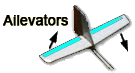 This is a new term that has sprung up with the advent of the newer computer radio control systems. It is where each elevator in a standard (conventional) or v-tail moves independently, like ailerons on a wing. In addition to each elevator side moving up and down together, each side moves in opposite directions when moving as an ailevator. On a <font color="#0066cc">v-tail</font>, this is also known as a <font color="#0066cc">ruddervator</font>, as they can serve the same purpose. Typically, both ailevators and ailerons are coupled together to maximize roll performance, especially on larger wingspan planes.
This is a new term that has sprung up with the advent of the newer computer radio control systems. It is where each elevator in a standard (conventional) or v-tail moves independently, like ailerons on a wing. In addition to each elevator side moving up and down together, each side moves in opposite directions when moving as an ailevator. On a <font color="#0066cc">v-tail</font>, this is also known as a <font color="#0066cc">ruddervator</font>, as they can serve the same purpose. Typically, both ailevators and ailerons are coupled together to maximize roll performance, especially on larger wingspan planes.
<a name="elevon"><font size="5">Elevon</font></a><a name="elevons"> - 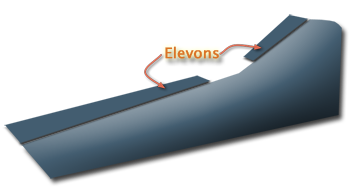 </a> Elevon is a term that means both aileron and elevator combined into the same control surface. It is used on tailless aircraft such as as flying wings. Like ailerons, an elevon provides for a plane's roll control by moving in opposite directions and like an elevator, provides pitch control by moving up and down together. In order for a plane to have elevons either a computer r/c system is needed or a <font color="#0066cc">mixer</font> (either electronic or mechanical). This movement is very similar to what happens in a <font color="#0066cc">V-Tail</font> setup.
</a> Elevon is a term that means both aileron and elevator combined into the same control surface. It is used on tailless aircraft such as as flying wings. Like ailerons, an elevon provides for a plane's roll control by moving in opposite directions and like an elevator, provides pitch control by moving up and down together. In order for a plane to have elevons either a computer r/c system is needed or a <font color="#0066cc">mixer</font> (either electronic or mechanical). This movement is very similar to what happens in a <font color="#0066cc">V-Tail</font> setup.
Whether a tailless aircraft has a vertical fin and rudder or not, when the ailerons are also used for pitch, 'elevon' should be correct. When the elevator halves are combined for roll and pitch, that becomes ailevators. I have a foam F-86 that has ailevators. One could argue they mean the same thing, but the true ailevator aircraft doesn't have elevons.
There used to be an Austrailian company that made a stand-alone elkectronic mixer (for Zagi wings) that didn't need a computerized transmiter mixing.
06-05-2012 | 09:19 AM
#31
Thread Starter
Member
Joined: Apr 2012
Posts: 44
Likes: 0
Received 0 Likes
on
0 Posts
From: brookhaven,
MS
RE: Help building first plane
ok so in post #25 the servo to the right has for lack of better words a piviot so when you power the one servo it pushes the piviot point on second servo moving both control arm at one time. and you still can use that servo with the pivot point on top of it to turn each of the control rods in opposite directions?
06-05-2012 | 09:24 AM
#32
Thread Starter
Member
Joined: Apr 2012
Posts: 44
Likes: 0
Received 0 Likes
on
0 Posts
From: brookhaven,
MS
RE: Help building first plane
well since your ace mixer is collecting dust...  why dont you help a fellow out and just send it to me?? haha.. but really if its just collecting dust i would like to get it from you if your willing to part with it and it dont cost me to much..
why dont you help a fellow out and just send it to me?? haha.. but really if its just collecting dust i would like to get it from you if your willing to part with it and it dont cost me to much..
06-05-2012 | 09:40 AM
#33
RE: Help building first plane
ORIGINAL: eddieC
I'll agree to disagree, as there are mixed terms depending on aircraft.
I'll agree to disagree, as there are mixed terms depending on aircraft.
Come over and sit on the divan and put your feet on the ottoman and I'll fix us a few highballs and we can discuss aeroplaneterminology.
06-05-2012 | 09:56 AM
#34
Senior Member
My Feedback: (2)
Joined: Nov 2002
Posts: 2,102
Likes: 0
Received 0 Likes
on
0 Posts
From: Jackson, MI
RE: Help building first plane
Come over and sit on the divan and put your feet on the ottoman and I'll fix us a few highballs and we can discuss aeroplane terminology.
06-05-2012 | 10:05 AM
#35
Senior Member
My Feedback: (2)
Joined: Nov 2002
Posts: 2,102
Likes: 0
Received 0 Likes
on
0 Posts
From: Jackson, MI
RE: Help building first plane
well since your ace mixer is collecting dust...  why dont you help a fellow out and just send it to me??
why dont you help a fellow out and just send it to me??
The DX6 recommended is a great little radio, save some moolah up and get into basic computer radios. Back in 1967, it took me 10 weeks of paper route money ($250.00 !) to buy an Esquire trainer with a 10-channel (5 function) Controlaire reed radio that was being sold on consignment at the local hobby shop (LHS). I bought a 1960 VW bus to carry it in for $300, wish I had them both! [8D]
06-05-2012 | 10:24 AM
#36
Thread Starter
Member
Joined: Apr 2012
Posts: 44
Likes: 0
Received 0 Likes
on
0 Posts
From: brookhaven,
MS
RE: Help building first plane
haha i hear that.. i will be saving a few dollars and get me a trainer, but in the mean time i might put together the linked servo and just test it out see how it works and if i could figure it out.
06-05-2012 | 10:37 AM
#37
Senior Member
Joined: Jul 2003
Posts: 2,613
Likes: 0
Received 0 Likes
on
0 Posts
From: no city,
AL
RE: Help building first plane
ORIGINAL: Charlie P.
Spoken like a true gentleman and master of the polite contrary.
Come over and sit on the divan and put your feet on the ottoman and I'll fix us a few highballs and we can discuss aeroplane terminology.
ORIGINAL: eddieC
I'll agree to disagree, as there are mixed terms depending on aircraft.
I'll agree to disagree, as there are mixed terms depending on aircraft.
Come over and sit on the divan and put your feet on the ottoman and I'll fix us a few highballs and we can discuss aeroplane terminology.
Thank you, gentlemen.
Jess
06-05-2012 | 11:32 AM
#38


My Feedback: (1)
RE: Help building first plane
This is the Dubro mechanical mixer and is commonly avaliable at Tower (around 12 Bucks):
http://shop.dubro.com/products/productdetail/V-Tail+Mixer+(QTY/PKG%3A+1+)/part_number=215/101.0.1.1.5161.5191.0.0.0?pp=12&
They work OK and I have used them a number of times with various Scimitar flying wings. Of course now I would simply use Radio mixing.
They are listed as a V-tail mixer but can also be used as a elevon mixer makes no differance in the way it works.
Jhsmith
Two concerns, if you try to use a surface radio for your homebrew airplane is if it is a pistol grip that is not going to be practical and you will almost certainly not be able to control the airplane because of poor ergonomics.
The other concern is If: your surface transmitter is on the 75 Mhz band then it is illegal to use for an airplane. If it is 2.4 then that is shared and OK. If it is on the 27Mhz band then that also is a shared band and can be used for an airplane or surface.
John
http://shop.dubro.com/products/productdetail/V-Tail+Mixer+(QTY/PKG%3A+1+)/part_number=215/101.0.1.1.5161.5191.0.0.0?pp=12&
They work OK and I have used them a number of times with various Scimitar flying wings. Of course now I would simply use Radio mixing.
They are listed as a V-tail mixer but can also be used as a elevon mixer makes no differance in the way it works.
Jhsmith
Two concerns, if you try to use a surface radio for your homebrew airplane is if it is a pistol grip that is not going to be practical and you will almost certainly not be able to control the airplane because of poor ergonomics.
The other concern is If: your surface transmitter is on the 75 Mhz band then it is illegal to use for an airplane. If it is 2.4 then that is shared and OK. If it is on the 27Mhz band then that also is a shared band and can be used for an airplane or surface.
John
06-05-2012 | 11:49 AM
#39
Thread Starter
Member
Joined: Apr 2012
Posts: 44
Likes: 0
Received 0 Likes
on
0 Posts
From: brookhaven,
MS
RE: Help building first plane
i do have have a pitol grip transmitter but i will be using the 27mhz heli transmitter for the controller here.. i automaticly realized that a pistol grip would not do the job
06-05-2012 | 12:40 PM
#40

My Feedback: (17)
Joined: Aug 2004
Posts: 190
Likes: 0
Received 0 Likes
on
0 Posts
From: Brandon,
MS
RE: Help building first plane
You need to get with the guys at your local RC club in Brookhaven. They will be able to help you with your project. They usually fly at the airport on the weekends.
06-05-2012 | 04:35 PM
#43
RE: Help building first plane
ORIGINAL: flycatch
Why is this individual being given the time of the day? It's obvious that he is a troll and too many have taken the bait.
Why is this individual being given the time of the day? It's obvious that he is a troll and too many have taken the bait.
Idon't let others control my mood.
06-05-2012 | 05:01 PM
#46
Thread Starter
Member
Joined: Apr 2012
Posts: 44
Likes: 0
Received 0 Likes
on
0 Posts
From: brookhaven,
MS
RE: Help building first plane
Seriously if u don't want to help go away! <div>Say I am doing what he says I'm doin, he "knows what I'm doin" yet still falls for it..l</div><div>What an idiot.. Seriously if your not here to help and u think it's a waste of time don't waste your time troll!!!</div>
06-05-2012 | 08:42 PM
#47
Joined: Oct 2008
Posts: 131
Received 0 Likes
on
0 Posts
From: Eagle HeightsQueensland, AUSTRALIA
RE: Help building first plane
Flying wings aren't the "traditional" trainers but they can be used quite ok for a first plane. The launching is tricky but I know of of schools that have rc programs that use a flying wing. Yes, they are problematic with orientation but if you don't fly too far away, that isn't a huge issue. However, a beginner stopping themselves from flying too far away could be an issue ;-)
Often flying wings are made of EPP or EPO foam which is quite crash survivable which is a big advantage in a trainer.
Often flying wings are made of EPP or EPO foam which is quite crash survivable which is a big advantage in a trainer.
06-06-2012 | 06:47 AM
#48
 RE: Help building first plane
So to sum all this up.
1 Wings are not good trainers (trust us we know)
2 Heli motors could be used for an airplane but your esc will need to be programmed for airplane and not heli, also you will be limited on the weight and speed of your aircraft. Suggest a study on motor basics.
3 The mixer avail from tower works fine. plug your servos into the wye and then into your aileron channel. Again, wings are not trainers.
4 Building is fun and experimenting is knowledge. Inventors never fail, they just know hundreds of things that don't work.

5 Lot's of cheap radios and receivers available on ebay and swaps now that 2.4 is all the rage.
6 Check out the s.p.a.d forum for lots of cheap airplane ideas, right after the elections is a good time to p.u free material.
7 Most important, have fun with it. It's a hobby for pete's sake.</p>


