


Solder Question???
 05-30-2013 | 06:23 PM
#1
Thread Starter
Senior Member
Joined: Jan 2009
Posts: 206
Likes: 0
Received 0 Likes
on
0 Posts
From: Kershaw,
SC
 Solder Question???
About the only Soldering i will be doing is putting deans connectors on 3s Lipo batteries. I have been using a basic 30w iron but it has been acting funky for a few months now. I can get a 60w iron for minimally more than a 30w, but is there any reason i shouldn't? Would the 60w iron get too hot for this application? Thanks for any and all help you can give me!
 05-30-2013 | 07:16 PM
#2


Joined: Sep 2005
Posts: 1,456
Likes: 0
Received 0 Likes
on
0 Posts
From: Mesa, AZ
RE: Solder Question???
Basically the more the wattage the better the joints as you can quickly heat the two idea , and the instance the flux boils tap on some solder and it is done without overheating the insulation. You increase the chances of cold solder joints with small irons when doing larger items!
05-30-2013 | 07:53 PM
#3
RE: Solder Question???
60w is just about perfect for soldering on Deans connectors. You'll probably find that it heats your 24ga extensions a little faster than you'd like, but that's about it for negatives.
 05-31-2013 | 05:37 AM
#5
Senior Member
RE: Solder Question???
Yes, 60 watts is about ideal for the Dean's Ultra connectors. You also need to have as massive a tip as you can get, no small round tips, go with the big chisel tip with flat ends. You want to have a tip that holds the heat (won't cool off as soon as it touches a cooler object). The secret to a good joint is first to clean, clean ,clean the area to be soldered. This may require a wipe or two with a fine sandpaper or crocus cloth followed by a wipe with alcohol. Next, use a good flux on both the wire and the connector. Tin both the wire and connector. Physically hold the tinned wire and connector together (use a jig to hold them in place). Now just heat the area where the two touch, you may not need any more solder although it won't hurt if you have a bit of molten solder on the iron tip as you heat the junction. As soon as you see the solder flow, get the heat off the junction and let it cool a second or two before removing from the jig. You now have a perfect soldered joint.
05-31-2013 | 05:59 AM
#6
 RE: Solder Question???
Actually, solder on the end of the iron is the best way to get good heat transfer. It also protects the end of the iron from wear and errossion from general usage. I learned this over the course of several years of precision electrical soldering of the type you're discussing
05-31-2013 | 07:33 AM
#7
Joined: Sep 2005
Posts: 1,456
Likes: 0
Received 0 Likes
on
0 Posts
From: Mesa, AZ
RE: Solder Question???
Yes a clear well tinned soldering iron tip is the best way to clean a easy soldering! Clean off any srape that may have accumulated, if it can be scarped or files to bright copper do that. Heat the iron When it is at max temp the copper will have darkened in color, plunge it into the flux pot and let it boil and immediately apply solder. Clean it up each time you finish a job as the tip will last longer and will not be so hard to maintain.
05-31-2013 | 05:53 PM
#8
Joined: Nov 2012
Posts: 142
Likes: 0
Received 0 Likes
on
0 Posts
From: Colorado springs, CO
RE: Solder Question???
I agree with the last 2 posts, its important to have fresh solder on the end of the tip. All rosin core solder has flux in it, you can get liquid flux as well but I would use a combination of both, the liquid flux will let it wet better, if you need to touch up a joint use the liquid flux then tin the tip and put the tip on the joint. I'm not sure about the wattage but I have soldered lead solder Sn63/ PB37 which is standard electrical solder up to 850° no basic iron will ever get to that temp. I have soldered deans connectors and mine is a cheap iron, just have to hold it longer on the solder joint and has never damaged the connector. Also when you are done soldering tin the entire tip and unplug or turn off, you won't have to replace it for a very long time. Also do not use a file on a tip unless its pure copper, some of the higher end tips have tin impregnated in the metal of the tip, you will shred it with a file.
05-31-2013 | 07:32 PM
#9
RE: Solder Question???
One other tip for soldering Deans connectors is to plug in the other side of the connector that you're soldering so that if you do overheat the plastic the copper leads won't move. It also has a heat sink effect that helps keeps the connector from getting hot enough to soften the plastic in the first place.
06-03-2013 | 08:52 AM
#10
Junior Member
Joined: Jun 2013
Posts: 3
Likes: 0
Received 0 Likes
on
0 Posts
From: Sacramento, Ca.
RE: Solder Question???
<p style="margin-bottom: 0in">The quickest and best way to clean a soldering iron tip is with a water dampened sponge. The high endsoldering stations have a small tray to hold this sponge but in a pinch I have used metal jar lids and a corner cut off a bathroom sponge. Two quick swipes with your hot soldering iron and its clean. I also like Rodney's idea of using a jig of some sort to hold it. It would save the fingers a bit.</p><p style="margin-bottom: 0in"></p><p style="margin-bottom: 0in">Its a undeniable fact that electronic components are made out of smoke, because when it escapes, they stop working.</p>
06-03-2013 | 10:13 AM
#11

Senior Member
RE: Solder Question???
After years of soldering with cheap irons I sprung for a soldering station last year. The difference is readily apparent. I also made a soldering jig out of a piece of 2 x 4 and a couple of clothespins.
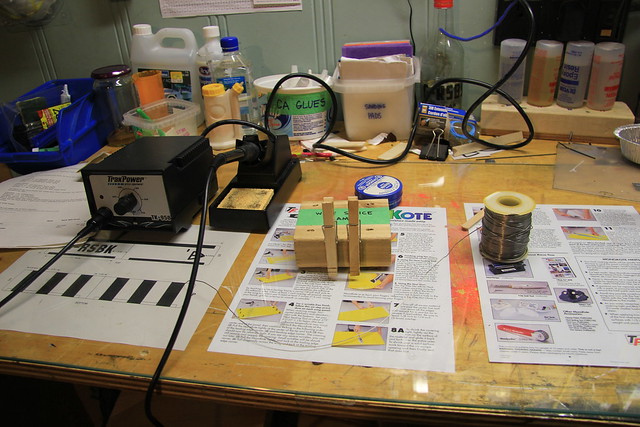
I have a write up on soldering splices if anyone's interested:
http://www.grosbeakrc.ca/tutorials/splice.html
I have a write up on soldering splices if anyone's interested:
http://www.grosbeakrc.ca/tutorials/splice.html
06-13-2013 | 05:11 PM
#12
 RE: Solder Question???
when I started to solder deans over heating was a problem. I found that if I was soldering a male onto a battery, I would plug it into a extra female and it would help heat sink a little and keep me from over heating them.
I have been soldering all my life, but its still a learning thing.
sticks
I have been soldering all my life, but its still a learning thing.
sticks


