


Identify this trainer!
 02-27-2007 | 01:07 PM
#1
Thread Starter
Senior Member
Joined: Oct 2006
Posts: 192
Likes: 0
Received 0 Likes
on
0 Posts
From: kansas City,
MO
 Identify this trainer!
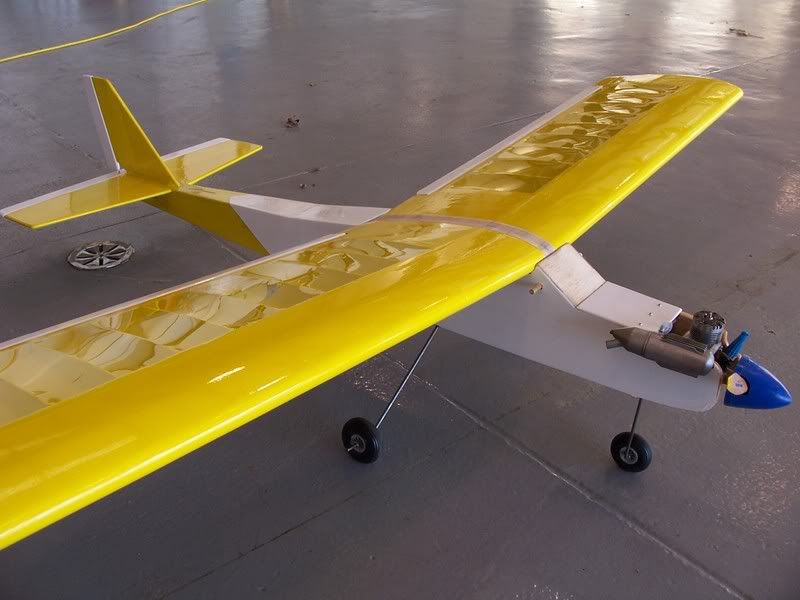
Can anyone help identify the kit maker and model of this 40-46 size trainer? 60-inch wingspan. This is the only photo I have until I pick it up this weekend. The seller didn't know who made the kit. (Click the link to see it.)
http://good-times.webshots.com/photo...ost=good-times

http://good-times.webshots.com/photo...ost=good-times


 02-27-2007 | 06:11 PM
#5

Senior Member
My Feedback: (14)
RE: Identify this trainer!
Looks to me to be one of the older PT-40 kits.
Things that give it away:
1) The elevator goes through the rudder. My father and my sister both had one of these and I remember the tail feathers. My sister still has hers.
2) The stringers in the wings look exactly the way the kit looked.
3) The rounded fake windscreen should be a solid block of balsa. Doesn't look like any other trainer on the market now.
4) The ailerons do not extend all the way to the wing tip as on most other trainers.
Note that this is the KIT, not the ARF version that GP sells now. The new PT-40 looks slightly different.
-Steve
Things that give it away:
1) The elevator goes through the rudder. My father and my sister both had one of these and I remember the tail feathers. My sister still has hers.
2) The stringers in the wings look exactly the way the kit looked.
3) The rounded fake windscreen should be a solid block of balsa. Doesn't look like any other trainer on the market now.
4) The ailerons do not extend all the way to the wing tip as on most other trainers.
Note that this is the KIT, not the ARF version that GP sells now. The new PT-40 looks slightly different.
-Steve

 02-27-2007 | 09:59 PM
#9
Thread Starter
Senior Member
Joined: Oct 2006
Posts: 192
Likes: 0
Received 0 Likes
on
0 Posts
From: kansas City,
MO
RE: Identify this trainer!
Duck- GREAT WORK! But who is the manufacturer?
I think the rounded, smallish windscreen is the clue and I wondered about that. The PT40MKII picture seems also seems to have a longish- "turtle deck" which doesn't match my picture, but perhaps the older version MkI doesn't. My picture has a flat one piece back behind the wing all the way to the tail feathers.
This is only important to me because if I decide to do any mods at all, I'd like to track down the plans and the balance points.
As another question, once you have done modifications to a plane, what's the general rule about a balance point? The thickest part of the wing, and then trim it out and see how it flies? I may post this as another newbie topic, since it applies to another of my old trainers I'm restoring and updating.
I think the rounded, smallish windscreen is the clue and I wondered about that. The PT40MKII picture seems also seems to have a longish- "turtle deck" which doesn't match my picture, but perhaps the older version MkI doesn't. My picture has a flat one piece back behind the wing all the way to the tail feathers.
This is only important to me because if I decide to do any mods at all, I'd like to track down the plans and the balance points.
As another question, once you have done modifications to a plane, what's the general rule about a balance point? The thickest part of the wing, and then trim it out and see how it flies? I may post this as another newbie topic, since it applies to another of my old trainers I'm restoring and updating.
02-28-2007 | 10:15 AM
#10
Senior Member
My Feedback: (14)
RE: Identify this trainer!
Great Planes made/makes the PT-40 series.
Unless you change the geometry of the wing, you should not deviate too far from the manufacturer's recomended balance point. On this plane a good starting point would be about 27-30% of the mean aerodynamic chord (MAC) for stability. Check around in the aerodynamics forum and they can help you out with understanding CG better.
By the way, in stock form this plane is very stable and will make a great primary trainer.
After you learn to fly it well, I had a freind who put a bigger engine on the nose, larger control surfaces, added flaps, and converted it to a tail dragger and made it into a well-behaved bush plane.
-Steve
Unless you change the geometry of the wing, you should not deviate too far from the manufacturer's recomended balance point. On this plane a good starting point would be about 27-30% of the mean aerodynamic chord (MAC) for stability. Check around in the aerodynamics forum and they can help you out with understanding CG better.
By the way, in stock form this plane is very stable and will make a great primary trainer.
After you learn to fly it well, I had a freind who put a bigger engine on the nose, larger control surfaces, added flaps, and converted it to a tail dragger and made it into a well-behaved bush plane.
-Steve
02-28-2007 | 02:35 PM
#11
Senior Member
Joined: Apr 2002
Posts: 4,987
Likes: 0
Received 0 Likes
on
0 Posts
From: Laurel, MD,
RE: Identify this trainer!
I'll second the vote for it being an older PT-40 kit. We had one as a club trainer back around '88 timeframe, and it looked a lot like that one. Great flying plane, I probably taught a dozen people to fly on it.
03-04-2007 | 11:46 PM
#12
Thread Starter
Senior Member
Joined: Oct 2006
Posts: 192
Likes: 0
Received 0 Likes
on
0 Posts
From: kansas City,
MO
RE: Identify this trainer!
Yep I picked it up this weekend. It has been rode hard and put up wet, and I've already stripped off the old layers of wrinkled covering, ready to try to restore it to it's original beauty. While I was with the seller, he also talked me into buying a Super Sporster Biplane for $40, which is beyond my flying skills at this point, but I will enjoy restoring it too.
Thanks for all your help in identifying it.
Thanks for all your help in identifying it.


