


pitts muffler

 08-27-2009 | 04:56 AM
#2
Senior Member
 RE: pitts muffler
Designing a tuned pipe muffler is a tough proposition. It involves creating a pressure wave that amplifies itself. The length of the pipe is adjusted based on the timing for that wave. Because of all that, most tuned mufflers wind up being pipes or tubes. They need the length to "catch the wave".
So don't look for pitts mufflers that work like tuned pipes. The requirement to keep all the muffler within the cowling blows their chances of creating the amplification.
So don't look for pitts mufflers that work like tuned pipes. The requirement to keep all the muffler within the cowling blows their chances of creating the amplification.
08-27-2009 | 04:59 AM
#3
Thread Starter

Joined: Dec 2008
Posts: 780
Likes: 0
Received 0 Likes
on
0 Posts
From: Bremen, Germany
RE: pitts muffler
I knew that, just thought someone out there maybe knew of something for me to get lucky... it would have looked nice on my Revolver coming out from underneath... but I guess I will just get a proper muffler...
08-27-2009 | 05:38 AM
#4


My Feedback: (1)
RE: pitts muffler
Why in heck do you need an RPM range like that? I hope you are not working with the information provided by manufacturers about the power output of the engine based on RPM because RPM's of that range are usually not attainable in most "MOST" stock commercial engines. The power range is usually in the neighborhood of 10,000 to about 13,000 RPM, depending on the engine.
I typically prop my engines to get a max RPM of about 12,000 out of my smaller (.46 - .55) engines the larger the lower that number will be. I typically get around 10,000 out of my OS .75 AX, and about 9,000 out of my 1.20 AX's, which is really working in the torque range of those engines. I get "unlimited vertical" out of my 1.20's on my pattern planes, and with my Goldberg Skylark 70 also, with the .55 AX.
Just remember what I always say about prop'ing engine is that noise does not equate to power. And an engine turning at that RPM will definitely make noise, but will not really gain you anything that properly prop'ing an engine will give you. And, of course, your engines will last longer at the lower RPM.
CGr.
I typically prop my engines to get a max RPM of about 12,000 out of my smaller (.46 - .55) engines the larger the lower that number will be. I typically get around 10,000 out of my OS .75 AX, and about 9,000 out of my 1.20 AX's, which is really working in the torque range of those engines. I get "unlimited vertical" out of my 1.20's on my pattern planes, and with my Goldberg Skylark 70 also, with the .55 AX.
Just remember what I always say about prop'ing engine is that noise does not equate to power. And an engine turning at that RPM will definitely make noise, but will not really gain you anything that properly prop'ing an engine will give you. And, of course, your engines will last longer at the lower RPM.
CGr.
08-27-2009 | 07:10 AM
#5
Thread Starter
Joined: Dec 2008
Posts: 780
Likes: 0
Received 0 Likes
on
0 Posts
From: Bremen, Germany
RE: pitts muffler
I want the RPMS for speed... I am using 11x8 prop... theory tells me that the max allowable speed if I hit max RPMS and there is no drag taking out account of all factors... pitch of 8 x 16 (16000RPMS) = 128 MPH... thats what I am going for... and I want to try and get those RPMS in air...
08-27-2009 | 09:58 AM
#7
Senior Member
RE: pitts muffler
ORIGINAL: CGRetired
Just remember what I always say about prop'ing engine is that noise does not equate to power.
CGr.
Just remember what I always say about prop'ing engine is that noise does not equate to power.
CGr.
 Actualllllyyyyyy........... since you said it that way................
noise does equate to power
The extra loud noise you hear when the rpms and prop diameter match up usually is some of the power being sluffed off to create the noise. So in a sense, hearing that louder noise means you're wasting some power.
There is another benefit of not making that noise by turning a larger diameter prop slower. The pitch is almost always greater and that usually means you've got a more efficient pitch/diameter. As well as having a more efficient result from the slower rpms. Neither effect is major, but heck, it's fun to talk about, and nobody has any proof if the effects actually are enough to matter. So it's just some more noise..............
08-27-2009 | 10:09 AM
#8
Thread Starter
Joined: Dec 2008
Posts: 780
Likes: 0
Received 0 Likes
on
0 Posts
From: Bremen, Germany
RE: pitts muffler
the main goal is just to fly fast and look good while doing so... the Revolver looks good... I have seen it do 159 with an electric and 129 with a 55AX by just running at high RPMS... which is why I don't care about power loss or anything... just want to get into those revs... I have posted in the speed prop area... but you guys reply sooner... and I get most my info from here...
08-27-2009 | 01:14 PM
#9

Senior Member
Joined: Feb 2006
Posts: 3,204
Likes: 0
Received 0 Likes
on
0 Posts
From: Poland,
OH
RE: pitts muffler
RPMs alone do not equal speed.
Prop design has alot of play.
There is a point with any prop that I call the sweet spot. that is where the prop is most efficient after that point you can reach a point that you will actually lose speed as the RPMs increase. You may find that your plane will fly faster at 14,000 rpms than at 16,000. You would have to experiment and find out.
Prop design has alot of play.
There is a point with any prop that I call the sweet spot. that is where the prop is most efficient after that point you can reach a point that you will actually lose speed as the RPMs increase. You may find that your plane will fly faster at 14,000 rpms than at 16,000. You would have to experiment and find out.
08-27-2009 | 01:47 PM
#11
My Feedback: (1)
RE: pitts muffler
ORIGINAL: da Rock
Actualllllyyyyyy........... since you said it that way................
noise does equate to power
The extra loud noise you hear when the rpms and prop diameter match up usually is some of the power being sluffed off to create the noise. So in a sense, hearing that louder noise means you're wasting some power.
There is another benefit of not making that noise by turning a larger diameter prop slower. The pitch is almost always greater and that usually means you've got a more efficient pitch/diameter. As well as having a more efficient result from the slower rpms. Neither effect is major, but heck, it's fun to talk about, and nobody has any proof if the effects actually are enough to matter. So it's just some more noise..............
ORIGINAL: CGRetired
Just remember what I always say about prop'ing engine is that noise does not equate to power.
CGr.
Just remember what I always say about prop'ing engine is that noise does not equate to power.
CGr.
Actualllllyyyyyy........... since you said it that way................noise does equate to power
The extra loud noise you hear when the rpms and prop diameter match up usually is some of the power being sluffed off to create the noise. So in a sense, hearing that louder noise means you're wasting some power.
There is another benefit of not making that noise by turning a larger diameter prop slower. The pitch is almost always greater and that usually means you've got a more efficient pitch/diameter. As well as having a more efficient result from the slower rpms. Neither effect is major, but heck, it's fun to talk about, and nobody has any proof if the effects actually are enough to matter. So it's just some more noise..............
So, in that case, noise does not equate to power. A perfect example was my Tiger 60 that had an OS 61 on board. I proped it, don't recall what prop I used, but I was turning about, oh, 13,500 RPM. It made a lot of noise but wasn't doing much in the air. But, it made lots of noise and it attracted lots of attention. I was better off using a good prop that got the engine in the power range of about 11,500 RPM and without all the tip speed noise.
CGr.
08-27-2009 | 03:31 PM
#13
Senior Member
RE: pitts muffler
ORIGINAL: CGRetired
What I meant is that many seem to think that when an engine/prop is making a lot of noise, it must be generating a lot of power. This is just not so. It takes the right combination of power (engine) and the right prop to get the desired speed. And, of course, that just won't happen with EVERY airframe. The airframe will only go so fast before it begins to have harsh consequences.
So, in that case, noise does not equate to power. A perfect example was my Tiger 60 that had an OS 61 on board. I proped it, don't recall what prop I used, but I was turning about, oh, 13,500 RPM. It made a lot of noise but wasn't doing much in the air. But, it made lots of noise and it attracted lots of attention. I was better off using a good prop that got the engine in the power range of about 11,500 RPM and without all the tip speed noise.
CGr.
ORIGINAL: da Rock
Actualllllyyyyyy........... since you said it that way................
noise does equate to power
The extra loud noise you hear when the rpms and prop diameter match up usually is some of the power being sluffed off to create the noise. So in a sense, hearing that louder noise means you're wasting some power.
There is another benefit of not making that noise by turning a larger diameter prop slower. The pitch is almost always greater and that usually means you've got a more efficient pitch/diameter. As well as having a more efficient result from the slower rpms. Neither effect is major, but heck, it's fun to talk about, and nobody has any proof if the effects actually are enough to matter. So it's just some more noise..............
ORIGINAL: CGRetired
Just remember what I always say about prop'ing engine is that noise does not equate to power.
CGr.
Just remember what I always say about prop'ing engine is that noise does not equate to power.
CGr.
Actualllllyyyyyy........... since you said it that way................noise does equate to power
The extra loud noise you hear when the rpms and prop diameter match up usually is some of the power being sluffed off to create the noise. So in a sense, hearing that louder noise means you're wasting some power.
There is another benefit of not making that noise by turning a larger diameter prop slower. The pitch is almost always greater and that usually means you've got a more efficient pitch/diameter. As well as having a more efficient result from the slower rpms. Neither effect is major, but heck, it's fun to talk about, and nobody has any proof if the effects actually are enough to matter. So it's just some more noise..............
So, in that case, noise does not equate to power. A perfect example was my Tiger 60 that had an OS 61 on board. I proped it, don't recall what prop I used, but I was turning about, oh, 13,500 RPM. It made a lot of noise but wasn't doing much in the air. But, it made lots of noise and it attracted lots of attention. I was better off using a good prop that got the engine in the power range of about 11,500 RPM and without all the tip speed noise.
CGr.
Yeah, I knew what you were saying, and wasn't arguing, just adding the bit about the sound from prop tips. Adding to your already good advice. With a slight bit of a new direction. I shoulda put a few more smiley faces in the post, I reckon. Good thing is that you added more examples that'll be good for beginners to read. That's the idea, after all.
08-27-2009 | 03:37 PM
#14

Joined: Nov 2005
Posts: 12,624
Likes: 0
Received 0 Likes
on
0 Posts
From: Poolesville, MD
RE: pitts muffler
ORIGINAL: Switch_639
Here is a chart, will this help you guys to tell me if I would be good or not? will I be losing speed beyond these RPM?
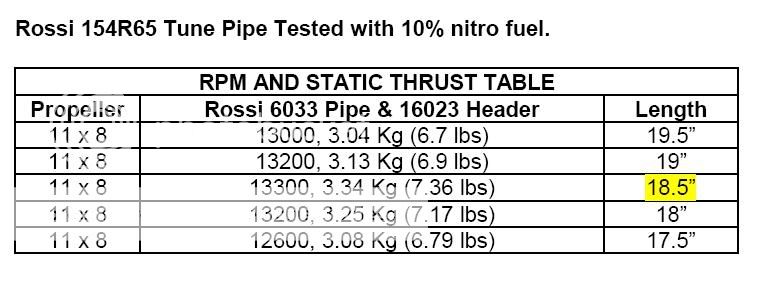
Here is a chart, will this help you guys to tell me if I would be good or not? will I be losing speed beyond these RPM?
High RPM engines are typically designed for this from the start.
08-27-2009 | 03:38 PM
#15
Senior Member
RE: pitts muffler
ORIGINAL: Switch_639
Here is a chart, will this help you guys to tell me if I would be good or not? will I be losing speed beyond these RPM?
Here is a chart, will this help you guys to tell me if I would be good or not? will I be losing speed beyond these RPM?
And so far, it doesn't appear that you've mentioned what engine your running. What does it tach on the ground now? How are you measuring the speed?
08-27-2009 | 07:03 PM
#16
My Feedback: (1)
RE: pitts muffler
ORIGINAL: da Rock
Yeah, I knew what you were saying, and wasn't arguing, just adding the bit about the sound from prop tips. Adding to your already good advice. With a slight bit of a new direction. I shoulda put a few more smiley faces in the post, I reckon. Good thing is that you added more examples that'll be good for beginners to read. That's the idea, after all.
ORIGINAL: CGRetired
What I meant is that many seem to think that when an engine/prop is making a lot of noise, it must be generating a lot of power. This is just not so. It takes the right combination of power (engine) and the right prop to get the desired speed. And, of course, that just won't happen with EVERY airframe. The airframe will only go so fast before it begins to have harsh consequences.
So, in that case, noise does not equate to power. A perfect example was my Tiger 60 that had an OS 61 on board. I proped it, don't recall what prop I used, but I was turning about, oh, 13,500 RPM. It made a lot of noise but wasn't doing much in the air. But, it made lots of noise and it attracted lots of attention. I was better off using a good prop that got the engine in the power range of about 11,500 RPM and without all the tip speed noise.
CGr.
ORIGINAL: da Rock
Actualllllyyyyyy........... since you said it that way................
noise does equate to power
The extra loud noise you hear when the rpms and prop diameter match up usually is some of the power being sluffed off to create the noise. So in a sense, hearing that louder noise means you're wasting some power.
There is another benefit of not making that noise by turning a larger diameter prop slower. The pitch is almost always greater and that usually means you've got a more efficient pitch/diameter. As well as having a more efficient result from the slower rpms. Neither effect is major, but heck, it's fun to talk about, and nobody has any proof if the effects actually are enough to matter. So it's just some more noise..............
ORIGINAL: CGRetired
Just remember what I always say about prop'ing engine is that noise does not equate to power.
CGr.
Just remember what I always say about prop'ing engine is that noise does not equate to power.
CGr.
Actualllllyyyyyy........... since you said it that way................noise does equate to power
The extra loud noise you hear when the rpms and prop diameter match up usually is some of the power being sluffed off to create the noise. So in a sense, hearing that louder noise means you're wasting some power.
There is another benefit of not making that noise by turning a larger diameter prop slower. The pitch is almost always greater and that usually means you've got a more efficient pitch/diameter. As well as having a more efficient result from the slower rpms. Neither effect is major, but heck, it's fun to talk about, and nobody has any proof if the effects actually are enough to matter. So it's just some more noise..............
So, in that case, noise does not equate to power. A perfect example was my Tiger 60 that had an OS 61 on board. I proped it, don't recall what prop I used, but I was turning about, oh, 13,500 RPM. It made a lot of noise but wasn't doing much in the air. But, it made lots of noise and it attracted lots of attention. I was better off using a good prop that got the engine in the power range of about 11,500 RPM and without all the tip speed noise.
CGr.
Yeah, I knew what you were saying, and wasn't arguing, just adding the bit about the sound from prop tips. Adding to your already good advice. With a slight bit of a new direction. I shoulda put a few more smiley faces in the post, I reckon. Good thing is that you added more examples that'll be good for beginners to read. That's the idea, after all.
Beginners do learn from this stuff, I hope, and pass it on to someone else, which is a good thing, for sure!
(There.. a smiley face!!  )
)CGr


