


Throttled versus CL Engines
 03-26-2015 | 10:01 PM
#1
Thread Starter

My Feedback: (16)
Joined: May 2002
Posts: 558
Likes: 0
Received 0 Likes
on
0 Posts
From: Clinton,
UT
 Throttled versus CL Engines
Is there any real detriment for a non competitive flyer to use an engine equipped with a throttle? That is of course considering the throttle were just fixed wide open.
 03-27-2015 | 05:25 AM
#3

Just if you crash. The rc carb is more vulnerable and expensive to fix. Normally it is cheaper because it is there to begin with, naturally. It is slightly higher if mounted upright, but usually that makes little difference, maybe richer when inverted.
03-27-2015 | 05:28 AM
#4


My Feedback: (1)
You mean something like this  . The answer is absolutely no real detriment. Doing so works perfectly fine. I have helped a few each year set their airplanes up this way wth no problems. Actually since 2002 when I dropped into this wheelchair I thought I thought controlline was over for me and would be stuck with just RC. But I discovered the 'Bill Young' over the wire electronic throttle control and never looked back using only throttled engines. That system is dated now and currently use 2.4 throttle on all my controlline airplanes.
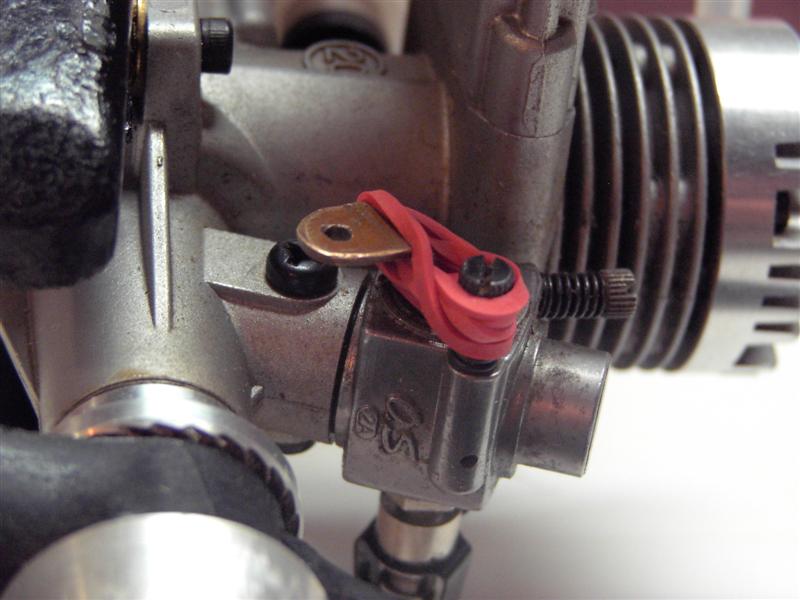
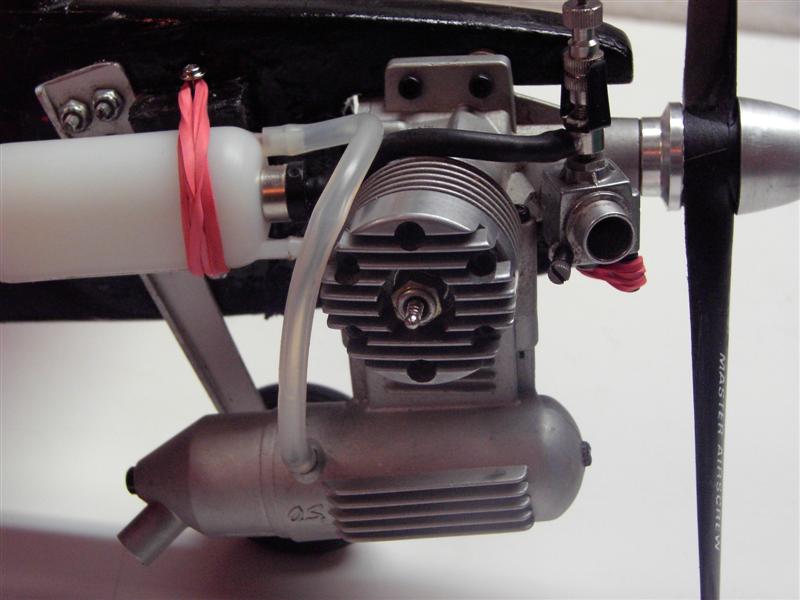
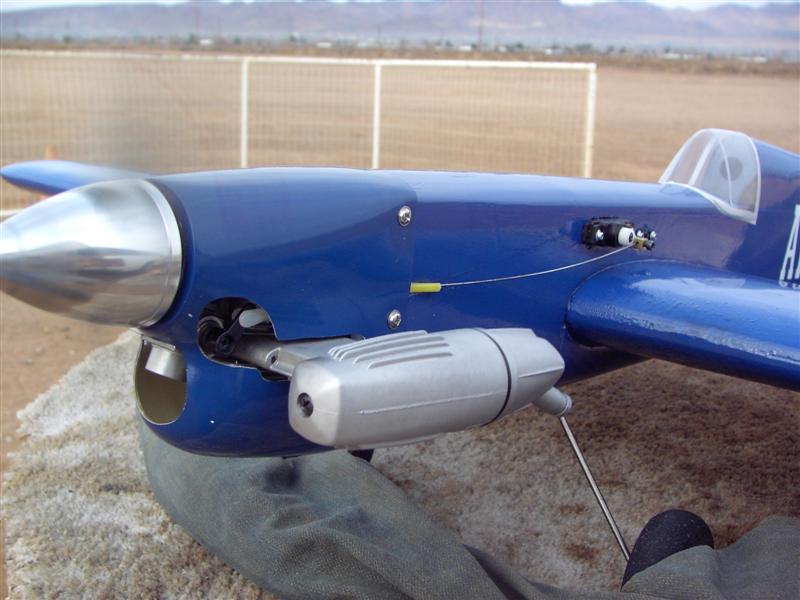
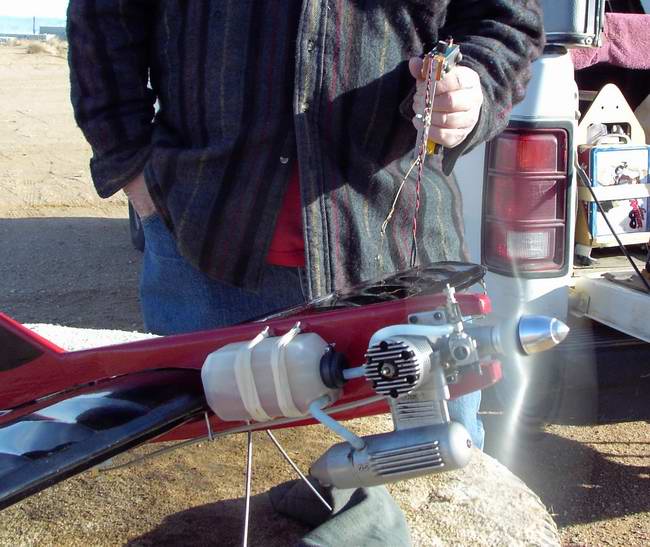
John
. The answer is absolutely no real detriment. Doing so works perfectly fine. I have helped a few each year set their airplanes up this way wth no problems. Actually since 2002 when I dropped into this wheelchair I thought I thought controlline was over for me and would be stuck with just RC. But I discovered the 'Bill Young' over the wire electronic throttle control and never looked back using only throttled engines. That system is dated now and currently use 2.4 throttle on all my controlline airplanes. John
Last edited by JohnBuckner; 03-27-2015 at 05:41 AM.
03-27-2015 | 10:30 AM
#5
Thread Starter
My Feedback: (16)
Joined: May 2002
Posts: 558
Likes: 0
Received 0 Likes
on
0 Posts
From: Clinton,
UT
Thanks guys. I bought a Stuntin' Ringmaster .35 Pro. I intended to put a McCoy .35 on it. Although it runs great on the bench everything I read about them on the forums has me thinking I had better find something else. The next CL engine I have is an ST 21/46 it's 4.5 ounces heavier with a muffler. The closest choice by weight is a Fox .36. It's only .6 ounces heavier but it's R/C. This is a new experience for me I've been flying RC for many years and 1/2 A CL on and off. This will be my first CL experience in this size range.
03-28-2015 | 07:04 AM
#6
If the McCoy runs well on the bench, there is no reason to think it won't run on the airplane. I would advise that you use fuel with at least 20% oil, and at least half of that castor. The same advice applies to the Fox .36. Sig red fuels are 20%, 1/2 Klotz, 1/2 Castor. They also make an all-castor blend in 20 and 25 percent. If you must use one of the low oil RC fuels, add castor to it.
03-28-2015 | 08:35 AM
#7
John:
I'm thinking of playing around with throttle control on a future C/L model. You mentioned 2.4 gig above. I take it you mean use of a transmitter either as part of your C/L handle or a separate unit somehow? Also, what receiver and servo setup would you use for .25 to .40 engines? Perhaps you've covered this elsewhere on this board and I just need to do a proper search.
Thanks!
Davey Mo...
I'm thinking of playing around with throttle control on a future C/L model. You mentioned 2.4 gig above. I take it you mean use of a transmitter either as part of your C/L handle or a separate unit somehow? Also, what receiver and servo setup would you use for .25 to .40 engines? Perhaps you've covered this elsewhere on this board and I just need to do a proper search.
Thanks!
Davey Mo...
03-28-2015 | 11:02 AM
#8
My Feedback: (1)
OK CLB and Davey If I may please let me point out a few things about using RC throttled engines and the ways of actuating those throttles.
Using a throttled engine will allow you to perform maneuvers hereto for only just dreamed about. First of course the touch and goes that can be for an entire flight if you like and is a joy.
Next straight line taxi for any distance is possible. Yes before I was in this chair it was a joy take off and fly at one end of the runway then land and taxi for the full distance of the runway then take off agine on the opposite end. This can only be done with the over the wire or RC systems and it was a simple matter to walk along with an occasional tug to make small corrections and control speed with throttle. The old three line (or more) could not do this because of the intermittent slacking of the lines.
OK another advantage of using an RC engine is just as Mikeainia pointed out there is no need to stock and transport special fuels beyond your normal RC fuels.
Now lets talk about the control systems if you use a throttle (or more). I used the Bill Young three channel over the wire system for about fifteen years. It used a custom trigger grip along with other switchs and trims. This system at the time was wonderful for me and I love it however it does have problems that is endemic to any over the wire system. First that trigger which is what every body wants is for me a bad idea being difficult to make precision throttle changes while at the same time controlling the airplane. After all those years I still dislike a trigger grip for throttle.
The next problem of any over the wire system is first you need insulated flying line and the two electronic wires that attach to each end of the lines are a weak point and tend to get beat up and sometimes fail leaving one with a very long flight but not by choice. Set up of these special lines are time consuming although not nearly as bad as the old three line (and more) systems. I grew to dread the set up time.
Walla, the advent of 2.4 now is wonderful and we can use the systems freely and at our RC fields if we desire. Setup time is as fast almost as just flying ordinary two line and I do not have to use that pesky trigger grip. There are no wires to hook up with plugs.
I use an elderly Hitec Prism 7X with 2.4 module with a matching receiver and a HS 81 servo to actuate the throttle. The power is four cell 270 mah pack that is quite small and seems to last forever.
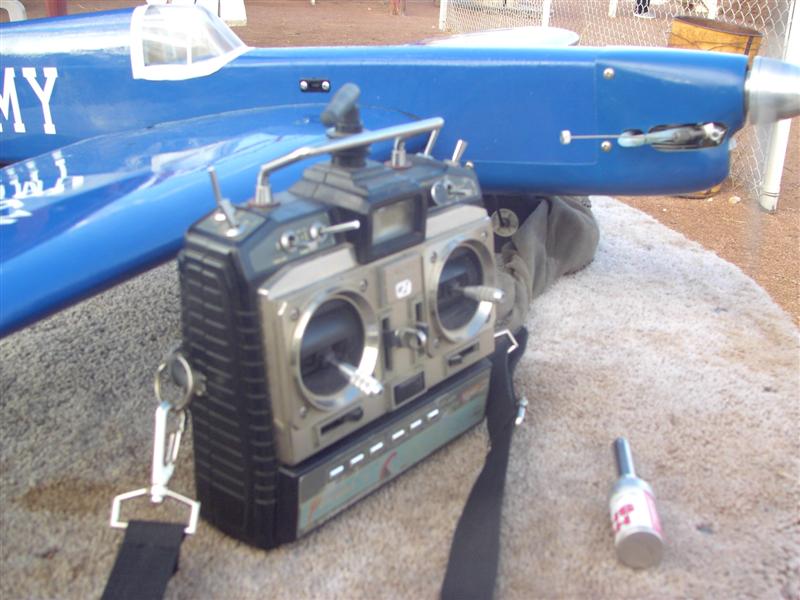
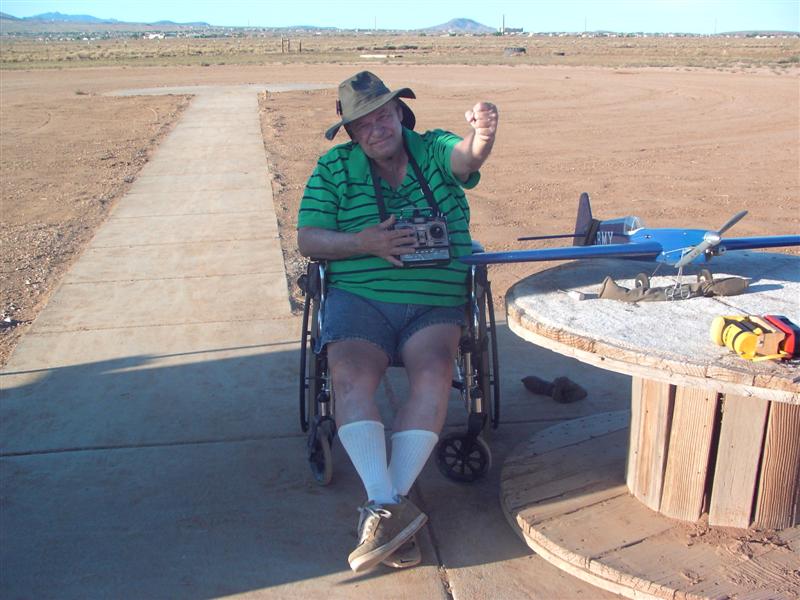
On to the best part I did a small mod to the Tx and bonded two hooks to the sides of the unit about where one formerly would have gripped the trx. Then just using an ordinary neck strap the tranny is worn around my neck and hangs in front with the sticks pointing toward the airplane. Using my left to fly the airplane its far easier to use my right for the throttle stick. .
I will try to get some pics up in a few.
John
Using a throttled engine will allow you to perform maneuvers hereto for only just dreamed about. First of course the touch and goes that can be for an entire flight if you like and is a joy.
Next straight line taxi for any distance is possible. Yes before I was in this chair it was a joy take off and fly at one end of the runway then land and taxi for the full distance of the runway then take off agine on the opposite end. This can only be done with the over the wire or RC systems and it was a simple matter to walk along with an occasional tug to make small corrections and control speed with throttle. The old three line (or more) could not do this because of the intermittent slacking of the lines.
OK another advantage of using an RC engine is just as Mikeainia pointed out there is no need to stock and transport special fuels beyond your normal RC fuels.
Now lets talk about the control systems if you use a throttle (or more). I used the Bill Young three channel over the wire system for about fifteen years. It used a custom trigger grip along with other switchs and trims. This system at the time was wonderful for me and I love it however it does have problems that is endemic to any over the wire system. First that trigger which is what every body wants is for me a bad idea being difficult to make precision throttle changes while at the same time controlling the airplane. After all those years I still dislike a trigger grip for throttle.
The next problem of any over the wire system is first you need insulated flying line and the two electronic wires that attach to each end of the lines are a weak point and tend to get beat up and sometimes fail leaving one with a very long flight but not by choice. Set up of these special lines are time consuming although not nearly as bad as the old three line (and more) systems. I grew to dread the set up time.
Walla, the advent of 2.4 now is wonderful and we can use the systems freely and at our RC fields if we desire. Setup time is as fast almost as just flying ordinary two line and I do not have to use that pesky trigger grip. There are no wires to hook up with plugs.
I use an elderly Hitec Prism 7X with 2.4 module with a matching receiver and a HS 81 servo to actuate the throttle. The power is four cell 270 mah pack that is quite small and seems to last forever.
On to the best part I did a small mod to the Tx and bonded two hooks to the sides of the unit about where one formerly would have gripped the trx. Then just using an ordinary neck strap the tranny is worn around my neck and hangs in front with the sticks pointing toward the airplane. Using my left to fly the airplane its far easier to use my right for the throttle stick. .
I will try to get some pics up in a few.
John
Last edited by JohnBuckner; 03-28-2015 at 11:09 AM.
03-28-2015 | 11:56 AM
#9
Thread Starter
My Feedback: (16)
Joined: May 2002
Posts: 558
Likes: 0
Received 0 Likes
on
0 Posts
From: Clinton,
UT
After spending quite a lot of time researching fuels I ended up ordering a couple different ones from Sig last Monday. I found (especially in higher nitro content) other fuel brands with 20% or more oil advertising castor/ synthetic blends did in fact only contain 1% castor. Sig is the only brand I could find that clearly stated the mix percentages, and how much of the advertised oil content is castor. They were also the only company that gave the brand name of their synthetic (Klotz). I bought 10% nitro 20% oil 50/50 Klotz/ castor for the majority of my engines and 35% sharing the other specs for my 1/2 A engines.
03-28-2015 | 01:40 PM
#10
My Feedback: (1)
DaveyMo
Here are a few pictures that show how I use the conventional two stick RC transmitter (it can be either mode two or one) worn backwards with the bonded clips. Even if I were not in the wheelchair I would continue to use mostly throttled engines and 2.4 for control:
John
Here are a few pictures that show how I use the conventional two stick RC transmitter (it can be either mode two or one) worn backwards with the bonded clips. Even if I were not in the wheelchair I would continue to use mostly throttled engines and 2.4 for control:
John
03-28-2015 | 01:58 PM
#11
For fuel on the older motors of which most of mine are, I just add 3 oz. of castor per gallon to whatever fuel I have, unless it is clearly labelled to have 10% syth. and 10% castor. As for the 2.4 throttles, I was thinking of using the pistol type radio in my left hand and the handle in my right on some future project. I have seen some pics of the pistol type transmitters with the handle built in. I would think maybe with stunting a lot, that the throttle adjustment on the trigger could be bumped or sloppy? Not sure if wheelchair flying would be possible even, with both hands used up.
03-28-2015 | 02:52 PM
#12
My Feedback: (1)
One of the problems with the pistol grip set up is the weight and shape either above, below or in front of the handle and I can best describe this aspeed by comparison with the old Jim Walker UReely which I am sure you know was somewhat ackward with its mass considerably forward.
What I fround works best in my years with the Bill Young pistol grip is to simply keep the throttle nailed as if there was no throttle during all maneuvering and pattern stuff. Only reducing power for slow speed stuff, touch and goes etc. It is during this slow stuff that precision throttle positioning becomes most difficult with a pistol grip.
Now with the 2.4 tranny on my neck this difficult throttle positioning is very easy and far more preferable. Also I do not keep my free hand continuously on the throttle, not necessary and not needed. So yes the chair flying is possible and practical while stil multi tasking with the free hand. I have had a considerable number of flights on a Kaos, Magician and a Jr Ringmaster over the last two years using 2.4.
For whatever reason my Magician by going inverted and up to a 45 degree angle to increase the rotation speed will by using my free hand to lock one wheel and raising my good foot will spin me until the tank is dry or my arm becomes exhausted.
John
What I fround works best in my years with the Bill Young pistol grip is to simply keep the throttle nailed as if there was no throttle during all maneuvering and pattern stuff. Only reducing power for slow speed stuff, touch and goes etc. It is during this slow stuff that precision throttle positioning becomes most difficult with a pistol grip.
Now with the 2.4 tranny on my neck this difficult throttle positioning is very easy and far more preferable. Also I do not keep my free hand continuously on the throttle, not necessary and not needed. So yes the chair flying is possible and practical while stil multi tasking with the free hand. I have had a considerable number of flights on a Kaos, Magician and a Jr Ringmaster over the last two years using 2.4.
For whatever reason my Magician by going inverted and up to a 45 degree angle to increase the rotation speed will by using my free hand to lock one wheel and raising my good foot will spin me until the tank is dry or my arm becomes exhausted.
John
 03-29-2015 | 04:44 AM
#16

Get a little creative. Get on the ELECTRONIC DESIGN section here & at RC Groups. A super tiny micro receiver & servo setup in the plane would allow that light throttle effort to be fully controllable even if the lines twist & touch as in stunt & combat.
Go for it
Landing & take offs are a scale lovers dream. Carrier would be nicer to. No 3 rd wire needed. The DIY guys can show you how to do a EXTERNAL speed control potentiometer box on your belt. WE did all the When I was very young. I am 77. Many ways to get what you want. They could even put the speed pot box on your wrist with a Velcro strap.
Go for it
Landing & take offs are a scale lovers dream. Carrier would be nicer to. No 3 rd wire needed. The DIY guys can show you how to do a EXTERNAL speed control potentiometer box on your belt. WE did all the When I was very young. I am 77. Many ways to get what you want. They could even put the speed pot box on your wrist with a Velcro strap.
Last edited by cyclops2; 03-29-2015 at 04:50 AM.
03-29-2015 | 02:01 PM
#17
Hey John:
Thanks for the detailed explanation and the photo's. But above all, much obliged for your wheelchair technique and desire to stick with it - an inspiration indeed! Having said that, you've convinced me that 2.4 throttle control is the way to go.
Oh One-Eyed One:
You've indicated that there's more than one way to get this done. I'll look into the resources you've mentioned. Thanks!
Davey Mo....
Thanks for the detailed explanation and the photo's. But above all, much obliged for your wheelchair technique and desire to stick with it - an inspiration indeed! Having said that, you've convinced me that 2.4 throttle control is the way to go.
Oh One-Eyed One:
You've indicated that there's more than one way to get this done. I'll look into the resources you've mentioned. Thanks!
Davey Mo....
04-01-2015 | 06:25 PM
#18

Regarding RC engines on CL planes, I found that RC engines work well.
I replaced the OS Max 15FP-S and 8x4 Masters prop with an Enya 15-III TV and 8x6 Masters prop. With throttle wired wide open I found I was getting the same lap speeds. The plain bearing Enya cross scavenge HP peaks out at a lower RPM than the sport Schneurle ported OS.
These Enyas are powerful little rascals.
I replaced the OS Max 15FP-S and 8x4 Masters prop with an Enya 15-III TV and 8x6 Masters prop. With throttle wired wide open I found I was getting the same lap speeds. The plain bearing Enya cross scavenge HP peaks out at a lower RPM than the sport Schneurle ported OS.
These Enyas are powerful little rascals.
04-01-2015 | 09:37 PM
#19
Thread Starter
My Feedback: (16)
Joined: May 2002
Posts: 558
Likes: 0
Received 0 Likes
on
0 Posts
From: Clinton,
UT
I'm not going to play with throttles while I'm learning. I've found the McCoy .35 and the throttled Fox .36? are quite interchangeable. I'll try both. I doubt the carb on the Fox would actually be very successful for throttling. I have several other engines but these two are the lightest in that size range. Also they're likely to be stuffed in the turf.
04-02-2015 | 05:38 AM
#20
"Also they're likely to be stuffed in the turf." Hopefully not a self fulfilling prophecy. If the plane is fairly light, the damage to the motors is sometimes less anyway. Hard to believe an 8-6 prop on a .15 works. Must have been a strong motor for it's day.
04-02-2015 | 07:55 AM
#21
Originally Posted by Peter Chinn
As regards power, the 15-III TV did not put out the highest horsepower of any .15 R/C engine we have tested to date, but it was one of the best nevertheless. With the muffler fitted, maximum power was developed at just over 12,000 rpm where an output of nearly 0.23 bhp was indicated. When the muffler was removed, power went up to over 0.25 bhp at approximately 12,700 rpm. Typical prop speeds, without muffler fitted, included 8500 on a 10x4 Tornado nylon, 10,000 on a 9x4 Top-Flite nylon, 11,500 on an 8x6 Power-Prop, 12,600 on an 8x4 Top-Flite nylon and 14,100 on an 8x3-1/2 Top-Flite wood. Fitting the muffler reduced these figures by 100-500 rpm but, as we have previously remarked, slightly helped idle.
This Aeromodeller article http://www.sceptreflight.net/Model%2...-III%20CL.html stated:
Originally Posted by Peter Chinn
Only when props smaller than 8x4 were tried, did the Enya's starting deteriorate and, since such a prop size would take r.p.m. beyond the b.h.p. peaking speed, this is of academic interest only.
04-02-2015 | 05:22 PM
#23
 As is, they are able to cut leather. I learned to break the edges, which helps.
  06-05-2015 | 07:46 PM
#25
Joined: Oct 2014
Posts: 31
Likes: 0
Received 0 Likes
on
0 Posts
I fly CL scale and I have a Sig Skyray with throttle control on the model that I use for practice. I use the tactic 650 transmitter that is clipped to my belt. After you fly with 2.4 Ghz you won't go back to the down the wire systems. The conversion from down the wire to 2.4 Ghz required me to swap out to new receiver and I was done!
I only have one model without throttle control so for me flying without throttle is new for me!
Fred Cronenwett
I only have one model without throttle control so for me flying without throttle is new for me!
Fred Cronenwett

