


FROG 149 Vibramatic
 09-12-2013 | 04:04 PM
#26


The resonance between two engines on a single wng is something that has to be seen to be believed. A mere 12" separation is no hindrance. I recall a friend who put two Fox stunt (glow) .35 engines on a "combat" CL wing. He described the response as like wringing out a hand towel! With the simple, old Fox 35 stunt!
Needless to say, the center section between the two engines MUST be sturdy- or limber enough to prevent linking the two torques...
Some of our 1/2A (up to 1cc/.061 cu in) profile scale multi-engine profiles - Mike Keville rules - models seem to rely more on 'softness' than rigidity.
Whatever works, eh?
Needless to say, the center section between the two engines MUST be sturdy- or limber enough to prevent linking the two torques...
Some of our 1/2A (up to 1cc/.061 cu in) profile scale multi-engine profiles - Mike Keville rules - models seem to rely more on 'softness' than rigidity.
Whatever works, eh?
 09-12-2013 | 10:24 PM
#27
Senior Member
Yeah Lou, obviously resonance exists, but DD suggested it would affect the Frog reed valves, and it was that statement that surprised me.
Plus the fact that most people's experience with reed valves is limited to Cox 049s, and they're so specific and inconsistent anyway that one couldn't base much assessment on running BabeBees.
I've only ever built one twin (in 1963!), a CL scale Catalina with one Oliver Tiger and one PAW 2.49. I certainly don't recall any problem due to resonance...
Plus the fact that most people's experience with reed valves is limited to Cox 049s, and they're so specific and inconsistent anyway that one couldn't base much assessment on running BabeBees.
I've only ever built one twin (in 1963!), a CL scale Catalina with one Oliver Tiger and one PAW 2.49. I certainly don't recall any problem due to resonance...
09-12-2013 | 11:35 PM
#28
My Feedback: (1)
I'm certainly not surprised that anything with a Fox 35 for power would have a resonance problem. Two even more so!
I've only ever built one twin, a c/l model for twin Norvel 061's, and they ran as smooth as a baby's bottom.
I have recently seen a full size Catalina run up on our local lakeside hardstand. At full RPM with the pilots holding it on the brakes with full down elevator (as in the pic)
the rear tail section, from just behind the side bubbles, resonated at least a foot either side at the tailplane tips.
Presumably this doesn't happen when it's flying!
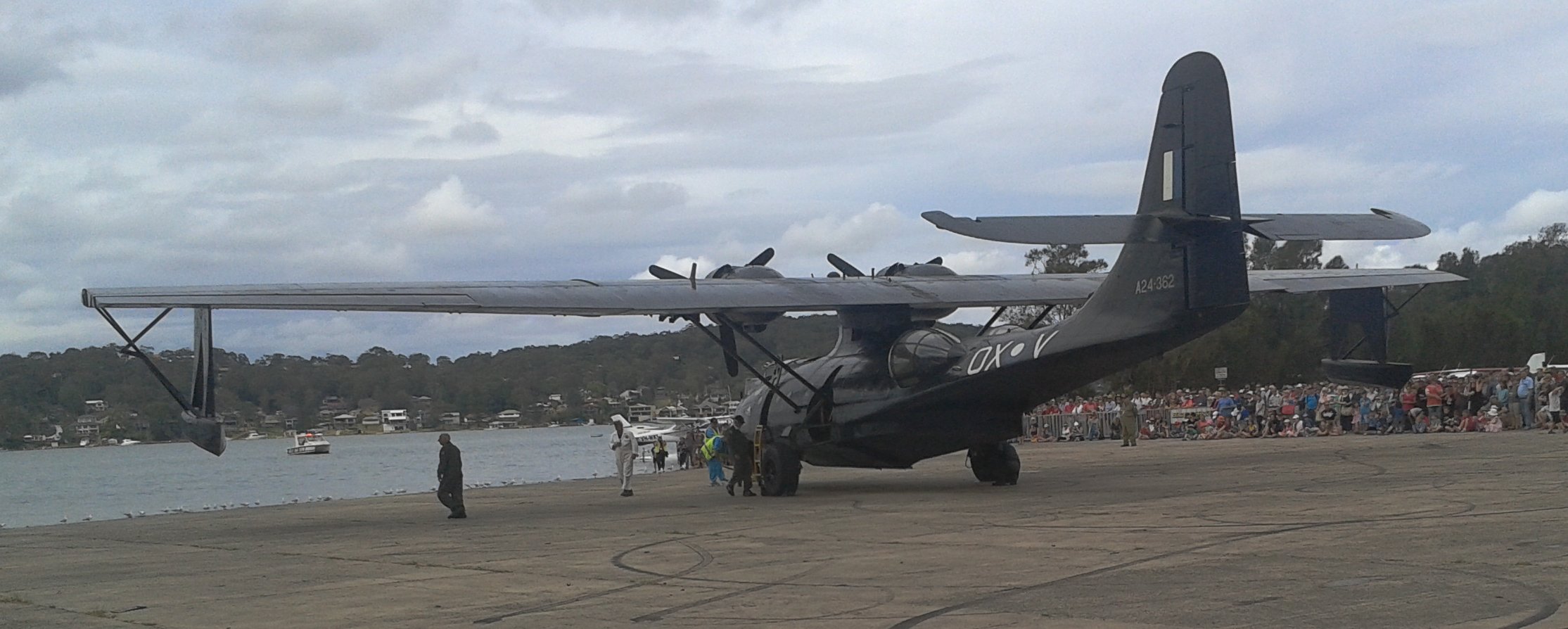
Interestingly an RTF electric r/c Catalina in our club shows serious stress marks across the same rear fuselage sections.
Resonance has also proven to be a problem with some Oliver Tiger type diesel engines on 1/2" thick Aluminium alloy plate based engine test stands.
Vibrations with amplitudes of 1/2" have been reported. It was cured by making the plate mounting less rigid.
Resonance is certainly a complex business.
Ray
I've only ever built one twin, a c/l model for twin Norvel 061's, and they ran as smooth as a baby's bottom.
I have recently seen a full size Catalina run up on our local lakeside hardstand. At full RPM with the pilots holding it on the brakes with full down elevator (as in the pic)
the rear tail section, from just behind the side bubbles, resonated at least a foot either side at the tailplane tips.
Presumably this doesn't happen when it's flying!
Interestingly an RTF electric r/c Catalina in our club shows serious stress marks across the same rear fuselage sections.
Resonance has also proven to be a problem with some Oliver Tiger type diesel engines on 1/2" thick Aluminium alloy plate based engine test stands.
Vibrations with amplitudes of 1/2" have been reported. It was cured by making the plate mounting less rigid.
Resonance is certainly a complex business.
Ray
Last edited by qazimoto; 09-12-2013 at 11:41 PM.
09-13-2013 | 02:14 AM
#29
Senior Member
Ray,
Concerning your Catalina comments, I can add a bit of my own experience.
You probably know the Aeromodeller CL Catalina plan, 62" span for 2 x 2.5cc.
This is an absolutely superb design and plane that I would recommend to anyone.
In 1963, I was in Aden for two years (horrible), BUT we had the most fabulous model aircraft club, the guys virtually lived in there.
About 5 miles from the base, there were "salt pans". This is small lake, about twice the size of a football pitch, with a perfectly smooth and level sandy bottom, and a constant depth of about one foot, over the entire area.
I decided that this would be absolutely ideal for water plane flying, so I built the Catalina, as a pure flying boat (no u/c).
It did fly, absolutely great, once you get it into the air, but unsticking is a big problem.
Think about it... On a scale CL plane, you must have the CG well forward (no problem), BUT, in the case of a flying boat, the fuselage is the floating hull, and this means that you're stuck with a very nose-down attitude when sitting on the water. It's a helluva job to get the nose to rise on the take-off run. At least a lap with two powerful 2.5s running full bore, and full up elevator! Anyway, eventually it unsticks, but the power required for take-off is such that the flying speed is unbelievable (no u/c drag). What a memory!!!
Concerning your Catalina comments, I can add a bit of my own experience.
You probably know the Aeromodeller CL Catalina plan, 62" span for 2 x 2.5cc.
This is an absolutely superb design and plane that I would recommend to anyone.
In 1963, I was in Aden for two years (horrible), BUT we had the most fabulous model aircraft club, the guys virtually lived in there.
About 5 miles from the base, there were "salt pans". This is small lake, about twice the size of a football pitch, with a perfectly smooth and level sandy bottom, and a constant depth of about one foot, over the entire area.
I decided that this would be absolutely ideal for water plane flying, so I built the Catalina, as a pure flying boat (no u/c).
It did fly, absolutely great, once you get it into the air, but unsticking is a big problem.
Think about it... On a scale CL plane, you must have the CG well forward (no problem), BUT, in the case of a flying boat, the fuselage is the floating hull, and this means that you're stuck with a very nose-down attitude when sitting on the water. It's a helluva job to get the nose to rise on the take-off run. At least a lap with two powerful 2.5s running full bore, and full up elevator! Anyway, eventually it unsticks, but the power required for take-off is such that the flying speed is unbelievable (no u/c drag). What a memory!!!
09-15-2013 | 07:18 PM
#30
My Feedback: (1)
Ray,
Concerning your Catalina comments, I can add a bit of my own experience.
You probably know the Aeromodeller CL Catalina plan, 62" span for 2 x 2.5cc.
This is an absolutely superb design and plane that I would recommend to anyone.
In 1963, I was in Aden for two years (horrible), BUT we had the most fabulous model aircraft club, the guys virtually lived in there.
About 5 miles from the base, there were "salt pans". This is small lake, about twice the size of a football pitch, with a perfectly smooth and level sandy bottom, and a constant depth of about one foot, over the entire area.
I decided that this would be absolutely ideal for water plane flying, so I built the Catalina, as a pure flying boat (no u/c).
It did fly, absolutely great, once you get it into the air, but unsticking is a big problem.
Think about it... On a scale CL plane, you must have the CG well forward (no problem), BUT, in the case of a flying boat, the fuselage is the floating hull, and this means that you're stuck with a very nose-down attitude when sitting on the water. It's a helluva job to get the nose to rise on the take-off run. At least a lap with two powerful 2.5s running full bore, and full up elevator! Anyway, eventually it unsticks, but the power required for take-off is such that the flying speed is unbelievable (no u/c drag). What a memory!!!
Concerning your Catalina comments, I can add a bit of my own experience.
You probably know the Aeromodeller CL Catalina plan, 62" span for 2 x 2.5cc.
This is an absolutely superb design and plane that I would recommend to anyone.
In 1963, I was in Aden for two years (horrible), BUT we had the most fabulous model aircraft club, the guys virtually lived in there.
About 5 miles from the base, there were "salt pans". This is small lake, about twice the size of a football pitch, with a perfectly smooth and level sandy bottom, and a constant depth of about one foot, over the entire area.
I decided that this would be absolutely ideal for water plane flying, so I built the Catalina, as a pure flying boat (no u/c).
It did fly, absolutely great, once you get it into the air, but unsticking is a big problem.
Think about it... On a scale CL plane, you must have the CG well forward (no problem), BUT, in the case of a flying boat, the fuselage is the floating hull, and this means that you're stuck with a very nose-down attitude when sitting on the water. It's a helluva job to get the nose to rise on the take-off run. At least a lap with two powerful 2.5s running full bore, and full up elevator! Anyway, eventually it unsticks, but the power required for take-off is such that the flying speed is unbelievable (no u/c drag). What a memory!!!
I know that model, but I'll respond via PM 'cause we're way off topic here.
regards Ray


