


DLE Engine Mods
 11-17-2016 | 10:40 PM
#1

 DLE Engine Mods
I'm starting this thread to see and share just DLE engine mods and results.
For starters I'm playing with a 20RA that's being rebuilt post crash. The head and crank took most of the impact straight in so I'm replacing the head, gaskets, both bearings and the piston ring. The crank checked out but the main bearing seems tight so for $3 a piece I'm replacing both. I considered BOCA performance bearings but I'm looking for a certain result first before I go that far.
First mod:
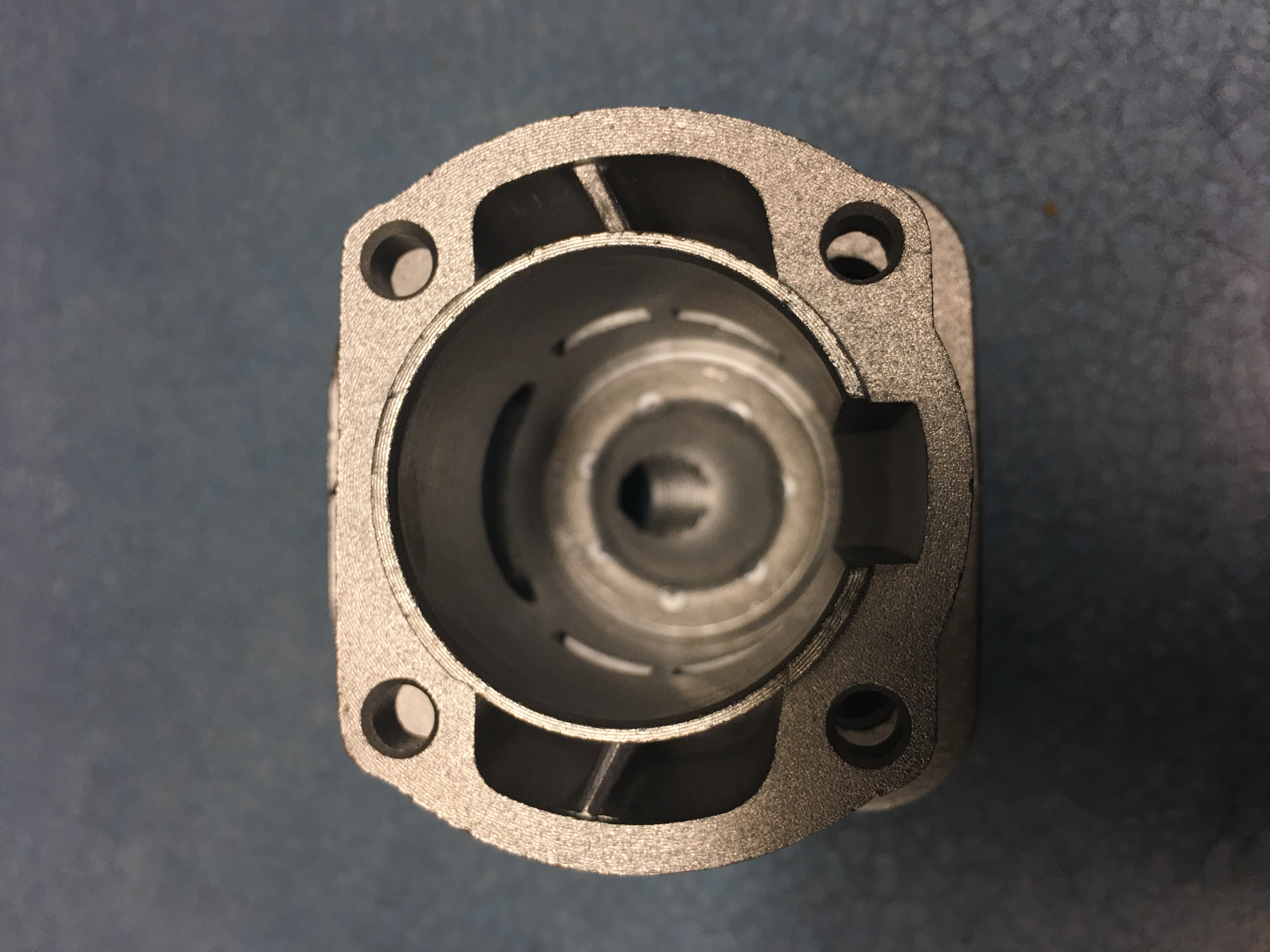
The left and right transfer ports have this nice blunt divider leading edge so I filed it to a sharp edge.
For starters I'm playing with a 20RA that's being rebuilt post crash. The head and crank took most of the impact straight in so I'm replacing the head, gaskets, both bearings and the piston ring. The crank checked out but the main bearing seems tight so for $3 a piece I'm replacing both. I considered BOCA performance bearings but I'm looking for a certain result first before I go that far.
First mod:
The left and right transfer ports have this nice blunt divider leading edge so I filed it to a sharp edge.
 11-17-2016 | 11:04 PM
#2
Next mod is the bearing seals. One thing we did when we raced RC nitro cars was to remove the interior bearing shields or seals to reduce drag. The front bearing outer seal is left intact and for this one I'm also leaving the inside seal. The main bearing will not have any seals. I want to see if there's any leaking from the front seal after some running. If not I can take out the inner front bearing seal and check again.
Back cover mod: The back cover helps reduce the volume of the crank case. That's great but it's also not optimized for flow. I'm going to port the cover to favor the engines natural direction and suction on the power stroke. I'll post a pic on this later. The idea here is to improve flow to the transfer port when the charge should be at its highest velocity. The port opening has very sharp square edges. I'll be adding a radius and smoothing the edges.
Next up are the gaskets. If you dry assemble the head with the gasket to the case you will clearly see the gasket edges encroach on the ports. This has to be port matched. This has to be done on the intake too.
Then theres the dreaded intake reeds. This wasn't done before I was given the engine so I'll be blueprinting the reed block and making sure the reeds seat tightly to the surfaces.
Why am I bothering with all this?
The regular 20 engine powered a TF 60 size P-51 to 109mph with an APC 16x10 prop. I want to go faster!! I want to see 120mph! So I'm switching to the RA which has better performance normally but I'm making it better than stock. We shall see..,
Thats it for for now on this little beast. Please post about your engine mods and results so we can learn and improve these engines.
Back cover mod: The back cover helps reduce the volume of the crank case. That's great but it's also not optimized for flow. I'm going to port the cover to favor the engines natural direction and suction on the power stroke. I'll post a pic on this later. The idea here is to improve flow to the transfer port when the charge should be at its highest velocity. The port opening has very sharp square edges. I'll be adding a radius and smoothing the edges.
Next up are the gaskets. If you dry assemble the head with the gasket to the case you will clearly see the gasket edges encroach on the ports. This has to be port matched. This has to be done on the intake too.
Then theres the dreaded intake reeds. This wasn't done before I was given the engine so I'll be blueprinting the reed block and making sure the reeds seat tightly to the surfaces.
Why am I bothering with all this?
The regular 20 engine powered a TF 60 size P-51 to 109mph with an APC 16x10 prop. I want to go faster!! I want to see 120mph! So I'm switching to the RA which has better performance normally but I'm making it better than stock. We shall see..,
Thats it for for now on this little beast. Please post about your engine mods and results so we can learn and improve these engines.
Last edited by Chris Nicastro; 11-17-2016 at 11:10 PM.

 11-18-2016 | 03:14 PM
#5

My Feedback: (19)
The easiest way to pic up a bit of power is to increase the compression ratio by installing a slightly thinner base gasket. From there, taking just a bit of timing out of the engine can sometimes increase full throttle RPM. Just a couple of degrees can make a big difference on some engines.
11-19-2016 | 10:45 AM
#6


My Feedback: (6)
The easiest way to pic up a bit of power is to increase the compression ratio by installing a slightly thinner base gasket. From there, taking just a bit of timing out of the engine can sometimes increase full throttle RPM. Just a couple of degrees can make a big difference on some engines.
On a different note, part of the experiment will be to see if the crankshaft lives...
AV8TOR
11-19-2016 | 01:10 PM
#7
My Feedback: (19)
My thoughts on the crank also. Cantilever cranks aren't the strongest link in these engines. I've said it before and will repeat it here, if I were going for speed, I'd work around a piston ported engine with a dual counterweight crank .. such as a Zenoah or any number of chainsaw engines. Reed valve engines as used for model applications are really mid range, torque producers and don't like to turn much over 8000 for extended periods of time. Any of the high quality piston ported engines will be happy all day long at 10,000 or more. This and the piston ported engines breath their best at high speeds where the reed valve engines become restricted. Using any practical prop size, you wouldn't be turning a gasser at 10K, but propped for 8.5 to 9K on the ground it will easily be turning 10K in the air.
 11-19-2016 | 11:17 PM
#9
My Feedback: (6)
My thoughts on the crank also. Cantilever cranks aren't the strongest link in these engines. I've said it before and will repeat it here, if I were going for speed, I'd work around a piston ported engine with a dual counterweight crank .. such as a Zenoah or any number of chainsaw engines. Reed valve engines as used for model applications are really mid range, torque producers and don't like to turn much over 8000 for extended periods of time. Any of the high quality piston ported engines will be happy all day long at 10,000 or more. This and the piston ported engines breath their best at high speeds where the reed valve engines become restricted. Using any practical prop size, you wouldn't be turning a gasser at 10K, but propped for 8.5 to 9K on the ground it will easily be turning 10K in the air.
But, in any case it will be interesting to see how this DLE turns out.
AV8TOR
11-20-2016 | 10:21 AM
#11
On my marble block I sanded the case mating surface for the cylinder flat too. I also smoothed out a couple areas inside the case below the transfer ports that have sharp edges and angles.
Are you guys talking about only gas engine counter balance cranks? Because there are plenty of examples of counter balance cranks that turn well north of 10K rpm in nitro engines. Some are ported thru the crank and some are rear carb like ducted fan engines. I've modified the one piece disc counter balance on some buggy engines before too. I have never broken a crank I modified. If they are built to take the rpm they will hold and if not you will know soon enough.
Reed or not the whole point is flow. I've made simple clean ups on 26cc gas boat engines and compared to stock it makes all the difference. They start easier and make a little more power.
Im not making any claims I'm just trying this out.
Are you guys talking about only gas engine counter balance cranks? Because there are plenty of examples of counter balance cranks that turn well north of 10K rpm in nitro engines. Some are ported thru the crank and some are rear carb like ducted fan engines. I've modified the one piece disc counter balance on some buggy engines before too. I have never broken a crank I modified. If they are built to take the rpm they will hold and if not you will know soon enough.
Reed or not the whole point is flow. I've made simple clean ups on 26cc gas boat engines and compared to stock it makes all the difference. They start easier and make a little more power.
Im not making any claims I'm just trying this out.
11-20-2016 | 11:27 AM
#13
My Feedback: (19)
Regarding cantilever cranks, yes, I was referring to gas engines only and 20 cc or above. Glo engines are usually smaller engines compared with gas engines and usually have less reciprocating weight with aluminum rods, no heavy steel needle bearings and light weight pistons. Most gas engines have a lot more thrashing around inside with much heavier steel rods, needle bearings and much more robust pistons. Even if the cranks don't break on some of these engines, at high RPM, flexing can exist that can rob the engine of power. Add to that, many cantilever crank engines are light on counter weight and this shows up as increased vibration at high RPM. On gas engines, a crank supported on each side of the rod makes for a longer service life with less vibration. With few exceptions, most industrial or other heavy use 2 stroke engines don't use cantilever cranks.
11-20-2016 | 03:21 PM
#14
Ok well we shall see what it can do.
I swapped out the bearings and used the crank for alignment during reassembly. As it cooled the crank could spin freely so job done on that with a good result.
Everything went back together with no issues. The gaskets have been cleared from interference. I also smoothed out the skirt of the cylinder next to the side transfer ports because it's kinda rough there.

I swapped out the bearings and used the crank for alignment during reassembly. As it cooled the crank could spin freely so job done on that with a good result.
Everything went back together with no issues. The gaskets have been cleared from interference. I also smoothed out the skirt of the cylinder next to the side transfer ports because it's kinda rough there.
11-20-2016 | 04:14 PM
#16
My Feedback: (19)
Sorry Chris, I didn't mean to imply that modifying the DLE wasn't worth the effort. I think I might have come across a bit harsh.
I'll be anxious to see how the engine runs with the changes you made. With the right prop the performance improvements might be more than you expect. Good luck and let us know how it does.
I'll be anxious to see how the engine runs with the changes you made. With the right prop the performance improvements might be more than you expect. Good luck and let us know how it does.
11-20-2016 | 09:15 PM
#17
No worries, I know there are many other engines better suited to performance mods etc but this is what I have to experiment with right now. Plus it's a direct upgrade to a plane I've flown a lot with the 20 engine. If I wanted to put a lot of power in this Mustang I would have dropped in an OS or BVM 91 DF engine for ultimate power to weight ratio!
Im redoing the radio and tank installation so it's going to take a little time for the engine run report.
Last time I ran the 20 I remember the tach reading about 8500 with an APC 16x10. I'm going to use the same, new, prop to have a comparison with the RA.
If you guys have DLE Mod or improvement info please post it here.
Im redoing the radio and tank installation so it's going to take a little time for the engine run report.
Last time I ran the 20 I remember the tach reading about 8500 with an APC 16x10. I'm going to use the same, new, prop to have a comparison with the RA.
If you guys have DLE Mod or improvement info please post it here.
Last edited by Chris Nicastro; 11-20-2016 at 09:18 PM.


