


Laser Cut Kits
 03-19-2011 | 07:32 PM
#1
Thread Starter

My Feedback: (8)
Joined: May 2005
Posts: 174
Likes: 0
Received 0 Likes
on
0 Posts
From: san diego,
CA
 Laser Cut Kits
I am buying more and more kits and have noticed some of the new laser cut kits recommend putting a structure together first like a jigsaw puzzle, then gluing with CA with the structure together. I normally build with white glue, makes for a strong clean joint. Should I just do what the manufacture says and build with CA or try to find a way to still use white glue? P.s I have tried Super Phatic glue and it does not wick very well.
 03-19-2011 | 07:37 PM
#2

RCU Forum Manager/Admin
My Feedback: (9)
RE: Laser Cut Kits
I build with Elmer's wood glue and I run into the same thing. Some structures are easy to simply use wood glue instead of CA. But sometimes if a built up structure such as a wing was designed for CA it can be difficult to use wood glue, but not impossible. Just sit down and figure out the best way to use wood glue instead of CA and you'll be fine.
Ken</p>
03-19-2011 | 08:18 PM
#3
Banned
RE: Laser Cut Kits
You can use CA and then follow with double gluing with good wood glue creating all the fillets in the corners and considerably increasing the binding areas.
The extra weight is negligeable. Like 3 oz of weight for double gluing an 11 lbs model.
Zor
The extra weight is negligeable. Like 3 oz of weight for double gluing an 11 lbs model.
Zor
03-20-2011 | 04:05 AM
#4
RE: Laser Cut Kits
I use Titbond II for just about everything now I do it like Ken says: redesign the building process where I need to.
Aligning well-cut parts in advance and then locking them in with adhesives is a wonderful way to get a straight structure, but for me the downsides of using CA are too oppressive. For wings, I almost always build them on my RCM wing jig, so alignment's not an issue on wings I sometimes have to stack the ribs and drill them for the jig rods but that's the biggest change I have to make (and it's no problem for me: I always stack them and sand them together anyway)
Almost off topic If you're wild about precision alignment and haven't built on a wing jig, I just want to tell you that I owned one for years and only first tried it when I was about to sell it to get it out of my shop space and I've never gone back to my pre-jigging ways since. Alignement's guaranteed and building's about the speed as you can do with CA ('cause the jig holds it all in place so there's no need to wait for drying time), but there's no fumes and the structure's better looking after it's all dry.
Aligning well-cut parts in advance and then locking them in with adhesives is a wonderful way to get a straight structure, but for me the downsides of using CA are too oppressive. For wings, I almost always build them on my RCM wing jig, so alignment's not an issue on wings I sometimes have to stack the ribs and drill them for the jig rods but that's the biggest change I have to make (and it's no problem for me: I always stack them and sand them together anyway)
Almost off topic If you're wild about precision alignment and haven't built on a wing jig, I just want to tell you that I owned one for years and only first tried it when I was about to sell it to get it out of my shop space and I've never gone back to my pre-jigging ways since. Alignement's guaranteed and building's about the speed as you can do with CA ('cause the jig holds it all in place so there's no need to wait for drying time), but there's no fumes and the structure's better looking after it's all dry.
03-20-2011 | 01:33 PM
#5
Senior Member
My Feedback: (13)
Joined: Sep 2004
Posts: 333
Likes: 0
Received 0 Likes
on
0 Posts
From: Fulton,
NY
RE: Laser Cut Kits
ORIGINAL: scigs30
I am buying more and more kits and have noticed some of the new laser cut kits recommend putting a structure together first like a jigsaw puzzle, then gluing with CA with the structure together. I normally build with white glue, makes for a strong clean joint. Should I just do what the manufacture says and build with CA or try to find a way to still use white glue? P.s I have tried Super Phatic glue and it does not wick very well.
I am buying more and more kits and have noticed some of the new laser cut kits recommend putting a structure together first like a jigsaw puzzle, then gluing with CA with the structure together. I normally build with white glue, makes for a strong clean joint. Should I just do what the manufacture says and build with CA or try to find a way to still use white glue? P.s I have tried Super Phatic glue and it does not wick very well.
 , but I don't see where the problem would be if you prefer using a slower setting glue. I would think that the longer set-time of these types of glue would allow this.
03-20-2011 | 01:51 PM
, but I don't see where the problem would be if you prefer using a slower setting glue. I would think that the longer set-time of these types of glue would allow this.
03-20-2011 | 01:51 PM
#6
RCU Forum Manager/Admin
My Feedback: (9)
RE: Laser Cut Kits
ORIGINAL: dredhea
Why could you not put glue on the pieces as you asseble the "jigsaw puzzle"? Myself, I like using CA because I have a low tolerance when it comes to patience, but I don't see where the problem would be if you prefer using a slower setting glue. I would think that the longer set-time of these types of glue would allow this.
Why could you not put glue on the pieces as you asseble the "jigsaw puzzle"? Myself, I like using CA because I have a low tolerance when it comes to patience
, but I don't see where the problem would be if you prefer using a slower setting glue. I would think that the longer set-time of these types of glue would allow this.
However, applying the glue like you said is usually how Isolve the problem in the long run. BUTFIRST, Iwill completely dry assemble the structure to ensure everything fits correctly. Then I will pull it apart and reassemble it with glue. This is if Ican't find any other way to do it.
There is nothing wrong with using CA for building, as the majority of builders prefer this method. I used to build this way as well, and still do on a very rare occasion. But Imade the choice to change to using primarily wood glue quite some time back, and Ifeel the the quality of my builds has improved dramatically because of that choice. Ialso feel better as the CA usually does a number on my sinuses and lungs. It's just in occasions like this where Ihave to figure out how to do some things because Ichoose to use wood glue instead of CA.
Ken
03-20-2011 | 02:58 PM
#8
RCU Forum Manager/Admin
My Feedback: (9)
RE: Laser Cut Kits
ORIGINAL: Zor
Post #3 combines the advantages of both methods.
Hee! Hee! does it not ?
Zor
Post #3 combines the advantages of both methods.
Hee! Hee! does it not ?
Zor
Occasionally Imay use a very small drop of CA to hold the wood together while the wood glue sets. But your recommendation of using CAfirst and then wood glue is totally different than this, and in my opinion isn't a workable solution for me. Iprefer to use wood glue. Like Isaid, Ifeel the quality of my builds has improved dramatically when Ichanged over to wood glue. My builds turn out much better now. Partially because Ihave more time to work on getting parts set in place one the glue is applied, you don't have that option with CA. Also I feel that the wood is easier to sand with wood glue, which IMHO makes the final finish much better.
Many will argue that they don't want to wait for wood glue, and that the CAbuilds faster than wood glue. However, Iwill argue back that with just a little bit of planning and forethought I can build as fast with wood glue as with CA. Wood glue only requires about 30 minutes to set before it's set enough that you can handle it. I use this time to review and plan my next steps. Also, with planning you can be working on something else while the glue is setting on another part. But when it's all boiled down to the final finished plane my building with wood glue can turn out a finished plane just as quickly as a build with CA. And with not breathing in CAfumes the whole time Iam much happier as my body doesn't complain. And when it's all said and done, that's what this is all about. Enjoying the hobby, and enjoying the build.
Many have heard about the "CA allergy", but this isn't specifically true. CAworks by reacting with moisture, it is what causes the adhesive to "kick". When the vapors are inhaled they will react with any moisture and have a reaction. Unfortunately for us the nose, throat, and lungs are nothing but moist membranes for the fumes to react with. Some people will have a higher tolerance to this reaction and it won't initially affect them. However, it seems that some will develop a larger reaction to the adhesive fumes and when that happens it's usually very bad. Some people will complain about congestion, difficulty breathing, pain in their lungs, problems with their nose and throat, and a myriad of other problems. And these symptoms can last for days after being exposed to the fumes from CA. Once that happens these people have a very hard time even being around CA. While I'm not at the point that Iam laid out for days after being around CA Ido feel uncomfortable whenIuse it. Much more than when I started in the RChobby 15 years ago (I have been building wood models since I was 8 years old but only started using CAwhen Istarted flying RC15 years ago). So I am very careful in when I do use the CA to get as little as Ican in my system. Iuse a fan blowing across my work area as well as an exhaust fan to get the fumes completely out of the shop. This is one of the major reasons whyIswitched to wood glue.Iwould suggest that those plan on using CA and not switching to wood glue at least take the precautions of an exhaust fan as well as a fan across the build area before they develop an over sensitivity to the adhesives.
Hope this helps
Ken
03-20-2011 | 03:44 PM
#9
Banned
RE: Laser Cut Kits
Ken,</p>
You know well that I did not post #3 for you or anyone with a reasonable building experience.</p>
It was aimed at those who insist that CA is the only way to build, that insistently preach using CA and of course those building manuals that recommend CA glue.</p>
I personally do not suffer from any CA reactions for the simple reason that like you I only occasionally put a small drop to tack something or hold in place an item that cannot be clamped in a proper way.</p>
These days I use Sig-Ment as convenience because the LHS has it in stock and it does a good job. It also cures enough in 20 to 30 minutes to handle the pieces gently.</p>
Other glues are also very good.</p>
I hope your posting is read by all the beginners and follow the good advice.
It is regretful that building manuals that come with many kits are instructing to use CA and epoxy.</p>
I believe that CA vapors inhaled are causing permanent damage to our internal tissues.</p>
Thanks for your posting.</p>
Zor
</p>
03-20-2011 | 06:53 PM
#11
Senior Member
My Feedback: (13)
Joined: Sep 2004
Posts: 333
Likes: 0
Received 0 Likes
on
0 Posts
From: Fulton,
NY
RE: Laser Cut Kits
ORIGINAL: RCKen
The problem with this is because if you simply apply the glue and stick the pieces together you have no way of dealing with any issues that come up. With kits designed for CA specifically you need to put all the parts together to verify that all the parts fit and align properly. You should make any adjustments to the parts and then you can start applying CA to the joints. If you are putting wood glue on the parts as you assemble the first time you don't have any time to make any adjustments for improper fit or alignment of the parts.
However, applying the glue like you said is usually how I solve the problem in the long run. BUT FIRST, I will completely dry assemble the structure to ensure everything fits correctly. Then I will pull it apart and reassemble it with glue. This is if I can't find any other way to do it.
There is nothing wrong with using CA for building, as the majority of builders prefer this method. I used to build this way as well, and still do on a very rare occasion. But I made the choice to change to using primarily wood glue quite some time back, and I feel the the quality of my builds has improved dramatically because of that choice. I also feel better as the CA usually does a number on my sinuses and lungs. It's just in occasions like this where I have to figure out how to do some things because I choose to use wood glue instead of CA.
Ken
ORIGINAL: dredhea
Why could you not put glue on the pieces as you asseble the ''jigsaw puzzle''? Myself, I like using CA because I have a low tolerance when it comes to patience, but I don't see where the problem would be if you prefer using a slower setting glue. I would think that the longer set-time of these types of glue would allow this.
Why could you not put glue on the pieces as you asseble the ''jigsaw puzzle''? Myself, I like using CA because I have a low tolerance when it comes to patience
, but I don't see where the problem would be if you prefer using a slower setting glue. I would think that the longer set-time of these types of glue would allow this.
However, applying the glue like you said is usually how I solve the problem in the long run. BUT FIRST, I will completely dry assemble the structure to ensure everything fits correctly. Then I will pull it apart and reassemble it with glue. This is if I can't find any other way to do it.
There is nothing wrong with using CA for building, as the majority of builders prefer this method. I used to build this way as well, and still do on a very rare occasion. But I made the choice to change to using primarily wood glue quite some time back, and I feel the the quality of my builds has improved dramatically because of that choice. I also feel better as the CA usually does a number on my sinuses and lungs. It's just in occasions like this where I have to figure out how to do some things because I choose to use wood glue instead of CA.
Ken
I was going to try gorilla glue in place of CA when I started my Sopwith Pup this winter. That lasted about two days before I was back to CA. I just have no patience to wait for glue to set!![&o] When you are building the "small parts" such as the tail feathers, planning ahead doesn't help as once the building board is full, you can't start anything else for lack of a place to put it together. I really wish that I did have more patience as I really think the Gorilla glue would make a stronger build. I happen to be one of the lucky people that has no problem with the fumes from CA, but I try not to breathe it in any more than necessary, just the same.
03-20-2011 | 07:12 PM
#12


My Feedback: (3)
Joined: Sep 2008
Posts: 599
Likes: 0
Received 0 Likes
on
0 Posts
From: Hoodsport, WA
RE: Laser Cut Kits
ORIGINAL: scigs30
Thank you for all the info, sounds like I will just have to plan my builds out if I want to continue using white glue.
Thank you for all the info, sounds like I will just have to plan my builds out if I want to continue using white glue.
Over the last twenty-five-plus years, I've used Titebond as a woodworker, producing casework, cabinets, and furniture pieces. It has never failed me. After a twenty-plus year hiatus from model aircraft building, I have built two airframes using Titebond. I still enjoy and trust it today.
Since getting back into building, I've collected several kits that were marketed from the '80's to present day. Keep in mind that CA glue came on the model building scene in the late 1970s. in response to this "instant" time-saving miracle, several kit builders marketed their own CA glue (Carl Goldberg & Sig for example) and included their brand in their building instructions/manuals. This doesn't mean that it was the right adhesive for the job (application) it just meant that they could offer (market) a faster avenue from the kit box to the flying field (also keep in mind that this was prior to the pre-ARF/RTF era). Personally, I do not like the brittle state that CA leaves wood in. Wood, by nature, needs to move. Contract and expand. The application of CA puts constraints on this process and therein sets up a "fight". I also do not like what CA does tobalsa, and (as RCKen points out) makes it harder to sand than surrounding areas. What that really means is that it wicks into the fibers of the wood, which is good for bonding, but makes that area harder. Sanding is in fact a material removal (in this case wood) process. When you sand an area of unequal hardness, you will be removing more of the softer material than the harder material which will create ridges and troughs.
CA depends on wicking and curing for it's strength, and aliphatic resin glue relies on pressure (clamping) during the gluing lay-up process for it's strength.
A large part of my enjoyment of building is the finely-fitted joinery and gluing process.Of the kits that I have that instruct the usage of CA, I will use it where sanding or shaping is not applicable. In all other areas I'll be using Titebond II or thirty-minute epoxy.<br type="_moz" />
03-20-2011 | 07:17 PM
#13
My Feedback: (3)
Joined: Sep 2008
Posts: 599
Likes: 0
Received 0 Likes
on
0 Posts
From: Hoodsport, WA
RE: Laser Cut Kits
ORIGINAL: dredhea
I should have specified that the parts should be dry fitted together first.. My bad. Thanks RC!
I was going to try gorilla glue in place of CA when I started my Sopwith Pup this winter. That lasted about two days before I was back to CA. I just have no patience to wait for glue to set!!
I should have specified that the parts should be dry fitted together first.. My bad. Thanks RC!
I was going to try gorilla glue in place of CA when I started my Sopwith Pup this winter. That lasted about two days before I was back to CA. I just have no patience to wait for glue to set!!
<br type="_moz" />
03-21-2011 | 04:28 AM
#14
Senior Member
My Feedback: (13)
Joined: Sep 2004
Posts: 333
Likes: 0
Received 0 Likes
on
0 Posts
From: Fulton,
NY
RE: Laser Cut Kits
ORIGINAL: EJWash1
Sounds like you enjoy the flying side more than the building side. No worries. Personally, I'm more a 60/40% builder/flyer. Depends on the model...
<br type=''_moz'' />
ORIGINAL: dredhea
I should have specified that the parts should be dry fitted together first.. My bad. Thanks RC!
I was going to try gorilla glue in place of CA when I started my Sopwith Pup this winter. That lasted about two days before I was back to CA. I just have no patience to wait for glue to set!!
I should have specified that the parts should be dry fitted together first.. My bad. Thanks RC!
I was going to try gorilla glue in place of CA when I started my Sopwith Pup this winter. That lasted about two days before I was back to CA. I just have no patience to wait for glue to set!!
<br type=''_moz'' />
 Does that make me a 50/50 buider/flyer?
03-21-2011 | 10:55 AM
Does that make me a 50/50 buider/flyer?
03-21-2011 | 10:55 AM
#15
My Feedback: (3)
Joined: Sep 2008
Posts: 599
Likes: 0
Received 0 Likes
on
0 Posts
From: Hoodsport, WA
RE: Laser Cut Kits
ORIGINAL: dredhea
Well, not really more than building, but probably just as much as. Does that make me a 50/50 buider/flyer?
Well, not really more than building, but probably just as much as.
Does that make me a 50/50 buider/flyer?
As far as waiting for glue to dry, I picked-up something during my woodworking years that I brought to model airplane building: work on another kit! No, I don't have the building board room to lay-up two kits at the same time, but that doesn't stop me from cutting out formers or stacking and sanding ribs...<br type="_moz" />
03-21-2011 | 12:03 PM
#16
Thread Starter
My Feedback: (8)
Joined: May 2005
Posts: 174
Likes: 0
Received 0 Likes
on
0 Posts
From: san diego,
CA
RE: Laser Cut Kits
Dry times are not too bad with white glue. A few years ago we switched from yellow wood glue to plain white glue sold by Titebond. This stuff is just as strong as Aliphatic glue but does not leave the yellowish tinge when it dries. We also discovered it dries pretty fast, So I started using with my hobbies.....Freeflight, RC and Estes Rockets. The only problem is Titebond only sells it in gallon jugs.
03-21-2011 | 02:40 PM
#17
Senior Member
My Feedback: (54)
RE: Laser Cut Kits
ORIGINAL: Al Stein
Almost off topic If you're wild about precision alignment and haven't built on a wing jig, I just want to tell you that I owned one for years and only first tried it when I was about to sell it to get it out of my shop space and I've never gone back to my pre-jigging ways since. Alignement's guaranteed and building's about the speed as you can do with CA ('cause the jig holds it all in place so there's no need to wait for drying time), but there's no fumes and the structure's better looking after it's all dry.
Almost off topic If you're wild about precision alignment and haven't built on a wing jig, I just want to tell you that I owned one for years and only first tried it when I was about to sell it to get it out of my shop space and I've never gone back to my pre-jigging ways since. Alignement's guaranteed and building's about the speed as you can do with CA ('cause the jig holds it all in place so there's no need to wait for drying time), but there's no fumes and the structure's better looking after it's all dry.
03-21-2011 | 03:39 PM
#18
Senior Member
My Feedback: (13)
Joined: Sep 2004
Posts: 333
Likes: 0
Received 0 Likes
on
0 Posts
From: Fulton,
NY
RE: Laser Cut Kits
ORIGINAL: EJWash1
HA!
As far as waiting for glue to dry, I picked-up something during my woodworking years that I brought to model airplane building: work on another kit! No, I don't have the building board room to lay-up two kits at the same time, but that doesn't stop me from cutting out formers or stacking and sanding ribs...<br type=''_moz'' />
ORIGINAL: dredhea
Well, not really more than building, but probably just as much as. Does that make me a 50/50 buider/flyer?
Well, not really more than building, but probably just as much as.
Does that make me a 50/50 buider/flyer?
As far as waiting for glue to dry, I picked-up something during my woodworking years that I brought to model airplane building: work on another kit! No, I don't have the building board room to lay-up two kits at the same time, but that doesn't stop me from cutting out formers or stacking and sanding ribs...<br type=''_moz'' />
03-21-2011 | 07:38 PM
#19
My Feedback: (3)
Joined: Sep 2008
Posts: 599
Likes: 0
Received 0 Likes
on
0 Posts
From: Hoodsport, WA
RE: Laser Cut Kits
ORIGINAL: SitNFly
Does anybody even sell a wing jig anymore?
Does anybody even sell a wing jig anymore?
http://www3.towerhobbies.com/cgi-bin/wti0001p?&I=LXK258&P=7<br type="_moz" />
03-21-2011 | 07:40 PM
#20
My Feedback: (3)
Joined: Sep 2008
Posts: 599
Likes: 0
Received 0 Likes
on
0 Posts
From: Hoodsport, WA
RE: Laser Cut Kits
ORIGINAL: dredhea
I have a Balsa USA 1/4 scale Sopwith Pup, A GP PatriotXL, and a Goldberg Ultimate 10-300 all going together now. As soon as I get at least one done, I have a BUSA 1913 Taube waiting in the wings. I'd start that as well, but the girlfriend threatened me with removal of body parts that I'd really rather keep[X(].
I have a Balsa USA 1/4 scale Sopwith Pup, A GP PatriotXL, and a Goldberg Ultimate 10-300 all going together now. As soon as I get at least one done, I have a BUSA 1913 Taube waiting in the wings. I'd start that as well, but the girlfriend threatened me with removal of body parts that I'd really rather keep[X(].
<br type="_moz" />
03-21-2011 | 08:53 PM
#21
RE: Laser Cut Kits
ORIGINAL: SitNFly... Does anybody even sell a wing jig anymore?
It consists of two 1/4" steel rods and a frame to hold them parallel. I made my own for two reasons to hold bigger structures (longer wing and/or wider chord) and to have more room to get my hands underneath the wing while it's on the jig. WIth appreciation to Mike James, his jig looks like this...
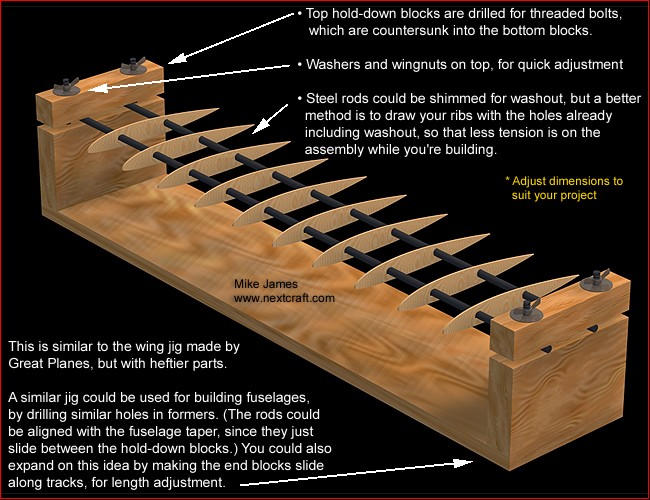
A few notes about how I do it, personally:
1. No need for two hold-downs per side: holddown only maintains alignment which takes very little force
2. I always place jig holes at same spot in all ribs (and shim the jig rods for wash-out if needed): staggering holes for washout doesn't allow ribs to be bolted together and block sanded, plus it forces each to be cut out separately.
3. 1/2" to 3/4" board or ply has plenty of strength for the frame parts.
4. For hold downs, I use 1/4" hanger bolts (one end is threaded as a wood screw nad the other as a machine screw) Crank the wood screw end into the frme and use the machine screw end for the wing nuts. I also add a spacer about 3/16" long to the shaft of the holddown screw to make setup a little easier.
The big surprise for me was how fast things go together with this setup when I was cranking out a bunch of airplanes, I used to crank out a wing panel before going to work in the morning. Great little tool... glad to fill in any other info if you need.
03-22-2011 | 08:38 AM
#22
My Feedback: (-1)
RE: Laser Cut Kits
I don't get to see a lot of laser cut kits, most the kits I build for myself or others are older die cut kits that often require some sanding and fitting before gluing. One of the big improvements with laser cutting is the fit. I prefer CA glue but I do get a reaction from it. I have tried different wood glues but don't care for it. I use a lot of it in wood working and it's great, I just like CA better for kit building.
When ZOR mentioned double gluing I was a bit taken back. If your going to tack with CA why not just use CA throughout the build? The reason for a laser cut kit is the fit, if you have gaps then you have done something wrong. CA thin isn't a gap filler but the thick sure is. Glue of any type is crap as a filler anyway, if I have a gap that needs filling I use filler then when dry I will hit it with thin CA for strength.
Glue types have been mentioned here almost as much as What Prop For My________. It comes down to choice. I like CA but I have about 6 different types of glue on my bench and use the one I think will work best fot the part I'm ready to glue.
I also have found I have a lot less reaction to orderless CAs but they do cost a few bucks more. If in Doubt you can always use Ambroids, old school but it still works very well.
When ZOR mentioned double gluing I was a bit taken back. If your going to tack with CA why not just use CA throughout the build? The reason for a laser cut kit is the fit, if you have gaps then you have done something wrong. CA thin isn't a gap filler but the thick sure is. Glue of any type is crap as a filler anyway, if I have a gap that needs filling I use filler then when dry I will hit it with thin CA for strength.
Glue types have been mentioned here almost as much as What Prop For My________. It comes down to choice. I like CA but I have about 6 different types of glue on my bench and use the one I think will work best fot the part I'm ready to glue.
I also have found I have a lot less reaction to orderless CAs but they do cost a few bucks more. If in Doubt you can always use Ambroids, old school but it still works very well.
03-22-2011 | 05:50 PM
#23
RE: Laser Cut Kits
ORIGINAL: Gray Beard... If in Doubt you can always use Ambroids, old school but it still works very well.


