


Balsa USA Phaeton ll kit
 01-16-2006 | 05:04 PM
#1

Thread Starter

My Feedback: (6)
Joined: Oct 2002
Posts: 2,684
Likes: 0
Received 0 Likes
on
0 Posts
From: Mountain Home,
AR
 Balsa USA Phaeton ll kit
Looking for advice on the building characteristics of a Balsa USA Phaeton ll kit. I guess first of all, how are Balsa USA kits to build? How is the wood supplied? These are, I believe, die crushed kits--how cleanly do they release from the sheets and how well do they fit? Are the plans any good--etc. Further, how is the Phaeton ll kit in particular with respect to the above? I'm not especially interested in how it flies, just how it builds. Thanks, folks
Max
Max
 01-16-2006 | 06:43 PM
#2
Senior Member
RE: Balsa USA Phaeton ll kit
I built a Phaeton II kit about 6 years ago and I did hear that it has been updated since then. I've been building airplanes for most of my 40 years and let me tell you, I really liked building this one...constrution couldn't be simpler..There are no cap strips on the wings. Strip ailerons on the bottom wing only. The plans are blueprint style and the instructions are minimal yet to the point.The plastic cowl goes right into the trash...Quality of die cutting was pretty damn good, and so was the quality of balsa supplied! The only thing that might turn off a curious potential builder would be the fact that the cabane struts have to ge soldered together...This turned out to be much easier than I thought it was going to be and actually was kind of fun! I would definatly recomend this kit! and by the way, they fly really well also! Johnny
01-17-2006 | 12:39 AM
#3


My Feedback: (16)
RE: Balsa USA Phaeton ll kit
Max,
A friend built one this past summer. He just couldn't get over how fast the build was. The plane has a low parts count. Everything is simple.
The Plane was re-engineered just a few years ago so the cutting dies are still sharp. There was no crushed wood.
He must have thrown the cowl away for it has balsa cowl cheeks on it?
He is extremely pleased with the plane.
Enjoy,
Jim
A friend built one this past summer. He just couldn't get over how fast the build was. The plane has a low parts count. Everything is simple.
The Plane was re-engineered just a few years ago so the cutting dies are still sharp. There was no crushed wood.
He must have thrown the cowl away for it has balsa cowl cheeks on it?
He is extremely pleased with the plane.
Enjoy,
Jim
01-17-2006 | 04:24 PM
#4
Joined: Dec 2001
Posts: 488
Likes: 0
Received 0 Likes
on
0 Posts
From: Jacksonville, IL
RE: Balsa USA Phaeton ll kit
I just finished covering mine. It has no trim or hardware installed just yet. The kit built OK, but be aware that the plans for the wings do not match up too exactly. I was warned about this before I started by another builder who loves his and told me not to worry about it. Just use the plans to locate the wing ribs, and the rest of it takes care of itself. The cowl did get "trashed" as others have noted. Both my friend and I decided to do something different for the wing struts than the kit calls for. (I am beginning to wish I had stuck with the kit suggestions.) Getting the plywood to wrap around the top of the fuse between the cockpit and the nose was more of a hassle for me than simply planking it. All in all a nice looking plane when you're done, and my friend really likes to fly his (although he added ailerons to the top wing as well as the stock ones on the bottom wing). Good luck, Dzl
10-15-2006 | 05:07 PM
#5

Joined: Oct 2006
Posts: 76
Likes: 0
Received 0 Likes
on
0 Posts
From: ponce inlet,
FL
RE: Balsa USA Phaeton ll kit
I need a set of instructions and fuse prints if someone has a set. Balsa USA phaeton II. I lost mine. I still have the wing prints. Sarted working on it (only my second plane to build) set it aside in the garage and they have dissapeared.
Thanks, Charlie [email protected] if you can help.
Thanks, Charlie [email protected] if you can help.
10-16-2006 | 11:08 AM
#6
Senior Member
RE: Balsa USA Phaeton ll kit
I've built and flown two of the Phaeton 40's and two of the Phaeton 90's but quite some time back. I do not recall any problems with the die cutting or anything else. They are not a beginners kit, you need a little experience or help if this it your first kit. All flew great, had a 1.20 on the first Phaeton 90 the put Quadra 72cc on the second. Both were a ball to fly, especially the overpowered (and beefed up landing gear and firewall) with the big Quadra.
10-26-2006 | 11:08 AM
#7
Senior Member
Joined: Mar 2003
Posts: 148
Likes: 0
Received 0 Likes
on
0 Posts
From: Caledonia, IL
RE: Balsa USA Phaeton ll kit
I'll throw my 2 cents worth in here, for what it's worth. It probably is a little late seeing that you started this string in January, AND my kit was an old kit I bought from a friend for next to nothing, and was 15+ years old. This kit was my project last winter. Firstly, let me say that the plan print is very well done. Clear and space-saving. I believe the instructions suggested cutting the wing portion of the print off and using that to build on separately. After all these years, the wood was still straight and of very good quality. The mention of bending and warping of the plywood over the top front of the airframe being a hassle was an understatement. I was able to wet and coax it to fit over the radius while gluing, by starting on one side and working toward the other. Only then, did I cut off the excess on the other side. With the cabane wires in the way, this was a chore. I did use the cowl, but the two halves were not matched well at all and poorly formed, warped and flimsy. When the plane is done however, and if you tried your best to match the cowl halves together by sanding, cutting and gluing overlapping strips inside, it looks pretty good. I'm surprised that over the years, they didn't make a new cowl mold that would mold a 1-piece cowl. Really, that's not hard to do in molding. Incidently it's a great model to fly, stable, even on landing in a brisk wind. I put a Saito 72 in mine, and it looks and sounds great while flying.
Jackster
Jackster
11-22-2006 | 06:40 PM
#10
My Feedback: (16)
RE: Balsa USA Phaeton ll kit
The Phaeton II is a 46-60 2 stroke or 52-82 4 stroke plane.
The Phaeton II's are mighty hot with a 60 two stroke or a 70-82 four stroke.
A Saito 56 would be about right for a Phaeton II
OR
Did you want to know about the big Phaeton, they are a 120 size plane?
The Phaeton II's are mighty hot with a 60 two stroke or a 70-82 four stroke.
A Saito 56 would be about right for a Phaeton II
OR
Did you want to know about the big Phaeton, they are a 120 size plane?
03-25-2007 | 08:27 PM
#11
Member
Joined: Nov 2006
Posts: 31
Likes: 0
Received 0 Likes
on
0 Posts
From: Scottsburg,
IN
RE: Balsa USA Phaeton ll kit
i got this plane from a guy that crashed it. the only thing that broke was the bottom wing. The question i have, is this plane tail heavy? the guy had a O.S. 46 FX on it with a lot of extra weight to it. but what could i do to make it lighter? just cut some of the fuse along the sides and the stab and fin? thanks for the help.
nathan
nathan
05-14-2007 | 12:19 AM
#13
RE: Balsa USA Phaeton ll kit
Hello Folks.
I bought a Phaeton II 45 from a buddy, fixed it up, and now I'm ready to try for a
maiden flight tommorrow. Hopefully someone has one of these birds and can inform
me of the proper CG location. I didn't get the instructions, unfortunately.
Right now, I'm basing the CG on a how-to article in 'Model Airplane News' about biplanes
in general. I would love to get the story from the manual, though, if anyone can remember.
Need to know:
- CG location
- Control surface throws.
Thanks.
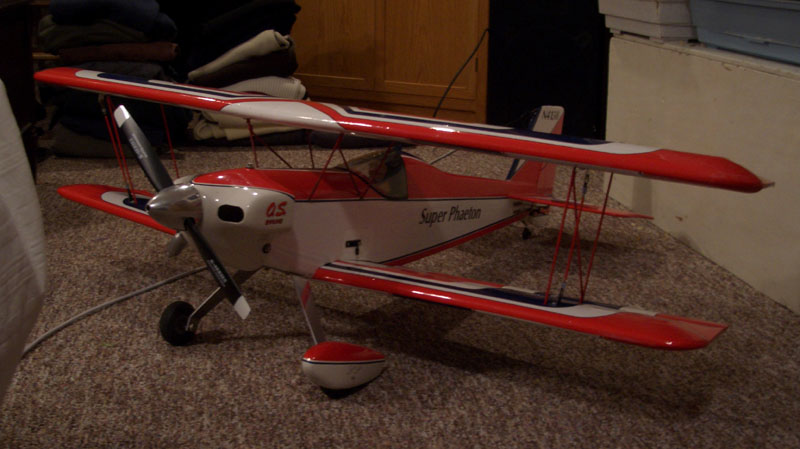
Aircraft Details
- O.S.91 four stroke surpass
- Weight = 8lb
- ball bearing servos
I bought a Phaeton II 45 from a buddy, fixed it up, and now I'm ready to try for a
maiden flight tommorrow. Hopefully someone has one of these birds and can inform
me of the proper CG location. I didn't get the instructions, unfortunately.
Right now, I'm basing the CG on a how-to article in 'Model Airplane News' about biplanes
in general. I would love to get the story from the manual, though, if anyone can remember.
Need to know:
- CG location
- Control surface throws.
Thanks.
Aircraft Details
- O.S.91 four stroke surpass
- Weight = 8lb
- ball bearing servos
05-14-2007 | 07:55 AM
#15
Joined: Dec 2001
Posts: 488
Likes: 0
Received 0 Likes
on
0 Posts
From: Jacksonville, IL
RE: Balsa USA Phaeton ll kit
Here's what the manual says:
"Balancing the model: This is critically important, do not omit this step. The model should balance at the CG location shown on the plans. This is best measured from the leading edge at the center of the upper wing back a distance of 4-1/8". Make sure that the model balances at this point before any flights are attempted."
Nice looking plane. Good luck, Dzl
"Balancing the model: This is critically important, do not omit this step. The model should balance at the CG location shown on the plans. This is best measured from the leading edge at the center of the upper wing back a distance of 4-1/8". Make sure that the model balances at this point before any flights are attempted."
Nice looking plane. Good luck, Dzl
05-14-2007 | 11:35 AM
#16
RE: Balsa USA Phaeton ll kit
ORIGINAL: w8ye
That plane was intended for a 40 size engine. It's going to be pretty hot with that 91, even when you pull the throttle back half way.
That plane was intended for a 40 size engine. It's going to be pretty hot with that 91, even when you pull the throttle back half way.
wouldn't even manage unlimited vertical. That suprises me.
Maybe the air density here in Utah (elev. 4,500ft) is thin enough to make that
much of a performance dent. I'm not after unlimited vertical; just want a nice
sport flier, so I hope he's right.
ORIGINAL: Dzlstunter
Here's what the manual says:
"Balancing the model: This is critically important, do not omit this step. The model should balance at the CG location shown on the plans. This is best measured from the leading edge at the center of the upper wing back a distance of 4-1/8". Make sure that the model balances at this point before any flights are attempted."
Nice looking plane. Good luck, Dzl
Here's what the manual says:
"Balancing the model: This is critically important, do not omit this step. The model should balance at the CG location shown on the plans. This is best measured from the leading edge at the center of the upper wing back a distance of 4-1/8". Make sure that the model balances at this point before any flights are attempted."
Nice looking plane. Good luck, Dzl
05-14-2007 | 12:36 PM
#17
My Feedback: (16)
RE: Balsa USA Phaeton ll kit
A friend has one with a Saito 80 at 500' elevation. It is a dart even at half throttle. He really likes the plane except he has to fly another plane first to build up his nerve.
He relates flying it to the Andrews Aeromaster in characteristics. The Aeromaster is a standard of comparison for sport bipes. The Pheaton has a lower parts count and is much easier to build than the Aeromaster.
He relates flying it to the Andrews Aeromaster in characteristics. The Aeromaster is a standard of comparison for sport bipes. The Pheaton has a lower parts count and is much easier to build than the Aeromaster.
05-14-2007 | 06:32 PM
#19

Joined: Mar 2003
Posts: 90
Likes: 0
Received 0 Likes
on
0 Posts
From: Newmarket,
ON, CANADA
RE: Balsa USA Phaeton ll kit
I have been flying a Phaeton II for a couple of seasons know. I have an OS .61 sf for power and I had Aero glass make me a fiber glass cowl for it. The only change I made is I added solder lugs and hard wood points in the wings to bolt the interplane struts to the wings. This because every Phaeton I have seen has holes in the covering where the interplane struts have so much movement they poke many holes in the covering.
Dave
Dave
05-15-2007 | 12:17 PM
#20
RE: Balsa USA Phaeton ll kit
Well, the Phaeton flew yesterday as planned. I could tell right away that flying a biplane was very different than other planes. It climbs and turns very differently. Lots of fun! Here are my observations:
1) Good low-speed flight performance. Take-off and landing was a breeze.
2) Lots of trim adjustments were needed as the aircraft speed changed. Perhaps this is the nature of biplanes? Or maybe I need to adjust the engine thrust angle, etc. Comments?
3) During the stall test, it looked like the Phaeton was about to roll left into a wicked spin. I backed off before this happened. I'll be wary of the stall with this bird.
4) The O.S.91 four-stroke powers the plane well, but I found that the speed created by 3/4 throttle and full throttle was essentially the same! It is as if there is a speed barrier enforced by drag on the aircraft structure, regardless of the power applied.
JRBmoto,
The plane IS really nice looking, isn't it? I can't take credit for that, because it was covered and furnished by the original builder. I just had to do some minor repairs / replacements to get this one airborne. It was nice to get a new aircraft and have it airborne in just a weekend!
1) Good low-speed flight performance. Take-off and landing was a breeze.
2) Lots of trim adjustments were needed as the aircraft speed changed. Perhaps this is the nature of biplanes? Or maybe I need to adjust the engine thrust angle, etc. Comments?
3) During the stall test, it looked like the Phaeton was about to roll left into a wicked spin. I backed off before this happened. I'll be wary of the stall with this bird.
4) The O.S.91 four-stroke powers the plane well, but I found that the speed created by 3/4 throttle and full throttle was essentially the same! It is as if there is a speed barrier enforced by drag on the aircraft structure, regardless of the power applied.
JRBmoto,
The plane IS really nice looking, isn't it? I can't take credit for that, because it was covered and furnished by the original builder. I just had to do some minor repairs / replacements to get this one airborne. It was nice to get a new aircraft and have it airborne in just a weekend!
05-15-2007 | 03:42 PM
#21
Senior Member
RE: Balsa USA Phaeton ll kit
If trim changes with airspeed, yes you need some adjustments. You did not say how it changed. If it climbs with increased speed or dives as you reduce power, you need more downthrust. If it is a roll rate change, you have a warped wing or two warped wings. Have you checked your relative incidence, i.e. upper wing relative to lower wing? In some dozen or more bipes I've built including two Phaeton40's and two Phaeton90's, all flew best with the upper wing 1.5 degrees less angle of attack than the lower wing was. As you change this relationship, you will find a definate difference in how well the plane handles through all manuevers.


