


Performance Test: Turnigy SK3 2118-2250Kv, 17g, motor
 03-31-2013 | 05:18 AM
#1
Thread Starter
Senior Member
Joined: Mar 2009
Posts: 515
Likes: 0
Received 0 Likes
on
0 Posts
From: M, S, NEW ZEALAND
 Performance Test: Turnigy SK3 2118-2250Kv, 17g, motor
<span style="font-size: medium">Here is a controlled, objective test of the Turnigy SK3 2118-2250Kv motor:
</span>
<u><span style="font-size: medium">MOTOR TEST: Turnigy SK3 2118-2250kv</span></u><span style="font-size: medium"> </span><span style="font-size: x-small">-Supplied by: HobbyKing (HK) <span style="font-size: small">PRICE: $13.07</span>
</span><div style="margin-bottom: 0cm">Motor Weight: 17g (HKdata)</div><div style="margin-bottom: 0cm">Rated Kv: 2250 (HK data)</div><div style="margin-bottom: 0cm">Max current: 4A; Max power: 36W; Motor internal resistance (Rm): 290 milliohm (HK data)</div><div style="margin-bottom: 0cm">External dimensions: diam 21mm, length 18mm (-<span style="font-size: small">the reason it is called a "2118" motor</span>)</div><div style="margin-bottom: 0cm">Stator size: diam 17mm, length 5mm (i.e. 1705 stator)</div><div style="margin-bottom: 0cm">Number wire turns: 11 (11T); Stator arms:9; Magnet poles: 12; Length of magnets: 5mm</div><div style="margin-bottom: 0cm">Shaft diam: 2mm</div><div style="margin-bottom: 0cm">X-Mount (black) weight: 0.8g;
MANUFACTURED BY: SUNRAY TECHNOLOGY: http://sunraytechnology.com/</div><div style="margin-bottom: 0cm">Retailer website: http://www.hobbyking.com/hobbyking/s...ner_Motor.html</div><div style="margin-bottom: 0cm"><span style="font-size: xx-small">
Measuring equipment used: Eagle Tree V4 data logger with brushless RPM sensor and micro-thermistor temperature sensors (for measuring voltage, current, motor RPM and motor temperature); Additional optical tachometer; Additional infra-red thermometer; ABCON Digital scales for measuring thrust.
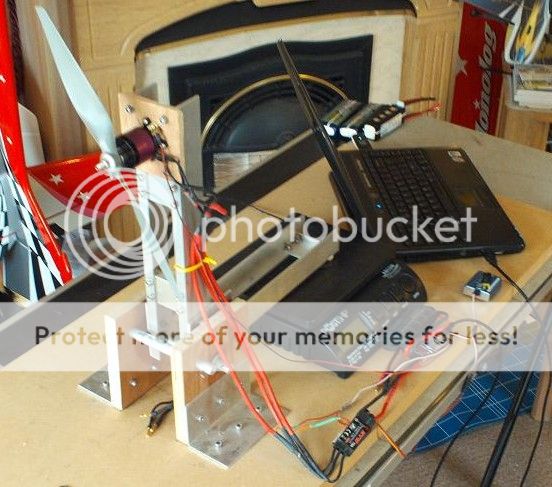
I used a GT-Power Watt Meter to check the current readings on the Eagle Tree data logger, especially for low currents <1A. A </span><span style="font-size: xx-small">GT-Power Servo tester device was used to control a ZTW 70A S-BEC speed controller, which was connected to motor.</span></div><div style="margin-bottom: 0cm"><span style="font-size: xx-small">I used fully charged, 30C to 45C, 2S and 3S LiPo packs as the power source.</span></div><div style="margin-bottom: 0cm"><span style="font-size: xx-small">On the Motor Thrust test stand used, the lower horizontal arm pushes on the scales to measure grams of thrust (see photo). The props are therefore mounted on motor so that thrust is generated in a direction away from motor and stand (i.e. with front face of prop facing the motor and test stand). </span></div><div style="margin-bottom: 0cm">
Description of motor:The Turnigy SK3 2118 2250kv motor, with wires and 2mm connectors, weighed 16.9g. The motor has a 9-arm stator (manuf states: wound with 11T turns) and 12 magnet poles. Externally, it is 21mm diameter; the motor main body is 20mm long, and adding the small nut on the rear housing makes it 22mm long. Motor came fitted with 2mm male connectors.</div><div style="margin-bottom: 0cm">The motor has an in-built prop saver on the front housing. The prop saver suits 3.9mm and 5.5mm prop hubs, and a supplied collar allows for props with 8mm bore. 2 phillips bolts are placed either side of the prop saver, for fixing the O-rings which hold the prop on the saver. The motor came with four O-rings in two sizes. It also came with a small black aluminium X-mount, and two fiberglass X-mounts. There were also two 2mm phillips screws for fixing the X-mount to the rear housing. The rear housing has 4 threaded holes at 14mm centers, although only 2 screws were supplied.</div><div style="margin-bottom: 0cm">
<span style="font-size: small">Standard motor test procedure:</span></div><div style="margin-bottom: 0cm">I mounted this motor using its black aluminium X-mount (which I bolted to the rear motor housing) onto the 8mm plywood plate of my motor test stand (see photo).</div><div style="margin-bottom: 0cm">I then attempted to fix props onto the prop saver with the O-rings.</div><div style="margin-bottom: 0cm">-And this is where I had my first problem -the gap between the back of the black screws and the front motor housing was very narrow -<1mm -and I had difficulty getting the O-ring on and off the screws. I ended up using my Dremel to remove the back of each screw, to widen the gap. After this, I had no problem quickly changing props. (I did not, however, have this same problem with a Turnigy 2122 motor, which has exactly the same front housing).</div><div style="margin-bottom: 0cm">There was also another small issue -there were only 2 screws supplied for fixing the X-mount to the rear motor housing. I wanted the motor to be secure, and found another 2 screws to use in addition.</div><div style="margin-bottom: 0cm">
Test procedure: First, I ran no-loads at 7.4V (2S Li-Po) and at 11.1V (3S Li-Po), at full speed, and measured current (I), voltage (V) and RPM.</div><div style="margin-bottom: 0cm">I then ran 6 different props at full speed, in ascending order of size, using both 2S LiPo and 3S LiPo (3S LiPo for at least some props), and measured I, V, RPM and Thrust.</div><div style="margin-bottom: 0cm">After charging the LiPo's back up again, I then ran the same 6 props, now in descending order of size, to check that the results were reproducible. The second run gave almost identical values.</div><div style="margin-bottom: 0cm">
<span style="font-size: medium">Results:</span></div><div style="margin-bottom: 0cm">This little motor ran very smoothly indeed, and seemed well engineered. It sounded very nice and had a nice “whistle” sound when it ran. It also ran smoothly with all the props tested. It did, a few times, stutter to start with the largest props used, and to get it running I just spun the prop before starting.</div><div style="margin-bottom: 0cm">Results are shown on the attached data sheet.</div><div style="margin-bottom: 0cm">
Kv: I used two methods for calculating Kv. First, I used www.peakeff.com to calculate Rm ("static" motor resistance) and Kv (I used the 2S LiPo data values for smallest and largest props, to give the largest difference in load).</div><div style="margin-bottom: 0cm">Second, I used DriveCalc to calculate Rd ("dynamic" motor resistance) and ns ("real world no load speed"). -DriveCalc also gives a Kv value when data is entered for a new motor (For DriveCalc, I used 2S LiPo test values for 3 different props, at different loads).</div><div style="margin-bottom: 0cm">PeakEff gave a Kv of 2170 RPM/V; DriveCalc gave a Kv of 2197 RPM/V, and also an ns value of 2138. All these values were very close. PeakEff and DriveCalc also gave similar values for Rm and Rd, of 331 and 337 milliohm respectively.</div><div style="margin-bottom: 0cm">
Current and Power: This motor has a max current rating of 4A given by HobbyKing <span style="font-size: small">-And yet NONE of the props I tested, even when using a 2S LiPo pack, gave a current of less than 4A ...!</span></div><div style="margin-bottom: 0cm">The 2 smallest props - 4.5x4.1 and 5x3 -with 2S LiPo gave currents of 5.8A and 4.7A. With a 3S LiPo pack, the current draw was 7.8A and 9.4A, and power input for these was 90W and 109W<span style="font-size: small"> -well above the max manuf. rating of 36W ...!</span></div><div style="margin-bottom: 0cm">I could not run the other 4 larger props with 3S LiPo, because it may have drawn too much current and melted this lovely little motor. So I only ran these larger props with 2S LiPo. Current increased with prop size, up to a max of 12.6A (i.e. 3 times the manuf max rating). The 2 largest props - 7x4 and 8x3.8 -produced an input power of 83 and 88W -again 2.5 times the manuf max rating.</div><div style="margin-bottom: 0cm">
RPM: In general, RPM reduced as prop size became larger. However it is notable that the GWS 5x3 prop had a higher RPM than the APC 4.5x4.1 prop (and also gave more thrust for a lower current). You can also see that the GWS 6x5 prop gave the same RPM as APC 7x4, whilst at the same time drawing more current and producing larger thrust.</div><div style="margin-bottom: 0cm">
Thrust: This small 17g motor was capable of generating more than 300g thrust -and this is impressive. It gave 334g thrust when the GWS 5x3 prop was used with 3S LiPo. And 312g thrust when the 8x3.8 prop was driven with 2S LiPo.</div><div style="margin-bottom: 0cm">For the 2 smallest props, thrust with a 3S LiPo pack was roughly twice as large compared to 2S LiPo.</div><div style="margin-bottom: 0cm">It is also notable that the GWS 6x3 prop generated larger thrust than the 6x5 prop, whist drawing a smaller current.</div><div style="margin-bottom: 0cm">
g of Thrust per Watt of input power: In general, the values for this motor were relatively low. Using 2S LiPo, the GWS 5x3 and 6x3 props gave values around 5. The APC 4.5x4.1 prop gave vales between 2.2 and 3. The 3 largest props, when driven by 2S LiPo, gave values between 2.9 and 3.5.</div><div style="margin-bottom: 0cm">Some brushless motors gives values of 7 or more for g thrust produced per W. With the props tested, this motor produced relatively low thrust per W of input power. Low values between 2 and 4 suggest that the prop might have been overloading the motor.</div><div style="margin-bottom: 0cm">
RPM as % of Kv x V: Values for the 3 smallest props were between 64% and 74%. For the 3 largest props, the values were low, between 40% and 49%, suggesting that these large props may have been overloading the motor.</div><div style="margin-bottom: 0cm">
Efficiency: This was calculated as Power OUT (i.e. power produced by motor, taking into account internal Rm losses) divided by POWER IN (Vin x Iin =Watts in).</div><div style="margin-bottom: 0cm">The 3 smallest props showed an efficiency between 63% and of 70%. The 3 largest props tested had very low efficiencies, between 38% and 50% -again indicating they might have been overloading the motor.
Pics show: 1, The Motor Test Stand used (Can accomodate motors up to 60-size motors, and measure up to 20kg thrust); 2, 3,Turnigy 2118 motor and box; 4, Turnigy SK3 2118 2250kv motor with accessories; 5, 6,Turnigy2118 Motor mounted on test stand;7,Results of the test -the original datasheet, with original readings; 8, Props used for test


 </div>
</span>
<u><span style="font-size: medium">MOTOR TEST: Turnigy SK3 2118-2250kv</span></u><span style="font-size: medium"> </span><span style="font-size: x-small">-Supplied by: HobbyKing (HK) <span style="font-size: small">PRICE: $13.07</span>
</span><div style="margin-bottom: 0cm">Motor Weight: 17g (HKdata)</div><div style="margin-bottom: 0cm">Rated Kv: 2250 (HK data)</div><div style="margin-bottom: 0cm">Max current: 4A; Max power: 36W; Motor internal resistance (Rm): 290 milliohm (HK data)</div><div style="margin-bottom: 0cm">External dimensions: diam 21mm, length 18mm (-<span style="font-size: small">the reason it is called a "2118" motor</span>)</div><div style="margin-bottom: 0cm">Stator size: diam 17mm, length 5mm (i.e. 1705 stator)</div><div style="margin-bottom: 0cm">Number wire turns: 11 (11T); Stator arms:9; Magnet poles: 12; Length of magnets: 5mm</div><div style="margin-bottom: 0cm">Shaft diam: 2mm</div><div style="margin-bottom: 0cm">X-Mount (black) weight: 0.8g;
MANUFACTURED BY: SUNRAY TECHNOLOGY: http://sunraytechnology.com/</div><div style="margin-bottom: 0cm">Retailer website: http://www.hobbyking.com/hobbyking/s...ner_Motor.html</div><div style="margin-bottom: 0cm"><span style="font-size: xx-small">
Measuring equipment used: Eagle Tree V4 data logger with brushless RPM sensor and micro-thermistor temperature sensors (for measuring voltage, current, motor RPM and motor temperature); Additional optical tachometer; Additional infra-red thermometer; ABCON Digital scales for measuring thrust.
I used a GT-Power Watt Meter to check the current readings on the Eagle Tree data logger, especially for low currents <1A. A </span><span style="font-size: xx-small">GT-Power Servo tester device was used to control a ZTW 70A S-BEC speed controller, which was connected to motor.</span></div><div style="margin-bottom: 0cm"><span style="font-size: xx-small">I used fully charged, 30C to 45C, 2S and 3S LiPo packs as the power source.</span></div><div style="margin-bottom: 0cm"><span style="font-size: xx-small">On the Motor Thrust test stand used, the lower horizontal arm pushes on the scales to measure grams of thrust (see photo). The props are therefore mounted on motor so that thrust is generated in a direction away from motor and stand (i.e. with front face of prop facing the motor and test stand). </span></div><div style="margin-bottom: 0cm">
Description of motor:The Turnigy SK3 2118 2250kv motor, with wires and 2mm connectors, weighed 16.9g. The motor has a 9-arm stator (manuf states: wound with 11T turns) and 12 magnet poles. Externally, it is 21mm diameter; the motor main body is 20mm long, and adding the small nut on the rear housing makes it 22mm long. Motor came fitted with 2mm male connectors.</div><div style="margin-bottom: 0cm">The motor has an in-built prop saver on the front housing. The prop saver suits 3.9mm and 5.5mm prop hubs, and a supplied collar allows for props with 8mm bore. 2 phillips bolts are placed either side of the prop saver, for fixing the O-rings which hold the prop on the saver. The motor came with four O-rings in two sizes. It also came with a small black aluminium X-mount, and two fiberglass X-mounts. There were also two 2mm phillips screws for fixing the X-mount to the rear housing. The rear housing has 4 threaded holes at 14mm centers, although only 2 screws were supplied.</div><div style="margin-bottom: 0cm">
<span style="font-size: small">Standard motor test procedure:</span></div><div style="margin-bottom: 0cm">I mounted this motor using its black aluminium X-mount (which I bolted to the rear motor housing) onto the 8mm plywood plate of my motor test stand (see photo).</div><div style="margin-bottom: 0cm">I then attempted to fix props onto the prop saver with the O-rings.</div><div style="margin-bottom: 0cm">-And this is where I had my first problem -the gap between the back of the black screws and the front motor housing was very narrow -<1mm -and I had difficulty getting the O-ring on and off the screws. I ended up using my Dremel to remove the back of each screw, to widen the gap. After this, I had no problem quickly changing props. (I did not, however, have this same problem with a Turnigy 2122 motor, which has exactly the same front housing).</div><div style="margin-bottom: 0cm">There was also another small issue -there were only 2 screws supplied for fixing the X-mount to the rear motor housing. I wanted the motor to be secure, and found another 2 screws to use in addition.</div><div style="margin-bottom: 0cm">
Test procedure: First, I ran no-loads at 7.4V (2S Li-Po) and at 11.1V (3S Li-Po), at full speed, and measured current (I), voltage (V) and RPM.</div><div style="margin-bottom: 0cm">I then ran 6 different props at full speed, in ascending order of size, using both 2S LiPo and 3S LiPo (3S LiPo for at least some props), and measured I, V, RPM and Thrust.</div><div style="margin-bottom: 0cm">After charging the LiPo's back up again, I then ran the same 6 props, now in descending order of size, to check that the results were reproducible. The second run gave almost identical values.</div><div style="margin-bottom: 0cm">
<span style="font-size: medium">Results:</span></div><div style="margin-bottom: 0cm">This little motor ran very smoothly indeed, and seemed well engineered. It sounded very nice and had a nice “whistle” sound when it ran. It also ran smoothly with all the props tested. It did, a few times, stutter to start with the largest props used, and to get it running I just spun the prop before starting.</div><div style="margin-bottom: 0cm">Results are shown on the attached data sheet.</div><div style="margin-bottom: 0cm">
Kv: I used two methods for calculating Kv. First, I used www.peakeff.com to calculate Rm ("static" motor resistance) and Kv (I used the 2S LiPo data values for smallest and largest props, to give the largest difference in load).</div><div style="margin-bottom: 0cm">Second, I used DriveCalc to calculate Rd ("dynamic" motor resistance) and ns ("real world no load speed"). -DriveCalc also gives a Kv value when data is entered for a new motor (For DriveCalc, I used 2S LiPo test values for 3 different props, at different loads).</div><div style="margin-bottom: 0cm">PeakEff gave a Kv of 2170 RPM/V; DriveCalc gave a Kv of 2197 RPM/V, and also an ns value of 2138. All these values were very close. PeakEff and DriveCalc also gave similar values for Rm and Rd, of 331 and 337 milliohm respectively.</div><div style="margin-bottom: 0cm">
Current and Power: This motor has a max current rating of 4A given by HobbyKing <span style="font-size: small">-And yet NONE of the props I tested, even when using a 2S LiPo pack, gave a current of less than 4A ...!</span></div><div style="margin-bottom: 0cm">The 2 smallest props - 4.5x4.1 and 5x3 -with 2S LiPo gave currents of 5.8A and 4.7A. With a 3S LiPo pack, the current draw was 7.8A and 9.4A, and power input for these was 90W and 109W<span style="font-size: small"> -well above the max manuf. rating of 36W ...!</span></div><div style="margin-bottom: 0cm">I could not run the other 4 larger props with 3S LiPo, because it may have drawn too much current and melted this lovely little motor. So I only ran these larger props with 2S LiPo. Current increased with prop size, up to a max of 12.6A (i.e. 3 times the manuf max rating). The 2 largest props - 7x4 and 8x3.8 -produced an input power of 83 and 88W -again 2.5 times the manuf max rating.</div><div style="margin-bottom: 0cm">
RPM: In general, RPM reduced as prop size became larger. However it is notable that the GWS 5x3 prop had a higher RPM than the APC 4.5x4.1 prop (and also gave more thrust for a lower current). You can also see that the GWS 6x5 prop gave the same RPM as APC 7x4, whilst at the same time drawing more current and producing larger thrust.</div><div style="margin-bottom: 0cm">
Thrust: This small 17g motor was capable of generating more than 300g thrust -and this is impressive. It gave 334g thrust when the GWS 5x3 prop was used with 3S LiPo. And 312g thrust when the 8x3.8 prop was driven with 2S LiPo.</div><div style="margin-bottom: 0cm">For the 2 smallest props, thrust with a 3S LiPo pack was roughly twice as large compared to 2S LiPo.</div><div style="margin-bottom: 0cm">It is also notable that the GWS 6x3 prop generated larger thrust than the 6x5 prop, whist drawing a smaller current.</div><div style="margin-bottom: 0cm">
g of Thrust per Watt of input power: In general, the values for this motor were relatively low. Using 2S LiPo, the GWS 5x3 and 6x3 props gave values around 5. The APC 4.5x4.1 prop gave vales between 2.2 and 3. The 3 largest props, when driven by 2S LiPo, gave values between 2.9 and 3.5.</div><div style="margin-bottom: 0cm">Some brushless motors gives values of 7 or more for g thrust produced per W. With the props tested, this motor produced relatively low thrust per W of input power. Low values between 2 and 4 suggest that the prop might have been overloading the motor.</div><div style="margin-bottom: 0cm">
RPM as % of Kv x V: Values for the 3 smallest props were between 64% and 74%. For the 3 largest props, the values were low, between 40% and 49%, suggesting that these large props may have been overloading the motor.</div><div style="margin-bottom: 0cm">
Efficiency: This was calculated as Power OUT (i.e. power produced by motor, taking into account internal Rm losses) divided by POWER IN (Vin x Iin =Watts in).</div><div style="margin-bottom: 0cm">The 3 smallest props showed an efficiency between 63% and of 70%. The 3 largest props tested had very low efficiencies, between 38% and 50% -again indicating they might have been overloading the motor.
Pics show: 1, The Motor Test Stand used (Can accomodate motors up to 60-size motors, and measure up to 20kg thrust); 2, 3,Turnigy 2118 motor and box; 4, Turnigy SK3 2118 2250kv motor with accessories; 5, 6,Turnigy2118 Motor mounted on test stand;7,Results of the test -the original datasheet, with original readings; 8, Props used for test
 03-31-2013 | 05:30 AM
#2
Thread Starter
Senior Member
Joined: Mar 2009
Posts: 515
Likes: 0
Received 0 Likes
on
0 Posts
From: M, S, NEW ZEALAND
RE: Performance Test: Turnigy SK3 2118-2250Kv, 17g, motor
<div style="margin-bottom: 0cm"><span style="font-size: medium">Discussion of these Results:</span></div><div style="margin-bottom: 0cm">1. The results showed this motor has a Kv of around 2190 RPM/V, slightly lower than the HKcalculatedKv of 2250 RPM/V -but not by much.</div><div style="margin-bottom: 0cm">We can see very easily that the Kv of this motor must be lower than 2250, from the No-Load testing. The motor had an RPM of 25650 when driven by 12.36V. If the Kv was 2250, then the No-Load RPM would have been about 27810 (i.e. 12.36V x 2250 RPM/V).</div><div style="margin-bottom: 0cm">-However, Kv is only a theoretical value, calculated as if the motor is perfect with no losses, and is operating under a completely zero load. In reality, all electric motors have some load (even under no-external load conditions), and all brushless motors have some losses due to voltage drop across Rm and also due to thermal losses. The "real world no load speed" is probably a more practical value, and was calculated by DriveCalc as 2138 RPM/V (about 100 less than HKquoted Kv of 2250 RPM/V).</div><div style="margin-bottom: 0cm">
2. The No-Load current for this motor was0.38 to 0.53A, depending on voltage. The Rm / Rd was found to be about 331 / 337 milliohms, close to the HKquoted figure.</div><div style="margin-bottom: 0cm">
3. <span style="font-size: medium">The most striking feature of this motor test, is that NONE of the props tested, from 4" to 8" diameter, produced a current less than 4A -which is the max current quotedon HKspecs...!</span></div><div style="margin-bottom: 0cm">The prop which gave lowest current was the GWS 5x3 on 2S LiPo, and even this prop generated a current of 4.7A. It produced an input power of 36W, which is right at the top of theHK rating.</div><div style="margin-bottom: 0cm">It is possible that the rating given by HobbyKing is very conservative, and that in reality this motor can take much larger currents than 4A. It may be that the current / power rating will have to be revised in future, with perhaps something like 7A being a sensible max current for this motor (which, with 2S LiPo, would be a max power of ~50W i.e. 7.4V x 7A).</div><div style="margin-bottom: 0cm">
4. Despite input currents larger than 4A, this motor continued to perform, and was clearly able to handle much larger currents than 4A. It even handled currents between 9 and 12.6A, when generated by the largest props -however these props were probably overloading the motor.</div><div style="margin-bottom: 0cm">The motor certainly seemed to be able to handle currents of 5A and 6A, at least. The GWS 6x3 prop (on 2S LiPo) gave a thrust of 236g, whilst drawing 6.6A, and for an input power of about 50W. This appeared to be near optimum performance for this motor.
<div style="margin-bottom: 0cm">5. It seems clear that the 3 largest props overloaded this motor -judging by the fact their g/W values were very low, and their efficiency values were 50% and below. These larger props also drew currents of more than 9A. Therefore, it would seem that props larger than 6x5 cannot be recommended for this motor.</div></div>
2. The No-Load current for this motor was0.38 to 0.53A, depending on voltage. The Rm / Rd was found to be about 331 / 337 milliohms, close to the HKquoted figure.</div><div style="margin-bottom: 0cm">
3. <span style="font-size: medium">The most striking feature of this motor test, is that NONE of the props tested, from 4" to 8" diameter, produced a current less than 4A -which is the max current quotedon HKspecs...!</span></div><div style="margin-bottom: 0cm">The prop which gave lowest current was the GWS 5x3 on 2S LiPo, and even this prop generated a current of 4.7A. It produced an input power of 36W, which is right at the top of theHK rating.</div><div style="margin-bottom: 0cm">It is possible that the rating given by HobbyKing is very conservative, and that in reality this motor can take much larger currents than 4A. It may be that the current / power rating will have to be revised in future, with perhaps something like 7A being a sensible max current for this motor (which, with 2S LiPo, would be a max power of ~50W i.e. 7.4V x 7A).</div><div style="margin-bottom: 0cm">
4. Despite input currents larger than 4A, this motor continued to perform, and was clearly able to handle much larger currents than 4A. It even handled currents between 9 and 12.6A, when generated by the largest props -however these props were probably overloading the motor.</div><div style="margin-bottom: 0cm">The motor certainly seemed to be able to handle currents of 5A and 6A, at least. The GWS 6x3 prop (on 2S LiPo) gave a thrust of 236g, whilst drawing 6.6A, and for an input power of about 50W. This appeared to be near optimum performance for this motor.
<div style="margin-bottom: 0cm">5. It seems clear that the 3 largest props overloaded this motor -judging by the fact their g/W values were very low, and their efficiency values were 50% and below. These larger props also drew currents of more than 9A. Therefore, it would seem that props larger than 6x5 cannot be recommended for this motor.</div></div>
03-31-2013 | 05:38 AM
#3
Thread Starter
Senior Member
Joined: Mar 2009
Posts: 515
Likes: 0
Received 0 Likes
on
0 Posts
From: M, S, NEW ZEALAND
RE: Performance Test: Turnigy SK3 2118-2250Kv, 17g, motor
<span style="font-size: medium">CONT:
</span>6. The best props for this motor seem to be the 5x3 and 6x3.<div style="margin-bottom: 0cm">Even with 2S LiPo, the GWS 5x3 prop produced 182g thrust for only 4.7A current. With 3S LiPo, it produced 334g thrust for 7.8A (and for 90W of input power)</div><div style="margin-bottom: 0cm">The GWS 6x3 prop on 2S LiPo produced 236g thrust for only 6.6A of drawn current (and for just ~50W of input power)</div><div style="margin-bottom: 0cm">Perhaps a prop like the small APC 4.5x4.1 might be useful for some people who want a very fast flying plane, because this prop produced a pitch speed of 48mph with 2S LiPo, and a pitch speed of 63mph with 3S LiPo. These were higher pitch speeds than obtained with any other prop.</div><div style="margin-bottom: 0cm">
7. Thrust values of 230g with 2S LiPo, and 330g with 3S LiPo, seem very impressive for a very little 17g motor like this Turnigy SK3 2118 2250kv.</div><div style="margin-bottom: 0cm">
8. A 16g / 17g motor like this might be used for some Indoor flying planes. In 2013, many indoor planes are typically 800 to 900mm wingspan, weigh 100g to 150g, use 2S LiPo and are usually made of 3mm styrofoam (e.g. Pauzuolis-RC, RC-Factory, Fancy Foam, TopModelCZ, and TechOne indoor aerobatic planes).</div><div style="margin-bottom: 0cm">The fact that this 17g Turnigy motor can generate ~240g thrust with a 6x3 prop (when driven by 2S LiPo) is certainly useful for a 125g indoor plane. However, many of these indoor aerobatic planes tend to use 7x3.8 props, up to 9x4.7 props, and this 2250 Kv motor is not suited to larger props like these. It would be better to use a motor with Kv ~1400 to 1600 for indoor aerobatics e.g. ePower X2203/1700; OverskyRC AP15 Kv 1510Kv; Axi 2203/52 Kv1525;Scorpion S-1804-1650 F3P motor; TIGER T2204 motor, Kv 1700;See: http://www.rcgroups.com/forums/showthread.php?t=1779737 & http://www.rcgroups.com/forums/showthread.php?t=1322602</div><div style="margin-bottom: 0cm"> & http://www.rcgroups.com/forums/showthread.php?t=882180</div><div style="margin-bottom: 0cm">
9. This Turnigy SK3 2118 2250kv motor, with relatively high Kv, is therefore probably better suited to small faster flying "Park Flyer" -type planes of between 120g to ~200g in weight e.g. the “Mini VIPER Tomahawk“ plane - http://www.flymodelcomponents.it/sho...220&page=1 (-this Viper-Tomahawk plane uses a HYPERION Z1705-11T 2250 KV motor, and this Turnigy SK3 2118 2250kv motor is identical, and is even produced in the same Sunray Technology factory as the Hyperion motor -seehttp://www.rcuniverse.com/forum/fb.asp?m=11426913 This Sunray Tech factoryalso makesHacker,E-F Torque,LiPolice, OK Hobby Infinite, Shulman Aviation FURY, Gens Ace,and many other brands of motor. All these motor brands have almost identical specifications...).</div><div style="margin-bottom: 0cm">
10. For testing of this motor, I have deliberately used 2S and 3S LiPo packs, to simulate what we all use in the real flying situation. The usefulness of these data, is that they show - using a given prop and given number of LiPo cells -what level of current and thrust we might expect with various combinations of props and LiPo packs.</div><div style="margin-bottom: 0cm">These data also show us what ESC should be used with this motor. Since this Turnigy SK3motor could generate up to 11 and 12A with larger props, it would seem that a 15A or 20A ESC might be the best option, especially if using larger props.</div><div style="margin-bottom: 0cm">
BEST PROPS FOR THIS Turnigy SK3 2118 2250kv MOTOR:</div><div style="margin-bottom: 0cm">a. GWS 5x3 on 2S LiPo</div><div style="margin-bottom: 0cm">b. GWS 6x3 on 2S LiPo.</div><div style="margin-bottom: 0cm">c. GWS 5x3 on 3S LiPo.</div><div style="margin-bottom: 0cm"></div>
</span>6. The best props for this motor seem to be the 5x3 and 6x3.<div style="margin-bottom: 0cm">Even with 2S LiPo, the GWS 5x3 prop produced 182g thrust for only 4.7A current. With 3S LiPo, it produced 334g thrust for 7.8A (and for 90W of input power)</div><div style="margin-bottom: 0cm">The GWS 6x3 prop on 2S LiPo produced 236g thrust for only 6.6A of drawn current (and for just ~50W of input power)</div><div style="margin-bottom: 0cm">Perhaps a prop like the small APC 4.5x4.1 might be useful for some people who want a very fast flying plane, because this prop produced a pitch speed of 48mph with 2S LiPo, and a pitch speed of 63mph with 3S LiPo. These were higher pitch speeds than obtained with any other prop.</div><div style="margin-bottom: 0cm">
7. Thrust values of 230g with 2S LiPo, and 330g with 3S LiPo, seem very impressive for a very little 17g motor like this Turnigy SK3 2118 2250kv.</div><div style="margin-bottom: 0cm">
8. A 16g / 17g motor like this might be used for some Indoor flying planes. In 2013, many indoor planes are typically 800 to 900mm wingspan, weigh 100g to 150g, use 2S LiPo and are usually made of 3mm styrofoam (e.g. Pauzuolis-RC, RC-Factory, Fancy Foam, TopModelCZ, and TechOne indoor aerobatic planes).</div><div style="margin-bottom: 0cm">The fact that this 17g Turnigy motor can generate ~240g thrust with a 6x3 prop (when driven by 2S LiPo) is certainly useful for a 125g indoor plane. However, many of these indoor aerobatic planes tend to use 7x3.8 props, up to 9x4.7 props, and this 2250 Kv motor is not suited to larger props like these. It would be better to use a motor with Kv ~1400 to 1600 for indoor aerobatics e.g. ePower X2203/1700; OverskyRC AP15 Kv 1510Kv; Axi 2203/52 Kv1525;Scorpion S-1804-1650 F3P motor; TIGER T2204 motor, Kv 1700;See: http://www.rcgroups.com/forums/showthread.php?t=1779737 & http://www.rcgroups.com/forums/showthread.php?t=1322602</div><div style="margin-bottom: 0cm"> & http://www.rcgroups.com/forums/showthread.php?t=882180</div><div style="margin-bottom: 0cm">
9. This Turnigy SK3 2118 2250kv motor, with relatively high Kv, is therefore probably better suited to small faster flying "Park Flyer" -type planes of between 120g to ~200g in weight e.g. the “Mini VIPER Tomahawk“ plane - http://www.flymodelcomponents.it/sho...220&page=1 (-this Viper-Tomahawk plane uses a HYPERION Z1705-11T 2250 KV motor, and this Turnigy SK3 2118 2250kv motor is identical, and is even produced in the same Sunray Technology factory as the Hyperion motor -seehttp://www.rcuniverse.com/forum/fb.asp?m=11426913 This Sunray Tech factoryalso makesHacker,E-F Torque,LiPolice, OK Hobby Infinite, Shulman Aviation FURY, Gens Ace,and many other brands of motor. All these motor brands have almost identical specifications...).</div><div style="margin-bottom: 0cm">
10. For testing of this motor, I have deliberately used 2S and 3S LiPo packs, to simulate what we all use in the real flying situation. The usefulness of these data, is that they show - using a given prop and given number of LiPo cells -what level of current and thrust we might expect with various combinations of props and LiPo packs.</div><div style="margin-bottom: 0cm">These data also show us what ESC should be used with this motor. Since this Turnigy SK3motor could generate up to 11 and 12A with larger props, it would seem that a 15A or 20A ESC might be the best option, especially if using larger props.</div><div style="margin-bottom: 0cm">
BEST PROPS FOR THIS Turnigy SK3 2118 2250kv MOTOR:</div><div style="margin-bottom: 0cm">a. GWS 5x3 on 2S LiPo</div><div style="margin-bottom: 0cm">b. GWS 6x3 on 2S LiPo.</div><div style="margin-bottom: 0cm">c. GWS 5x3 on 3S LiPo.</div><div style="margin-bottom: 0cm"></div>
03-31-2013 | 05:43 AM
#4
Thread Starter
Senior Member
Joined: Mar 2009
Posts: 515
Likes: 0
Received 0 Likes
on
0 Posts
From: M, S, NEW ZEALAND
RE: Performance Test: Turnigy SK3 2118-2250Kv, 17g, motor
<span style="font-size: medium">Comparison with other information about this Turnigy SK3 2118-2250kv motor:</span><div style="margin-bottom: 0cm">a. Dr Kiwi (Phil M) tested this same Turnigy motor, in Oct 2011 - http://www.rcgroups.com/forums/showp...p;postcount=54</div><div style="margin-bottom: 0cm">b. He used props between 4x4 and 7x3.</div><div style="margin-bottom: 0cm">c. He found results very similar to mine:</div><div style="margin-bottom: 0cm">-With a 4x4 prop @ 7.8V, he found 35W and 120g thrust. With a 4.5x4.1 prop, I found 44W and 134g thrust.</div><div style="margin-bottom: 0cm">d. Dr Kiwi also used the same GWS 5x3 prop that I used, and this allows our data to be compared directly.</div><div style="margin-bottom: 0cm">-At 7.4V, he found 30W and 177g thrust; I found 36W and 182g thrust.</div><div style="margin-bottom: 0cm">e. For the GWS 6x3 prop, @7.4V he found 43W and 255g thrust; I measured 49W and 236g thrust.</div><div style="margin-bottom: 0cm">f. Dr Kiwi also reported g/W values which were quite close the ones I found, for the same props.</div><div style="margin-bottom: 0cm">
Therefore, because my results are nearly identical with those of Dr Kiwi, this validates the thrust stand that I have made, and also the methods and the measurement equipment that I used.</div><div style="margin-bottom: 0cm">There is, however, one small difference between the data of Dr Kiwi data and my data. With similar props and supply voltages, Dr Kiwi generally found prop RPM values which were ~1000 higher than the ones I measured. Dr Kiwi also suggested a Kv of 2340 from his measurements, slightly higher than my estimated Kv of ~2190. The fact that Dr Kiwi could measure slightly higher RPM's in the particular motor he tested, probably accounts for the small difference between the Kv values that we obtained. There is likely to be small variations in individual motors, and the particular motor I tested seemed to have slightly lower RPM's for the same props than the one Dr Kiwi tested. Not every Turnigy 2122 motor will have a Kv exactly at 2250 RPM/V -some will be 100 higher, some will be 100 lower, and that explains the small difference in the Kv's that we find. It seems the Kv of this motor will be around 2250,and probably varies in individual motors between 2150 and 2350.</div><div style="margin-bottom: 0cm">
</div><div style="margin-bottom: 0cm"><span style="font-size: small">User informationabout this Turnigy 2118 motor, on the HobbyKing website:</span></div><div style="margin-bottom: 0cm">There are relatively few user comments on the HobbyKing website about this Turnigy SK3 2118 2250kv motor.</div><div style="margin-bottom: 0cm">http://www.hobbyking.com/hobbyking/s...ner_Motor.html</div><div style="margin-bottom: 0cm">
At least one person mentions using a 6x3 prop with this motor: "... Best moter ever baught. I put it in a multiplex fox with 6x3 propeler,460 mah 3s nano-tech battery and 18-20amp esc. It never gets hot, fly for 4 minutes full throtle, lands on fields without grass and has never problems. Excellent thing ...".</div><div style="margin-bottom: 0cm">There are also other positive comments from users: " ... this motor is awsome have the same as hacker a10 15s and i found the specs for this motor on rcgroups ..."</div><div style="margin-bottom: 0cm">
NOW: THIS IS A BIT CONFUSING -And it is worth mentioning the matter here ....</div><div style="margin-bottom: 0cm">The Turnigy SK3 2118 2250kv is indeed almost identical to the Hacker A10-15 S motor -which has a reported Kv of 2320 and weight 15g. The designated name of the Hacker motor "10-15 S" suggests that it is a 15T motor, however. -Whereas the Turnigy SK3 2118 2250kv that I tested here, is supposed to be an 11T motor. Now, IF the Hacker is a 15T motor, then it should have a much lower Kv than 2320 (since Kv reduces as the number of turns increase). We might therefore expect the Hacker A10-15 S motor to have a Kv more like 1700.</div><div style="margin-bottom: 0cm">-And yet these 2 motors have a almost identical Kv. I suspect therefore, that the Hacker A10-15 S motor may not really be a a 15T motor, and that it may more likely be an 11T motor -like this Turnigy SK3 2118 2250kv. Maybe, the Hacker should be called a "Hacker A10-11 S" motor.</div><div style="margin-bottom: 0cm">-After all, the HYPERION Z1705-11T 2250 KV motor is known to be identical with the Hacker A10-15 S (and is made in the same Sunray factory as Hacker and Turnigy SK3 motors ... ) -and we can, of course, see from its name that the Hyperion is an 11T motor.</div><div style="margin-bottom: 0cm">Also see: http://www.rcuniverse.com/forum/fb.asp?m=11427004
</div>
Therefore, because my results are nearly identical with those of Dr Kiwi, this validates the thrust stand that I have made, and also the methods and the measurement equipment that I used.</div><div style="margin-bottom: 0cm">There is, however, one small difference between the data of Dr Kiwi data and my data. With similar props and supply voltages, Dr Kiwi generally found prop RPM values which were ~1000 higher than the ones I measured. Dr Kiwi also suggested a Kv of 2340 from his measurements, slightly higher than my estimated Kv of ~2190. The fact that Dr Kiwi could measure slightly higher RPM's in the particular motor he tested, probably accounts for the small difference between the Kv values that we obtained. There is likely to be small variations in individual motors, and the particular motor I tested seemed to have slightly lower RPM's for the same props than the one Dr Kiwi tested. Not every Turnigy 2122 motor will have a Kv exactly at 2250 RPM/V -some will be 100 higher, some will be 100 lower, and that explains the small difference in the Kv's that we find. It seems the Kv of this motor will be around 2250,and probably varies in individual motors between 2150 and 2350.</div><div style="margin-bottom: 0cm">
</div><div style="margin-bottom: 0cm"><span style="font-size: small">User informationabout this Turnigy 2118 motor, on the HobbyKing website:</span></div><div style="margin-bottom: 0cm">There are relatively few user comments on the HobbyKing website about this Turnigy SK3 2118 2250kv motor.</div><div style="margin-bottom: 0cm">http://www.hobbyking.com/hobbyking/s...ner_Motor.html</div><div style="margin-bottom: 0cm">
At least one person mentions using a 6x3 prop with this motor: "... Best moter ever baught. I put it in a multiplex fox with 6x3 propeler,460 mah 3s nano-tech battery and 18-20amp esc. It never gets hot, fly for 4 minutes full throtle, lands on fields without grass and has never problems. Excellent thing ...".</div><div style="margin-bottom: 0cm">There are also other positive comments from users: " ... this motor is awsome have the same as hacker a10 15s and i found the specs for this motor on rcgroups ..."</div><div style="margin-bottom: 0cm">
NOW: THIS IS A BIT CONFUSING -And it is worth mentioning the matter here ....</div><div style="margin-bottom: 0cm">The Turnigy SK3 2118 2250kv is indeed almost identical to the Hacker A10-15 S motor -which has a reported Kv of 2320 and weight 15g. The designated name of the Hacker motor "10-15 S" suggests that it is a 15T motor, however. -Whereas the Turnigy SK3 2118 2250kv that I tested here, is supposed to be an 11T motor. Now, IF the Hacker is a 15T motor, then it should have a much lower Kv than 2320 (since Kv reduces as the number of turns increase). We might therefore expect the Hacker A10-15 S motor to have a Kv more like 1700.</div><div style="margin-bottom: 0cm">-And yet these 2 motors have a almost identical Kv. I suspect therefore, that the Hacker A10-15 S motor may not really be a a 15T motor, and that it may more likely be an 11T motor -like this Turnigy SK3 2118 2250kv. Maybe, the Hacker should be called a "Hacker A10-11 S" motor.</div><div style="margin-bottom: 0cm">-After all, the HYPERION Z1705-11T 2250 KV motor is known to be identical with the Hacker A10-15 S (and is made in the same Sunray factory as Hacker and Turnigy SK3 motors ... ) -and we can, of course, see from its name that the Hyperion is an 11T motor.</div><div style="margin-bottom: 0cm">Also see: http://www.rcuniverse.com/forum/fb.asp?m=11427004
</div>
03-31-2013 | 05:54 AM
#5
Thread Starter
Senior Member
Joined: Mar 2009
Posts: 515
Likes: 0
Received 0 Likes
on
0 Posts
From: M, S, NEW ZEALAND
RE: Performance Test: Turnigy SK3 2118-2250Kv, 17g, motor
<span style="font-size: medium">Other similar (actually probably identical) 16g motors, with Kv ~2250, 11T motors: </span><div style="margin-bottom: 0cm">LiPolice LP-1705/11T-2275KV
HYPERION Z1705-11T 2250 KV</div><div style="margin-bottom: 0cm">OK Hobby Infinite A1705-2250, 11T</div><div style="margin-bottom: 0cm">Also:
Hacker A10-15 S, Kv 2320, 15T</div><div style="margin-bottom: 0cm">Shulman FURY SA-10-15S / 2320Kv, 15T</div><div style="margin-bottom: 0cm"> -These Hacker and Fury motors also appear to be identical to the Turnigy SK3 2118 2250kv I tested. The Fury and Hacker have an identical name, and also an identical Kv.</div><div style="margin-bottom: 0cm">
<span style="font-size: medium">Other similar 16g motors, with lower Kv:</span></div><div style="margin-bottom: 0cm">LiPolice LP-1705/14T-1825KV</div><div style="margin-bottom: 0cm">HYPERION Z1705-14T 1800 KV</div><div style="margin-bottom: 0cm">Foxy C1705/14 1825 Kv</div><div style="margin-bottom: 0cm">OK Hobby Infinite A1705-1800, 14T
</div><div style="margin-bottom: 0cm"><span style="font-size: medium">And with higher Kv
</span>Turnigy SK3 2118-2750kv, 9T</div><div style="margin-bottom: 0cm">Hacker A10-12 S, 2900Kv</div><div style="margin-bottom: 0cm">Shulman Fury-SA-10 12S / 2900Kv
(All Hacker, Hyperion-Z, LiPolice, Shulman Fury, Foxy, and Turnigy SK3 motors are made together in the Sunray Tech factory
-this explains their very similar specs)</div>
HYPERION Z1705-11T 2250 KV</div><div style="margin-bottom: 0cm">OK Hobby Infinite A1705-2250, 11T</div><div style="margin-bottom: 0cm">Also:
Hacker A10-15 S, Kv 2320, 15T</div><div style="margin-bottom: 0cm">Shulman FURY SA-10-15S / 2320Kv, 15T</div><div style="margin-bottom: 0cm"> -These Hacker and Fury motors also appear to be identical to the Turnigy SK3 2118 2250kv I tested. The Fury and Hacker have an identical name, and also an identical Kv.</div><div style="margin-bottom: 0cm">
<span style="font-size: medium">Other similar 16g motors, with lower Kv:</span></div><div style="margin-bottom: 0cm">LiPolice LP-1705/14T-1825KV</div><div style="margin-bottom: 0cm">HYPERION Z1705-14T 1800 KV</div><div style="margin-bottom: 0cm">Foxy C1705/14 1825 Kv</div><div style="margin-bottom: 0cm">OK Hobby Infinite A1705-1800, 14T
</div><div style="margin-bottom: 0cm"><span style="font-size: medium">And with higher Kv
</span>Turnigy SK3 2118-2750kv, 9T</div><div style="margin-bottom: 0cm">Hacker A10-12 S, 2900Kv</div><div style="margin-bottom: 0cm">Shulman Fury-SA-10 12S / 2900Kv
(All Hacker, Hyperion-Z, LiPolice, Shulman Fury, Foxy, and Turnigy SK3 motors are made together in the Sunray Tech factory
-this explains their very similar specs)</div>
03-31-2013 | 05:58 AM
#6
Thread Starter
Senior Member
Joined: Mar 2009
Posts: 515
Likes: 0
Received 0 Likes
on
0 Posts
From: M, S, NEW ZEALAND
RE: Performance Test: Turnigy SK3 2118-2250Kv, 17g, motor
<div style="margin-bottom: 0cm"><span style="font-size: medium">Some other motors about16g weight.Just for information
</span>
TIGER T1804 motor, Kv 2250, 14g
TIGER T2202 motor, Kv 2305, 14.5g
OverskyRC AP15, Kv 1510, 16g</div><div style="margin-bottom: 0cm">TIGER T2402 motor, Kv 2090, 16g</div><div style="margin-bottom: 0cm">A1510-2200 2200KV Micro Brushless Motor, 16g</div><div style="margin-bottom: 0cm">PICHLER C6126, Kv 2000,16g
hexTronik Brushless Outrunner 1700kv, 16g, Kv 2000
AK/1818/2200/16g Micro Brushless Outrunner Motor</div><div style="margin-bottom: 0cm">C2403 Brushless Outrunner 2100kv, 17.7g</div><div style="margin-bottom: 0cm">Axi 2203/52 Kv 1525, 18g
TIGER T2403 motor, Kv 2100, 18g
TIGER T1806 motor, Kv 2000, 18g</div><div style="margin-bottom: 0cm">HobbyKing 2403 Brushless Outrunner 2100kv, 18g</div><div style="margin-bottom: 0cm">HobbyKing 2314 Brushless Outrunner 2000KV, 18g</div><div style="margin-bottom: 0cm">TIGER T2204 motor, Kv 1700, 19.5g
C2404 Brushless Outrunner 1900kv, 20.9g
TIGER T2404 motor, Kv 1600, 22g
TIGER T2204 motor, Kv 1500, 25g
</div>
</span>
TIGER T1804 motor, Kv 2250, 14g
TIGER T2202 motor, Kv 2305, 14.5g
OverskyRC AP15, Kv 1510, 16g</div><div style="margin-bottom: 0cm">TIGER T2402 motor, Kv 2090, 16g</div><div style="margin-bottom: 0cm">A1510-2200 2200KV Micro Brushless Motor, 16g</div><div style="margin-bottom: 0cm">PICHLER C6126, Kv 2000,16g
hexTronik Brushless Outrunner 1700kv, 16g, Kv 2000
AK/1818/2200/16g Micro Brushless Outrunner Motor</div><div style="margin-bottom: 0cm">C2403 Brushless Outrunner 2100kv, 17.7g</div><div style="margin-bottom: 0cm">Axi 2203/52 Kv 1525, 18g
TIGER T2403 motor, Kv 2100, 18g
TIGER T1806 motor, Kv 2000, 18g</div><div style="margin-bottom: 0cm">HobbyKing 2403 Brushless Outrunner 2100kv, 18g</div><div style="margin-bottom: 0cm">HobbyKing 2314 Brushless Outrunner 2000KV, 18g</div><div style="margin-bottom: 0cm">TIGER T2204 motor, Kv 1700, 19.5g
C2404 Brushless Outrunner 1900kv, 20.9g
TIGER T2404 motor, Kv 1600, 22g
TIGER T2204 motor, Kv 1500, 25g
</div>
03-31-2013 | 12:54 PM
#7
Senior Member
Joined: Dec 2002
Posts: 2,198
Likes: 0
Received 0 Likes
on
0 Posts
From: Chattanooga,
TN
RE: Performance Test: Turnigy SK3 2118-2250Kv, 17g, motor
I've tested the Turnigy 2118, the Hyperion 1705 and the Infinite 1705... maybe they are all from the same factory.
04-02-2013 | 10:08 AM
#8
Thread Starter
Senior Member
Joined: Mar 2009
Posts: 515
Likes: 0
Received 0 Likes
on
0 Posts
From: M, S, NEW ZEALAND
RE: Performance Test: Turnigy SK3 2118-2250Kv, 17g, motor
ORIGINAL: <span style="font-size: small">Dr Kiwi I've tested the Turnigy 2118, the Hyperion 1705 and the Infinite 1705</span>... maybe they are all from the same factory.
Phil: I DID mention the excellent test that you made in Oct 2011, of this same Turnigy SK3 2118-2250Kv motor, in post #4 of this thread.
The results that we each obtained for this motor, appear to be very similar indeed.</p>
However, I have just realised myself, that not only did you test this Turnigy 2118 motor, you ALSO tested the HYPERION Z1705-11T 2250 KV motor and also the OK Hobby Infinite A1705-2250 motor. As you know, these are both 11T motors with a 1705 stator, and therefore they would appear, in many respects, to be almost identical to the Turnigy SK3 2118-2250Kv motor.
-And of course we DO know that Hyperion, OKHobby Infinite, and Turnigy SK3 motors, are all made in the same Sunray Tech factory (see next post). Soin all likelihood, the Hyperion, Infinite, and SK31709 2250Kv motors are all actually exactly the same motor, justclothedin different color garments ....
-I will look at your data for the Hyperion and Infinite1705 motors in the next few days, and compare it the results I obtained for the Turnigy 2118 motor.
Thanks again, Phil</p>
04-02-2013 | 10:13 AM
#9
Thread Starter
Senior Member
Joined: Mar 2009
Posts: 515
Likes: 0
Received 0 Likes
on
0 Posts
From: M, S, NEW ZEALAND
RE: Performance Test: Turnigy SK3 2118-2250Kv, 17g, motor
ORIGINAL: Dr Kiwi I've tested the Turnigy 2118, the Hyperion 1705 and the Infinite 1705...<span style="font-size: medium"> maybe they are all from the same factory</span>.
<span style="font-size: medium">It is NOT a "maybe" Phil.
It is a DEFINITE. 100% DEFINITE.
</span><span style="font-size: small">We now know full well (and you do too, to be honest) that the Hyperion-Z, OK Hobby Infinite, Turnigy SK3 and Hacker motors are all made together at the Sunray Technology factory in Shenzhen, China.</span></p>
<span style="font-size: small"> -</span><span style="font-size: x-small">And not only are these motor brands </span>made at this Sunray factory. Many others are also made at this factory, including: Extreme Flight Torque, Shulman Aviation FURY, Gens Ace, Common-Sense-RC, LiPolice, Pelikan Foxy, Viper VA, Apache, Pilotage Nova-Line, MegaPower Taurus, Lipotech, Sonic Electric, BMI Models "Spitz" motors, Precision Aerobatics Thrust motors, Boost motors (from Pichler -sold by Robotbirds in UK), JP E-Pro motors; ELE motors (now discontinued) -there are probably more than this, we just don't know about them yet ..</p>
ALSO: We know that O.S. motors, and Futaba motors, are also made at this Sunray factory.</p>
In addition to this, we now know that Sunray also make the ESC's for most of the same brands that they make brushless motors for. -This a relatively new finding.
see: http://www.rcuniverse.com/forum/fb.asp?m=11452486 post #43 onwards.</p>
We know for certain that Sunray make the following ESC's: Hacker X-Pro; Hyperion Titan; Extreme Flight Airboss; Common-Sense-RC; Sonic Electric; Gens Ace; OK Hobby Infinite; Shulman Aviation FURY ESC's; Apache; LiPolice; Pilotage Nova-Line; BMI Spitz standard ESC's; BMI Spitz data log ESC's; HDX Brushless 35A ESC; JP E-PRO ESC's; and also: ELE-RC "Advance" ESC's (now discontinued); Watts-Up Hobbies AP 90A ESC (now discontinued);</p>
In addition, Sunray Tech also make Turnigy dlux ESC's., and Turnigy Trust ESC's.
They may also make Precision Aerobatics Quantum ESC's
It is also very likely indeed that Sunray make Jeti ADVANCE and Jeti SPIN ESC's; see http://www.rcuniverse.com/forum/fb.asp?m=11463027</p>
<span style="font-size: medium">So it is most certainly NOT a "maybe", Phil.
It is a 100% DEFINITE: That Hyperion-Z, OK Hobby Infinite, Turnigy SK3 and Hacker motors, and all the other brands, are made in the same factory -and that factory IS Sunray Technology.
</span></p>
04-05-2013 | 02:25 AM
#10
Thread Starter
Senior Member
Joined: Mar 2009
Posts: 515
Likes: 0
Received 0 Likes
on
0 Posts
From: M, S, NEW ZEALAND
RE: Performance Test: Turnigy SK3 2118-2250Kv, 17g, motor
Test post -to try and upload pic and some graphs.
Several attempts to upload anypic all givemessage:
<span style="font-size: medium">"... 500 - Internal server error.
There is a problem with the resource you are looking for, and it cannot be displayed. ..."
</span>
RCU upload system not working; I am connected to server RCU2
Several attempts to upload anypic all givemessage:
<span style="font-size: medium">"... 500 - Internal server error.
There is a problem with the resource you are looking for, and it cannot be displayed. ..."
</span>
RCU upload system not working; I am connected to server RCU2
04-05-2013 | 02:31 AM
#11
Thread Starter
Senior Member
Joined: Mar 2009
Posts: 515
Likes: 0
Received 0 Likes
on
0 Posts
From: M, S, NEW ZEALAND
RE: Performance Test: Turnigy SK3 2118-2250Kv, 17g, motor
<span style="font-size: medium">HOW <u>REPRODUCIBLE </u>ARE THESE RESULTS OF MOTOR TESTING ...?</span></p>
Let me answer right at the start, before I explain a little -
<span style="font-size: small">THE RESULTS ARE ENTIRELY AND COMPLETELY REPRODUCIBLE </span>-There is very little variability indeed in the results obtained for each motor.</p>
1. It is very important to show that these motor testing results are reliable and reproducible, and not just some "random" collection of readings that cannot be relied upon.
2. I am going to be testing motors from the size of a 20g, 1709 stator motor (i.e. A-10 S size) right up to a 600g 5030 stator motor (i.e. A-60 S size). I may test even larger motors. So before really starting, it is important to show that these results are very repeatable and reliable.</p>
I have done this recently, by performing several runs on the same 30-size motor.
For 1 run, I tested the different props in order of increasing size. In the next run, I started with the largest prop, and made the run in order of decreasing prop size. In other runs, I jumped between different props, to see if this made any difference to the results.
All runs gave almost the same readings and results.
I even performed some runs on this motor using a ZTW ESC, and other runs using a SunriseModel-Pro ESC, to see if the ESC made any difference. The runs performed with the ZTW and SunriseModel ESC's gave the same readings, so the particular ESC used made no difference to the results. It is the motor that completely determines the result of this testing.</p>
I show below, the actual datasheets from 2 different runs of this 30-size motor. Lets just compare these:
a. For each prop, the lower voltage reading is for 3S LiPo, and the higher one is for 4S LiPo as the voltage source.</p>
b. We can see that for the 10x5 prop on 3S LiPo, the 1st run gave: 205.7W, 9060 RPM, and 1135g of Thrust.
For the same prop, the 2nd run gave: 199.3W, 9170 RPM, and 1120g of Thrust.</p>
c. For the 13x6.5 prop on 3S LiPo, the 1st run gave: 409.7W, 7070 RPM and 1930g of Thrust.
For the same prop, the 2nd run gave: 387.9W, 7160 RPM and 1955g of Thrust.</p>
d. These figures are all extremely close.</p>
e. Indeed, the figures for all 6 props tested, and on both 3S and 4S LiPo, are very close for the 2 different runs</p>
<span style="font-size: medium">Therefore, the results of motor testing are very reliable and repeatable.
</span><span style="font-size: small">They most certainly can be relied upon, for closely comparing and examining the performance of different brushless motors.
<span style="font-size: x-small">Pics are shown here (I am now using "PHOTOBUCKET" toupload images -and these images can then display on RCU, using the HTML tag for each image): Here are the datasheets:


 </span></span></p>
04-05-2013 | 02:33 AM
</span></span></p>
04-05-2013 | 02:33 AM
#12
Thread Starter
Senior Member
Joined: Mar 2009
Posts: 515
Likes: 0
Received 0 Likes
on
0 Posts
From: M, S, NEW ZEALAND
RE: Performance Test: Turnigy SK3 2118-2250Kv, 17g, motor
<span style="font-size: medium">SIMPLE GRAPHS OF THE DATA
</span>As well as looking at the actual datasheets, we can also plot the data to compare different runs -and also later, these plots can be used to compare different motors.
The parameters measured during the test were: V, I, RPM & Thrust (and also motor temp).
Power = V x I; And we can plot Power against the 2 other measured parameters, Prop RPM and Thrust.
I show 2 simple graphs below.</p>
a. In the first graph on the left, for 3S LiPo, I have plotted Prop RPM vs Power Input, in W.
I have chosen to use Power on the X axis, because this combines both the driving voltage and current drawn by the motor, in one measure (Power = V x I).
-This plot shows that RPM fell, as Power increased. This was because prop size (diam) increased as the data points move to the right, and a larger prop is swung by the motor at a lower RPM.
The blue points are for Run 1, and the red points for Run 2.
However, the important point here, is that both Run 1 and Run 2 gave almost identical plots. The plots almost overlaid each other.</p>
b. In the second graph on the right, for 3S LiPo, I have plotted Thrust vs Power Input.
Thrust increased as Power increased, and this is because larger props (greater diam) generated more Thrust, and required more input power.
The orange points are for Run 1, and the light blue points for Run 2.
Once again, the <span style="font-size: small">important point </span>is that <span style="font-size: small">the plots were very similar indeed, and almost overlaid each other.
</span>
-This again shows that different runs performed on the same motor, give closely -almost identical -similar results.
The readings of Power, RPM and Thrust from a given motor arehighly repeatable and reproducible, for the same set of 6 props used.
<span style="font-size: small">The plots of RPM vs Power, and Thrust vs Power, almost give a "fingerprint" of each particular motor.</span></p>
These plots of RPM vs Power,and Thrust vs Power,will be used to analyse each motor tested in future.
-And will also be used to compare different motors, from different brands.
For instance: ,<span style="font-size: small">IF</span><span style="font-size: small"> two differently branded 30-size motors give readings and also plots which are almost identical, and overlay each other (like the plots shown here) -Then we can be almost totally certain that the two motors are basically the same identical motor underneath, made with all the same internal working components.</span></p>
Finally, we should not be surprised that multiple test runs on the same motor, give almost identical readings and results. A brushless motor is after all, just a few wound loops of wire in the centre, surrounded by a rotating can with magnets on its inner surface. The motor does not change between runs, and the motor would be expected to behave in exactly the same way, and generate the same currents, RPM and Thrust, in each test run made.
 </p>
04-09-2013 | 04:21 AM
</p>
04-09-2013 | 04:21 AM
#13
Thread Starter
Senior Member
Joined: Mar 2009
Posts: 515
Likes: 0
Received 0 Likes
on
0 Posts
From: M, S, NEW ZEALAND
RE: Performance Test: Turnigy SK3 2118-2250Kv, 17g, motor
<span style="font-size: medium">PICTURES NOW ADDED </span>-toposts #11& #12 in this thread
-The RCU photo upload system has not been working for several days now, and anyway it normally keeps going down for several days, at various intervals. -So I was unable to add the relevant images to these posts, when I made them.
So: Ihave set up anew image upload sys****sing PHOTOBUCKET;First I upload the images to Photobucket, and then I put an HTML code into the post where I want the image to be. -AND IT WORKS-as you can see (now that I have worked out the correct HTML code ...)
-So now, there is no further need to stop uploading images, when the RCU system does down for a few weeks (-as it seem to do repeatedly...)
<span style="font-size: medium">GREAT STUFF ....
</span>
</p>
04-09-2013 | 04:27 AM
#14
Thread Starter
Senior Member
Joined: Mar 2009
Posts: 515
Likes: 0
Received 0 Likes
on
0 Posts
From: M, S, NEW ZEALAND
RE: Performance Test: Turnigy SK3 2118-2250Kv, 17g, motor
<span style="font-size: small">IMAGES FOR POST #1, AND POST #7- </span>I also notethat the images uploaded by me for post #1 of this thread, and also the images uploaded by DrKiwi for his post #7, cannot be seen at the moment -because of the general problems with the RCU servers, and the broken programming in the RCU picture handling system.
-I will delete the images for post #1, and re-do them using the Photobucket system, which works well ... -<span style="font-size: small">HAS NOW BEEN DONE</span></p>
 04-10-2013 | 01:12 PM
#16
Thread Starter
Senior Member
Joined: Mar 2009
Posts: 515
Likes: 0
Received 0 Likes
on
0 Posts
From: M, S, NEW ZEALAND
RE: Performance Test: Turnigy SK3 2118-2250Kv, 17g, motor
ORIGINAL: rosnikyour user forum settings to receive PM , please.
My ability to send / receive PM on RCU has been disabled.It cannot be enabled now.
Instead, Please send me an email at: [email protected]
Very best wishes to you, Dr M
PS: RCU has been down for about 1 day.
Even though it is now back up, we STILLcannnot use the RCU photo upload system (it still does not work ...), and on the whole we cannot see on most threads any images that have been uploadedusing the RCU system.
-I intend to carry on using the alternative PHOTOBUCKET system for uploading images -which works very well.... (unlike the RCU system...)


