


Engine for pylon training
 10-13-2020 | 05:31 PM
#26

My Feedback: (6)

Dub Jett model aircraft - Bubble-Jett fuel tanks and accessories
Two or three fills and you will be good togo.
Any idea what RPM you are turning? also what is you time on course?
Sparky
Two or three fills and you will be good togo.
Any idea what RPM you are turning? also what is you time on course?
Sparky
 10-13-2020 | 08:13 PM
#27
Whiskey 29. What Elmshoot has said in the previous post is to use a plunger type syringe to fill the bladder tank. Evacuate all the air from the tank with the syringe, and then pump in an ounce or two of fuel. Then evacuate that fuel and some more air will come with the fuel. It is recommended that you do this a minimum of three times to be certain that all but a few air bubbles have been removed from the tank. It is important that you remove as much air as possible. Dub Jett sells a "tankard" for fueling, and most of us use his syringe. It includes a good set of instructions. I have a animal medical syringe that I purchased from Tractor Supply that I keep in my tool box for emergencies, like when I forget my tankard! It only has a 2 or 3 oz. capacity so it takes several fills to fill up a Quickie tank. The other thing is you are going to want some kind of a clamp on the fuel line to keep the bladder from flooding your engine. Some of us use medical clamps like the kind that are used on IV systems, Home Depot has a small clamp, and some folks use hemostats.
10-14-2020 | 04:23 AM
#28
Thread Starter
Sparky, thanks for the link, I have seen that before too 
I was going to try 50cc animal syringe.
the engine turning 15.5k with 9x75, my best lap was 103 secs (in the morning) while national ran mid 90s,
Greg thanks for the hemostats tips
by the way, if I use bubble-less tank, can I mount the tan kat cg (under wing) instead of behind firewall?
I was going to try 50cc animal syringe.
the engine turning 15.5k with 9x75, my best lap was 103 secs (in the morning) while national ran mid 90s,
Greg thanks for the hemostats tips
by the way, if I use bubble-less tank, can I mount the tan kat cg (under wing) instead of behind firewall?
Last edited by whiskey29; 10-14-2020 at 04:47 AM.
10-14-2020 | 04:50 AM
#29
My Feedback: (6)
Whiskey,
Can you post a picture of your race planes? It sounds like you are flying a 424 like airplane based on time and distance flown. Do you race head to head (first one to the finish line is the winner regardless of time) or is it more like FAI and time is used for winners.
Sparky
Can you post a picture of your race planes? It sounds like you are flying a 424 like airplane based on time and distance flown. Do you race head to head (first one to the finish line is the winner regardless of time) or is it more like FAI and time is used for winners.
Sparky
10-14-2020 | 12:06 PM
#30
Whisky, To answer your question ,another advantage is that you can, within reason, mount your fuel tank almost anywhere in your airplane. Many of the modelers racing the Q40 event, for example, locate their tanks on the center of gravity, so that there isn't a trim change as the fuel is burned.
10-17-2020 | 06:16 AM
#31
Thread Starter
Sparky, I will take some pics tomorrow.
we race FAI and use time.
Greg, is it just my feeling that I don't really feel the trim change towards the end of the flight.
we race FAI and use time.
Greg, is it just my feeling that I don't really feel the trim change towards the end of the flight.
10-17-2020 | 12:13 PM
#32
Whisky, Tough question? With the tank on the CG it's possible to move the airplane's CG further back. A more rearward CG will allow the airplane to turn with less elevator throw to accomplish the same turn radius, so the airplane doesn't slow down as much in the turn with the more rearward CG. The conventional CG location for an airplane with the tank behind the firewall might get too sensitive as the fuel burns off. The two pluses with bladder tanks is that you can set the needle valve much closer to peak RPM, and the tank can be located further from the engine.
10-20-2020 | 05:46 AM
#33
Thread Starter
Whisky, Tough question? With the tank on the CG it's possible to move the airplane's CG further back. A more rearward CG will allow the airplane to turn with less elevator throw to accomplish the same turn radius, so the airplane doesn't slow down as much in the turn with the more rearward CG. The conventional CG location for an airplane with the tank behind the firewall might get too sensitive as the fuel burns off. The two pluses with bladder tanks is that you can set the needle valve much closer to peak RPM, and the tank can be located further from the engine.
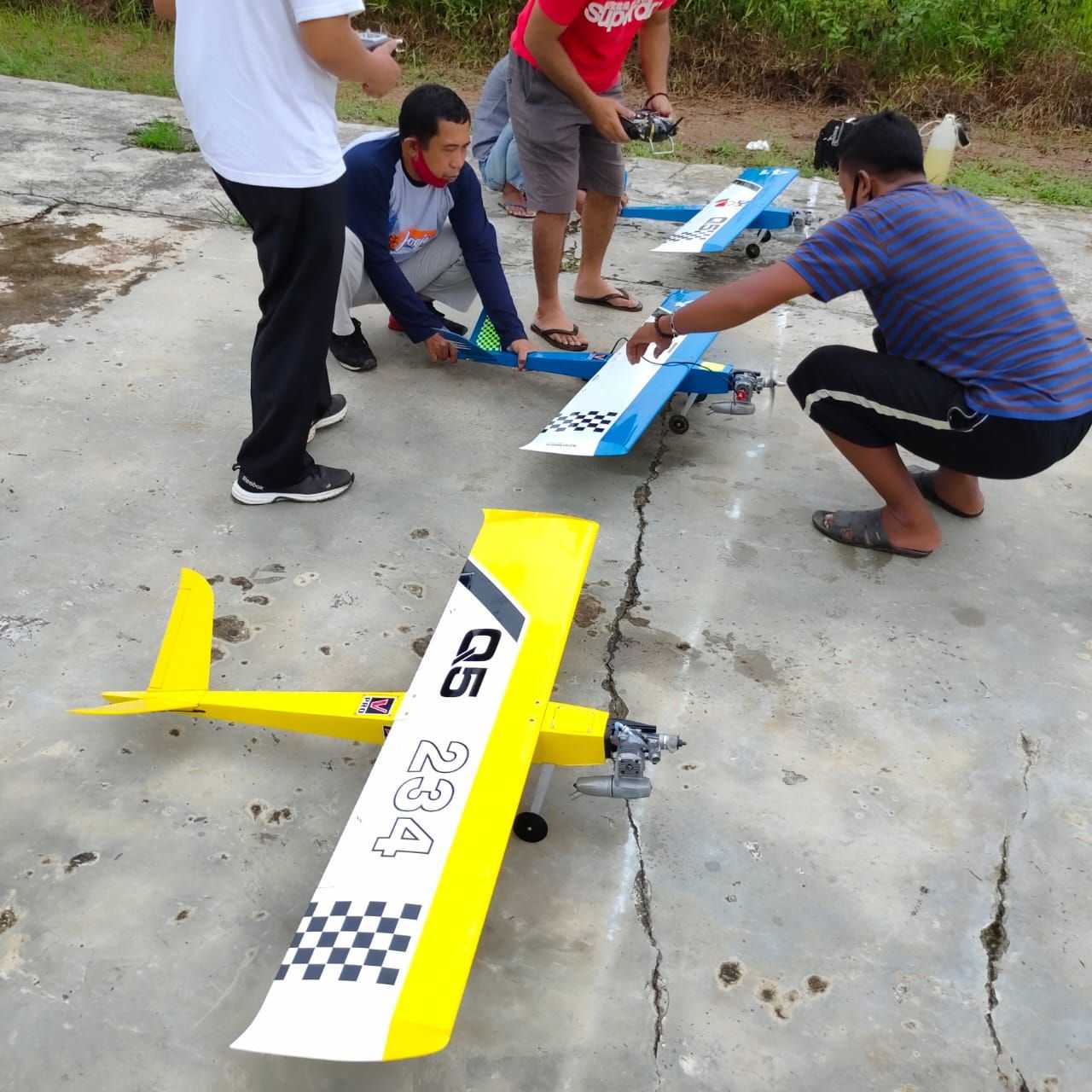
attached are what friends here are using.
The yellow no 4. Is mine to fly, given by a friend that lives in other city, its running abuse able
os.46 fx with 50ish muffler, not legal, just for practicing. That engine RPM gets close to OS .46AXI have a seeker as well, currently finishing other two. I uploaded pic the plane on Shartman posts a long while ago

 10-23-2020 | 04:52 PM
#36
My Feedback: (6)
Try the 10.5x4.5 APC its faster than the 9X6. If you are running a 10x6 I don't see how you have engine problems since you aren't turning high RPM. If that's the case you need to understand how to dial a needle valve.
Are you allowed to run the bubble free tanks like the Tetra tanks? that might also be an issue.
Sparky
Are you allowed to run the bubble free tanks like the Tetra tanks? that might also be an issue.
Sparky
10-25-2020 | 04:20 PM
#37
Thread Starter
Try the 10.5x4.5 APC its faster than the 9X6. If you are running a 10x6 I don't see how you have engine problems since you aren't turning high RPM. If that's the case you need to understand how to dial a needle valve.
Are you allowed to run the bubble free tanks like the Tetra tanks? that might also be an issue.
Sparky
Are you allowed to run the bubble free tanks like the Tetra tanks? that might also be an issue.
Sparky
We just tested yesterday with some props arrival, those Q5 likes 9x7.5, those are friend's however.
My seeker run better with heavier prop 9x8, static RPM is about 15400, and 16k+ in the air.
I do understand how to dial the valve, had to richen the needle abit and it gets leaner towards the end of the flight.
The original post was trying to get better engine with similar performance just for battling possible longevity issue with running the OS at limit.
I just read the other day, of tuned down Jett engine that run similar to OS 46, I will have to inquiry them if it would be suitable replacement for practicing
10-25-2020 | 06:20 PM
#38
My Feedback: (6)
I doubt that Dub will know anything more than it is an equivalent to the existing TT.40 and EVO .46 with a 9x6 prop. On paper your engines should be faster. In Club 40 racing we use the World Models Skyraider 2 which has more drag but the same engines as 424. I have never been beat (in Club 40) by a .46 in the few times I have raced against them. Don't forget that Dub Jett engine is 3x the price.
Mixture doesn't change noticeably if using a Bubble free tank do you run those?
Sparky
Mixture doesn't change noticeably if using a Bubble free tank do you run those?
Sparky
10-25-2020 | 06:27 PM
#39
Whiskey. Dub Jett supplies all the engines for one of the American Quickie events. We call it Supper Sport Quickie; event 426. Those airplanes fly at speeds around 165mph. We also have an event called Sport Quickie; event 424, with speeds around 115mph. Those of us who are trying to answer your questions have concluded that your performance is similar to our 424 Quickie event. While there are several different engines that were approved for the 424 event, the Thunder Tiger pro .40 became the preferred engine. When they were discontinued, our national racing organization approved the Evolution .46, When the Evolution was discontinued, Dub Jett was asked if he could "de-tune" his 426 engine for the 424 event. Dub came up with a different (shorter) muffler, and a smaller venturi. The one draw back to this engine is the price. One plus for us is that with a muffler, and venturi change the engine can be used in two different events. There is a good possibility that we may have to come up with an electric solution for our 424 quickie event because of a lack of an inexpensive engine option. I thing if you could find a "gently" used Thunder Tiger Pro .40 or .46 it would out perform your OS.
10-26-2020 | 02:12 AM
#40
Thread Starter
Whiskey. Dub Jett supplies all the engines for one of the American Quickie events. We call it Supper Sport Quickie; event 426. Those airplanes fly at speeds around 165mph. We also have an event called Sport Quickie; event 424, with speeds around 115mph. Those of us who are trying to answer your questions have concluded that your performance is similar to our 424 Quickie event. While there are several different engines that were approved for the 424 event, the Thunder Tiger pro .40 became the preferred engine. When they were discontinued, our national racing organization approved the Evolution .46, When the Evolution was discontinued, Dub Jett was asked if he could "de-tune" his 426 engine for the 424 event. Dub came up with a different (shorter) muffler, and a smaller venturi. The one draw back to this engine is the price. One plus for us is that with a muffler, and venturi change the engine can be used in two different events. There is a good possibility that we may have to come up with an electric solution for our 424 quickie event because of a lack of an inexpensive engine option. I thing if you could find a "gently" used Thunder Tiger Pro .40 or .46 it would out perform your OS.
Have you got any experience with detuned Jett for 424 with q-500 airframe ?
10-26-2020 | 05:09 AM
#41
My Feedback: (6)
I don't have one of these engines but have raced against them. I was told that it was tested and detuned to the same performance level with an stock APC 9x6 propeller to the current crop of engines. There are only a few engines being flown as the price differential between the engines is substantial. They are being flown by some of the top echelon pilots who have a lot of experience and would be near the top if they were flying the EVO or TT. They are winning with this engine. They aren't suppose to be superior to the EVO or TT any more than some of those engines perform better than the next engine.
I believe the Jett motor will be more robust as it has better metallurgy design and manufacture than the Mass produced EVO and TT.
I have two TT.46 engines that I purchased for a scale twin engine project that I would sell you for $100 US each plus shipping and PP. They are break in only with 10x6 engines maybe 10 fights on each. I haven't touched them in at least 10 years so I'd have to pull them out and evaluate. If they need bearings Ill include them with the price of the engine. I generally baby my engines so If you are interested in them let me know.
Sparky
I believe the Jett motor will be more robust as it has better metallurgy design and manufacture than the Mass produced EVO and TT.
I have two TT.46 engines that I purchased for a scale twin engine project that I would sell you for $100 US each plus shipping and PP. They are break in only with 10x6 engines maybe 10 fights on each. I haven't touched them in at least 10 years so I'd have to pull them out and evaluate. If they need bearings Ill include them with the price of the engine. I generally baby my engines so If you are interested in them let me know.
Sparky
10-26-2020 | 09:59 AM
#42
Whiskey, I have two of the Jett .40's that have been raced in both 424, and 426 Quickie. In the 424 configurations my engines seem to be on a par with the TT and Evolutions. In the 426 configuration my engines are NOT on a par with the "fast guys". For our 424 event the Jett was approved with a venturi, while the TT and Evo have carburetors. I don't know what your rules require, but if carburetors are required, that will increase the price of the Jett. Sparky, and I are not trying to steer you away from the Jett. We just think you could get the same performance from the Thunder Tiger. Our Sport Quickie 500 rules limited the engines to .40 displacement. That rule was waved for the Evolution because the performance of the .46 was closer to the Thunder Tiger .40. We also discovered that the Evolutions don't seem to have the same quality, and durability as the TT's. I have two of the Evolutions, which ran fairly well for a short while, before they started loosing power.
10-26-2020 | 11:01 AM
#43
My Feedback: (6)
To put it bluntly the EVO .46 are not as reliable to any other model engine I have ever owned. Granted they are being run reasonably hard around 16.5 on the ground and then they unload to over 17K In flight. They do not pick up the RPM we see with the TT in the same conditions. While running the EVO I have had the case crack, a wrist pin break and a connecting rod break. Between my engine and the ones on my racing team. I had Horizon replace the one with the broken Crank case. The engines were no longer being supported for the other two failures.
Sparky
Sparky
10-26-2020 | 04:33 PM
#44
Thread Starter
Thank you for the input guys.
Sparky sure I am interested with both TT .46. By the way, how long after you race TT engine then notice the reduction in power ?
what prop do you run with them for 424 class ? 9x6 ? what fuel and at what RPM does it run ?
I haven't try any prop lighter than 9x7. If I remember Correctly, 9x7 run about 16500, 9x7.5 16000, 9x8 15500ish.
So far 9x8 seems to be fastest.
Greg, we are only allowed ASP, TT, SuperTigre and OS as the engine, all with carburator, the engine must be race as is out of the box.
I might be able to use the Jett for practice, how about using carb, and limit the throtle barrel to similar OS RPM and using same prop ?
Sparky sure I am interested with both TT .46. By the way, how long after you race TT engine then notice the reduction in power ?
what prop do you run with them for 424 class ? 9x6 ? what fuel and at what RPM does it run ?
I haven't try any prop lighter than 9x7. If I remember Correctly, 9x7 run about 16500, 9x7.5 16000, 9x8 15500ish.
So far 9x8 seems to be fastest.
Greg, we are only allowed ASP, TT, SuperTigre and OS as the engine, all with carburator, the engine must be race as is out of the box.
I might be able to use the Jett for practice, how about using carb, and limit the throtle barrel to similar OS RPM and using same prop ?
10-26-2020 | 06:40 PM
#45
Whiskey, The basic Jett Quickie .40 is $260.00 + $38.00 for the backplate mount. For a long time the only way it was available was for our 426 Quickie event. Then a year or so ago, Dub made the "detuning" parts available so we could use the engine in our 424 event. If you have the 426 engine, the 424 parts are $35.00, but you can buy the engine configured for the slower event, and then if you want to, you could get the 426 muffler, and venturi. For our 424 Quickie event there is only one prop option, the APC 9/6, so there is no reason for us to experiment with other props. In 426 we use stock unmodified APC props. One example is the APC D-1, 8.8 X 8.75. I believe there is some benefit to practice with something that is faster then your actual race planes. Some things like your race timing will be different, but being able to negotiate the race course with the faster airplane translates in you having more time to master the race course with the slower configuration. If money were no object, you might consider the Jett 426 for practice. I still go back to my earlier recommendation that a Thunder Tiger Pro .46 if you can find one new or used, but not abused. Another option, but harder to find, would be a used Nelson short stroke 428 motor. That event is no longer flown in the US, so sometimes these engines come available on the used market like Ebay. Finally, and this is important, if you bump up the speed with a 426 Jett, or a 428 Nelson be certain that your wing is strong enough to withstand the higher G loading. The Italian Super Tigres were great engines, but they are probably harder to find ones that haven't been run to death.
10-27-2020 | 03:20 PM
#48
Thread Starter
Thank you sparky.
For the fuel system, i am running regular fuel tank, so had to tuned it slightly rich at beginning and after about 5 laps it leans out to max.
I have bubble-less Tetra tank, I plan to use it with the next two seeker I am building.
For the fuel system, i am running regular fuel tank, so had to tuned it slightly rich at beginning and after about 5 laps it leans out to max.
I have bubble-less Tetra tank, I plan to use it with the next two seeker I am building.
10-27-2020 | 05:32 PM
#49
Whisky, Here's another suggestion. It looks like all but one of the engine set ups on the pictured airplanes have traditional motor mounts. It also looks like they are black "fiber filled nylon" engine mounts. If your rules will allow it, I would recommend he backplate type mounts, or aluminum beam motor mounts. The more rigid your engine is mounted, the more power it will make. The plastic mounts flex more then the aluminum mounts. We also have rear cover back plate mounts for all the engines, but I assume that your rules would disallow them, because they aren't straight "out of the box". I definitely am in agreement with Sparky on the bladder tanks. Tetra, and Jett are the most popular. They allow you to lean the engine closer to peak RPM, and then they don't lean out after 5 laps. Also, most of use a 4 oz. tank in our 424 Quickies.

