


Need help troubleshooting Intairco UAT
 05-30-2017 | 10:21 AM
#1

 Need help troubleshooting Intairco UAT
I have two flights on my PC-21. Both times, the UAT was half full on landing... no bueno... Everything is sealed drum tight. Is this the type that should be mounted vertically? I bought the plane built, I've never used one like this.
Thanks, Mike
Thanks, Mike
 05-30-2017 | 11:37 AM
#4

How many main tanks?
If it is just one (or multiple plumbed in serial) it could be air coming in from the tank immediately before the UAT, either by the clunk coming out of the fuel or a split in the clunk line.
If it is just one (or multiple plumbed in serial) it could be air coming in from the tank immediately before the UAT, either by the clunk coming out of the fuel or a split in the clunk line.
05-30-2017 | 12:13 PM
#5


My Feedback: (21)
I helped a friend trouble shoot the same type of problem on his 1.3 scale Hawk's UAT. Same brand after we switched from a large CAT. It turned out to be that the fuel tank's vent lines were offering to much of a restriction. It was plumbed with 6mm line and large fittings. We were suggested to either go to a larger vent line or just double up with two complete vent lines. We added a second vent line and this solved his problem. He was running a large motor, but I can't recall the mane of the motor at this time.
05-30-2017 | 12:53 PM
#7

I experience the same problem last year at Redflag. factory pick up in the tank wouldn't allow enough flow for the new G2 210g fuel flow. Never notice a problem on the first 210g I had in it.
My UAT would show up 1/2 full after a flame out at the end of a flight. I replaced it with the larger GBR filter type from Dream works there and also made sure the vent had no crimps. The old one had very slight crimps from bending so it could have also contributed.
I did a static test on the main single tank flow out of the plane and after the changes it increase over 25%, problem solved.
best of luck and hope you find it.
My UAT would show up 1/2 full after a flame out at the end of a flight. I replaced it with the larger GBR filter type from Dream works there and also made sure the vent had no crimps. The old one had very slight crimps from bending so it could have also contributed.
I did a static test on the main single tank flow out of the plane and after the changes it increase over 25%, problem solved.
best of luck and hope you find it.
05-30-2017 | 03:29 PM
#8

The beautiful thing about the Intairco trap is it's clear, had it been a non clear type you might not have caught the air leak soon enough.
Also makes it easier to see bacterial growth in your fuel, they look like little white threads (ask me how I know, HA!).
Also makes it easier to see bacterial growth in your fuel, they look like little white threads (ask me how I know, HA!).
05-30-2017 | 04:32 PM
#9

the slime is clear from my experience, looks like a clear gel.
05-30-2017 | 07:37 PM
#11
Hi Mike,
I would be looking at the pick up in your main tank as suggested above...what type are you using in the main tank? Those intairco traps are very well made and if you have air in there it is entering the system prior to the air trap (it could be fuel vapour bubbles getting into the tank as a result of cavitation or air in the system).
Several possibilities to consider:
1. split in main tank pick up line
2. tank geometry is such that pick up is not submerged continuously in fuel (are you pulling lots of vertical manoeuvres?)
3. hardened tygon in tank causing problem #2
4. leaking fittings on main tank lines
5. blocked (or partially blocked or undersized) main pick up in main tank. Are you using a felt pick up? If so, that is the first place I would look for obstruction. In our warmer climate, they are notorious for harbouring bacterial and fungal growth and using them is a no-no in my experience. I have had an engine shut down due to cavitation caused by such an obstruction.
6. if you are using a metal pick up, make sure that if the open face can contact the bottom of the fuel tank that you cross drill the pick up so it can't suck itself down onto the bottom of the tank and self seal.....I have had fuel cavitation result from that before too.
7. inadequate venting...would show up as cavitation in fuel line to header/ pump at full throttle....a very fine stream of small bubbles.
Can you give more details...what is config of fuel system, shape of fuel tank, pick up details, vent diameter/ number?
I would be looking at the pick up in your main tank as suggested above...what type are you using in the main tank? Those intairco traps are very well made and if you have air in there it is entering the system prior to the air trap (it could be fuel vapour bubbles getting into the tank as a result of cavitation or air in the system).
Several possibilities to consider:
1. split in main tank pick up line
2. tank geometry is such that pick up is not submerged continuously in fuel (are you pulling lots of vertical manoeuvres?)
3. hardened tygon in tank causing problem #2
4. leaking fittings on main tank lines
5. blocked (or partially blocked or undersized) main pick up in main tank. Are you using a felt pick up? If so, that is the first place I would look for obstruction. In our warmer climate, they are notorious for harbouring bacterial and fungal growth and using them is a no-no in my experience. I have had an engine shut down due to cavitation caused by such an obstruction.
6. if you are using a metal pick up, make sure that if the open face can contact the bottom of the fuel tank that you cross drill the pick up so it can't suck itself down onto the bottom of the tank and self seal.....I have had fuel cavitation result from that before too.
7. inadequate venting...would show up as cavitation in fuel line to header/ pump at full throttle....a very fine stream of small bubbles.
Can you give more details...what is config of fuel system, shape of fuel tank, pick up details, vent diameter/ number?
Last edited by Craig B.; 05-30-2017 at 07:40 PM.
05-30-2017 | 11:24 PM
#12

Amazing how we all have different experience - I only use felt clunk's and done so since 1997 without ever having had a single problem....just saying.
Hope you find the source of your air accumulation problem. Unfortunately I cannot make any suggestions as again I have never had such a sitiation with any of my installations.
Cheers,
Jan
Hope you find the source of your air accumulation problem. Unfortunately I cannot make any suggestions as again I have never had such a sitiation with any of my installations.
Cheers,
Jan
05-31-2017 | 02:41 AM
#13
If you're landing with air in the UAT then it sounds like it's doing it's job and trapping the air that's coming from upstream. Can you show another picture of your fuel filter? some of them have the direction arrow facing the wrong way and that could be back siphoning air.
If you're interested in peace of mind maybe worth checking our Intairco's new iTrap - it has a pressure sensor inside that triggers when it detects an air pocket - I'm putting one in my Rebel now..
On the left in this picture, the sensor is at the top and you can see the signal lead exiting to the left
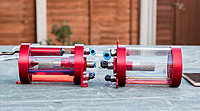
If you're interested in peace of mind maybe worth checking our Intairco's new iTrap - it has a pressure sensor inside that triggers when it detects an air pocket - I'm putting one in my Rebel now..
On the left in this picture, the sensor is at the top and you can see the signal lead exiting to the left
Last edited by Quandry; 05-31-2017 at 03:29 AM.
05-31-2017 | 05:26 AM
#15

If you go the "O" ring fix as Bob did, some "O" rings don't like kero or jet fuel, they will swell. Put the O ring in some fuel and let it soak for a bit and see if it will swell. Viton O rings works best and will not swell
05-31-2017 | 08:30 AM
#17
Amazing how we all have different experience - I only use felt clunk's and done so since 1997 without ever having had a single problem....just saying.
Hope you find the source of your air accumulation problem. Unfortunately I cannot make any suggestions as again I have never had such a sitiation with any of my installations.
Cheers,
Jan
Hope you find the source of your air accumulation problem. Unfortunately I cannot make any suggestions as again I have never had such a sitiation with any of my installations.
Cheers,
Jan
05-31-2017 | 08:33 AM
#18

If you're landing with air in the UAT then it sounds like it's doing it's job and trapping the air that's coming from upstream. Can you show another picture of your fuel filter? some of them have the direction arrow facing the wrong way and that could be back siphoning air.
If you're interested in peace of mind maybe worth checking our Intairco's new iTrap - it has a pressure sensor inside that triggers when it detects an air pocket - I'm putting one in my Rebel now..
On the left in this picture, the sensor is at the top and you can see the signal lead exiting to the left
Attachment 2217964
If you're interested in peace of mind maybe worth checking our Intairco's new iTrap - it has a pressure sensor inside that triggers when it detects an air pocket - I'm putting one in my Rebel now..
On the left in this picture, the sensor is at the top and you can see the signal lead exiting to the left
Attachment 2217964
05-31-2017 | 05:43 PM
#21
My Feedback: (2)
There are a number of sources for air leaks in a jet installation and my problem was air leaking through the fittings using the supplied rubber washers. I don't believe my leak problem was great enough to fill half the tank with air during a normal flight time. If the air trap is half empty after a flight, there may be a larger air leak coming from another source.


