


Pattern Plane With Dorsal And Ventral Fins
 12-12-2010 | 11:06 AM
#1
Thread Starter
Senior Member
My Feedback: (18)
Joined: Mar 2005
Posts: 164
Likes: 0
Received 0 Likes
on
0 Posts
From: Parker,
NE
 Pattern Plane With Dorsal And Ventral Fins
I've been searching for more information on a pattern plane of unusual configuration that I read of approximately 15 years ago. The model had low aspect ratio dorsal and ventral "fins" located about the aerodynamic center. The vertical stabilizer area was divided equally above and below the fuselage centerline. I believe the designer / builder may have been from Louisiana.
Anyone have a lead on the identification of this model?
Thanks!!!
This slope model is of approximately the same configuration.
Anyone have a lead on the identification of this model?
Thanks!!!
This slope model is of approximately the same configuration.

 12-13-2010 | 12:58 AM
#5

Senior Member
Joined: Dec 2008
Posts: 687
Likes: 0
Received 2 Likes
on
2 Posts
From: Cape L\'\'\'\'\'\'\'\'Agulhas, SOUTH AFRICA
RE: Pattern Plane With Dorsal And Ventral Fins
Very interesting concept.
How does it fly (i.e. knife edge, roll, cross wind handling)compared to a "normal" plane of that size without the fins?
Just wondering - The power version makes sense but the slope soarer in 1st postmay side slip in cross wind on a slope.If this powered concept makes a big difference, why don't we see more ofthese type planes around?
Except for "foamies" etc, I've seen some planes with "canard " wings and "stall strakes" but not with these extended vertical fins.
Bundu
How does it fly (i.e. knife edge, roll, cross wind handling)compared to a "normal" plane of that size without the fins?
Just wondering - The power version makes sense but the slope soarer in 1st postmay side slip in cross wind on a slope.If this powered concept makes a big difference, why don't we see more ofthese type planes around?
Except for "foamies" etc, I've seen some planes with "canard " wings and "stall strakes" but not with these extended vertical fins.
Bundu
12-13-2010 | 08:34 AM
#6

My Feedback: (1)
RE: Pattern Plane With Dorsal And Ventral Fins
ORIGINAL: Bundubasher
...
Just wondering - The power version makes sense but the slope soarer in 1st post may side slip in cross wind on a slope. If this powered concept makes a big difference, why don't we see more of these type planes around?
...
...
Just wondering - The power version makes sense but the slope soarer in 1st post may side slip in cross wind on a slope. If this powered concept makes a big difference, why don't we see more of these type planes around?
...
Here's a good explanatory thread:
http://www.rcgroups.com/forums/showt...130761&page=30
As a power flyer (who's used to much better and crisper yaw control), VTPR isn't really my cup of tea, but it does offer another slant on waking up your left thumb on the slope.
Joe
12-13-2010 | 09:43 AM
#7
Member
Joined: Dec 2008
Posts: 52
Likes: 0
Received 0 Likes
on
0 Posts
From: LiegeLiege, BELGIUM
RE: Pattern Plane With Dorsal And Ventral Fins
Hello,
Here is mine:
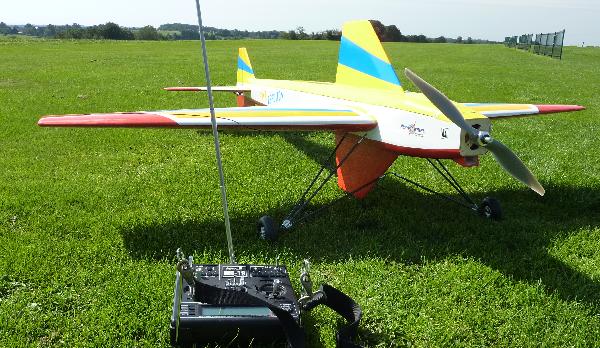
The construction:
http://www.rcuniverse.com/forum/m_9749764/tm.htm
It's realy a nice pattern plane! In particular with the electric propulsion.
Here is mine:
The construction:
http://www.rcuniverse.com/forum/m_9749764/tm.htm
It's realy a nice pattern plane! In particular with the electric propulsion.
12-13-2010 | 09:52 AM
#8
Member
Joined: Dec 2008
Posts: 52
Likes: 0
Received 0 Likes
on
0 Posts
From: LiegeLiege, BELGIUM
RE: Pattern Plane With Dorsal And Ventral Fins
We don't see more of this type of planes around because, according to the general opinion, this plane is not fashionable. It's not my point of view, but I can tell that the first reaction when you arrive at the flying field with this plane is: "Beurk, it's horrible". After this first reaction, people are amazed by the flying qualities. But it's only the second reaction...
12-13-2010 | 10:00 AM
#9
Senior Member
Joined: Dec 2008
Posts: 687
Likes: 0
Received 2 Likes
on
2 Posts
From: Cape L\'\'\'\'\'\'\'\'Agulhas, SOUTH AFRICA
RE: Pattern Plane With Dorsal And Ventral Fins
Thanks guys, this is most interesting. I'm keen on giving this a try.
I've got a modified Mirage (Cheetah) with canards etc, but all these mods are only horizotally orientated. Just shows one can learn always something new... even after 40 years.
Just a question - would you place these dorsal fins at the same cg point as the main wing or does it not matter too much?
Thanks
Bundu
I've got a modified Mirage (Cheetah) with canards etc, but all these mods are only horizotally orientated. Just shows one can learn always something new... even after 40 years.
Just a question - would you place these dorsal fins at the same cg point as the main wing or does it not matter too much?
Thanks
Bundu
12-13-2010 | 11:25 PM
#11
Thread Starter
Senior Member
My Feedback: (18)
Joined: Mar 2005
Posts: 164
Likes: 0
Received 0 Likes
on
0 Posts
From: Parker,
NE
RE: Pattern Plane With Dorsal And Ventral Fins
ORIGINAL: Bundubasher
Very interesting concept.
How does it fly (i.e. knife edge, roll, cross wind handling) compared to a ''normal'' plane of that size without the fins?
Just wondering - The power version makes sense but the slope soarer in 1st post may side slip in cross wind on a slope. If this powered concept makes a big difference, why don't we see more of these type planes around?
Except for ''foamies'' etc, I've seen some planes with ''canard '' wings and ''stall strakes'' but not with these extended vertical fins.
Bundu
Very interesting concept.
How does it fly (i.e. knife edge, roll, cross wind handling) compared to a ''normal'' plane of that size without the fins?
Just wondering - The power version makes sense but the slope soarer in 1st post may side slip in cross wind on a slope. If this powered concept makes a big difference, why don't we see more of these type planes around?
Except for ''foamies'' etc, I've seen some planes with ''canard '' wings and ''stall strakes'' but not with these extended vertical fins.
Bundu
http://www.vimeo.com/17705369
12-14-2010 | 04:09 AM
#12
Senior Member
Joined: Mar 2003
Posts: 1,881
Likes: 0
Received 0 Likes
on
0 Posts
From: Perth, AUSTRALIA
RE: Pattern Plane With Dorsal And Ventral Fins
wow, if there ever was a soarer to keep me interested, that'd probably be it.
Even though I live in one of the windiest cities in the world, we just don't have good enough sloping hills!
Even though I live in one of the windiest cities in the world, we just don't have good enough sloping hills!
12-14-2010 | 10:28 AM
#13
Senior Member
My Feedback: (2)
Joined: Jan 2002
Posts: 941
Likes: 0
Received 0 Likes
on
0 Posts
From: Fenton,
MI
RE: Pattern Plane With Dorsal And Ventral Fins
Pattern slope soaring... Now that would be interesting and pretty cool too.
ORIGINAL: Rendegade
wow, if there ever was a soarer to keep me interested, that'd probably be it.
Even though I live in one of the windiest cities in the world, we just don't have good enough sloping hills!
wow, if there ever was a soarer to keep me interested, that'd probably be it.
Even though I live in one of the windiest cities in the world, we just don't have good enough sloping hills!
12-14-2010 | 03:50 PM
#15
My Feedback: (1)
RE: Pattern Plane With Dorsal And Ventral Fins
ORIGINAL: Rendegade
Something tells me we'd get pretty tired of the weak verticals very quick.
Something tells me we'd get pretty tired of the weak verticals very quick.
When you fly a really fast heavy bird like that, there is a rule which you learn pretty fast == What comes down, must go UP! That means you've got a lot of energy to play with after each dive, and it's up to you to decide where to spend it all. Like I said, on a really good hill on a good day, you really won't miss having a motor if you just want to fly patterns.
It's when you want to do multiple snaps, successive spin recoveries, extended KE maneuvers (any type of energy killing move), or any real 3D stuff that the slope falls short. But for max speed and adrenaline, the sheer size of the maneuvers, and breathtaking places to fly, it's still among my favorite ways to spend a few hours (or weeks!
 )
12-15-2010 | 02:41 AM
)
12-15-2010 | 02:41 AM
#16

Senior Member
RE: Pattern Plane With Dorsal And Ventral Fins
ORIGINAL: Bundubasher
Just a question - would you place these dorsal fins at the same cg point as the main wing or does it not matter too much?
Thanks
Bundu
Just a question - would you place these dorsal fins at the same cg point as the main wing or does it not matter too much?
Thanks
Bundu
12-16-2010 | 04:47 AM
#17
Senior Member
Joined: Mar 2004
Posts: 498
Likes: 0
Received 0 Likes
on
0 Posts
From: Moss, NORWAY
RE: Pattern Plane With Dorsal And Ventral Fins
You have to place the fins matching the Aerodinamic center of the fin with the CoG of the plane; otherwise you'll get an extra moment around the yaw axis...
The aerodynamic centre of pressure is normally not the same whether the model is flying the right way up or in knife edge. Is it not the location of the TOTAL aerodynamic centre of pressure that matters, including all the stick-on bits?
Magne
12-16-2010 | 05:40 AM
#18
Senior Member
RE: Pattern Plane With Dorsal And Ventral Fins
ORIGINAL: Magne
But then again, all the T-canalisers I have seen have been mounted behind the C of G, and their purpose is to an extent the same as these Dorsal and Ventral Fins.
The aerodynamic centre of pressure is normally not the same whether the model is flying the right way up or in knife edge. Is it not the location of the TOTAL aerodynamic centre of pressure that matters, including all the stick-on bits?
Magne
You have to place the fins matching the Aerodinamic center of the fin with the CoG of the plane; otherwise you'll get an extra moment around the yaw axis...
The aerodynamic centre of pressure is normally not the same whether the model is flying the right way up or in knife edge. Is it not the location of the TOTAL aerodynamic centre of pressure that matters, including all the stick-on bits?
Magne
By having them say behind the CoG, you're actually adding in a sense to the size of the fin at the rear of the aircraft as it's adding stability as well as side area. In fact, if you were to put these fins far behind the CoG, so that the moment they produce during a side slip is large, you would have to increase the size of the rudder or it's throw. This is because the rudder will have to 'fight' the extra stability provided by the fins, which may be counter-productive for pattern.
12-16-2010 | 05:50 AM
#19
Senior Member
RE: Pattern Plane With Dorsal And Ventral Fins
ORIGINAL: robert
I think I see what you're saying. Having the fins away from the aerodynamic centre isn't necessarilly a bad thing. Just think of the stab or fin, the moment they produce is used to counter other moments and add stability. But these fins are designed to add lift in knife-edge, not for stability. By having them on the CoG they won't change the attitude (yaw) of the aircraft at different fin angles of attack (sideslip angles). All they do is add lift.
I think I see what you're saying. Having the fins away from the aerodynamic centre isn't necessarilly a bad thing. Just think of the stab or fin, the moment they produce is used to counter other moments and add stability. But these fins are designed to add lift in knife-edge, not for stability. By having them on the CoG they won't change the attitude (yaw) of the aircraft at different fin angles of attack (sideslip angles). All they do is add lift.
ORIGINAL: robert
By having them say behind the CoG, you're actually adding in a sense to the size of the fin at the rear of the aircraft as it's adding stability as well as side area. In fact, if you were to put these fins far behind the CoG, so that the moment they produce during a side slip is large, you would have to increase the size of the rudder or it's throw. This is because the rudder will have to 'fight' the extra stability provided by the fins, which may be counter-productive for pattern.
By having them say behind the CoG, you're actually adding in a sense to the size of the fin at the rear of the aircraft as it's adding stability.
By having them say behind the CoG, you're actually adding in a sense to the size of the fin at the rear of the aircraft as it's adding stability as well as side area. In fact, if you were to put these fins far behind the CoG, so that the moment they produce during a side slip is large, you would have to increase the size of the rudder or it's throw. This is because the rudder will have to 'fight' the extra stability provided by the fins, which may be counter-productive for pattern.
By having them say behind the CoG, you're actually adding in a sense to the size of the fin at the rear of the aircraft as it's adding stability.
12-16-2010 | 07:59 PM
#20

My Feedback: (1)
Joined: Jul 2004
Posts: 571
Likes: 0
Received 0 Likes
on
0 Posts
From: Atlanta ,
GA
RE: Pattern Plane With Dorsal And Ventral Fins
Here's mine:
Slightly different fuselage but same concept with the vertical fins. Also inspired by Nat Penton and Mark Hunt and with the help of many others (Rusty Dose, Jim Sheffield, Richard Lewis, to name a few.)
-Chris
Slightly different fuselage but same concept with the vertical fins. Also inspired by Nat Penton and Mark Hunt and with the help of many others (Rusty Dose, Jim Sheffield, Richard Lewis, to name a few.)
-Chris


