


Flying for the camera!
 06-03-2009 | 11:11 AM
#1

Thread Starter

 Flying for the camera!
Two facts are certain. 1) Aircraft rarely look best when photographed from below and 2) the photographer is almost always below a flying model. So what can a good pilot do to increase the chance of a good photographer getting a GREAT in-flight shot?
Just like different movie stars have different "best sides," most aircraft (and our models of them) also tend to look best from certain angles. Most models don't look their best in a flat side view (as for example in the middle of a low pass) and most don't look coming straight at the camera. The most dramatic photos are almost always during banking motion. In my opinion, most WWI biplanes look best in a downward looking 3/4 rear angle, that is when the model is flying away and both climbing and banking at the same time. But by the time we typically do this type of turn the model is down at the end of the field where even a 300mm lens can't get at it.
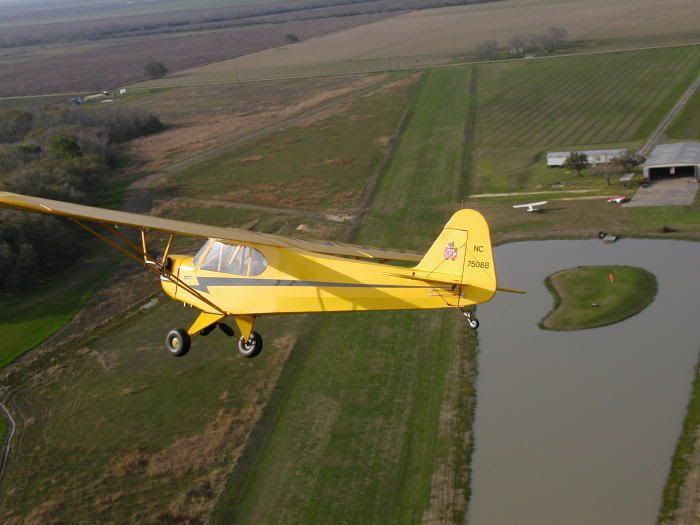
So what would be the most photogenic flight path we could follow? I've borrowed a photo that Mike posted on the Best Scale Photo thread to illustrate the point of this thread. This is a good example, the model appears to be right "in front" of the photography but it's rare to see a model turn "into the pits" at mid-pass. Just what was the pilot doing at the time this photo was made?
Just like different movie stars have different "best sides," most aircraft (and our models of them) also tend to look best from certain angles. Most models don't look their best in a flat side view (as for example in the middle of a low pass) and most don't look coming straight at the camera. The most dramatic photos are almost always during banking motion. In my opinion, most WWI biplanes look best in a downward looking 3/4 rear angle, that is when the model is flying away and both climbing and banking at the same time. But by the time we typically do this type of turn the model is down at the end of the field where even a 300mm lens can't get at it.
So what would be the most photogenic flight path we could follow? I've borrowed a photo that Mike posted on the Best Scale Photo thread to illustrate the point of this thread. This is a good example, the model appears to be right "in front" of the photography but it's rare to see a model turn "into the pits" at mid-pass. Just what was the pilot doing at the time this photo was made?
 06-03-2009 | 12:01 PM
#3

My Feedback: (4)
Joined: Dec 2001
Posts: 672
Likes: 0
Received 0 Likes
on
0 Posts
From: West Linn,
OR
RE: Flying for the camera!
Excellent thread concept! 
There are lots of bad RC shots e.g. tiny dots of airplanes in the sky. I think to get the best photos, the camera man and flyer will need to be well coordinated and you will need to get the cooperation of other flyers.
I think to get a shot like your example, the pilot could come in over the runway say from the left, a just past the cameraman, execute a left hand 185 degree left turn, the shot is taken just before roll out, the pilot then rolls right before coming back over the runway.
Big lenses are a must 300mm is probably a minimum
Kent
There are lots of bad RC shots e.g. tiny dots of airplanes in the sky. I think to get the best photos, the camera man and flyer will need to be well coordinated and you will need to get the cooperation of other flyers.
I think to get a shot like your example, the pilot could come in over the runway say from the left, a just past the cameraman, execute a left hand 185 degree left turn, the shot is taken just before roll out, the pilot then rolls right before coming back over the runway.
Big lenses are a must 300mm is probably a minimum
Kent
06-03-2009 | 12:23 PM
#4
Senior Member
RE: Flying for the camera!
Fly low!
The sponsor banners were not on the field at Top Gun this year so I, and several others, used the drainage ditch across the runway to our advantage. I expect that allowed photographers that were present to be able to get more shots of the top sides this year and the banners won't be disrupting the photos either. But then again, most of my flight maneuvers are done less than 10' in the air so a photographer or videographer on a 3 step stool is usually higher than the model during passes.
The sponsor banners were not on the field at Top Gun this year so I, and several others, used the drainage ditch across the runway to our advantage. I expect that allowed photographers that were present to be able to get more shots of the top sides this year and the banners won't be disrupting the photos either. But then again, most of my flight maneuvers are done less than 10' in the air so a photographer or videographer on a 3 step stool is usually higher than the model during passes.
06-03-2009 | 12:35 PM
#5
Thread Starter
RE: Flying for the camera!
That's good, but shooting down with terrain in the background isn't ideal either. Well, except maybe if you're flying a crop duster!  The perfect shot for me is a shot that looks like it was taken from another aircraft instead of from the ground. And if there are dramatic skies...all the better.
The perfect shot for me is a shot that looks like it was taken from another aircraft instead of from the ground. And if there are dramatic skies...all the better.
06-03-2009 | 12:36 PM
#6

My Feedback: (8)
RE: Flying for the camera!
The step ladder(or scissor lift ) is a great way to get an different angle with low flying a/c the only problem arises is if there are multi aircraft airborne a safety issue is present. Communication between the pilot/spotter and photographer is a MUST . Clouds in the backround are a big plus . IMO any lens over a 300mm is hard to handle, as they really start getting heavy ,and a slight movement at the lens is Giant movement at the subject.
Semper Fi
Joe
Abufletcher Great thread..
Semper Fi
Joe
Abufletcher Great thread..
06-03-2009 | 12:41 PM
#7

My Feedback: (1)
RE: Flying for the camera!
ORIGINAL: abufletcher
I've borrowed a photo that Mike posted on the Best Scale Photo thread to illustrate the point of this thread. This is a good example, the model appears to be right "in front" of the photography but it's rare to see a model turn "into the pits" at mid-pass. Just what was the pilot doing at the time this photo was made?
I've borrowed a photo that Mike posted on the Best Scale Photo thread to illustrate the point of this thread. This is a good example, the model appears to be right "in front" of the photography but it's rare to see a model turn "into the pits" at mid-pass. Just what was the pilot doing at the time this photo was made?
Mike
06-03-2009 | 12:46 PM
#8
Thread Starter
RE: Flying for the camera!
The position of clouds can make all the difference. In the photos below the clouds were quite low and so with the model headed inbound it looks more like the view from some bomber under attack!
06-03-2009 | 02:15 PM
#9
Junior Member
My Feedback: (1)
Joined: Oct 2004
Posts: 13
Likes: 0
Received 0 Likes
on
0 Posts
From: Livingston,
TX
RE: Flying for the camera!
I have been taking pictures for a few years at our field. I think a 200mm lens is perfect, any longer is too hard to handle. I'm lucky to be able to get close to the field and know all the pilots. The B-24 on front page of my website has not flown yet and I think will be at Bomber Field next week. It was built by Gary Hughes.
www.ellsworthphotos.com</p>
Don</p>
</p>
06-03-2009 | 07:33 PM
#10
Thread Starter
RE: Flying for the camera!
It seems to me that the flight path that would create the most photo opportunities for the photographer would be one where the model is zig-zagged in and out as many times as possible as the model slowly makes its way from one end of the field to the other. So think of something like the flight path of a crop duster making runs that are perpendicular to the flight line. This is not something that most pilots practice, however.
Alternatively, flying tight figure 8s might work.
Alternatively, flying tight figure 8s might work.
06-03-2009 | 08:43 PM
#11
My Feedback: (1)
RE: Flying for the camera!
These were taken with a 100-500 Tamron lens (150-750mm effective on my D80) using a monopod. It allowed me to get an interesting angle that normally would have been to far away to be on any interest, and make use of the light at that time with that pattern.I sure did miss the Image Stabilization my Nikon 70-300 has though. Borrowed the Tamron from my rep.
These are models of course. Hoosier Dawn Patrol 2008. They were flying (mostly) a right handed race track pattern. Tripe was doing a figure8 I think.


These are models of course. Hoosier Dawn Patrol 2008. They were flying (mostly) a right handed race track pattern. Tripe was doing a figure8 I think.

 06-03-2009 | 08:59 PM
#13
Thread Starter
RE: Flying for the camera!
Those show some good angles and you're right that a long lens would typically be needed because these maneuvers are not typically performed right in front of the photographer.
Again the real question for this thread is what can the PILOT do to increase the opportunities for good photos? As a photographer myself, I'm always conflicted when I have to do a maiden flight. Part of me would rather be holding a camera than a transmitter, in the sense that there are lots of people at the field who can fly but relatively few who can photograph well. But then, I really prefer to maiden my own models. Too bad, transmitters don't include a "snapshot button" as well!
Again the real question for this thread is what can the PILOT do to increase the opportunities for good photos? As a photographer myself, I'm always conflicted when I have to do a maiden flight. Part of me would rather be holding a camera than a transmitter, in the sense that there are lots of people at the field who can fly but relatively few who can photograph well. But then, I really prefer to maiden my own models. Too bad, transmitters don't include a "snapshot button" as well!
06-03-2009 | 09:08 PM
#14
My Feedback: (1)
RE: Flying for the camera!
ORIGINAL: abufletcher
Again the real question for this thread is what can the PILOT do to increase the opportunities for good photos?
Again the real question for this thread is what can the PILOT do to increase the opportunities for good photos?
ORIGINAL: abufletcher
Too bad, transmitters don't include a "snapshot button" as well!
Too bad, transmitters don't include a "snapshot button" as well!
Don,
You just need one of these....
 06-04-2009 | 12:05 AM
#16

Joined: Mar 2008
Posts: 385
Likes: 0
Received 0 Likes
on
0 Posts
From: Murrieta, CA
RE: Flying for the camera!
YOU DO REALIZE the Triplane is FULLSIZE ? Right ? I would like to add,IMHO, most R/C pilots don't understand how to FLY FOR THE CAMERA. They tend to flyWAY too fast,not realizing we are shooting "STILLS" not video!...Done correctly, it's very boreing for the pilot, but essentual for us " R/C PHOTOGS " to fly SLOWLY and closer-in than they maybe used to.
I would like to add,IMHO, most R/C pilots don't understand how to FLY FOR THE CAMERA. They tend to flyWAY too fast,not realizing we are shooting "STILLS" not video!...Done correctly, it's very boreing for the pilot, but essentual for us " R/C PHOTOGS " to fly SLOWLY and closer-in than they maybe used to.
ORIGINAL: abufletcher
Two facts are certain. 1) Aircraft rarely look best when photographed from below and 2) the photographer is almost always below a flying model. So what can a good pilot do to increase the chance of a good photographer getting a GREAT in-flight shot?
Just like different movie stars have different "best sides," most aircraft (and our models of them) also tend to look best from certain angles. Most models don't look their best in a flat side view (as for example in the middle of a low pass) and most don't look coming straight at the camera. The most dramatic photos are almost always during banking motion. In my opinion, most WWI biplanes look best in a downward looking 3/4 rear angle, that is when the model is flying away and both climbing and banking at the same time. But by the time we typically do this type of turn the model is down at the end of the field where even a 300mm lens can't get at it.
So what would be the most photogenic flight path we could follow? I've borrowed a photo that Mike posted on the Best Scale Photo thread to illustrate the point of this thread. This is a good example, the model appears to be right "in front" of the photography but it's rare to see a model turn "into the pits" at mid-pass. Just what was the pilot doing at the time this photo was made?
Two facts are certain. 1) Aircraft rarely look best when photographed from below and 2) the photographer is almost always below a flying model. So what can a good pilot do to increase the chance of a good photographer getting a GREAT in-flight shot?
Just like different movie stars have different "best sides," most aircraft (and our models of them) also tend to look best from certain angles. Most models don't look their best in a flat side view (as for example in the middle of a low pass) and most don't look coming straight at the camera. The most dramatic photos are almost always during banking motion. In my opinion, most WWI biplanes look best in a downward looking 3/4 rear angle, that is when the model is flying away and both climbing and banking at the same time. But by the time we typically do this type of turn the model is down at the end of the field where even a 300mm lens can't get at it.
So what would be the most photogenic flight path we could follow? I've borrowed a photo that Mike posted on the Best Scale Photo thread to illustrate the point of this thread. This is a good example, the model appears to be right "in front" of the photography but it's rare to see a model turn "into the pits" at mid-pass. Just what was the pilot doing at the time this photo was made?
06-04-2009 | 01:01 AM
#17
Thread Starter
RE: Flying for the camera!
ORIGINAL: rcphotog
YOU DO REALIZE the Triplane is FULLSIZE ? Right ?
YOU DO REALIZE the Triplane is FULLSIZE ? Right ?
I would like to add,IMHO, most R/C pilots don't understand how to FLY FOR THE CAMERA. They tend to flyWAY too fast,not realizing we are shooting "STILLS" not video!...Done correctly, it's very boreing for the pilot, but essentual for us " R/C PHOTOGS " to fly SLOWLY and closer-in than they maybe used to.
06-04-2009 | 01:17 AM
#18
Senior Member
My Feedback: (2)
Joined: Dec 2008
Posts: 150
Likes: 0
Received 0 Likes
on
0 Posts
From: Reva,
SD
RE: Flying for the camera!
Myself and a friend have been working on close up airial shots, Ithink we are gettinga good thing going here, we just need a better camera and more practice!</p>
06-04-2009 | 08:38 AM
#19

Senior Member
My Feedback: (3)
Joined: Aug 2002
Posts: 274
Likes: 0
Received 0 Likes
on
0 Posts
From: Comox,
BC, CANADA
RE: Flying for the camera!
My friends maintain a website loaded with their model photos. They take some really nice pictures and put a lot of time into composition, lighting, etc. Here's an example with my Gotha G.IV http://teamtracon.netfirms.com/event...=25&pos=47
Have a look at the rest of the website, too. http://www.teamtracon.com/0001.html
Have a look at the rest of the website, too. http://www.teamtracon.com/0001.html
06-04-2009 | 09:37 AM
#20
Thread Starter
RE: Flying for the camera!
ORIGINAL: vonJaerschky
My friends maintain a website loaded with their model photos. They take some really nice pictures and put a lot of time into composition, lighting, etc. Here's an example with my Gotha G.IV http://teamtracon.netfirms.com/event...=25&pos=47
Have a look at the rest of the website, too. http://www.teamtracon.com/0001.html
My friends maintain a website loaded with their model photos. They take some really nice pictures and put a lot of time into composition, lighting, etc. Here's an example with my Gotha G.IV http://teamtracon.netfirms.com/event...=25&pos=47
Have a look at the rest of the website, too. http://www.teamtracon.com/0001.html
 06-04-2009 | 02:46 PM
#23
Senior Member
My Feedback: (3)
Joined: Aug 2002
Posts: 274
Likes: 0
Received 0 Likes
on
0 Posts
From: Comox,
BC, CANADA
RE: Flying for the camera!
ORIGINAL: abufletcher
So the question is what did YOU do to assist with their photography while you were flying? Great looking Gotha, BTW.
So the question is what did YOU do to assist with their photography while you were flying? Great looking Gotha, BTW.
. I also don't get too close to the camera. The good photographers usually have a pretty long lens, so if you fly too close to the camera, the photographer will have a really hard time trying to follow the model.Sam &Beverly have a good feel about where to position themselves to get the best shots, too.
 06-06-2009 | 12:49 AM
#25
Junior Member
Joined: Sep 2008
Posts: 15
Likes: 0
Received 0 Likes
on
0 Posts
From: St. Louis, MO
RE: Flying for the camera!
ORIGINAL: TopShelf
There are lots of bad RC shots e.g. tiny dots of airplanes in the sky.
Kent
There are lots of bad RC shots e.g. tiny dots of airplanes in the sky.
Kent
Another tip is midday lighting usually stinks this for type of shooting. With the light beating straight down, the model is usually just a silhouette. Shooting in the morning or late afternoon/early evening will give much more pleasing results.
Steve S.

