


Scale P6E


 05-27-2010 | 01:00 PM
#7

 RE: Scale P6E
What scale kits have you built so far? You might keep your experience with kits in mind as you're looking over the plans. What seems different from how you've built before? And do those differences seem like advantages? Do they add weight?
05-27-2010 | 02:22 PM
#8
 RE: Scale P6E
A good place to start is deciding what you want to do with this model...is it just to build a "nice airplane" semi scale? or full scale?
if you ask 10 different people how to start building you will get 10 different answers. I would strongly suggest you consider your time frame for getting this model done, scratch building inevitably takes longer but is more gratifying..I know quite a few people who have half-finished dinosaurs in their shops in which they have invested hundreds of hrs. and $$$ only to give them away a few yrs. later because they "ran out of gas". The P6E is a fabulous aircraft that will provide many happy days of building.
If your shop is not set up make sure you have a sturdy, straight, and level building board....take your time and make sure everything is glued square up to center fuse line. I always start with tail section to get my feet wet and make some progress...but starting with the fuse also makes good sense..build it straight and true so you know you have a quality airframe that will provide many years of service and eliminate trouble shooting should you encounter any unusual flight characteristics. Make sure your wings have no twists in them...again straight and level..triple check before gluing...and as always keep it as light as possible....I use lots of small gussets to give added strength where needed.
I'm sure there are some "how too" books on scratch building out there somewhere. Good luck in your project..you will get good advice on this forum as you move through the procedures....but most of the fun will be in solving your own problems....take pride and do quality work.
We look forward to seeing your project take off !!
if you ask 10 different people how to start building you will get 10 different answers. I would strongly suggest you consider your time frame for getting this model done, scratch building inevitably takes longer but is more gratifying..I know quite a few people who have half-finished dinosaurs in their shops in which they have invested hundreds of hrs. and $$$ only to give them away a few yrs. later because they "ran out of gas". The P6E is a fabulous aircraft that will provide many happy days of building.
If your shop is not set up make sure you have a sturdy, straight, and level building board....take your time and make sure everything is glued square up to center fuse line. I always start with tail section to get my feet wet and make some progress...but starting with the fuse also makes good sense..build it straight and true so you know you have a quality airframe that will provide many years of service and eliminate trouble shooting should you encounter any unusual flight characteristics. Make sure your wings have no twists in them...again straight and level..triple check before gluing...and as always keep it as light as possible....I use lots of small gussets to give added strength where needed.
I'm sure there are some "how too" books on scratch building out there somewhere. Good luck in your project..you will get good advice on this forum as you move through the procedures....but most of the fun will be in solving your own problems....take pride and do quality work.
We look forward to seeing your project take off !!
05-27-2010 | 03:17 PM
#9
Thread Starter
Junior Member
My Feedback: (1)
Joined: Oct 2008
Posts: 11
Likes: 0
Received 0 Likes
on
0 Posts
From: Fisher,
IL
RE: Scale P6E
I am in the process of building a 60 size J-3 cub kit and have built 2 wood boat kits(racing not ships). I would like it to be scale but semi scale is ok too. I want to fly it not show it so much.
05-27-2010 | 06:20 PM
#10
 RE: Scale P6E
sounds like to me your not quite ready for a plane of this type, do yourself a favor and build a few more kits first. and i am not talking about ugly stick type aircraft
a scratch built plane like a p6e in a large scale takes alot of building experiance to get it right and a plane that is built right will live for years, if not built right seconds.... if you even get done building it
maybe do a search for a old royal p6e kit, they are out there they are a builders kit and require a lot of sanding. but it will teach you things you will need for a larger model
a scratch built plane like a p6e in a large scale takes alot of building experiance to get it right and a plane that is built right will live for years, if not built right seconds.... if you even get done building it
maybe do a search for a old royal p6e kit, they are out there they are a builders kit and require a lot of sanding. but it will teach you things you will need for a larger model
05-28-2010 | 08:49 AM
#11

Member
Joined: Dec 2002
Posts: 78
Likes: 0
Received 0 Likes
on
0 Posts
From: Houston,
TX
RE: Scale P6E
No one ever gets into RC wanting to fly a trainer or for that matter...an ARF..after learning to fly. Discreationary
time is an issue today VS. when many of us were starting our trek into this hobby. The last four words in that
last sentence are important. Back in the day is a term you are sure to have read or heard already.
That refers not only to tenure as much as it has to do with evolved skillset gained along the trek. Today, with so
many alternative activities and family distractions or interactions...the hobby is definately different than a number
of us remember.
Why such a wordy greeting? Well it was intended to make a statement instead of just being a row of words.
People get into this hobby because they envision themselves flying a scale model replica of a 1:1 aircraft. In your
case its the P6e.
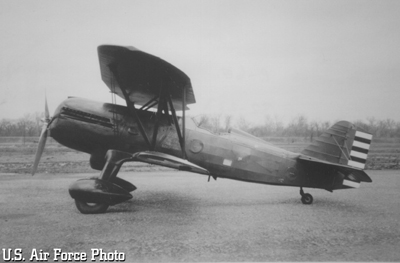
While it is true the larger a model is the easier it is to fly, there are transitional flight issues which can not be
accounted for without the stick time on a type of model...radial ~ inline engine, cowled ~ uncowled, tapered ~
untapered wing, landing gear configuration,
It is this last issue I want to address. It is actually the cause of a number of issues for a modeler resulting
from the natural behavior of a shape traveling through air...and speed required to achieve flight with even
a 2" x 4" board.
Here is the data on the planset already introduced into this discussion:
H.P. ranges exceeding 100% of minimum recommendation would in my opinion be a red flag with respect to
weight ~ performance and the experience required for the design. BobH is correct, however there are other
contributing factors to raising a red flag this early on in your R/C trek. Building light weight equates to flying
more easily with fewer "landing" issues.
That F-11C-2 multiple view drawing is online and I recommend you downloading it...link is below the
image on its page.
You will notice there is a rather big difference between what appears below and what you saw when
you clicked the above link and downloaded the drawing you found there. Details...its all in the details
or in this case...disclosure.
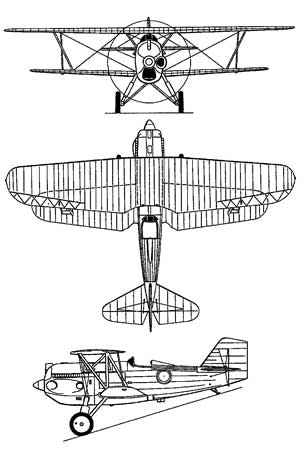
What all too often happens is you find an airplane you are attracted to. There's no definition for it, other
than what I call gegaw factor. Its the same reason a competitor selects a subject to build and fly in scale
contests. Its emotional...which should send a huge red flag up right away :^O
In other words if you are making a subject decision based on the bottom multiple view drawing... never
make a decision without at least two more multiple view drawings of the subject before you decide.
F-11C-2 is a radial engine version of the 'tween the wars F-11C-2 which provides all the gegaw
factor you could ever hope for.
Here is some useful documentation...depending on the version of the F-11C-2 you desire to build, build
docs first.
time is an issue today VS. when many of us were starting our trek into this hobby. The last four words in that
last sentence are important. Back in the day is a term you are sure to have read or heard already.
That refers not only to tenure as much as it has to do with evolved skillset gained along the trek. Today, with so
many alternative activities and family distractions or interactions...the hobby is definately different than a number
of us remember.
Why such a wordy greeting? Well it was intended to make a statement instead of just being a row of words.
People get into this hobby because they envision themselves flying a scale model replica of a 1:1 aircraft. In your
case its the P6e.
While it is true the larger a model is the easier it is to fly, there are transitional flight issues which can not be
accounted for without the stick time on a type of model...radial ~ inline engine, cowled ~ uncowled, tapered ~
untapered wing, landing gear configuration,
power ~ weight recommendation.
It is this last issue I want to address. It is actually the cause of a number of issues for a modeler resulting
from the natural behavior of a shape traveling through air...and speed required to achieve flight with even
a 2" x 4" board.
Here is the data on the planset already introduced into this discussion:
Power 2-5 HP Weight 24-26 lbs
H.P. ranges exceeding 100% of minimum recommendation would in my opinion be a red flag with respect to
weight ~ performance and the experience required for the design. BobH is correct, however there are other
contributing factors to raising a red flag this early on in your R/C trek. Building light weight equates to flying
more easily with fewer "landing" issues.
[link=http://plans.aerofred.com/data/media/38/Curtiss_P-6E_Hawk_Wylam_1of4.jpg]P-6E Hawk Fuse View[/link]
[link=http://plans.aerofred.com/data/media/38/Curtiss_P-6E_Hawk_Wylam_2of4_2.jpg]P6E Wing[/link]
That F-11C-2 multiple view drawing is online and I recommend you downloading it...link is below the
image on its page.
You will notice there is a rather big difference between what appears below and what you saw when
you clicked the above link and downloaded the drawing you found there. Details...its all in the details
or in this case...disclosure.
What all too often happens is you find an airplane you are attracted to. There's no definition for it, other
than what I call gegaw factor. Its the same reason a competitor selects a subject to build and fly in scale
contests. Its emotional...which should send a huge red flag up right away :^O
In other words if you are making a subject decision based on the bottom multiple view drawing... never
make a decision without at least two more multiple view drawings of the subject before you decide.
[link=http://plans.aerofred.com/data/media/38/Curtiss_P-6E_Hawk_Wylam_4of4.jpg]Second Perspective Of P6E[/link]
F-11C-2 is a radial engine version of the 'tween the wars F-11C-2 which provides all the gegaw
factor you could ever hope for.
[img]{akamaiimageforum}/upfiles/15437/Mk25768.jpg[/img]
Here is some useful documentation...depending on the version of the F-11C-2 you desire to build, build
docs first.


