


AT-6 reflections
 01-12-2005 | 02:28 AM
#26

My Feedback: (37)
Joined: Oct 2002
Posts: 534
Likes: 0
Received 0 Likes
on
0 Posts
From: Dothan, AL
 RE: AT-6 reflections
I got to fly an AT-6 (actually an SNJ, the Navy version) a couple years ago. A small group that traveled around from airport to airport giving warbird rides about nine months out of the year came to an airport a couple hours drive away. Their normal deal was just for rides only, but business was a little slow for them at that point in time, and the guy that did the flying was willing to work out a deal to let me fly it. I told him that I had a couple hundred hours in Cessna 172's, showed him my logbook, and told him what I really wanted to do was some basic aerobatics. Nothing real high-G, like snaps or spins, because I didn't think my stomach could take it, but some loops, rolls, hammerheads, inverted flight, etc. As soon as we were airborne, the pilot pulled the gear up and announced that the aircraft was mine. We headed out to the local training area and climbed to 3,000 feet. He would do a maneuver once, while I held the controls loosely and he described what he was doing - then I would try it. He said later that he was very impressed with how smoothly I did the manuevers, and how quickly I became comfortable with the joystick, having only flown an aircraft with a yoke. I told him that I supposed that years of RC aerobatics probably helped a lot. Also, having dreamed about flying some kind of warbird my whole life probably helped prepared me mentally, too. I was immediately impressed with how responsive the SNJ was. I had expected it to handle somewhat like a big truck, being accustomed to the little Cessna. But it obediently went right where I pointed it, and was a real pleasure to fly. After an hour's flight, I was pretty worn out and ready to call it a day. I'm 54-years-old, and carrying an extra couple of saddle bags, so aerobatic flying was a little more physically stressful than it would have been when I was twenty, like most of the pilots that learned to fly this bird before going on to the Mustangs, Thunderbolts, etc. that they would fly in combat in WWII. My instructor said when we climbed out of the cockpit that if my grin were any bigger that it would break my face. It was literally a dream come true, an experience that I feel extremely lucky to have had. I doubt I'll ever fly another warbird, but I'll never forget that flight.

 01-12-2005 | 11:32 AM
#28
Senior Member
My Feedback: (3)
Joined: Nov 2002
Posts: 20,205
Likes: 0
Received 20 Likes
on
15 Posts
From: Mary Esther, Florida, FL
RE: AT-6 reflections
Nony:
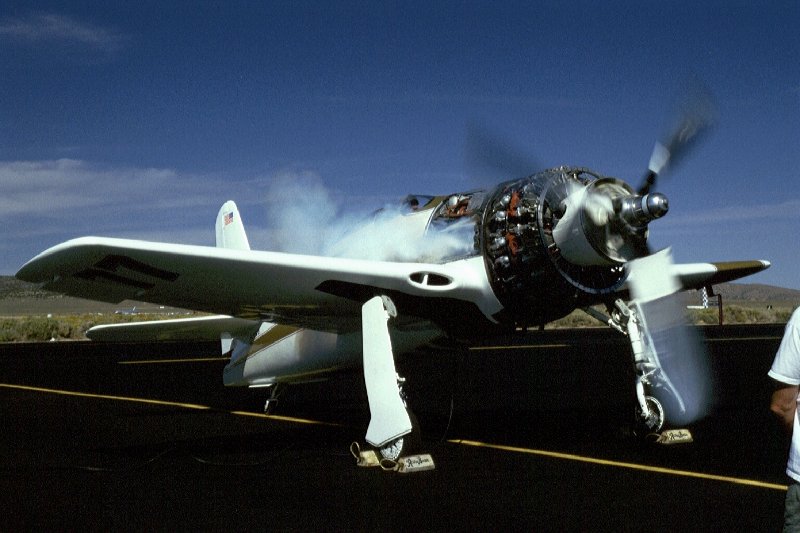
Your picture is proof that particular airplane had a 3350 at the time the picture was taken.
Somewhere I know I saw a note saying the Rare Bear had a 4360, but even Lyle Shelton's R-B site now says 3350. Maybe he tried a 4360 and went back to the 3350. I don't know.
Fast? R-B is fast enough to hold the current prop speed record, possibly Dago Red is enough faster in the turns to come out even in the end.
Bill.
Your picture is proof that particular airplane had a 3350 at the time the picture was taken.
Somewhere I know I saw a note saying the Rare Bear had a 4360, but even Lyle Shelton's R-B site now says 3350. Maybe he tried a 4360 and went back to the 3350. I don't know.
Fast? R-B is fast enough to hold the current prop speed record, possibly Dago Red is enough faster in the turns to come out even in the end.
Bill.
01-13-2005 | 01:06 AM
#29


My Feedback: (2)
RE: AT-6 reflections
The information I have is that Rare Bear has always had a 3350 since it was modified for racing. I have photos of it back to '74 wiith the cowling off. There is a Sea Fury named Dreadnaught with a 4360 that looks somewhat similar to Rare Bear from the side view, expecially with it's extra tall fin.
Racing and straight line speed runs are different animals. In John Penny's words (Air Classics July '96) "the plane experiences a significant directional trim change when rolling from straightaway into the turn around the pylons. Lyle and I estimate 55-70 lbs of bottom (left) rudder pressure is required to keep the ball centered in a five to six G pylon turn." He goes on to say "On the course at race power and speeds, the Bear is just plain hostile." The team has been challenged in recent years just to keep everything running under the terrrific stresses they place on the hardware.
In any case, matching the worlds most powerful radial engine with a 60 year old airframe and running both way beyond their design limits finally paid off with a win in Reno in 2004.
Racing and straight line speed runs are different animals. In John Penny's words (Air Classics July '96) "the plane experiences a significant directional trim change when rolling from straightaway into the turn around the pylons. Lyle and I estimate 55-70 lbs of bottom (left) rudder pressure is required to keep the ball centered in a five to six G pylon turn." He goes on to say "On the course at race power and speeds, the Bear is just plain hostile." The team has been challenged in recent years just to keep everything running under the terrrific stresses they place on the hardware.
In any case, matching the worlds most powerful radial engine with a 60 year old airframe and running both way beyond their design limits finally paid off with a win in Reno in 2004.


