


Another Drone Pilot does it Again
 01-01-2016 | 09:34 AM
#2776


Even if damage to engine is contained, you often lose redundant electrical and hydraulic systems due to compressor / turbine blades cutting lines etc. Leaking hydraulic fluid on hot section of engine often then leads to inflight fire.
I can only imagine what a 2lb quad full of metal motor casings and lipos would do.
Last edited by franklin_m; 01-01-2016 at 09:38 AM.
 01-01-2016 | 09:57 AM
#2777
The big difference, birds dont explode into a fireball when they hit, where the Lipo will. Anyone who has been around a jet engine knows there is a safety zone you need to stay out of, or risk getting sucked into it. That holds true on the ground and in the air.
 01-01-2016 | 10:08 AM
#2779
01-01-2016 | 10:08 AM
#2780
01-01-2016 | 10:10 AM
#2781
You said explode, flames will likely not hurt an engine designed to burn fuel. It also takes a while, but will be finely chopped up before burning.
01-01-2016 | 11:09 AM
#2782
Did you not see the pictures posted above from bird strikes? If a bird could cause that much damage to an engine, imagine what would happen with the high speed blades hitting hard plastic and metal. Add in the hot flames from the burning Lipo, which would cause the engine to overheat and immediately shut down, and you have a plane that would be in serious trouble, especially on take off.
Besides, not all explosions are violent. A very hot sudden burst of flame is also considered an explosion. Even if it just smolders, the smoke given off could extinguish the burners in the engine. Not to mention the collateral damage the blades will do when they break apart from the impact. They are traveling at a very high rate of speed, and can shoot through the cabin, rip though lines and cabling, and the sudden loss of balance in the engine could cause it to break off. Frankly this is not something I would ever want to hear happen.
Besides, not all explosions are violent. A very hot sudden burst of flame is also considered an explosion. Even if it just smolders, the smoke given off could extinguish the burners in the engine. Not to mention the collateral damage the blades will do when they break apart from the impact. They are traveling at a very high rate of speed, and can shoot through the cabin, rip though lines and cabling, and the sudden loss of balance in the engine could cause it to break off. Frankly this is not something I would ever want to hear happen.
01-01-2016 | 06:11 PM
#2783

Joined: Feb 2014
Posts: 360
Likes: 0
Received 0 Likes
on
0 Posts
From: Cartersville, GA
Remember back in 1991 When the FCC mandated dual conversion receivers. OH the Out cry. What's stopping the, FCC on be half of the FAA, to mandate all new receivers or add ons that require GEO Fencing? That way the FAA would not have to enforce any NEW Rules and it would be the FCC's mandate and they don't have any such mandate, not to make new rules for R/C Toys.
Now I'm not trying to give the "Gestapo" any new Ideas. Just Saying.
GoodNight to all see a next year ... My puter says 23:57 Dec 31 2015
Now I'm not trying to give the "Gestapo" any new Ideas. Just Saying.
GoodNight to all see a next year ... My puter says 23:57 Dec 31 2015
If the AMA expects me to hold off on flying any new aircraft, does the AMA also recommend that we advice new pilots to not get started in the hobby until February?
01-02-2016 | 07:04 AM
#2785
Did you not see the pictures posted above from bird strikes? If a bird could cause that much damage to an engine, imagine what would happen with the high speed blades hitting hard plastic and metal. Add in the hot flames from the burning Lipo, which would cause the engine to overheat and immediately shut down, and you have a plane that would be in serious trouble, especially on take off.
Besides, not all explosions are violent. A very hot sudden burst of flame is also considered an explosion. Even if it just smolders, the smoke given off could extinguish the burners in the engine. Not to mention the collateral damage the blades will do when they break apart from the impact. They are traveling at a very high rate of speed, and can shoot through the cabin, rip though lines and cabling, and the sudden loss of balance in the engine could cause it to break off. Frankly this is not something I would ever want to hear happen.
Besides, not all explosions are violent. A very hot sudden burst of flame is also considered an explosion. Even if it just smolders, the smoke given off could extinguish the burners in the engine. Not to mention the collateral damage the blades will do when they break apart from the impact. They are traveling at a very high rate of speed, and can shoot through the cabin, rip though lines and cabling, and the sudden loss of balance in the engine could cause it to break off. Frankly this is not something I would ever want to hear happen.
01-02-2016 | 07:06 AM
#2786
01-02-2016 | 07:14 AM
#2787
I guess you missed the photo of the helicopter with the bird through the windscreen (approx. 120kias), and the small commuter plane with the bird through the windscreen (maybe 250kias)?
01-02-2016 | 07:53 AM
#2789

 Hi Franklin ,
  Our buddy Sport is "misinformed" as to the relative strength/weakness of aircraft structures . He appears to harbor this highly inaccurate view that aircraft are "built like Mack trucks" and no amount of presenting factual information will change his patently false assertions . I and others have tried presenting the facts to him , that it truly is "luck of the draw" when ANYTHING strikes an aircraft in flight ("Miracle on the Hudson" ring any bells , Sport ?) but his steadfast refusal to accept these facts points to a person who really doesn't WANT to accept the truth (recreational arguing , AKA "Trolling" , comes to mind here) . I know not what the man's credentials are in aircraft mechanical attributes , But I suspect he has NOT had any training of the type that one would have in the earning of an A&P certificate as I and some others here at RCU have had . Course , ANYONE can get on the internet and play "instant expert , just add subject" , but those of us who DO know , know just how obvious it is that the guy has no real world aircraft maintenance experience whatsoever to be asserting his false notion that all aircraft are as tough as a '53 Buick !
 PS , this really WAS my '53 Buick , 30 or so years ago .......
Last edited by init4fun; 01-02-2016 at 07:56 AM.
01-02-2016 | 08:51 AM
#2790
I help restore a B-17E, and know how thin the skin is on these, One day someone dropped a bucking bar in the cockpit, it landed on the lower skin and put a hole in it. This was a 1/2 pound block of steel, that fell 3 feet. If you have done any skin repairs, you know what is involved to repair this little hole. Two options, patch it, or replace the entire skin. Really pissed off the owner as he wants this plane to look as it did the day it left Boeing, but he decided that at this point, he has enough time involved with the forward section that he is going to just patch it. Since it is dented, this will be a real chore as we need to flatten it back to match the curve before it can be patched. It happened just aft of the lower hatch under the cockpit so it is right in plain sight. Until you actually work on a plane, you really have no clue just how fragile all the parts are, and it is really amazing how these planes were able to take the beating they did and still return to base.
I also know how jet engines are built, how they function, and what can happen if something fails, though never personally saw one up close. I do know that the blades are sectional on the rotating part, each blade inserts in a slot and are very thin and very sharp. There are a series of these fans rotational and fixed and each set decreases in size to compress the air and speed it up, then it gets injected into the burners where the jet fuel is ignited. The force of the burning fuel pushes against another series of fans, which drives the compressor fans. These fans rotate at very high speeds, and ingesting something solid, even something as small as a screw, can cause serious damage. A birds is flesh and bone, and there will be some damage, but for the most part, the organic matter, flesh and bones will be chewed up and spit out, but something like a drone, with four metal outrunners, hard plastic spine, and large lipo batteries, along with the servos and anything attached to it will cause major damage when ingested by the engine. It can shatter the fan blades, cause an imbalance in the rotational mass, which will cause further damage as the engine shakes itself apart. The smoke from igniting Lipos, would cause the burners to flame out, killing thrust. So if this happened during a take off, it will cause the plane to crash, and chances are, there wont be a river to land in, nor a pilot as quick on the controls as Sulley was. People will die if this happens. This is why the FAA is doing what it did, unfortunately, the actions of a few affect the whole.
I also know how jet engines are built, how they function, and what can happen if something fails, though never personally saw one up close. I do know that the blades are sectional on the rotating part, each blade inserts in a slot and are very thin and very sharp. There are a series of these fans rotational and fixed and each set decreases in size to compress the air and speed it up, then it gets injected into the burners where the jet fuel is ignited. The force of the burning fuel pushes against another series of fans, which drives the compressor fans. These fans rotate at very high speeds, and ingesting something solid, even something as small as a screw, can cause serious damage. A birds is flesh and bone, and there will be some damage, but for the most part, the organic matter, flesh and bones will be chewed up and spit out, but something like a drone, with four metal outrunners, hard plastic spine, and large lipo batteries, along with the servos and anything attached to it will cause major damage when ingested by the engine. It can shatter the fan blades, cause an imbalance in the rotational mass, which will cause further damage as the engine shakes itself apart. The smoke from igniting Lipos, would cause the burners to flame out, killing thrust. So if this happened during a take off, it will cause the plane to crash, and chances are, there wont be a river to land in, nor a pilot as quick on the controls as Sulley was. People will die if this happens. This is why the FAA is doing what it did, unfortunately, the actions of a few affect the whole.
01-02-2016 | 10:14 AM
#2791
My Feedback: (6)
Hi franklin
Your pic's do show a lot, I hit a bird when flying my first cross country in getting my Privet LIc., in a T-Craft @ 90 indicated just to the left of the wind screen with at the leading edge took out the first 2 ribs crushed the L/E back to the main sparr, ( scared the S%$#t out of me ) as I was letting down to inter the landing pattern, My instructor and the school owner said at the time I was lucky it had not come thru the prop and the wind screen. Don't have a picture any more do to a house fire, but I will never forget that incident.
PS this was back in 1950
Cheers
Your pic's do show a lot, I hit a bird when flying my first cross country in getting my Privet LIc., in a T-Craft @ 90 indicated just to the left of the wind screen with at the leading edge took out the first 2 ribs crushed the L/E back to the main sparr, ( scared the S%$#t out of me ) as I was letting down to inter the landing pattern, My instructor and the school owner said at the time I was lucky it had not come thru the prop and the wind screen. Don't have a picture any more do to a house fire, but I will never forget that incident.
PS this was back in 1950
Cheers
01-02-2016 | 10:36 AM
#2792
Hi Acdii , Great for you to be restoring such a historic aircraft ! Also I'd like to say that I agree 100% with your post and am myself lucky to have never personally witnessed a turbine engine being destroyed by foreign object damage . I have , however , seen films during my A&P training of both "destructive" testing done in laboratory conditions and films of real world foreign object damage taken from airport security video as well as from bystanders who happened to be there and have a camera running at the instant the damage happened . The one bit of aircraft damage I have personally witnessed , one of the things that really opened my eyes at to the fragility of aircraft was ;
My A&P school , "East Coast Aero Tech" was located mostly on the civilian side of Hanscom AFB in Lexington/Concord Massachusetts . The civilian side was called "Bedford Airport" and we had classes in various buildings on both the Air Force and civilian sides of the airfield . For lunch on warm days we would sit out a distance from the runway and watch the action . A small twin turboprop that ferried mail had landed and the van that was to receive the mail sacks backed up to the parked jet so the mailbags could be thrown from the plane to the back of the van . The van driver had already opened the back doors and was backing slowly up to the plane when his foot accidentally slipped off the brake and at no more than a very slow roll (barely 1 MPH tops !) the van struck the side of the plane . This resulted in the side of the plane being totally caved in , rumpled metal everywhere , and the most incredible thing was THAT THE VAN'S DOORS STILL PROPERLY CLOSED AFTERWARD !!!! It was right there that I got MY healthy respect for just how fragile an aircraft is and why I find Sport's assertions of the "Army Tank" like strength of aircraft to be so absurd . Just like your mention of the dent in the B-17's skin , everybody who has actually mechanically worked on aircraft has seen the incredible fragility of aircraft structures firsthand , and knows JUST how lucky are the folks who have safely landed after their aircraft has sustained in air damage of any sort .
Last edited by init4fun; 01-02-2016 at 10:39 AM.
01-02-2016 | 10:42 AM
#2793
Hi franklin
Your pic's do show a lot, I hit a bird when flying my first cross country in getting my Privet LIc., in a T-Craft @ 90 indicated just to the left of the wind screen with at the leading edge took out the first 2 ribs crushed the L/E back to the main sparr, ( scared the S%$#t out of me ) as I was letting down to inter the landing pattern, My instructor and the school owner said at the time I was lucky it had not come thru the prop and the wind screen. Don't have a picture any more do to a house fire, but I will never forget that incident.
PS this was back in 1950
Cheers
Your pic's do show a lot, I hit a bird when flying my first cross country in getting my Privet LIc., in a T-Craft @ 90 indicated just to the left of the wind screen with at the leading edge took out the first 2 ribs crushed the L/E back to the main sparr, ( scared the S%$#t out of me ) as I was letting down to inter the landing pattern, My instructor and the school owner said at the time I was lucky it had not come thru the prop and the wind screen. Don't have a picture any more do to a house fire, but I will never forget that incident.
PS this was back in 1950
Cheers
And you sir are thankfully one of the lucky ones I mentioned in my post above ! You had an Angel watching out for you to have landed safely with such a damaged wing .
01-02-2016 | 06:55 PM
#2796

My Feedback: (49)
Had a sparrow hit my armored windshield at 500kts (EA6B at 500' AGL on a military training route) - completely shattered, nearly penetrated into cockpit. I can assure you that hitting a bird can quickly become a safety of flight emergency in an aircraft. Here's a few pics to see what birds can do:

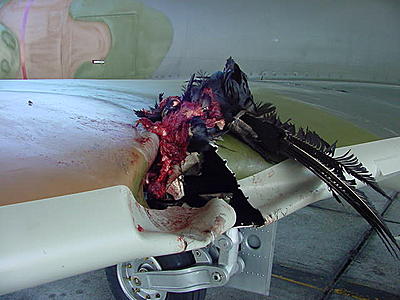


Even if damage to engine is contained, you often lose redundant electrical and hydraulic systems due to compressor / turbine blades cutting lines etc. Leaking hydraulic fluid on hot section of engine often then leads to inflight fire.
I can only imagine what a 2lb quad full of metal motor casings and lipos would do.
Even if damage to engine is contained, you often lose redundant electrical and hydraulic systems due to compressor / turbine blades cutting lines etc. Leaking hydraulic fluid on hot section of engine often then leads to inflight fire.
I can only imagine what a 2lb quad full of metal motor casings and lipos would do.
01-02-2016 | 11:30 PM
#2797

Junior Member
My Feedback: (1)
Joined: Jul 2003
Posts: 16
Likes: 0
Received 0 Likes
on
0 Posts
From: Hereford, AZ
You Don't Need to Shoot Down a Drone to Destroy It Anymore
http://www.popularmechanics.com/flight/drones/a17717/you-dont-need-to-shoot-down-a-drone-to-destroy-it-anymore/
Here's a video that shows the Blighter AUDS system in action:
https://www.youtube.com/watch?t=1&v=P8aZ0zWX3SA
http://www.popularmechanics.com/flight/drones/a17717/you-dont-need-to-shoot-down-a-drone-to-destroy-it-anymore/
Here's a video that shows the Blighter AUDS system in action:
https://www.youtube.com/watch?t=1&v=P8aZ0zWX3SA
Sweet!!
01-03-2016 | 06:13 AM
#2798
01-03-2016 | 06:30 AM
#2799
My Feedback: (49)
 Originally Posted by franklin_m
I guess you missed the photo of the helicopter with the bird through the windscreen (approx. 120kias), and the small commuter plane with the bird through the windscreen (maybe 250kias)?[QUOTE=Sport_Pilot;12154797]Hardly happens enough to register all toys. What next footballs?
[/QUOTE}:
Way back in '67 while stationed at K.I.Sawyer In the UP had occasion to take a Missile up to one of the big hangers where they service the B-52's and KC-135's any way this guy says u want to see something. I/we went up into the cockpit and the Co-Pilots wind screen was gone and the seat was covered in Blood and Goose feathers. No details but U can fill in the rest. He said it Killed the Co-Pilot.
Last edited by HoundDog; 01-03-2016 at 06:33 AM.

