


Easy to Fly Trainer

 11-07-2014 | 05:44 PM
#3


This is the trainer I built for my son many years ago. Wing is two lengths of 1/2" sheet balsa butt glued together and sanded to what might laughingly be called a symmetrical section (mainly to reduce weight) and covered with doped on silk for strength. Fuselage was 1/2" balsa with 1/2" square hardwood engine mounts. We used a 40 engine but it'll take anything from around a 30-45. This is essentially identical to what I learned to fly with about 57 years ago using a 29 engine. I added flaps on this one though for a bit more wing area and it was quite comfortable doing round manoeurvres like loops, 8's and inverted.
11-07-2014 | 06:43 PM
#4

ARF Nobler - just add engine. Although I love building you have to get out and FLY.

If you are going to build, Ringmaster kit available at Brodak

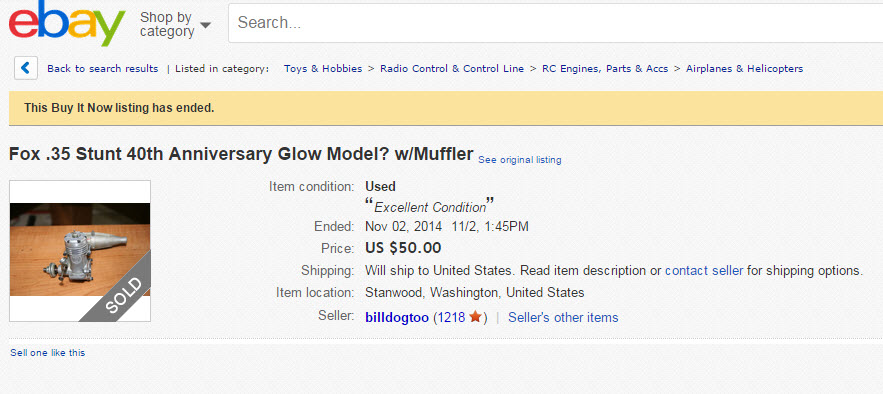
Decent used .35's on eBay - excellent engine for $50 + shipping
Plans for Ringmaster - pretty basic materials, simple enough to build over a weekend
http://www.outerzone.co.uk/plan_file...Ringmaster.pdf

Cheers,
PG
If you are going to build, Ringmaster kit available at Brodak
Decent used .35's on eBay - excellent engine for $50 + shipping
Plans for Ringmaster - pretty basic materials, simple enough to build over a weekend
http://www.outerzone.co.uk/plan_file...Ringmaster.pdf
Cheers,
PG
Last edited by BrightGarden; 11-07-2014 at 09:05 PM.
11-08-2014 | 07:33 AM
#5

I always thought the Sig Skyray 35 was good answer for this type of question. Robust easy construction, a great flier with a wide range of motor possibilities. http://www.sigmfg.com/IndexText/SIGCL25.html
11-08-2014 | 08:18 AM
#6
Thread Starter

Joined: Nov 2005
Posts: 167
Likes: 0
Received 0 Likes
on
0 Posts
From: Lincoln,
NE
11-08-2014 | 08:38 AM
#8
Senior Member
Hi OC, The absolutely best control line trainer is not a model airplane; It is a kite. The first kite C/L trainer we came across was a two-line stunt kite produced by Charles Mackey.
That was almost 30 years ago, so no longer available. It used a 15" dowel handle with an eyelet near each end; to which the 90' lines were attached . The kites would do any
maneuver a model airplane could do except wingovers. It also out turned even 1/2A combat ships. It was almost bomb proof; you could dive the kite into grass and it
simply bounced back into the air. These kites could fly as long as you could last. Moreover, no broken props, fuel consumed, blown plugs, no high risk anxiety; just lots of flying.
We trained many newbies with these kites. My twin sons learned and mastered the kites after a several sessions. They then switched to a Dumas Tomahawk, powered
with a very strong Webra mach II .15 diesel on 58'X .015" lines. One twin, on his very first C/L flight, flew a few laps, then started flying horizontal eights, vertical eights, big open squares,
and some overhead stuff. he only got disoriented when he flew through the top of the circle because kites didn't do that! Both boys learned that that there is no upside down ,
or right side up orientation; there was only right turn or left turn. They did not develop the up/down bias. In very little time, they were soon flying high performance 1/2A Combat
models, and soon after that, they were flying 1/2A combat matches.
Okay if you're still with me, here's a link to a stunt kite that should be an excellent C/L trainer: http://www.intothewind.com/shop/Stun...tes/Prism_Jazz
Toss the individual plastic handles provided; and get a 16" long X 7/8ths" diameter wood dowel, screw an eyelet near each end, rendering 15" line spacing. Fly the kite holding the wood dowel
vertically, just like an ordinary C/L handle. The only thing you'll need is 7-15mph wind. After you master the stunt kite, you can take on any .35 cu" powered profile, Ringmaster,
FliteStreak, etc.... Best of luck

Tony
Last edited by paw080; 11-09-2014 at 05:03 PM. Reason: correction
11-08-2014 | 03:37 PM
#11
Also, add this to the hangar for when it is TOO windy to fly airplanes.
Thanks for the tip, PAW080
11-08-2014 | 04:04 PM
#12
The Top Flite Flight Streak ARF would be a fast way to get into the air also. http://www3.towerhobbies.com/cgi-bin...?&I=LXDVF3&P=0
Great share.
PG
11-08-2014 | 10:55 PM
#13

George
11-09-2014 | 05:56 AM
#14
Thread Starter
Joined: Nov 2005
Posts: 167
Likes: 0
Received 0 Likes
on
0 Posts
From: Lincoln,
NE
I flew CL as a kid. A friend gave me a partially completed Stork that renewed my interest. I completed it but crashed it on takeoff. It's repairable. Next I built a plank 1/2 A that I have yet to have a successful flight with.
11-09-2014 | 03:16 PM
#16
The original "CL trainers" that I recall from the late 1940's/early-1950's were like the 'plank' mentioned near the top of this thread. The had a "lifting" airfoil - flat bottom, curved top - thicker at the front and tapered down to a fairly sharp trailing edge. Vertical 1/2" sheet 'slab' fuselage with a tray for the tank and upright engine. Sheet tail surfaces. Rugged construction.
Fairly heavy, and if the elevator angles were not extreme, with relatively "sluggish" response to the handle .Testor's (long vanished from the marketplace) sold the most often seen, as Jim mentioned, in a few different sizes. The #3 was about right for the .29 to .35 engines of the day. Today's engines generally have more power than those, but set a bit richer they do well.
Over-control is the usual problem for new fliers. It doesn't take much, once you've found where 'neutral' (where the model flies level) is. Once you have a comfortable neutral, you can make the model rise gently by raising your arm, and have it descend gradually by lowering your arm. ...Without moving your wrist from the 'neutral' position relative to your arm. As you get more comfortable, you can relax and fly more confidently. It comes quickly...
Control-line has many possibilities once you've mastered confident level flight and gentle 'altitude' changes. There's so much more you can do that you shouldn't ever be stuck with a boring experience flying CL. I'm not bored yet, and have been flying CL for over 60 years... Welcome, or welcome back, whichever works best!
Fairly heavy, and if the elevator angles were not extreme, with relatively "sluggish" response to the handle .Testor's (long vanished from the marketplace) sold the most often seen, as Jim mentioned, in a few different sizes. The #3 was about right for the .29 to .35 engines of the day. Today's engines generally have more power than those, but set a bit richer they do well.
Over-control is the usual problem for new fliers. It doesn't take much, once you've found where 'neutral' (where the model flies level) is. Once you have a comfortable neutral, you can make the model rise gently by raising your arm, and have it descend gradually by lowering your arm. ...Without moving your wrist from the 'neutral' position relative to your arm. As you get more comfortable, you can relax and fly more confidently. It comes quickly...
Control-line has many possibilities once you've mastered confident level flight and gentle 'altitude' changes. There's so much more you can do that you shouldn't ever be stuck with a boring experience flying CL. I'm not bored yet, and have been flying CL for over 60 years... Welcome, or welcome back, whichever works best!
11-11-2014 | 06:31 AM
#17
A friend of mine turned me on to a Flite Streak trainer he was training his son with. It has a solid plank wing, and a Brodak 15. I helped train his son that day, his wife, and mine. I was so impressed with the setup I purchased one for the wife and future pilots I hope. Great little airplane and plenty tough.
11-11-2014 | 11:21 AM
#18
The Beast
Guillows Profile Basic Trainer II
Material: Pine -YES Pine- Fuselage and Engine Rail
Wing: Balsa plank, carved to approximate an airfoil
Covering - None, everything is a plank. However, finished with "Early 1960's Porch Stain" (guesstimate)
Engine: McCoy .19 Bluehead
Muffler: Muffler? What's a muffler?
Built by a NASA engineer, so it has to be good (bought in a hangar sale from a NASA Engineer. I know he was one because he told me AND there was NASA sticker on the flight box I also got from him. Flight box came with 1960's Cox fuel, no less.)
There was a larger Guillows Profile Basic Trainer --->III<--- for .35 engines.
http://www.flyboyzblog.com/flyboyz-g...g/#prettyPhoto
This plane looks indestructible.


Guillows Profile Basic Trainer II
Material: Pine -YES Pine- Fuselage and Engine Rail
Wing: Balsa plank, carved to approximate an airfoil
Covering - None, everything is a plank. However, finished with "Early 1960's Porch Stain" (guesstimate)
Engine: McCoy .19 Bluehead
Muffler: Muffler? What's a muffler?
Built by a NASA engineer, so it has to be good (bought in a hangar sale from a NASA Engineer. I know he was one because he told me AND there was NASA sticker on the flight box I also got from him. Flight box came with 1960's Cox fuel, no less.)
There was a larger Guillows Profile Basic Trainer --->III<--- for .35 engines.
http://www.flyboyzblog.com/flyboyz-g...g/#prettyPhoto
This plane looks indestructible.
11-11-2014 | 12:32 PM
#19

Senior Member
My Feedback: (3)
The best trainer I know of is a sheet of coroplast with a .049 engine screwed to it. It can be flown with 25 feet of Spiderline fishing string.
http://www.balsabeavers.com/informat...ans/manwin.pdf
http://www.balsabeavers.com/informat...ans/manwin.pdf
11-11-2014 | 02:31 PM
#20
Senior Member
Testors had a line of trainers, TC3 or something like that. Three sizes, 049, 19 and 29. These morphed into the Freshman series. The Brodak Flite Streak Trainer is good. I have seen one fly with a McCoy 19. I had three of the Guillow's trainers, two #2s and a #3. These were picked up at antique shops and refurbished. My favorite was a #2 with a worn out McCoy 19, White plastic 9 x 4 prop. It flew on 63 ft lines and would start off doing 7 second laps, then work down to 6 sec laps as the tank ran down (no uniflow). It would fly 28 laps on a full tank. The engine had no compression, but with a head prime and choke it almost always did a one flip start and ran steadily and reliably. That airplane had several hundred flights on it. I gave all three trainers to CL flying buddies, as I am no longer able to fly CL. It amazed me that such a small, slow, heavy airplane generated enough lift to fly quite nicely going round in circles.
11-11-2014 | 03:17 PM
#21

My Feedback: (18)
Depends on what you mean by trainer; Basic trainer or Stunt trainer?
If you mean a basic trainer, then I vote for the Guillows Basic Trainer but they are impossible to find these days. Next vote is the Brodak Flight Streak Trainer, with sheet balsa wing, fuselage and tail.
But the cheapest and easiest way to learn to fly is an Osborne Platter with a Cox .049 on the nose. Extremely stable, easy to fly, handles wind. Cheap and quick to build and nearly indestructible! With a few minor mods it will even serve as a great stunt trainer that will survive many many crashes without serious damage.
I once built 3 platters for a day of teaching kids to fly while the grown ups participated in a Giant Scale Fly In. I thought I would need 3 complete airframes with engines to get me through the day. The first platter lasted all day and flew countless flights which almost always ended in a crash, only occasionally needing a drop or two of CA before the next flight. Went through a lot of props that day!
Even the RC guys stood inline with the kids to fly it!
Sorry but all of these are smaller than .35 to .60. Most planes in the size you requested will be designed for stunt not for basic training. For stunt training in that size I would think about a Sig Sky Ray, S1 Ringmaster or similar profile non-flapped stunt plane.
The ARF Flight Streak is pretty fast and somewhat fragile, the ARF Nobler is a great flyer but also fragile. Seems to me you want a high level of durability with a trainer.
If you mean a basic trainer, then I vote for the Guillows Basic Trainer but they are impossible to find these days. Next vote is the Brodak Flight Streak Trainer, with sheet balsa wing, fuselage and tail.
But the cheapest and easiest way to learn to fly is an Osborne Platter with a Cox .049 on the nose. Extremely stable, easy to fly, handles wind. Cheap and quick to build and nearly indestructible! With a few minor mods it will even serve as a great stunt trainer that will survive many many crashes without serious damage.
I once built 3 platters for a day of teaching kids to fly while the grown ups participated in a Giant Scale Fly In. I thought I would need 3 complete airframes with engines to get me through the day. The first platter lasted all day and flew countless flights which almost always ended in a crash, only occasionally needing a drop or two of CA before the next flight. Went through a lot of props that day!
Even the RC guys stood inline with the kids to fly it!
Sorry but all of these are smaller than .35 to .60. Most planes in the size you requested will be designed for stunt not for basic training. For stunt training in that size I would think about a Sig Sky Ray, S1 Ringmaster or similar profile non-flapped stunt plane.
The ARF Flight Streak is pretty fast and somewhat fragile, the ARF Nobler is a great flyer but also fragile. Seems to me you want a high level of durability with a trainer.
Last edited by 049flyer; 11-11-2014 at 03:31 PM.
11-12-2014 | 09:10 AM
#22
Senior Member
new to C/L modelers to do simple aerobatics on their VERY FIRST control line flight. I can recall three adults that in their first
flight, did lazy eights, inside and outside loops and inverted flight(to them, inverted was just the other direction). One of those
adults was James Szhou, formerly of CS and Raptorz model engines. I'd like to point out that uninterrupted repetition of a
single maneuver such as the four-leaf clover is easy to master if you can do it for 20 minutes without refueling, without crashing.
Within an hour, you will be flying vertical and horizontal hourglasses. This will be my last rant in support of a beginner's first control line flying,
should should be with a stunt kite. I'm available to answer questions for anyone that wants to learn more about kite flying. Best Regards;
Tony
Last edited by paw080; 11-12-2014 at 10:14 AM. Reason: reason
11-12-2014 | 10:03 AM
#24
Senior Member
My Feedback: (3)
I would emphasize that the control sensitivity of a basic trainer begins with the line spacing at the handle. You want an unresponsive feel at the endle, so the line spacing for a 1/2 A trainer should be about the same distance as your middle two fingers....an inch and a half or so. The same spacing at the bellcrank gives you a 1 to 1 ratio. Next, the elevator push rod needs to pivot as close as practical to the bell crank's pivot point...aim for the inner hole on a Carl Goldberg bellcrank.
Do not use "1/2A "control horns, use a medium or tall horn on the elevator. The total amount of elevator movement only needs to be 10 degrees either side of neutral if the CG of the plane is set at 20 - 25% of the wing chord. The idea is to have just enough pitch control to gradually take off, fly some laps and then have a easy time off allowing the plane to land. More control can be "dialed in" later, once the pilot gets bored with doing basic laps. APC sells a 6 x 2 pitch prop to help keep the lap times to a manageable pace.
The Goldberg Lil Wizard was the absolute easiest trainer I ever flew. It was well matched with a Cox .049 and a 6x2 prop to keep the speed down. It was a thrill to be able to fly on 26 foot long dacron lines at the time because my only other experience flying was with those awful RTF plastic planes that came with much shorter line.
Thanks to a very knowledgeable hobby shop owner in Auburn Washington , [Harvey Wagner]...he set me up with the "trainer package" that I described here.
Do not use "1/2A "control horns, use a medium or tall horn on the elevator. The total amount of elevator movement only needs to be 10 degrees either side of neutral if the CG of the plane is set at 20 - 25% of the wing chord. The idea is to have just enough pitch control to gradually take off, fly some laps and then have a easy time off allowing the plane to land. More control can be "dialed in" later, once the pilot gets bored with doing basic laps. APC sells a 6 x 2 pitch prop to help keep the lap times to a manageable pace.
The Goldberg Lil Wizard was the absolute easiest trainer I ever flew. It was well matched with a Cox .049 and a 6x2 prop to keep the speed down. It was a thrill to be able to fly on 26 foot long dacron lines at the time because my only other experience flying was with those awful RTF plastic planes that came with much shorter line.
Thanks to a very knowledgeable hobby shop owner in Auburn Washington , [Harvey Wagner]...he set me up with the "trainer package" that I described here.

