


Electronic solutions to modifying glow engines of all sizes to gasoline
 03-07-2023 | 03:56 AM
#1401


Yeah the fg33r3 carb will also fit directly to the ft160 manifold and will definitely be a good starting point for testing..i wont even bother with the fg21 carb ..as like you said its a tad large for the given cc,s ....
damn saito for not doing a better job of producing a decent intake system on the radthes..well i wasted some bucks on a mmm intake for the fg19r3...its simply just a larger cup inside of the manifold..does make a difference..but when the engine sits idle for a minute or more it builds up a rch mixture..sure it never dies just a bit of spluttering then it clears up well in no time..yeah saito radials sound great, little fiddling to get them running well enough to enjoy..price is fair enough too..
im trying to decide between saito fg41ts or another dreaded r3 radial..but a 60cc ..bout 500 grams between these 2 engines for my peashooter ..well a little extra weight may reduce slow flying capacity
damn saito for not doing a better job of producing a decent intake system on the radthes..well i wasted some bucks on a mmm intake for the fg19r3...its simply just a larger cup inside of the manifold..does make a difference..but when the engine sits idle for a minute or more it builds up a rch mixture..sure it never dies just a bit of spluttering then it clears up well in no time..yeah saito radials sound great, little fiddling to get them running well enough to enjoy..price is fair enough too..
im trying to decide between saito fg41ts or another dreaded r3 radial..but a 60cc ..bout 500 grams between these 2 engines for my peashooter ..well a little extra weight may reduce slow flying capacity
 03-07-2023 | 06:37 AM
#1402
Looking at that peashooter, I would not worry too much, it looks like it won't be bothered too much with an additional 500 grammes.
My Seagull FW190A has the ASP radial, which weighs in at near 2,8 kilo. The plane turned out to be built such, that had I fitted a lightweight 40 or 50 cc gasser 2-stroke I would have had to add lead to the nose anyway, as it balanced perfectly with the radial on. So the plane would have ended up exactly at the same weight regardless of a lighter engine.
Then again, you can push forward the decision of which engine, after you have your hands on the plane, right?
As for those aftermarket intake mods offered, I am always a bit suspicious, because usually there are way easier and cheaper options.
My ASP also had a TERRIBLE fuel distribution, and I solved it by simply drilling 3 holes 0,8 mm in the intake elbow. The mod is basically free (OK... a drill bit set including 0,8 mm costs maybe €3,50) but the trick is to know where and how to drill...
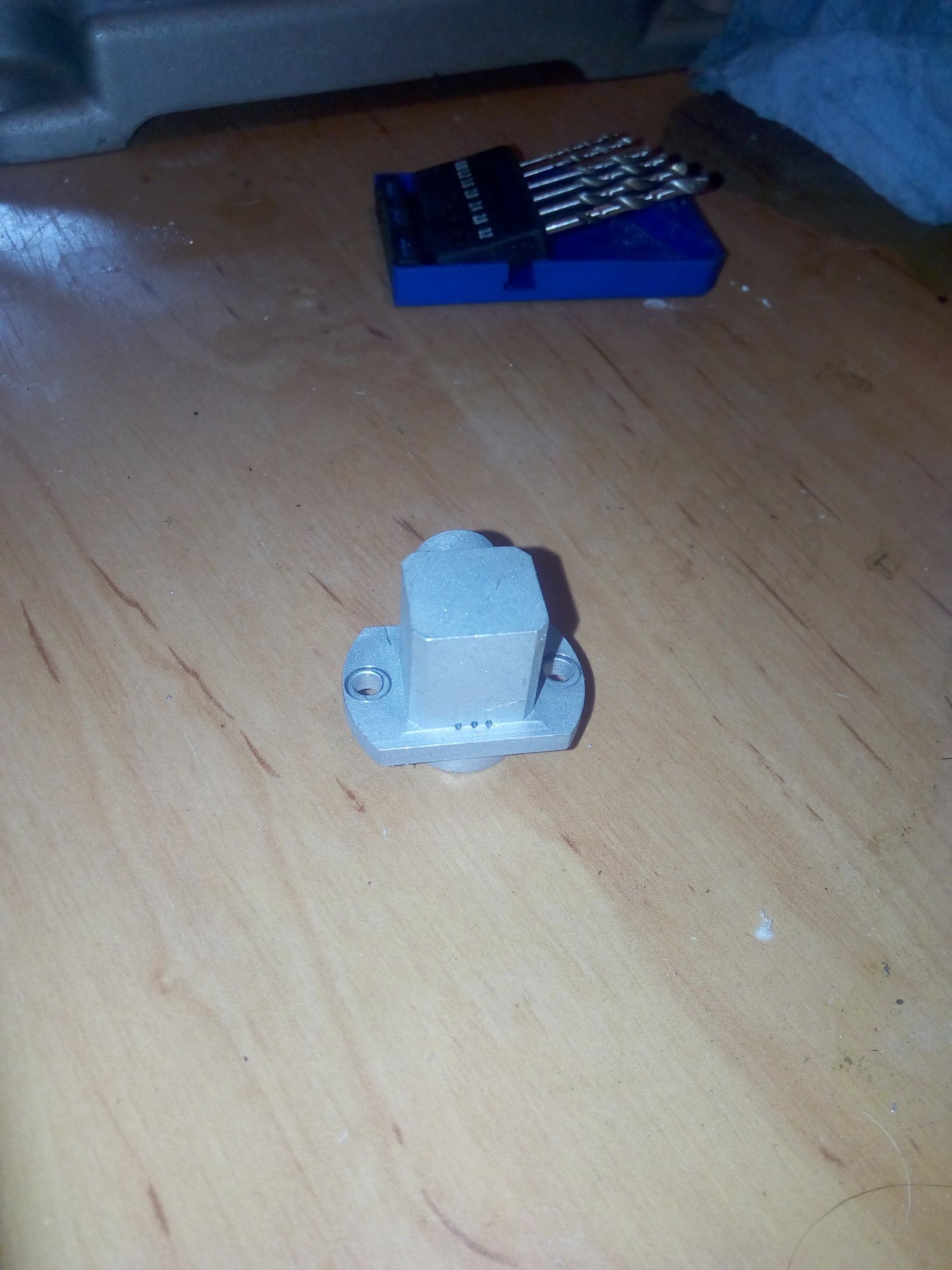

Fixed it right up, from this:
to this:
The difference might not be all that audible, but it is not just 4~500 RPM more, it also is a throttle that responds over the full stroke and much more equal cylinder temperatures.
What basically happened was that fuel distribution would vary with throttle opening, so from about half throttle, cylinders that were rich to begin with would go lean and vice versa, resulting in basically no change of RPM, but a lot of change in temperature.
Before the mod, I saw differences in cylinder temperature of 80~100 deg C, after the mod, that reduced to 40 or less. Also, the oil residue from the crankcase cleared up noticably.
Sometimes, people think too much in terms of "I've got a lathe and machining skills", and not enough in terms of "what could be the actual problem"
My Seagull FW190A has the ASP radial, which weighs in at near 2,8 kilo. The plane turned out to be built such, that had I fitted a lightweight 40 or 50 cc gasser 2-stroke I would have had to add lead to the nose anyway, as it balanced perfectly with the radial on. So the plane would have ended up exactly at the same weight regardless of a lighter engine.
Then again, you can push forward the decision of which engine, after you have your hands on the plane, right?
As for those aftermarket intake mods offered, I am always a bit suspicious, because usually there are way easier and cheaper options.
My ASP also had a TERRIBLE fuel distribution, and I solved it by simply drilling 3 holes 0,8 mm in the intake elbow. The mod is basically free (OK... a drill bit set including 0,8 mm costs maybe €3,50) but the trick is to know where and how to drill...
Fixed it right up, from this:
to this:
The difference might not be all that audible, but it is not just 4~500 RPM more, it also is a throttle that responds over the full stroke and much more equal cylinder temperatures.
What basically happened was that fuel distribution would vary with throttle opening, so from about half throttle, cylinders that were rich to begin with would go lean and vice versa, resulting in basically no change of RPM, but a lot of change in temperature.
Before the mod, I saw differences in cylinder temperature of 80~100 deg C, after the mod, that reduced to 40 or less. Also, the oil residue from the crankcase cleared up noticably.
Sometimes, people think too much in terms of "I've got a lathe and machining skills", and not enough in terms of "what could be the actual problem"


The following users liked this post:
Rcplanedan (03-07-2023)
03-07-2023 | 06:18 PM
#1405
Ive noticed on my saito fg19r3 to get a nice idle you have to lean the low speed a fair bit but once you get to mid range its lean..so to have good mid range its stuck with rich idle ..maybe bert designed those holes to lean the idle mix then once up in mid range velocity overcomes those small holes ..just an idea,could fit a fuel nipple to that manifold and fit a needle vave from a os 46la or similar to adjust the air bleed ..would act similar to an airbleed maybe..
im not a professional..its just a thought!!
im not a professional..its just a thought!!
03-08-2023 | 12:09 AM
#1406
You hit the jackpot, Lonnie!
Of course... Have I ever had a lack of words?
On the ASP, the intake system consists of a central intake hole, and a set of spiral shaped channels. Looks like this:

Assumption on my side, but I think this is done to prevent that the lower cylinders flood with oil/fuel at standstill: there is not one single intake that has a straight downward path, so gravity cannot do its dasterdly deed,
The fuel/air mixture enters in the brass ring, which has 5 holes drilled into it.
On the outside, the carb is fitted with a 90 degree elbow, and oriented such that when the engine is mounted according instructions, the intake mouth points down.
Again an assumption on my side, but I think this also is done to prevent any fuel possibly syphoning, to run out, instead of into the engine flooding it.
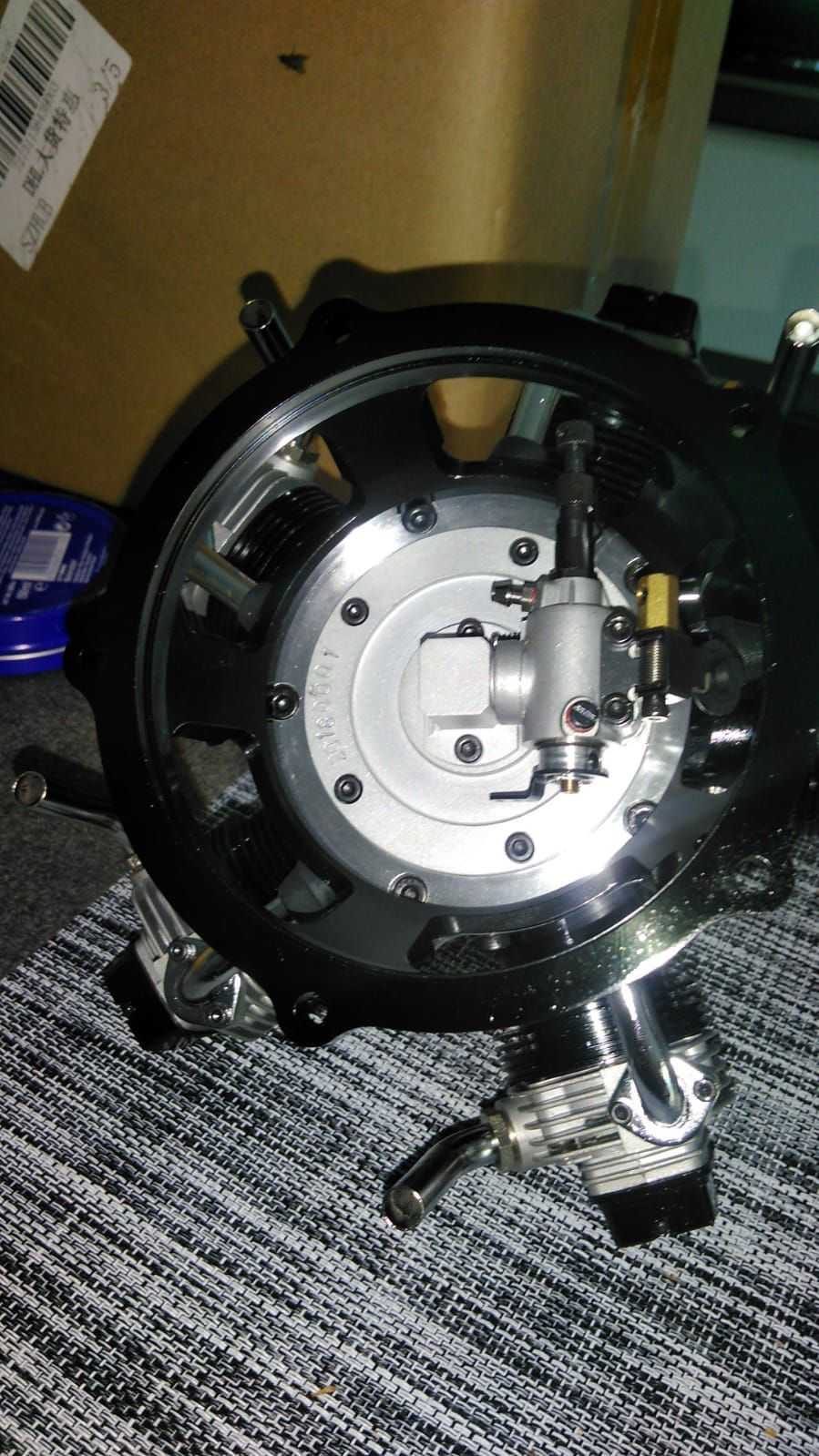
The engine is pictured here tilted roughly 30 degrees counterclockwise. In manual-prescribed mounting orientation (cyl 1 vertical upwards), the carb is below horizontal by 54 degrees
Now this elbow, and the brass ring in the first pic, THEY are the problem: the fuel/oil/air mixture directly behind the spraybar is not yet a homogeneous mix: it's air, vapour and droplets.
When that mixture has to pass the 90 degree bend, inertial forces separate this mix, air/vapour follows the change of direction but the liquid ends up at the wall opposite of where the carb is.
So that liquid does not enter the brass ring in the middle, but at the circumference, favouring 1 or 2 cylinders over the rest, And because the carb is a normal glow carb, with a laterally moving throttle barrel, the throttle position affects which cylinders exactly are favoured, because as the FT160 demonstrated, the amount of throttle opening affects WHERE exactly that liquid ends up at the wall.
What do the three tiny holes do?
When the engine is running, there is intake vacuum, IN that elbow. So air will rush in through these three holes. These holes are by the way, drilled under an approximate angle of 45 degrees, they are NOT perpendicular to the intake bore. They are also drilled parallel, not radial to the centreline of the bore.
Now, mixture comes into the elbow, passes the 90 degree direction change, and the liquid fuel/oil ends up at the wall of the bore. when that fluid passes the three bores, the inrushing air blasts that liquid back into "suspension" in the airflow. Turbulence, velocity and kinetic energy do the rest.
It is not perfect, but WAY better than what it was from the factory.
That is how it works.
MAIN reason for taking this route was that I could do this in literally 10 minutes and a 1 dollar drillbit, as opposed to sourcing large barstock Aluminium and spending days behind the lathe (I can handle myself, but am far from skilled, so it would take me ages).
But thinking about it a bit more, I arrived at a few conclusions that make me feel, the expensive commercially availlable mods are not all that desirable.
To me, the downsides of a "negative crankase pressure modification" would be:
-Oil lubricates better than "fuel dilluted oil", Although this has in other engines never presented a significant problem, it remains a fact that a negative pressure crankcase means the crankshaft and rods are lubricated with diluted oil instead of undiluted oil. Personal preference.
-Radials do not, like 2-strokes (and most fourstrokes) have a labyrinth at the crankshaft, meaning that the entire functioning of the engine becomes dependent on the quality of the forward crankshaft seal.
This splits in two, IMHO rather nasty consequences:
-If the seal starts leaking, but not yet enough to disturb normal operation, the air ingress in the front of the engine, will scavenge lubrication AWAY FROM the cam drums and associated gears. So there is a real risk of accelerated valve train wear while it will not be immediately obvious to an operator, what causes this accelerated wear.
-progressing deterioration of this seal, will cause inconsistent adjustments, again, without its cause being immediately obvious.
-A full faillure of this seal will disrupt engine operation, period.
The big deterrent for me is, replacing this forward crankshaftseal (big words for "bearing replacement" ) requires a FULL dismantling of the engine, And there are assemblies in a radial that are sensitive and pose a certain risk when dismantling: A :censored: crankshaft seal replacement should NEVER require that kind of risk.
The literal only thing that could possibly go wrong with my solution is a clogging of the holes, and that can very easily be fixed without even taking the engine off the firewall... It has zero effect on the mechanical properties of the engine at all.
Have I ever had a lack of words? On the ASP, the intake system consists of a central intake hole, and a set of spiral shaped channels. Looks like this:
Assumption on my side, but I think this is done to prevent that the lower cylinders flood with oil/fuel at standstill: there is not one single intake that has a straight downward path, so gravity cannot do its dasterdly deed,
The fuel/air mixture enters in the brass ring, which has 5 holes drilled into it.
On the outside, the carb is fitted with a 90 degree elbow, and oriented such that when the engine is mounted according instructions, the intake mouth points down.
Again an assumption on my side, but I think this also is done to prevent any fuel possibly syphoning, to run out, instead of into the engine flooding it.
The engine is pictured here tilted roughly 30 degrees counterclockwise. In manual-prescribed mounting orientation (cyl 1 vertical upwards), the carb is below horizontal by 54 degrees
Now this elbow, and the brass ring in the first pic, THEY are the problem: the fuel/oil/air mixture directly behind the spraybar is not yet a homogeneous mix: it's air, vapour and droplets.
When that mixture has to pass the 90 degree bend, inertial forces separate this mix, air/vapour follows the change of direction but the liquid ends up at the wall opposite of where the carb is.
So that liquid does not enter the brass ring in the middle, but at the circumference, favouring 1 or 2 cylinders over the rest, And because the carb is a normal glow carb, with a laterally moving throttle barrel, the throttle position affects which cylinders exactly are favoured, because as the FT160 demonstrated, the amount of throttle opening affects WHERE exactly that liquid ends up at the wall.
What do the three tiny holes do?
When the engine is running, there is intake vacuum, IN that elbow. So air will rush in through these three holes. These holes are by the way, drilled under an approximate angle of 45 degrees, they are NOT perpendicular to the intake bore. They are also drilled parallel, not radial to the centreline of the bore.
Now, mixture comes into the elbow, passes the 90 degree direction change, and the liquid fuel/oil ends up at the wall of the bore. when that fluid passes the three bores, the inrushing air blasts that liquid back into "suspension" in the airflow. Turbulence, velocity and kinetic energy do the rest.
It is not perfect, but WAY better than what it was from the factory.
That is how it works.
MAIN reason for taking this route was that I could do this in literally 10 minutes and a 1 dollar drillbit, as opposed to sourcing large barstock Aluminium and spending days behind the lathe (I can handle myself, but am far from skilled, so it would take me ages).
But thinking about it a bit more, I arrived at a few conclusions that make me feel, the expensive commercially availlable mods are not all that desirable.
To me, the downsides of a "negative crankase pressure modification" would be:
-Oil lubricates better than "fuel dilluted oil", Although this has in other engines never presented a significant problem, it remains a fact that a negative pressure crankcase means the crankshaft and rods are lubricated with diluted oil instead of undiluted oil. Personal preference.
-Radials do not, like 2-strokes (and most fourstrokes) have a labyrinth at the crankshaft, meaning that the entire functioning of the engine becomes dependent on the quality of the forward crankshaft seal.
This splits in two, IMHO rather nasty consequences:
-If the seal starts leaking, but not yet enough to disturb normal operation, the air ingress in the front of the engine, will scavenge lubrication AWAY FROM the cam drums and associated gears. So there is a real risk of accelerated valve train wear while it will not be immediately obvious to an operator, what causes this accelerated wear.
-progressing deterioration of this seal, will cause inconsistent adjustments, again, without its cause being immediately obvious.
-A full faillure of this seal will disrupt engine operation, period.
The big deterrent for me is, replacing this forward crankshaftseal (big words for "bearing replacement"
) requires a FULL dismantling of the engine, And there are assemblies in a radial that are sensitive and pose a certain risk when dismantling: A :censored: crankshaft seal replacement should NEVER require that kind of risk.The literal only thing that could possibly go wrong with my solution is a clogging of the holes, and that can very easily be fixed without even taking the engine off the firewall... It has zero effect on the mechanical properties of the engine at all.
Last edited by 1967brutus; 03-08-2023 at 03:09 AM.
03-08-2023 | 12:28 AM
#1407
Ive noticed on my saito fg19r3 to get a nice idle you have to lean the low speed a fair bit but once you get to mid range its lean..so to have good mid range its stuck with rich idle ..maybe bert designed those holes to lean the idle mix then once up in mid range velocity overcomes those small holes ..just an idea,could fit a fuel nipple to that manifold and fit a needle vave from a os 46la or similar to adjust the air bleed ..would act similar to an airbleed maybe..
im not a professional..its just a thought!!
im not a professional..its just a thought!!
Basically, it is impossible to get an EXACT equal fuel distribution to all cylinders, and this distribution is influenced by many factors, in other words, it is most likely not the same at every RPM. As long as these imbalance is within a certain range, this is no big deal, after all, nothing is "perfect", right?
Fuel/air ratio determines ignitability of the fresh charge, and this is what we adjust with the needles. In a single cylinder, things are obvious: too lean is too lean and too rich is too rich. Not so in a multi: Leaning out, ONE cylinder gets too lean, making the entire engine appear lean, while in reality total average fuel/air ratio could very well be on the rich side. Fattening up that single carb, could very well make ONE cylinder (another one, no doubt) too rich, making the entire engine appear rich,
Usually, distribution is most equal at full throttle (not "perfect", because nothing is, but "most good")
Now what happens when for example at idle cylinder 1 is getting significantly too rich (so you lean out the entire engine at idle to make it run better), but at midrange and higher things even out? Then the engine tends to run lean at midrange at at least ONE cylinder, and again, that makes the entire engine appear to be lean. So you set the LS needle a bit fatter to have a good midrange, and you're back to that rich idle.
And all the while, it is very possible and even very likely, that the "total average" fuel/air ratio is within acceptable limits throughout the entire rev range. The engine is running, after all, isn't it? So at least SOME cylinders should receive an acceptable mixture.
The carb might therefore very well have an overall good fuel linearity, but if the fuel is not equally distributed, the engine is never going to run really well.
So efforts to keep that mixture distributed as evenly as possible, will improve running on ANY multicylinder engine.
The holes only are an attempt to keep the fuel suspended in the intake airstream as good as possible, making fuel distribution as equal as I can get it. They do not serve to correct rich or lean spots. But they definitely have an effect AS IF they correct rich or lean spots. Because the rich and lean spots you observed, are only "apparent", they are not real as far as the carb is concerned, they are caused by unequal fuel distribution. They are NOT an airbleed, and are NOT tunable, because that is not their purpose. Their total cross section as well as their effect on fuel/air ratio per se is negligable.
So, the holes do not serve to tweak the fuel linearity. That is the job of that electronic device that is at the base of the title of this thread. It basically makes that LS and HS needles and their correlation do not really play a role anymore. What we do is set a more or less "random but acceptable" LS setting and HS setting, and once that is done, these needles are left alone. The entire throttle range, fuel is controlled by a curve programmed in the transmitter, and basically we have for each conceivable throttle position a separate needle, in an indefinite number. I can literally set mixture independently for idle, 10% throttle, 20%, 30%, etc etc etc, all the way up to full throttle.
And when the weather changes, the ambient temperature, the barometric pressure, or even the flying altitude, this is corrected automatically.
Last edited by 1967brutus; 03-08-2023 at 03:21 AM.
 ..
03-08-2023 | 05:45 AM
..
03-08-2023 | 05:45 AM
#1409
03-08-2023 | 05:57 AM
#1410
Thanks Bert.
I've been keeping my finger on the the pulse of conversions for a few years now, glow to Methanol/CDI and Methanol to Gas. It seems that almost everyone is happier with the running characteristics of CDI, nothing new there and the benefits are more apparant on multi cylinder engines than on singles.
I'm also seeing the general multi-cylinder modelling population happier moving from Methanol/CDI to Gas, and not just because of the reduced fuel costs and easier cleanup. I suspect this is primarily due to the butterfly carb design (equal fuel distribution throughout the rpm range) and lower oil content (less oil pooling). Utilizng a rotary barrel carb, those that travel in and out to meter fuel, on a multi-cylinder engine, seems a less than optimal choice.
I've been keeping my finger on the the pulse of conversions for a few years now, glow to Methanol/CDI and Methanol to Gas. It seems that almost everyone is happier with the running characteristics of CDI, nothing new there and the benefits are more apparant on multi cylinder engines than on singles.
I'm also seeing the general multi-cylinder modelling population happier moving from Methanol/CDI to Gas, and not just because of the reduced fuel costs and easier cleanup. I suspect this is primarily due to the butterfly carb design (equal fuel distribution throughout the rpm range) and lower oil content (less oil pooling). Utilizng a rotary barrel carb, those that travel in and out to meter fuel, on a multi-cylinder engine, seems a less than optimal choice.
Last edited by Glowgeek; 03-08-2023 at 06:08 AM.
03-08-2023 | 06:06 AM
#1411
Bert ..i have read myself to sleep on this electronically converted carb system..i would like to know the module for this and give it a go on the ft160..meanwhile my damn saito fg33r3 sat for too long so had to pull the carb down for a clean..guess i should have done that when i brought the engine (second hand) ran for a short period and sat for god knows before i got it..i can put up picks yet..but i done a further mod on its intake to see if it improves running..meanwhile i hope to see this fg60r3 in the mail tomorrow.. excuse all the saito talk😁..i love/hate them its all good...cant wait to get that asp twin on the bench..oh and i checked out the fg33r3 carb..its 1mm smaller on the throttle compared to the ft160 carburettor..close enough for some testing..
03-08-2023 | 06:36 AM
#1412
Dan, don't worry about all the Saito talk, I have at least 10 planes equipped with them. 
I can't testify to how well the microcontroller/solenoid system works on Saito multi-cylinder engines but it does work well on my big Saito singles.
I can't testify to how well the microcontroller/solenoid system works on Saito multi-cylinder engines but it does work well on my big Saito singles.
03-08-2023 | 06:45 AM
#1413
Thanks Bert.
I've been keeping my finger on the the pulse of conversions for a few years now, glow to Methanol/CDI and Methanol to Gas. It seems that almost everyone is happier with the running characteristics of CDI, nothing new there and the benefits are more apparant on multi cylinder engines than on singles.
I'm also seeing the general multi-cylinder modelling population happier moving from Methanol/CDI to Gas, and not just because of the reduced fuel costs and easier cleanup. I suspect this is primarily due to the butterfly carb design (equal fuel distribution throughout the rpm range) and lower oil content (less oil pooling). Utilizng a rotary barrel carb, those that travel in and out to meter fuel, on a multi-cylinder engine, seems a less than optimal choice.
I've been keeping my finger on the the pulse of conversions for a few years now, glow to Methanol/CDI and Methanol to Gas. It seems that almost everyone is happier with the running characteristics of CDI, nothing new there and the benefits are more apparant on multi cylinder engines than on singles.
I'm also seeing the general multi-cylinder modelling population happier moving from Methanol/CDI to Gas, and not just because of the reduced fuel costs and easier cleanup. I suspect this is primarily due to the butterfly carb design (equal fuel distribution throughout the rpm range) and lower oil content (less oil pooling). Utilizng a rotary barrel carb, those that travel in and out to meter fuel, on a multi-cylinder engine, seems a less than optimal choice.
But yes, despite the "simplicity and elegance" of methanol/glow, gas and spark are the better option when it comes to reliability and smoothness. The downside is its high demands on mixture preparation. But I am convinced, especially with the way Chris is going about it, we will get closer and closer to nice and manageable solutions.
I recently had an idea for a "not-TX based" solution, but that hinges on whether I can think of a way to incorporate a throttle position sensor in that beautiful carb with integrated solenoid he designed.
The idea is to, instead of a connection to the RX, hook the driver up to tthe TPS, and the driver then has the curve stored inside. I have to still think about the user interface and the method of setting the curve, but once I have a workable idea, I can see if Hans or Dave can translate that into a working solution. There are two obstacles: One is that darned user interface that has to be workable for everybody, the other is that the TX-based set-up allows for a difference in timing between fuel and throttle, and a TPS sensor would make that impossible. And I recently ran into a situation where the possibility to have fuel preceed throttle turned out to be extremely relevant. So I am not yet there.
03-08-2023 | 06:51 AM
#1414
If you are not that handy with the tiny stuff (like me) then there is user "hmeijdam" also in this thread, who makes the drivers for me. You can ask him to make one for you, but as an alternative, I will receive a batch of 10 drivers in May, and I can set you up with to your choice a driver, a partial set (driver and housing, you source the solenoid yourself) or a full set (driver, solenoid and housing).
But as said, you'll have to wait until May then, because I first have to interrupt my life for some necessary money-earning work...
03-08-2023 | 06:54 AM
#1415
And no, there indeed is nothing wrong with talking about Saito's. In fact, due to their design with cylinder and head in one single casting, they seem more suited to gasoline conversions than most other engines (thermally less critical).
Last edited by 1967brutus; 03-08-2023 at 06:57 AM.
03-08-2023 | 01:38 PM
#1416
Hi to all..
my first time post,this thread is great to read and interesting..i have recently purchased a asp ft160 and have so far made a pickup/magnet ring from a piece of aluminialumin that i hacked and machined from a motorcycle top triple clamp..i like to utilise materials when possible!
I am waiting on the ignition system now..and i probably should get looking for a suitable magnet before the mail arrives..im now wondering what carburettor i should use..i have a saito fg21 and the carburettor fits on the ft160 manifold good.slight mod would have it mounted..i used this carb on the asp fs120 and ran perfectly....
you guys are doing some brilliant work on these engines
my first time post,this thread is great to read and interesting..i have recently purchased a asp ft160 and have so far made a pickup/magnet ring from a piece of aluminialumin that i hacked and machined from a motorcycle top triple clamp..i like to utilise materials when possible!
I am waiting on the ignition system now..and i probably should get looking for a suitable magnet before the mail arrives..im now wondering what carburettor i should use..i have a saito fg21 and the carburettor fits on the ft160 manifold good.slight mod would have it mounted..i used this carb on the asp fs120 and ran perfectly....
you guys are doing some brilliant work on these engines
Gassers handle a bit of lugging down WAY better than glow engines, in fact, they prefer it even, so that is not a problem at all..
03-08-2023 | 01:45 PM
#1417
Just a tip about the FT160 in general: Do NOT overrev it. The engine is rated for 9K but that number is pretty optimistic. Andrew White from JustEngines fame once advised me to make ABSOLUTELY sure to keep RPM below 8500 under any circumstances including flight. So prop it for around 7500~7700 (peaked) on the ground, and tune it 500 RPM rich to compensate for unloading. Is valid for the OS 160 twin just as well, since these engines basically share conrods.
Gassers handle a bit of lugging down WAY better than glow engines, in fact, they prefer it even, so that is not a problem at all..
Gassers handle a bit of lugging down WAY better than glow engines, in fact, they prefer it even, so that is not a problem at all..
 For glow maybe?
03-08-2023 | 02:00 PM
For glow maybe?
03-08-2023 | 02:00 PM
#1418
Weird thing. I tried a Pitts muffler on my converted 180, muffler pressure was barely measureable and didn't rise with rpm hardly at all. I blocked one of the two exhaust outlets, pressure rose up to approx .25 psi but same problem, no pressure rise above 1/2 throttle. I guess I'll have to restrict the one outlet until pressure comes up further. Hoping for at least .50 psi but I suspect I'll not see much of a pressure rise with rpm. There are two nipples on the muffler, one for tank pressure and I suppose the other for smoke, even though there is no nozzle that hole is located close to the exhaust port. The Pitts may not be a good candidate for this gas conversion program.
03-08-2023 | 02:22 PM
#1419
Just a tip about the FT160 in general: Do NOT overrev it. The engine is rated for 9K but that number is pretty optimistic. Andrew White from JustEngines fame once advised me to make ABSOLUTELY sure to keep RPM below 8500 under any circumstances including flight. So prop it for around 7500~7700 (peaked) on the ground, and tune it 500 RPM rich to compensate for unloading. Is valid for the OS 160 twin just as well, since these engines basically share conrods.
Gassers handle a bit of lugging down WAY better than glow engines, in fact, they prefer it even, so that is not a problem at all..
Gassers handle a bit of lugging down WAY better than glow engines, in fact, they prefer it even, so that is not a problem at all..
Well i guess i cant send pics just yet..but have me saito fg33r3 running much better today..cleaned carb last night made a mod to the manifold 3 brass tubes!! It is reliable on idle much better a little smoother through the range..
Thanks for the tip on personal operation failure 😁
03-08-2023 | 02:30 PM
#1421
Weird thing. I tried a Pitts muffler on my converted 180, muffler pressure was barely measureable and didn't rise with rpm hardly at all. I blocked one of the two exhaust outlets, pressure rose up to approx .25 psi but same problem, no pressure rise above 1/2 throttle. I guess I'll have to restrict the one outlet until pressure comes up further. Hoping for at least .50 psi but I suspect I'll not see much of a pressure rise with rpm. There are two nipples on the muffler, one for tank pressure and I suppose the other for smoke, even though there is no nozzle that hole is located close to the exhaust port. The Pitts may not be a good candidate for this gas conversion program.
What I find particularly strange is that you report a pressure rise from idle to half throttle, but no more rise after that. Virtually all of my engines have a very small pressure rise in the lower part and a much steeper increase in the 2nd half of the throttle range.
Is there also a lack of RPM rise? That could indicate either overpropping (suppressed RPM) or a too large carb throat diameter
03-08-2023 | 02:40 PM
#1422
03-08-2023 | 02:46 PM
#1423
indeed i watch the video davidsstuff boom out came a rod..i will definitely not be over reving for sure..
Well i guess i cant send pics just yet..but have me saito fg33r3 running much better today..cleaned carb last night made a mod to the manifold 3 brass tubes!! It is reliable on idle much better a little smoother through the range..
Thanks for the tip on personal operation failure 😁
Well i guess i cant send pics just yet..but have me saito fg33r3 running much better today..cleaned carb last night made a mod to the manifold 3 brass tubes!! It is reliable on idle much better a little smoother through the range..
Thanks for the tip on personal operation failure 😁
Glad to hear you got better results from that radial. Many times bringing stuff back to factory specs (or to how the designer intended it) works wonders for engine performance...
Stories I can tell you! I own my bike now for 29 years and the carb on that bike had a bad rep straight from the time it hit the showroom floor 36 years ago. Because that particular carb came from a car, and "everybody knows that bike carbs are different, right? Stupid Italians!"

For 28 years I accepted those stories and rode the bike "as is", never giving it a second thought because of all the stories and believing it would not get any better anyway, In fact the last 6 or 7 years I rode barely and the last 2 not at all even.
Last year, it refused to start, so I had no option but to take apart that carb. I cleaned all jest and air circuits, adjusted it, but what I also did was go over all imechanical parts such as the actuating lever of the accelertion pump, and that pumps orifices and buffer springs, AND I got rid of the K&N filter, open airbox and every bit of "tuning" I did over the years.
Back to all original paper filter cartridge, "restricitve" (or so I thought) full airbox, and everything nice and clean,.
Dang... All of a sudden it felt like I installed a pair of Mikuni's. Bike never rode that well, never followed the throttle that nice, and as far as I can tell, full performance is restored to manual stated specs.
03-08-2023 | 02:53 PM
#1424
one down, two to go... That is because of the difference in ignition method: Engines running on glow, ignition "timing" is determined by fuel composition, CR, plug heat value and mixture strength.
Of those four variables, only the mixture strength is "on the fly" adjustable, the other three are engine parameters.
So if you lean the mixture on a glow engine, ignition timing changes "immediately", and THAT is what you hear: the "sound" of the engine changes pretty clearly audible.
Gasoline and spark ignition, the mixture strength does not affect the timing. so the change in how the engine runs is not immediately noticable, but with the fuel, also the oil supply changes, and with the reduction in excess fuel that oil also changes in "quality" (less soot and fuel dilution). So the engines exhaust note changes much more subtle, and the change takes more time.
Setting a gasser requires a bit more patience and attention.
The following users liked this post:
Rcplanedan (03-08-2023)
03-08-2023 | 03:18 PM
#1425
3 more posts and you can add pics... You can wait until you have collected something useful to say, or you can also post 3 times "Hi there" in random threads
Glad to hear you got better results from that radial. Many times bringing stuff back to factory specs (or to how the designer intended it) works wonders for engine performance...
Stories I can tell you! I own my bike now for 29 years and the carb on that bike had a bad rep straight from the time it hit the showroom floor 36 years ago. Because that particular carb came from a car, and "everybody knows that bike carbs are different, right? Stupid Italians!"
For 28 years I accepted those stories and rode the bike "as is", never giving it a second thought because of all the stories and believing it would not get any better anyway, In fact the last 6 or 7 years I rode barely and the last 2 not at all even.
Last year, it refused to start, so I had no option but to take apart that carb. I cleaned all jest and air circuits, adjusted it, but what I also did was go over all imechanical parts such as the actuating lever of the accelertion pump, and that pumps orifices and buffer springs, AND I got rid of the K&N filter, open airbox and every bit of "tuning" I did over the years.
Back to all original paper filter cartridge, "restricitve" (or so I thought) full airbox, and everything nice and clean,.
Dang... All of a sudden it felt like I installed a pair of Mikuni's. Bike never rode that well, never followed the throttle that nice, and as far as I can tell, full performance is restored to manual stated specs.
Glad to hear you got better results from that radial. Many times bringing stuff back to factory specs (or to how the designer intended it) works wonders for engine performance...
Stories I can tell you! I own my bike now for 29 years and the carb on that bike had a bad rep straight from the time it hit the showroom floor 36 years ago. Because that particular carb came from a car, and "everybody knows that bike carbs are different, right? Stupid Italians!"
For 28 years I accepted those stories and rode the bike "as is", never giving it a second thought because of all the stories and believing it would not get any better anyway, In fact the last 6 or 7 years I rode barely and the last 2 not at all even.
Last year, it refused to start, so I had no option but to take apart that carb. I cleaned all jest and air circuits, adjusted it, but what I also did was go over all imechanical parts such as the actuating lever of the accelertion pump, and that pumps orifices and buffer springs, AND I got rid of the K&N filter, open airbox and every bit of "tuning" I did over the years.
Back to all original paper filter cartridge, "restricitve" (or so I thought) full airbox, and everything nice and clean,.
Dang... All of a sudden it felt like I installed a pair of Mikuni's. Bike never rode that well, never followed the throttle that nice, and as far as I can tell, full performance is restored to manual stated specs.
Yes the radial runs alot better, not to mention the dirty carb..and oh i found a main failure of my tank vent was kinked,fixed that so between doing all these things..its pretty happy..only when it stays idle for couple mins it will build up in the intake and take a bit to burn that out before it will rev clean..
good job for a lot of things Italian, spoked wheels on a Yamaha..its the only Yamaha with backwards spoked outter rims..actual i think it was designed in france..but has Italian made rims?? ..lol
tokk me knee,and the dogs on their 10min walk..proceeding home and theres a man at the gare with a big surprise for me..time to bring out another saito radial

