


Electronic solutions to modifying glow engines of all sizes to gasoline
 07-15-2022 | 01:26 AM
#151

What are the cost to run a 5 axis cnc each hour? Including things like writeoff, maintenance cost, lifespan cutting bits, setup and electricity.
Add a reasonable wage for the operator, cost of packing shipping, order processing.
I would be verry surpriced if the price of a carb and electronics set would be less then €250.
There are many modelers who have no problem with spending this kind of money (cough turbines...) if it makes there planes fly better.
But you are basicly looking at starting a small company.
Comercial production does not have to contradict "open source" prusa for example is quite succesfull with there printers.
There design files are avaiable but its just cheaper to buy from then then to try to make the parts yourself.
Add a reasonable wage for the operator, cost of packing shipping, order processing.
I would be verry surpriced if the price of a carb and electronics set would be less then €250.
There are many modelers who have no problem with spending this kind of money (cough turbines...) if it makes there planes fly better.
But you are basicly looking at starting a small company.
Comercial production does not have to contradict "open source" prusa for example is quite succesfull with there printers.
There design files are avaiable but its just cheaper to buy from then then to try to make the parts yourself.
The CNC lathe takes about 5 minutes, a bit more, per housing. Going by that, and a throttle body being about 25 minutes for the CNC mill. I'd say that if I had to estimate, I'd think a body would at least be about 50 Euro, and probably there would still be some small finishing jobs to be done for that money, like the threads for the fuel nipple and the holes for attachment to the motor.
The insulator sleeve most likely would be mere euro's (5 or so, they are simple pieces, the lathe spits them out dozens per hour)
the throttle barrel is probably between 10 and 15 Euro, given that it is a rather simple piece to turn but also has a cross drilled throttle bore.
That is just a very careful estimation. I could ask my friend.
I would say, if I would change the design to say four sizes (7,5 cc/.45, 10 cc/.60, 12,5 cc/.75 and 15 cc/.90) I could keep the boss a bit small and supply different insulator sleeves, but that still is a huge hassle, and then there are engines that require threaded holes in the boss (like OS and ASP) and there are engines with a pinchbolt, but also engines with grubscrews (Irvine) and some dimensions are metric while others are imperial.
I keep butting my head against the wall of the need for these things to be made to fit a particular engine and I don't know how to make it more versatile (how to ensure that the .45 size will actually be able to be fitted to ALL .45 engines, etc...)
 07-15-2022 | 05:31 AM
#152
this is how manny perry carb versions there are
One thing i have no experience with is resin 3d printing. The required accuracy is trivial for those. Its more the question of the cured part is fuel proof or not.
Have a look at this service
https://www.pcbway.com/rapid-prototyping/.
There circuit boards are good but have not used there other services yet.
07-15-2022 | 06:47 AM
#153
Have a look here: Perry Pumps - Carbs
Otherwise it is better to buy a Saito FG series.
I mean, as it is now, a conversion costs the price of an ignition and roughly 60 bucks for the valve and associated stuff. That is doable, especially if there is allready an engine.
But if one has to buy a (used???) engine, an ignition, and the price of a throttle body, solenoid and electronics, the total cost is going to approach the price of a brand new gasser, and then it becomes pointless.
Something that COULD be an option, is to make valve housings with a threaded part that would fit into where the NVA screws into the carb body. It would maintain any possible airbleed or LS needle the carb allready has (solving the issues with idle stability), it would look "nearly the same" but again: not every manufacturer uses the same thread size for the NVA, and the absence of an orifice such as Chris and Rob use still would be a possible issue...
07-15-2022 | 07:55 AM
#154
better to worry about most engines later
Its just not practical to try to make a "one size fits all" carb that is why perry has this whole range.
Best is to find out what the most likely engine is that people want to convert and start with that one.
And a carb body that has the holes for the os style screws will also fit a clamp style engine with the same hole size so there will be some overlap.
Also rembered this part https://www.justengines.co.uk/shop/c...v=d2cb7bbc0d23
it might be usefull for people who want a seperate solnoid setup.
I got 2 to repair a 20 fp carb
Best is to find out what the most likely engine is that people want to convert and start with that one.
And a carb body that has the holes for the os style screws will also fit a clamp style engine with the same hole size so there will be some overlap.
Also rembered this part https://www.justengines.co.uk/shop/c...v=d2cb7bbc0d23
it might be usefull for people who want a seperate solnoid setup.
I got 2 to repair a 20 fp carb
07-15-2022 | 08:11 AM
#155
 that might work
I Something that COULD be an option, is to make valve housings with a threaded part that would fit into where the NVA screws into the carb body. It would maintain any possible airbleed or LS needle the carb allready has (solving the issues with idle stability), it would look "nearly the same" but again: not every manufacturer uses the same thread size for the NVA, and the absence of an orifice such as Chris and Rob use still would be a possible issue...
You could even go as far to include a small screw to plug the fuel nipple hole and reuse the nipple on the solenoid holder.
O.S. appears to use the same size holder on a whole range of carbs for both plane and heli engines.
What could be done is have a 2 part holder design.
The (possible delrin? )cup that holds the solenoid would be the same for all and then pressed into that a (bronze?) tube that is made to fit the original needle holder.
Thinking of it a bit more why not reuse the needle holder too?
Make a cup design that the needle holder has a snug fit into and secure it with a setscrew from the side.
A small "O" ring inside for the holder to press against should avoid any air leaks.
Last edited by cmulder; 07-15-2022 at 08:17 AM. Reason: brainwave
07-15-2022 | 08:36 AM
#157
this needs to be tested
The needle cup holder is unlikely to get hot so a 3d printed version from PETG should work
Its a verry simple thing to test the only "mod" is to unscrew the needle and the fuel nipple.
No permanent changes to the engine at all and can be done with the engine mounted in the model for most sport planes.
This might be the way for this system to become "mainstream"
Its a verry simple thing to test the only "mod" is to unscrew the needle and the fuel nipple.
No permanent changes to the engine at all and can be done with the engine mounted in the model for most sport planes.
This might be the way for this system to become "mainstream"
07-15-2022 | 08:48 AM
#158
for a even simpler test
Anyone here who has the current version and wants to try?
Instead of conncting the fuel line from the solenoid holder to the carb fuel nipple, connect it to the (empty needle holder and put a plug on the fuel nipple.
Its a "quick and dirty" test and not suitable to fly (?) but will show if the idea works.
Instead of conncting the fuel line from the solenoid holder to the carb fuel nipple, connect it to the (empty
needle holder and put a plug on the fuel nipple.Its a "quick and dirty" test and not suitable to fly (?) but will show if the idea works.
Last edited by cmulder; 07-15-2022 at 08:51 AM.
07-15-2022 | 09:42 AM
#159
Anyone here who has the current version and wants to try?
Instead of conncting the fuel line from the solenoid holder to the carb fuel nipple, connect it to the (empty needle holder and put a plug on the fuel nipple.
Its a "quick and dirty" test and not suitable to fly (?) but will show if the idea works.
Instead of conncting the fuel line from the solenoid holder to the carb fuel nipple, connect it to the (empty
needle holder and put a plug on the fuel nipple.Its a "quick and dirty" test and not suitable to fly (?) but will show if the idea works.
The solenoid is merely an "on/off switch" for the fuel flow, but there still needs to be a tailored to the engine fuel restriction in order to make the system work. In Chris' design that is the 3D-printer nozzle that is selected to size.
In my set-up that is the HS needle, in the Stihl configuration there are restrictors in the carb, but if we take out the HS NVA and replace it with simply a solenoid, there is no such restriction.
Last edited by 1967brutus; 07-15-2022 at 09:45 AM.
07-15-2022 | 11:50 AM
#160
restrictor location?
Is there a requirement on the location of this restriction in the fuel flow?
Could it be as simple as a plug in a fuel line with a small hole drilled in it?
Could it be as simple as a plug in a fuel line with a small hole drilled in it?
07-15-2022 | 12:04 PM
#161
In theory, not, but in reality, gasoline being a volatile fuel, the restriction should be the last in line to prevent bubbles forming due to the low pressure area, and for the same reason, the solenoid should be as close as practically possible to the restriction. It is not a big difference, but it IS noticable.
07-15-2022 | 12:16 PM
#162
On request of Rob.M, first flight vid of his rendering of Chris' throttle body design.
He has, in the mean time drilled a 1,1 mm airbleed port according Chris' drawings, and reports a very much improved idle in flight: Without the airbleed hole he saw an irregular idle in flight, the airbleed hole stabilized that.
Personally, I am a bit confused by that, because Dave way back when he converted his Boxer had issues trying to use the airbleed that was OEM present in the carb of his engine, and in earlier experiments of mine, the airbleed adjustment also was problematic and that was putting it mildly. My experiments back then were pre-solenoid admittedly, but Daves tests were WITH the solenoid.
Whatever the case, to me this sounds like a pretty good running engine, and according to Rob, top RPM in level flight has remained the same (12K) but throttle response improved in that it is more accurate and predictable (and it was allready pretty good previously if you ask me).
He has, in the mean time drilled a 1,1 mm airbleed port according Chris' drawings, and reports a very much improved idle in flight: Without the airbleed hole he saw an irregular idle in flight, the airbleed hole stabilized that.
Personally, I am a bit confused by that, because Dave way back when he converted his Boxer had issues trying to use the airbleed that was OEM present in the carb of his engine, and in earlier experiments of mine, the airbleed adjustment also was problematic and that was putting it mildly. My experiments back then were pre-solenoid admittedly, but Daves tests were WITH the solenoid.
Whatever the case, to me this sounds like a pretty good running engine, and according to Rob, top RPM in level flight has remained the same (12K) but throttle response improved in that it is more accurate and predictable (and it was allready pretty good previously if you ask me).
07-15-2022 | 12:26 PM
#163
what about?
In theory, not, but in reality, gasoline being a volatile fuel, the restriction should be the last in line to prevent bubbles forming due to the low pressure area, and for the same reason, the solenoid should be as close as practically possible to the restriction. It is not a big difference, but it IS noticable.
Also in setups where the solenoid is external from the carb just plugging the hole where the needle holder used to be might work too.
Then just use the original fuel nipple and possbly install the restriction disk under that.
Not having a needle stick out will make the carb much less vulnerable to crash damage like the os la series of engines.
On the other hand the simplicety of just mounting it on the needle holder also has advantages in other situations
07-15-2022 | 12:49 PM
#164
What if there is a small plastic disk under the fuel nipple of the solenoid casing with the hole in it?
Also in setups where the solenoid is external from the carb just plugging the hole where the needle holder used to be might work too.
Then just use the original fuel nipple and possbly install the restriction disk under that.
Not having a needle stick out will make the carb much less vulnerable to crash damage like the os la series of engines.
On the other hand the simplicety of just mounting it on the needle holder also has advantages in other situations
Also in setups where the solenoid is external from the carb just plugging the hole where the needle holder used to be might work too.
Then just use the original fuel nipple and possbly install the restriction disk under that.
Not having a needle stick out will make the carb much less vulnerable to crash damage like the os la series of engines.
On the other hand the simplicety of just mounting it on the needle holder also has advantages in other situations
I am hesitantly coming to the conclusion that Chris' design for me is not feasible to have it made even in limited production. Too many variables. Very suitable for anyone with the capabilities to make one, or access to somebody that is willing to make it. Maybe Chris can do something with this, but I cannot. Not within a "reasonable amount of effort" and not for a price I would myself be willing to pay for it.
I am very sure that in time, I will have at least one of these Chris-Tech Throttle bodies (how's that for a brand and product name?
 ) and I am sure, more people will at least try and do this.
But for, just as an example, the fourstrokes, I'll probably stick with the separate solenoid housings as before. Because fourstrokes are a different animal alltogether when it comes to heat isolation of the carb, and what's worse, they near literally all have different designs for carb attachment and stuff, WAY too much trouble to redesign for every separate brand and type.
07-15-2022 | 02:00 PM
#165
cad file?
If there is a cad design then sending it to companies like pcb-way might be a option
If resin printed part are fuel-proof then that would be the easiest/ cheapest way or else have it laser sintered from metal powder like space-x does for there engines.
Once proven it more becomes a issue of building a digital libary of designs and then have a company lik pcb-way make it once there is a order for a particulair design.
If resin printed part are fuel-proof then that would be the easiest/ cheapest way or else have it laser sintered from metal powder like space-x does for there engines.
Once proven it more becomes a issue of building a digital libary of designs and then have a company lik pcb-way make it once there is a order for a particulair design.
07-15-2022 | 04:06 PM
#166


My Feedback: (1)
On request of Rob.M, first flight vid of his rendering of Chris' throttle body design.
https://www.youtube.com/watch?v=d3z5-EGyYXw
He has, in the mean time drilled a 1,1 mm airbleed port according Chris' drawings, and reports a very much improved idle in flight: Without the airbleed hole he saw an irregular idle in flight, the airbleed hole stabilized that.
Personally, I am a bit confused by that, because Dave way back when he converted his Boxer had issues trying to use the airbleed that was OEM present in the carb of his engine, and in earlier experiments of mine, the airbleed adjustment also was problematic and that was putting it mildly. My experiments back then were pre-solenoid admittedly, but Daves tests were WITH the solenoid.
Whatever the case, to me this sounds like a pretty good running engine, and according to Rob, top RPM in level flight has remained the same (12K) but throttle response improved in that it is more accurate and predictable (and it was allready pretty good previously if you ask me).
https://www.youtube.com/watch?v=d3z5-EGyYXw
He has, in the mean time drilled a 1,1 mm airbleed port according Chris' drawings, and reports a very much improved idle in flight: Without the airbleed hole he saw an irregular idle in flight, the airbleed hole stabilized that.
Personally, I am a bit confused by that, because Dave way back when he converted his Boxer had issues trying to use the airbleed that was OEM present in the carb of his engine, and in earlier experiments of mine, the airbleed adjustment also was problematic and that was putting it mildly. My experiments back then were pre-solenoid admittedly, but Daves tests were WITH the solenoid.
Whatever the case, to me this sounds like a pretty good running engine, and according to Rob, top RPM in level flight has remained the same (12K) but throttle response improved in that it is more accurate and predictable (and it was allready pretty good previously if you ask me).
I am glad Rob reports improvement with the Air bleed - I think the success with this is simply a function of bringing the idle pulse width back into a better range for consistent metering...
Is Rob on a Hans or Dave controller?
On the Carb production - I think this would be a tough Game to get into with all the variables - I built custom rotor heads for mikado helis for a while and it was a very time consuming process that ate up a lot of hobby time. The limited production is an issue as it falls in that gap between a pure custom (we need too many) and a mass produced piece (we don't need this many) - When the busy summer is over I can probably do up some custom ones for Bert and others to play with to "advance" the tech. Its really not a complicated piece but still the issue would be the custom "fits and adapters" needed for so many engines.
07-15-2022 | 06:24 PM
#167

On request of Rob.M, first flight vid of his rendering of Chris' throttle body design.
https://www.youtube.com/watch?v=d3z5-EGyYXw
He has, in the mean time drilled a 1,1 mm airbleed port according Chris' drawings, and reports a very much improved idle in flight: Without the airbleed hole he saw an irregular idle in flight, the airbleed hole stabilized that.
Personally, I am a bit confused by that, because Dave way back when he converted his Boxer had issues trying to use the airbleed that was OEM present in the carb of his engine, and in earlier experiments of mine, the airbleed adjustment also was problematic and that was putting it mildly. My experiments back then were pre-solenoid admittedly, but Daves tests were WITH the solenoid.
Whatever the case, to me this sounds like a pretty good running engine, and according to Rob, top RPM in level flight has remained the same (12K) but throttle response improved in that it is more accurate and predictable (and it was allready pretty good previously if you ask me).
https://www.youtube.com/watch?v=d3z5-EGyYXw
He has, in the mean time drilled a 1,1 mm airbleed port according Chris' drawings, and reports a very much improved idle in flight: Without the airbleed hole he saw an irregular idle in flight, the airbleed hole stabilized that.
Personally, I am a bit confused by that, because Dave way back when he converted his Boxer had issues trying to use the airbleed that was OEM present in the carb of his engine, and in earlier experiments of mine, the airbleed adjustment also was problematic and that was putting it mildly. My experiments back then were pre-solenoid admittedly, but Daves tests were WITH the solenoid.
Whatever the case, to me this sounds like a pretty good running engine, and according to Rob, top RPM in level flight has remained the same (12K) but throttle response improved in that it is more accurate and predictable (and it was allready pretty good previously if you ask me).
That doesn't run half bad though, you don't see glow engines run much better than that, not at out field, with the majority pilots being misfits, and not really putting a whole lot of effort into tuning their engines. Their aircraft's look like they've been dragged behind the car in transport, real patch work quilts.
 07-15-2022 | 10:47 PM
#169
On the Carb production - I think this would be a tough Game to get into with all the variables - I built custom rotor heads for mikado helis for a while and it was a very time consuming process that ate up a lot of hobby time. The limited production is an issue as it falls in that gap between a pure custom (we need too many) and a mass produced piece (we don't need this many) - When the busy summer is over I can probably do up some custom ones for Bert and others to play with to "advance" the tech. Its really not a complicated piece but still the issue would be the custom "fits and adapters" needed for so many engines.
Typically, this is where an engine manufacture could step in, and either start building engines in "solenoid version", be it with or without solenoid. or sell optional solenoid carbs. But I doubt it would sell...
07-16-2022 | 09:57 AM
#170
You know Bert, you have the right Idea with the solenoid valve being grafted onto an existing carbs. That would be for the average flyer that wants to get their engine converted over to running on gas. and for the individual setup with machine equipment to make their own throttle body, most likely those individuals like Cat1 have the aptitude and skill to do so.
If you could come up with means of attaching the solenoid to the main needle threaded portion, that would work. you could have the threaded portion with a taper that replaces the main needle, and the entire solenoid housing can be turned / rotated to trim the fuel mixture while setting up the mixture curve. could be either a straight in threaded housing, or possibly a 90 degree so it fits inside the cowling.
And those Perry carbs could work out well due to the composite carb body, which makes a good thermal insulator. there's plenty of Perry carbs models available to fit most glow engines. Of course you wouldn't have to provide the carb in the kit, just the information, and the basic essentials, like you're doing now, and let the enduser acquire the carb as needed.
If you could come up with means of attaching the solenoid to the main needle threaded portion, that would work. you could have the threaded portion with a taper that replaces the main needle, and the entire solenoid housing can be turned / rotated to trim the fuel mixture while setting up the mixture curve. could be either a straight in threaded housing, or possibly a 90 degree so it fits inside the cowling.
And those Perry carbs could work out well due to the composite carb body, which makes a good thermal insulator. there's plenty of Perry carbs models available to fit most glow engines. Of course you wouldn't have to provide the carb in the kit, just the information, and the basic essentials, like you're doing now, and let the enduser acquire the carb as needed.
Last edited by John_M_; 07-16-2022 at 10:09 AM.
07-16-2022 | 08:30 PM
#173
My Feedback: (1)
Idea time
OK.. was trying to think of a way to make a throttle body that is adaptable to a wider range of displacement. That triggered a memory of the Martin (M&H) carb that used a unique arrangement that offered what is essential a variable Venturi. The original had a complex system of fuel passage to regulate fuel supply but I think it adapts well to having a solenoid stuck on its head. Three parts - solenoid mount/fuel nozzle - Body and rotating "plug" valve. The plug moves up and down using an angles slotted path for its actuating arm.
might be a winter project this year... I don't think it solves the problem of making these for general consumption but I think it looks cool
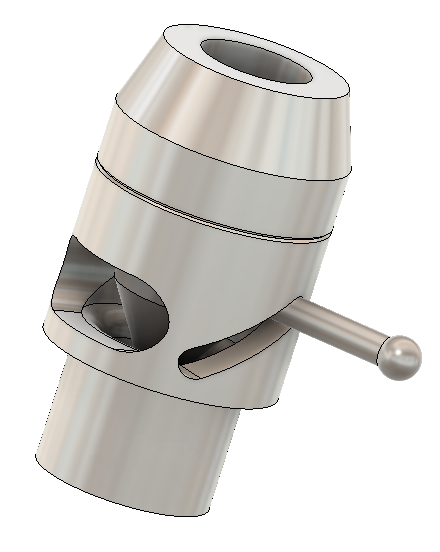


might be a winter project this year... I don't think it solves the problem of making these for general consumption but I think it looks cool
07-17-2022 | 01:51 AM
#174
Yup... Had a bit of a "now or never" moment.... Couldn't control myself. Going to be a heck of a project, because this is one engine that NOT AT ALL is designed for practical use (it is claimed to be able to put out 4 HP on glowfuel, which MIGHT theoretically be possible, but the cooling system is absolutely not up to it, and there are a few other things i want to change like the lubrication of the top-deck) and getting an ignition for this also is going to be a horribly pricey affair as there is nothing on the market which means 2 fourcylinder units combined.
And then the gasser conversion....
But I like the challenge...
Bit curious what the pumper carbs turn out to be and if they are going to be gasoline resistant or maybe I have to make something entirely of my own design.
Back in the day, I spent hours trying to figure out if this design could be modified to use gasoline (pre-solenoid days).
Never thought about how it might work with the solenoid incorporated.... Interesting new light on things....
And then the gasser conversion....
But I like the challenge...
Bit curious what the pumper carbs turn out to be and if they are going to be gasoline resistant or maybe I have to make something entirely of my own design.
OK.. was trying to think of a way to make a throttle body that is adaptable to a wider range of displacement. That triggered a memory of the Martin (M&H) carb that used a unique arrangement that offered what is essential a variable Venturi. The original had a complex system of fuel passage to regulate fuel supply but I think it adapts well to having a solenoid stuck on its head. Three parts - solenoid mount/fuel nozzle - Body and rotating "plug" valve. The plug moves up and down using an angles slotted path for its actuating arm.
might be a winter project this year... I don't think it solves the problem of making these for general consumption but I think it looks cool
might be a winter project this year... I don't think it solves the problem of making these for general consumption but I think it looks cool
Never thought about how it might work with the solenoid incorporated.... Interesting new light on things....
07-17-2022 | 02:53 AM
#175
Bert you bought one of those Toyan V8 engines, at least the crank mains are supported properly on that design, crank lips seals even. What are you going to use it in, boat, car,?
Thats a pretty neat idea Cat, certainly keeps it compact, definitely worth the effort..
Thats a pretty neat idea Cat, certainly keeps it compact, definitely worth the effort..

