


Need help tuning
 05-30-2014 | 10:08 AM
#1
Thread Starter
Senior Member
My Feedback: (2)
Joined: Jan 2004
Posts: 636
Likes: 0
Received 0 Likes
on
0 Posts
From: Helena,
MT
 Need help tuning
All right, first I know how to use the search function but after searching the everything diesel forum for "tuning" I have come up short after 5 hours of reading. If you look for how to tune a glow engine you will find 100 ways of doing it. I have found almost nothing that describes in detail on how to tune a diesel engine. Most threads are just talking about when you figure it out it will be easy, well I need some instructions on how to figure it out.
Is there a thread or link someone can point me in the right direction? The things I have figured out is you can either increase or decrease compression to start the engine. You turn the comp screw in or out after the engine starts. And you richen or lean the carb to get it to sound right. Now that is a bit confusing because you have a 50 - 50 % chance to get anything right.
Lets say I have just attached a conversion head to the engine and have the comp. screw all the way out. I have primed the engine and flipped the prop and keep increasing comp until it pops and starts for a second on the prime. Where do I go from here?
Thanks for any help that can be offered.
Is there a thread or link someone can point me in the right direction? The things I have figured out is you can either increase or decrease compression to start the engine. You turn the comp screw in or out after the engine starts. And you richen or lean the carb to get it to sound right. Now that is a bit confusing because you have a 50 - 50 % chance to get anything right.
Lets say I have just attached a conversion head to the engine and have the comp. screw all the way out. I have primed the engine and flipped the prop and keep increasing comp until it pops and starts for a second on the prime. Where do I go from here?
Thanks for any help that can be offered.
 05-31-2014 | 12:07 AM
#3

A good fuel is very important. I would recommend that you buy commercial fuel at first and only make your own once you get the hang of it, and get to know your engine.
With experience you will know how to tune it, each engine will also have its own little quirks, but that's the charm of it all. In principle a cold engine needs a little higher compression ratio to start, so once it is running the compression should be lowered. This is usually about 1/4 to 1/2 turn, and that will be the final compression setting. Don't worry if it misses a little, it will usually not stop running.
Once up to operating temperature you can find the correct settings by going from rich towards a leaner setting. Turn the needle in a little, if the engine picks up speed you are on the right track. If it picks up speed and starts to miss, then increase compression setting a little too. You can find the highest rpm as a function of compression setting but this should then be lowered to stay on the lower side (in terms of compression) of that setting. Make your compression settings at full throttle, the low end might then miss a little but that is not any real problem.
Set the low end needle for a good throttle response, not too rich. The low end can be set so that it misses a little, this makes sure that the compression ration is not too high. When the throttle is advances you get a very quick response this way too. While if the compression is too high, or the low end is too rich, it will hesitate.
With experience you will know how to tune it, each engine will also have its own little quirks, but that's the charm of it all. In principle a cold engine needs a little higher compression ratio to start, so once it is running the compression should be lowered. This is usually about 1/4 to 1/2 turn, and that will be the final compression setting. Don't worry if it misses a little, it will usually not stop running.
Once up to operating temperature you can find the correct settings by going from rich towards a leaner setting. Turn the needle in a little, if the engine picks up speed you are on the right track. If it picks up speed and starts to miss, then increase compression setting a little too. You can find the highest rpm as a function of compression setting but this should then be lowered to stay on the lower side (in terms of compression) of that setting. Make your compression settings at full throttle, the low end might then miss a little but that is not any real problem.
Set the low end needle for a good throttle response, not too rich. The low end can be set so that it misses a little, this makes sure that the compression ration is not too high. When the throttle is advances you get a very quick response this way too. While if the compression is too high, or the low end is too rich, it will hesitate.
Last edited by Mr Cox; 05-31-2014 at 12:10 AM.
05-31-2014 | 05:02 PM
#4

Joined: Jun 2008
Posts: 345
Likes: 0
Received 0 Likes
on
0 Posts
From: Christchurch, NEW ZEALAND
Flyby,
Just replied in your other thread, then found that Mr Cox said the same thing much more succinctly here.
Hopefully between the Davis instructions, Mr Cox, and me you have enough to go on.
Good luck
Dave H
Just replied in your other thread, then found that Mr Cox said the same thing much more succinctly here.
Hopefully between the Davis instructions, Mr Cox, and me you have enough to go on.
Good luck
Dave H
06-02-2014 | 06:54 AM
#5
Thread Starter
Senior Member
My Feedback: (2)
Joined: Jan 2004
Posts: 636
Likes: 0
Received 0 Likes
on
0 Posts
From: Helena,
MT
Thanks for all the help so far guys. What does it mean when the engine starts to surge? This happens when I am leaning out the needle valve and then the engine will surge ( rev die rev die ...) What should I do at this point? Do I increase the compression slightly, or just richen the needle a little? Is this the "Brrr Brrr Brrr" sound you were talking about in the other post Dave?
06-02-2014 | 07:43 AM
#6
This happens when the engine is a little lean for the compression setting used, or the compression setting is low for the given fuel setting, depending on how you see it. Overcompression is very hard on the engine and should always be avoided, so a few misses at low revs just shows that you are not overcompressed. It should not miss at full throttle though.
Here is a little video to show what happens when the compression setting is a little low and the low end a little lean. It is not really any problem and it does provide a very quick throttle response.
https://www.youtube.com/watch?v=hlaPw71z9Mk
Here is a little video to show what happens when the compression setting is a little low and the low end a little lean. It is not really any problem and it does provide a very quick throttle response.
https://www.youtube.com/watch?v=hlaPw71z9Mk
06-02-2014 | 10:07 AM
#8
Thanks for all the help so far guys. What does it mean when the engine starts to surge? This happens when I am leaning out the needle valve and then the engine will surge ( rev die rev die ...) What should I do at this point? Do I increase the compression slightly, or just richen the needle a little? Is this the "Brrr Brrr Brrr" sound you were talking about in the other post Dave?
Of course these are full throttle adjustments. Low throttle depends on your carb.
George
06-02-2014 | 02:59 PM
#9
Joined: Jun 2008
Posts: 345
Likes: 0
Received 0 Likes
on
0 Posts
From: Christchurch, NEW ZEALAND
Thanks for all the help so far guys. What does it mean when the engine starts to surge? This happens when I am leaning out the needle valve and then the engine will surge ( rev die rev die ...) What should I do at this point? Do I increase the compression slightly, or just richen the needle a little? Is this the "Brrr Brrr Brrr" sound you were talking about in the other post Dave?
If you are looking for maximum power you would bring the compression up, until the engine just smoothes out. You can then lean a bit more until you get the surge again, then increase compression until just smooth.
Keep doing this until you get the leanest possible setting which will be max power. You may want to fly with a richer setting than this though (remember to back off the compression first before you richen up though).
Maximum power is with the leanest possible needle and just enough compression to prevent the surging or maybe just a little more compression. Too much compression and the engine will 'go hard', slow down, knock, sound 'metallic', and/or overheat. Back off compression immediately then richen in this case.
When you are ready to fly set a slightly rich needle and just enough compression to prevent the surge. When the propellor unloads in the air it might start surging again. You can try a little more compression to prevent this but remember the symptoms of over compression. If the engine over compresses in the air be ready to throttle back, land, and readjust.
You can hear the slight miss (surging) in Mr Cox's video when he throttles back.
Dave H
Last edited by gerryndennis; 06-02-2014 at 03:02 PM.
06-03-2014 | 07:22 AM
#10
Thread Starter
Senior Member
My Feedback: (2)
Joined: Jan 2004
Posts: 636
Likes: 0
Received 0 Likes
on
0 Posts
From: Helena,
MT
I thought I was almost there last night but then had another setback. I redesigned my contra piston to use a silicone ring like the one in the picture. I made my silicone ring a very tight compressive fit and used a tapered sleeve I made to press it into the contra cylinder. I started it up and as I was tightening the compression, I went from about 4000 rpm to 8000 all at once and the loud metal clanking went away. I thought great and then just when I thought I was getting somewhere, I ran out of fuel in the tank. I have only been putting a small amount in the tank in case my testing was cut short. I refueled and fired it up again and could never get it back to where it was originally. After I ran out of the fuel I mixed up, I removed the head and inspected the inside. To my surprise half of the lower flange of the contra was cracked and pushed down into the cylinder. The lower tip of the contra had put a small mark into the piston top. I think I may have had too tight of a seal with the silicone ring that forced the lip to break off and push into the cylinder.
Anyway, I am going to give it one more try and make the silicone seal a little looser, if I can’t get it to run right, I might have to give this up and go back to glow.
I was reading some other diesel info and thought that maybe I was under propped and having to over compress to get it to smooth out. I have a 15x5 wood prop on it now. The engine is a os 91 fx.
I know that buying commercial fuel would eliminate the variable that my fuel may not be right but I really don’t want to spend that kind of money getting into this if the engine itself won’t work. The cheapest I can purchase Diesel Power for is $23.00 from tower hobbies for one quart and that’s only 2.6 tanks of fuel. My price on 15% nitro is only $18.00 gallon (10.6 tanks) right now and even if I get four times the fuel economy with the diesel, I am still losing money with it.
I have enough ether to mix up about 14 more ounces of fuel at a rate of 25% ether, 25% oil, 50% kero/heptane.
Anyway, I am going to give it one more try and make the silicone seal a little looser, if I can’t get it to run right, I might have to give this up and go back to glow.
I was reading some other diesel info and thought that maybe I was under propped and having to over compress to get it to smooth out. I have a 15x5 wood prop on it now. The engine is a os 91 fx.
I know that buying commercial fuel would eliminate the variable that my fuel may not be right but I really don’t want to spend that kind of money getting into this if the engine itself won’t work. The cheapest I can purchase Diesel Power for is $23.00 from tower hobbies for one quart and that’s only 2.6 tanks of fuel. My price on 15% nitro is only $18.00 gallon (10.6 tanks) right now and even if I get four times the fuel economy with the diesel, I am still losing money with it.
I have enough ether to mix up about 14 more ounces of fuel at a rate of 25% ether, 25% oil, 50% kero/heptane.
06-03-2014 | 09:53 AM
#11
I didn't quite get what was broken, but it sounds like you might have hollowed out the counter piston too much?
If it is aluminium it can be made solid or close to it, the extra weight would not be noticeable.
25% ether is a little low, you need closer to 35%. 25% with all castor oil should be fine and the rest kero, preferably there should be some ignition improver too. It is the ignition improver and high ether contents that keeps the compression level low enough to avoid damages to the engine. The compression ratio only needs to be slightly higher compared to glow fuel.
I don't have any such large engines myself, so I cannot comment on the prop size, other than that it is good to aim for max revs of around 10krpm. A higher load is not a problem but a smaller prop will increase the load and wear on the engine.
If it is aluminium it can be made solid or close to it, the extra weight would not be noticeable.
25% ether is a little low, you need closer to 35%. 25% with all castor oil should be fine and the rest kero, preferably there should be some ignition improver too. It is the ignition improver and high ether contents that keeps the compression level low enough to avoid damages to the engine. The compression ratio only needs to be slightly higher compared to glow fuel.
I don't have any such large engines myself, so I cannot comment on the prop size, other than that it is good to aim for max revs of around 10krpm. A higher load is not a problem but a smaller prop will increase the load and wear on the engine.
Last edited by Mr Cox; 06-03-2014 at 09:55 AM.
06-03-2014 | 10:09 AM
#12
Flybyjohn If you are making an O Ring do NOT USE silicone glow fuel tubing it is destroyed by model diesel fuel, use gas line tubing or a black nitrile O ring from your hardware store , sounds like you are getting there just need to make a new contra martin
06-03-2014 | 10:59 AM
#13
Thread Starter
Senior Member
My Feedback: (2)
Joined: Jan 2004
Posts: 636
Likes: 0
Received 0 Likes
on
0 Posts
From: Helena,
MT
I realize the silicone is destryed by model diesel fuel however this design has been used on a mvvs 49 diesel conversion and reports are that it lasts a year of compitition use before needing replacement. I origonally found the design in this thread. http://www.rcuniverse.com/forum/ever...on-design.html
06-03-2014 | 02:12 PM
#14
Senior Member
Joined: Oct 2009
Posts: 1,346
Likes: 0
Received 5 Likes
on
5 Posts
From: SydneyNew South wales, AUSTRALIA
I realize the silicone is destryed by model diesel fuel however this design has been used on a mvvs 49 diesel conversion and reports are that it lasts a year of compitition use before needing replacement. I origonally found the design in this thread. http://www.rcuniverse.com/forum/ever...on-design.html
The design worked well in a control line stunt model and I doubt that the engine was ever used in wide open throttle mode, so he 'got away' with it.
Cracked lower flanges have been reported on before (RJL heads if I remember correctly) and probably need to be thicker if you have issues.
Last edited by Recycled Flyer; 06-03-2014 at 02:18 PM.
06-04-2014 | 04:24 AM
#16
Thread Starter
Senior Member
My Feedback: (2)
Joined: Jan 2004
Posts: 636
Likes: 0
Received 0 Likes
on
0 Posts
From: Helena,
MT
No, just don't have any viton orings local so would have to order them. I have hundreds of rubber butile orings in my garage but I didn't think they would stand up to the heat. I just saw that mvvs .49 design using the silicone orings and it was suggested I try it a couple years ago when I was looking into building a head and so I thought I would try it. The one I removed, although it was only run a total of 5 minutes, didn't show any signs of change from when I put it in. With the cracked lower flange, the silicone was exposed directly to the cylinder gasses and it looked no different than the areas that were not directly exposed.
06-04-2014 | 05:07 AM
#17
When silicone is soaked in pure diesel fuel it tends to swell up, but this a rather slow process though. It takes several hours in raw fuel.
In head a guess that the silicone is mainly exposed to oil and other fuel residues so it may well be fine for a long time. As noted it was not the seal that failed but rather the aluminium counter piston. So back to the drawing board and make a stronger counter piston, that might be all you need, plus a little more ether in the fuel...
In head a guess that the silicone is mainly exposed to oil and other fuel residues so it may well be fine for a long time. As noted it was not the seal that failed but rather the aluminium counter piston. So back to the drawing board and make a stronger counter piston, that might be all you need, plus a little more ether in the fuel...

 06-04-2014 | 12:59 PM
#19
Thread Starter
Senior Member
My Feedback: (2)
Joined: Jan 2004
Posts: 636
Likes: 0
Received 0 Likes
on
0 Posts
From: Helena,
MT
Well, I finished my new contra piston and installed it in the head and on the engine. Mixed up the rest of the fuel for the ether I had with a mix of 30% ether this time, 25% caster and 45% kero. Still don’t have DII or cetane boost to put in. How important is this to the run ability. I have run across many people talking about how you only need 25% ether and don’t need DII. Is the DII really important, and also with larger engines like the .91 I heard that they don’t need quite as much ether as the smaller ones. It sounded like the higher ether was just used to get the engine started and then they went with a much lower percent. Is this true or just experimentation?
I have some Amsoil Cetane booster coming and will try some of that. Should I start with 2% or 1.5%?
I will try and find a larger prop. I have a 14x8 and the 15x5 but nothing bigger. Not many planes in my club that are that big.
I have some Amsoil Cetane booster coming and will try some of that. Should I start with 2% or 1.5%?
I will try and find a larger prop. I have a 14x8 and the 15x5 but nothing bigger. Not many planes in my club that are that big.
06-04-2014 | 02:30 PM
#21
Thread Starter
Senior Member
My Feedback: (2)
Joined: Jan 2004
Posts: 636
Likes: 0
Received 0 Likes
on
0 Posts
From: Helena,
MT
All right. Just had a quick run with it. No Cetane boost yet but added some more load the Redneck way. Not sure just what the load is that I added but should be sufficient. I am running 30% ether , 25% caster and 45% Kero/heptane. I was able to get it to run fairly smoothly. There was a lot of what sounded like knocking until I increased compression some but then most knocking went away and was able to pull right at 7000 rpm and then could go to about 8000 rpm with a little more compression but started hearing a different knock so backed off compression till just got a miss and then leaned it just a bit to smooth it out. Could idle about 2000 rpm, probably less but didn't have a proper setup to hold the throttle well. Took the head off again and the contra was just a little tint of brown, a lot less brown than it was last time I ran it. I found that without the tension on the adjustment screw, the contra screw will back itself out while running. I will wait until I get the cetane boost in before running again. I think I might just have this figured out.
Here are some pictures of my load and the under side of the head. The mark on the piston is where the broken rim on the old contra contacted the piston.
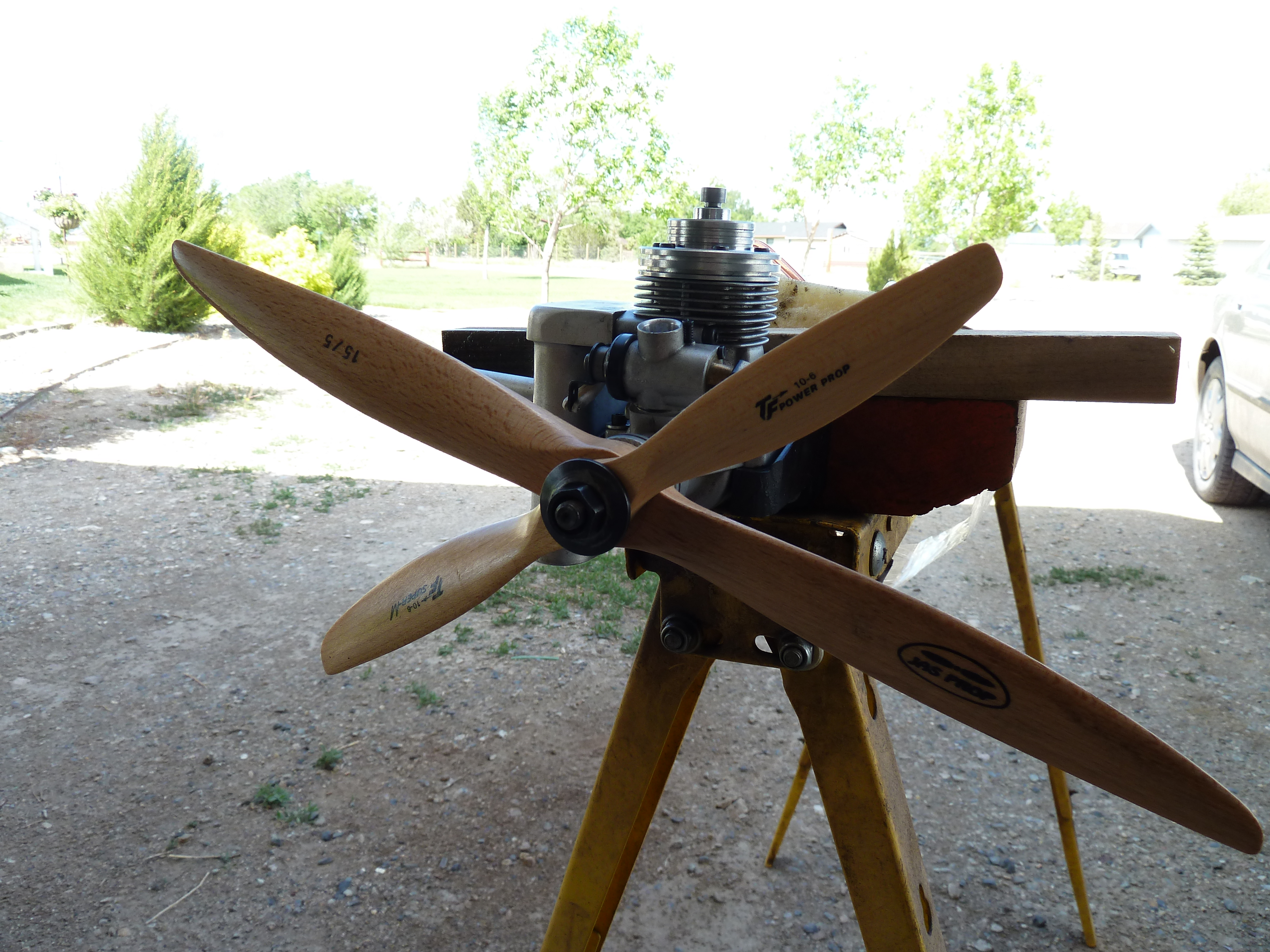
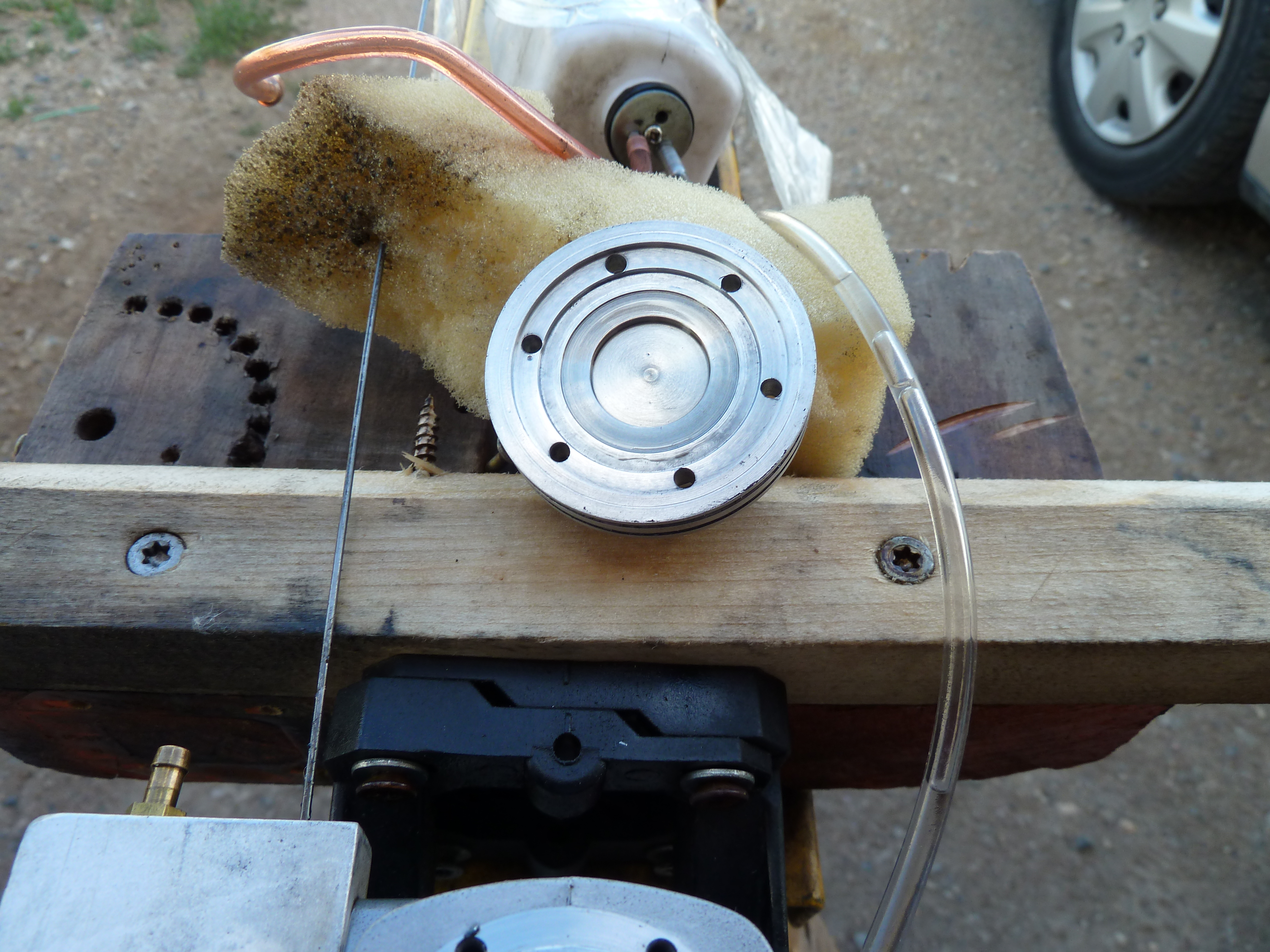
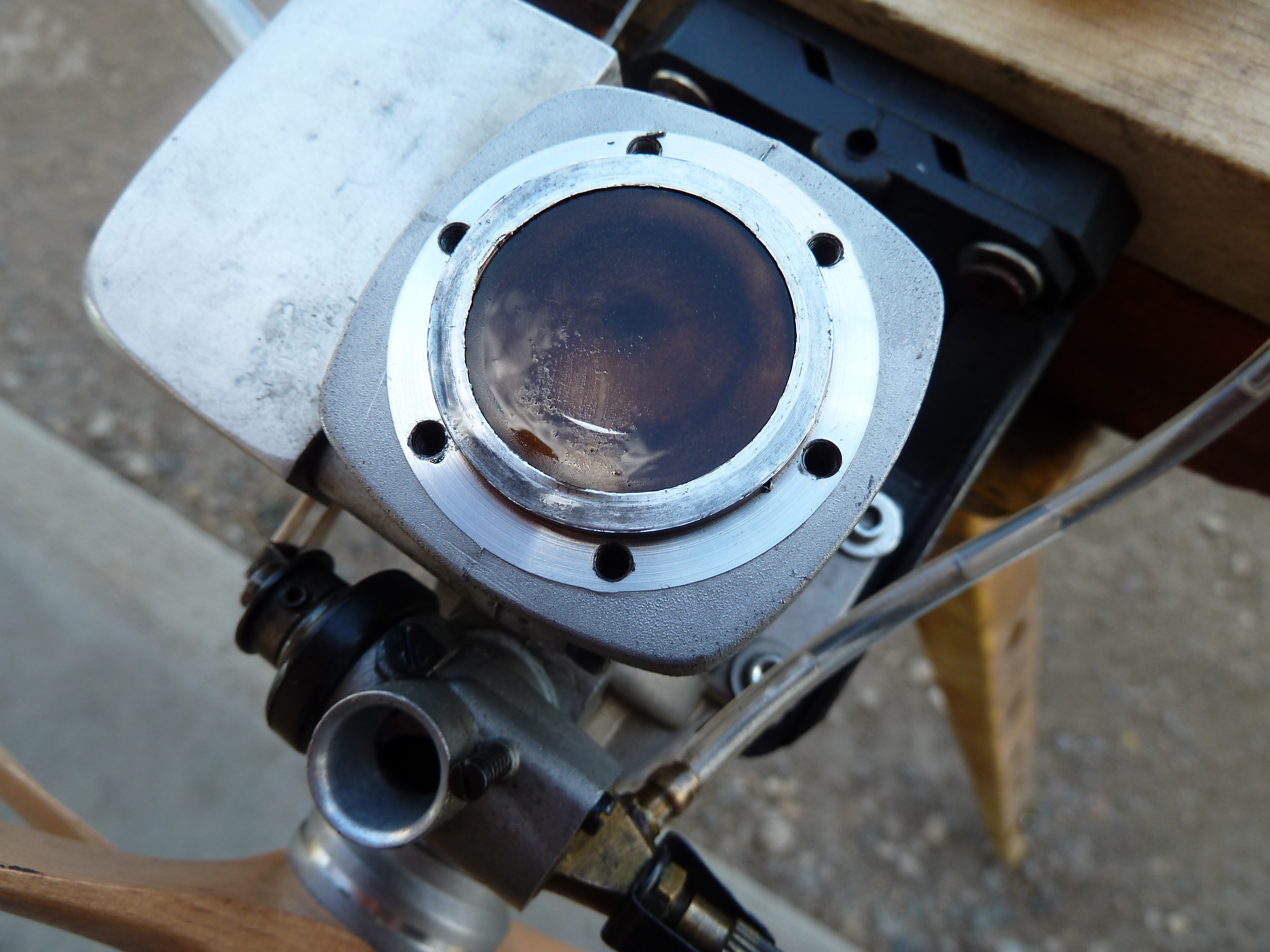
Here are some pictures of my load and the under side of the head. The mark on the piston is where the broken rim on the old contra contacted the piston.
06-04-2014 | 02:30 PM
#22
Senior Member
Joined: Oct 2009
Posts: 1,346
Likes: 0
Received 5 Likes
on
5 Posts
From: SydneyNew South wales, AUSTRALIA
Certain points to be noted with the head diagram that I got from Keith are -
1. The silicon undoubtedly will swell in contact with the fluid that it meant to seal against, so the problem is....? (There isn't one as its a benefit.)
2. It was an experimental head and although it worked well in an engine that had the boost port blocked off, fourth vestige of a port under the exhaust blocked off, a small fixed venturi designed for good fuel draw (not power), used wide blade props, and had the low timed Akrobat liner in it, it was still a work in progress and as such the length of the silicon tube could be tailored to suit unlike O rings that need far more length when doubling up for extra seal,
3. The original maker was the MVVS distributor at the time of making and the sizes in the diagrams suited the button heads 49's of old and as such may not have the ultimate dimensions all engines, and being a distributor had access to parts for tinkering that we can only dream of.
Anyway, probably best to talk to the source if you want to go further with this design.
1. The silicon undoubtedly will swell in contact with the fluid that it meant to seal against, so the problem is....? (There isn't one as its a benefit.)
2. It was an experimental head and although it worked well in an engine that had the boost port blocked off, fourth vestige of a port under the exhaust blocked off, a small fixed venturi designed for good fuel draw (not power), used wide blade props, and had the low timed Akrobat liner in it, it was still a work in progress and as such the length of the silicon tube could be tailored to suit unlike O rings that need far more length when doubling up for extra seal,
3. The original maker was the MVVS distributor at the time of making and the sizes in the diagrams suited the button heads 49's of old and as such may not have the ultimate dimensions all engines, and being a distributor had access to parts for tinkering that we can only dream of.
Anyway, probably best to talk to the source if you want to go further with this design.
Last edited by Recycled Flyer; 06-04-2014 at 02:50 PM.
06-04-2014 | 09:39 PM
#23

My Feedback: (1)
All right. Just had a quick run with it. No Cetane boost yet but added some more load the Redneck way. Not sure just what the load is that I added but should be sufficient. I am running 30% ether , 25% caster and 45% Kero/heptane. I was able to get it to run fairly smoothly. There was a lot of what sounded like knocking until I increased compression some but then most knocking went away and was able to pull right at 7000 rpm and then could go to about 8000 rpm with a little more compression but started hearing a different knock so backed off compression till just got a miss and then leaned it just a bit to smooth it out. Could idle about 2000 rpm, probably less but didn't have a proper setup to hold the throttle well. Took the head off again and the contra was just a little tint of brown, a lot less brown than it was last time I ran it. I found that without the tension on the adjustment screw, the contra screw will back itself out while running. I will wait until I get the cetane boost in before running again. I think I might just have this figured out.
Here are some pictures of my load and the under side of the head. The mark on the piston is where the broken rim on the old contra contacted the piston.
Here are some pictures of my load and the under side of the head. The mark on the piston is where the broken rim on the old contra contacted the piston.
O-Rings in Diesel heads have been around since the 1950's. The McCoy 049, and the OK 049 and 075 diesels used them along with the UK Frog 049.
They did have a bit of a problem with the lower rim of the contra breaking away.
Modern Racing diesels often use a Brass Contra within an Aluminium Alloy "head". These are rather easy to make and seal well. The Brass expands faster than the Alloy. I've only made two diesel heads, and after experimenting with O-Rings in Alloy Contra's found that plain brass contra sealed better.
Just make sure that the Contra is slightly larger by about .002" or so and heat and shrink the Alloy head on to it. It'll soon wear in to a nice snug fit so that you can move it . The surface finish on both the contra and head needs to be good. Otherwise it's foolproof.
Other materials such as Cast Iron are popular as well.
Nice job on your diesel head by the way.
Pic shows my first attempt for an OS 15 head.
Here's some more suggestions for compatable materials for heads/contra's etc.
Ray
Last edited by qazimoto; 06-04-2014 at 10:05 PM.
06-04-2014 | 09:59 PM
#24
Joined: Jun 2008
Posts: 345
Likes: 0
Received 0 Likes
on
0 Posts
From: Christchurch, NEW ZEALAND
Sounds like you are getting there,
I agree, I would have thought you can use less ether for a larger engine, but you can experiment with that later. 30% should be fine.
DII isn't absolutely required but it does make things a lot nicer. Starting is improved, you can run lower compression, and settings are less critical. I use 1% and that makes a noticeable difference, 1.5% should be fine. Amsoil is the way to go.
I'm intrigued by the 'silicon O ring', is this just a ring sliced of the end of a silicon tube? What diameter? How much is it compressed by? Do you cut a square cross section or a bit longer like a sleeve?
Well done so far,
Dave H
BTW well done on the 'redneck' prop load.
I agree, I would have thought you can use less ether for a larger engine, but you can experiment with that later. 30% should be fine.
DII isn't absolutely required but it does make things a lot nicer. Starting is improved, you can run lower compression, and settings are less critical. I use 1% and that makes a noticeable difference, 1.5% should be fine. Amsoil is the way to go.
I'm intrigued by the 'silicon O ring', is this just a ring sliced of the end of a silicon tube? What diameter? How much is it compressed by? Do you cut a square cross section or a bit longer like a sleeve?
Well done so far,
Dave H
BTW well done on the 'redneck' prop load.
Last edited by gerryndennis; 06-04-2014 at 10:05 PM.
06-04-2014 | 11:54 PM
#25
Senior Member
Joined: Oct 2009
Posts: 1,346
Likes: 0
Received 5 Likes
on
5 Posts
From: SydneyNew South wales, AUSTRALIA
Much of it is on the linked diagram -
Silicon band - 8mm OD
5mm ID
3mm hieght
Guessing it sits around a 12mm OD contra.
No details about the bore in the head except for the suggestion that it could be 12.01mm
Silicon band - 8mm OD
5mm ID
3mm hieght
Guessing it sits around a 12mm OD contra.
No details about the bore in the head except for the suggestion that it could be 12.01mm
Last edited by Recycled Flyer; 06-05-2014 at 12:06 AM.

