


Test Stand
 03-22-2012 | 03:56 PM
#1
Thread Starter
Senior Member
Joined: Aug 2009
Posts: 420
Likes: 0
Received 0 Likes
on
0 Posts
From: Gunton, MB, CANADA
 Test Stand
Hey folks. I am looking for ideas ( and photos) of test stands that others have built, for breaking in new engines. I have a new .46, a Saito FA100 and will have two more for the Twinstar that will come soon. I am thinking of 1/4 " Aluminum, as I started off my working life as a Machinist, and have access to a milling machine. I would also like to clamp it into the B&D Workmate.
P.S. Can I make this one size fits all? I know I will have to drill and tap for different engine mounts.
Any help would be greatly appreciated.
Kevin
P.S. Can I make this one size fits all? I know I will have to drill and tap for different engine mounts.
Any help would be greatly appreciated.
Kevin
 03-22-2012 | 04:10 PM
#2
Senior Member
Joined: Apr 2005
Posts: 1,680
Likes: 0
Received 0 Likes
on
0 Posts
From: goolwasa, AUSTRALIA
RE: Test Stand
Howdy just copy the P.S.P. ones , they look pretty good . Opps I mean dont copy the P.S.P. ones thats naughty . My bad from the pope. Its a wonder they havent been copied before , and before anyone gets all worked up Im about to get one But if I had a mill , well !!!!!!!!!!!!!!!
 03-22-2012 | 04:30 PM
#4


My Feedback: (16)
RE: Test Stand
Most stands just clamp the engine mount lugs and you do not have to drill holes for each engine.
However, most .40 through .55 glow engines have the same bolt spacing.
The Saito 1.00 and OS .91 have the same common spacing for larger four strokes this size.
However, most .40 through .55 glow engines have the same bolt spacing.
The Saito 1.00 and OS .91 have the same common spacing for larger four strokes this size.
03-23-2012 | 04:08 AM
#5
Senior Member
RE: Test Stand
Here's my stand; all made from scrap components.
It is fastened to the outdoor table, using the 6 mm bolts and wing-nuts.
The clamping mechanism is made from flat steel bar, top and bottom. The lower bars are screwed to beechwood blocks. One of the blocks is fixed; The other slides so as to accommodate a range of crankcase sizes. My smallest crankcase is a .30, the largest is a 1.80.
Each side of the clamping mechanism has a small tongue soldered to it, such that the engine is prevented from sliding forwards in the event that the clamps should loosen. There is a screw fitted to each of the upper clamping pieces ... this provides the facility for the clamps to be "parallel".
The throttle lever has a friction mechanism and the assembly can be turned on its post, such that it will accommodate a carb which is mounted on the left or right of the test' engine.
The rest is self-explanatory, I think.
If I'd had the materials available, I'd have used all-metal in the construction ... but I didn't, so I made do with beech and ply.
The engine shown is an un-run Laser 100, which belongs to my mate. He insists that I take it and use it, for some reason. Shouldn't we all have mates like that? Anyway, I don't yet have an appropriate airframe for the engine ... but I might just run it for the pleasure of seeing it and hearing it.
It is fastened to the outdoor table, using the 6 mm bolts and wing-nuts.
The clamping mechanism is made from flat steel bar, top and bottom. The lower bars are screwed to beechwood blocks. One of the blocks is fixed; The other slides so as to accommodate a range of crankcase sizes. My smallest crankcase is a .30, the largest is a 1.80.
Each side of the clamping mechanism has a small tongue soldered to it, such that the engine is prevented from sliding forwards in the event that the clamps should loosen. There is a screw fitted to each of the upper clamping pieces ... this provides the facility for the clamps to be "parallel".
The throttle lever has a friction mechanism and the assembly can be turned on its post, such that it will accommodate a carb which is mounted on the left or right of the test' engine.
The rest is self-explanatory, I think.
If I'd had the materials available, I'd have used all-metal in the construction ... but I didn't, so I made do with beech and ply.
The engine shown is an un-run Laser 100, which belongs to my mate. He insists that I take it and use it, for some reason. Shouldn't we all have mates like that? Anyway, I don't yet have an appropriate airframe for the engine ... but I might just run it for the pleasure of seeing it and hearing it.
03-24-2012 | 06:51 AM
#6

 RE: Test Stand
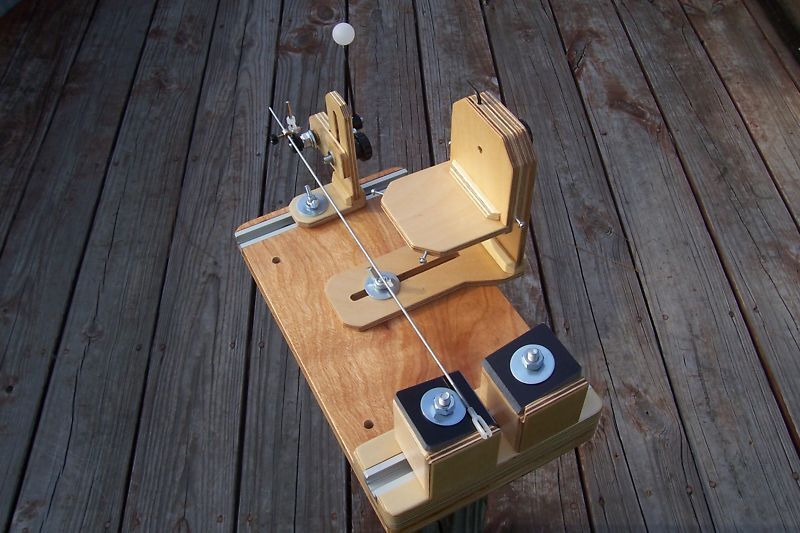
Although I have a couple of old Tatone stands, which are all aluminum and quite rugged and long lasting, I switched over to a nice test stand made by a guy who sells them on Ebay from time to time.
I have run engines as small as a .049 on it and as large as a 1.80 engine too.
For some engines the right side bolt and nut can interfere with the muffler and on small engines, I sometimes had to make a puck to hold the engine so that the needle valve or carb throttle would clear the mounting clamps.
He happens to have on up on Ebay at this time too.
http://www.ebay.com/itm/ENGINE-TEST-...item3373a5f819
Sorry, for some odd reason the forum software changes the URL to the pictures a \ASP is changed to \A when I save the message. So those links don't work here.
Norvel .059

ASP .28

Irvine .61

GMS 1.20

ASP 1.80

I have run engines as small as a .049 on it and as large as a 1.80 engine too.
For some engines the right side bolt and nut can interfere with the muffler and on small engines, I sometimes had to make a puck to hold the engine so that the needle valve or carb throttle would clear the mounting clamps.
He happens to have on up on Ebay at this time too.
http://www.ebay.com/itm/ENGINE-TEST-...item3373a5f819
Sorry, for some odd reason the forum software changes the URL to the pictures a \ASP is changed to \A when I save the message. So those links don't work here.
Norvel .059
ASP .28
Irvine .61
GMS 1.20
ASP 1.80
03-24-2012 | 07:01 AM
#7
 RE: Test Stand
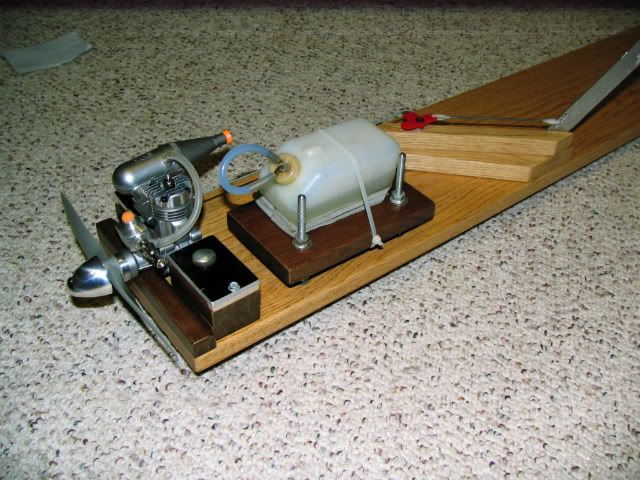
I built this one from materials I had on hand. Red oak and Brazilian Walnut (Ipé), and 3/16" aluminum for the engine clamps. Some 1/4-20 bolts clamp the engine down. Handles whatever size engine I can stick on it. I've had .29 up to .90's on mine.
I used a couple spare servo horns, a few drywall screws, 4-40 threaded rods, and a strip of 3/32" aluminum for a throttle linkage. The fuel tank platform can be raised or lowered.
Took me about an hour to cut all the pieces and another day or so to put a few coats of finish on it. The only engine I cant run on it is my small frame Fox .40. The drop down muffler hits the engine clamp.
I used a couple spare servo horns, a few drywall screws, 4-40 threaded rods, and a strip of 3/32" aluminum for a throttle linkage. The fuel tank platform can be raised or lowered.
Took me about an hour to cut all the pieces and another day or so to put a few coats of finish on it. The only engine I cant run on it is my small frame Fox .40. The drop down muffler hits the engine clamp.
03-24-2012 | 07:18 AM
#8
 RE: Test Stand
ORIGINAL: earlwb
Although I have a couple of old Tatone stands, which are all aluminum and quite rugged and long lasting, I switched over to a nice test stand made by a guy who sells them on Ebay from time to time.
I have run engines as small as a .049 on it and as large as a 1.80 engine too.
For some engines the right side bolt and nut can interfere with the muffler and on small engines, I sometimes had to make a puck to hold the engine so that the needle valve or carb throttle would clear the mounting clamps.
He happens to have on up on Ebay at this time too.
http://www.ebay.com/itm/ENGINE-TEST-...item3373a5f819
Sorry, for some odd reason the forum software changes the URL to the pictures a \ASP is changed to \A when I save the message. So those links don't work here.
Norvel .059
ASP .28
Irvine .61
GMS 1.20
ASP 1.80
Although I have a couple of old Tatone stands, which are all aluminum and quite rugged and long lasting, I switched over to a nice test stand made by a guy who sells them on Ebay from time to time.
I have run engines as small as a .049 on it and as large as a 1.80 engine too.
For some engines the right side bolt and nut can interfere with the muffler and on small engines, I sometimes had to make a puck to hold the engine so that the needle valve or carb throttle would clear the mounting clamps.
He happens to have on up on Ebay at this time too.
http://www.ebay.com/itm/ENGINE-TEST-...item3373a5f819
Sorry, for some odd reason the forum software changes the URL to the pictures a \ASP is changed to \A when I save the message. So those links don't work here.
Norvel .059
ASP .28
Irvine .61
GMS 1.20
ASP 1.80
03-24-2012 | 07:37 AM
#9
RE: Test Stand
ORIGINAL: 1QwkSport2.5r
I built this one from materials I had on hand. Red oak and Brazilian Walnut (Ipé , and 3/16" aluminum for the engine clamps. Some 1/4-20 bolts clamp the engine down. Handles whatever size engine I can stick on it. I've had .29 up to .90's on mine.
I used a couple spare servo horns, a few drywall screws, 4-40 threaded rods, and a strip of 3/32" aluminum for a throttle linkage. The fuel tank platform can be raised or lowered.
Took me about an hour to cut all the pieces and another day or so to put a few coats of finish on it. The only engine I cant run on it is my small frame Fox .40. The drop down muffler hits the engine clamp.
I built this one from materials I had on hand. Red oak and Brazilian Walnut (Ipé
, and 3/16" aluminum for the engine clamps. Some 1/4-20 bolts clamp the engine down. Handles whatever size engine I can stick on it. I've had .29 up to .90's on mine. I used a couple spare servo horns, a few drywall screws, 4-40 threaded rods, and a strip of 3/32" aluminum for a throttle linkage. The fuel tank platform can be raised or lowered.
Took me about an hour to cut all the pieces and another day or so to put a few coats of finish on it. The only engine I cant run on it is my small frame Fox .40. The drop down muffler hits the engine clamp.
Fox Eagle IV .60 engine for example:
 03-24-2012 | 07:43 AM
#10
RE: Test Stand
ORIGINAL: goirish
Any Idea where you can get the aluminum channel that is used on the test stand. I have looked almost everywhere.
Any Idea where you can get the aluminum channel that is used on the test stand. I have looked almost everywhere.
The other method is to make it all out of aluminum bar stock. You cut the groove and then cut the bolt recess for the Tee shape.
Of course there may be a machine or something out there that uses it already, where one could possibly order the part, but I never ran across it myself yet.
03-24-2012 | 07:46 AM
#11
Senior Member
RE: Test Stand
Mine is bolted onto a folding sawhorse. The sawhorse has locking bars to keep it solid. I put the rear locking bar through a concrete block so the whole rig can't tip forward. When I first used, it, without the block, a K&B 4011 tipped it forward toward my crotch. Fortunately, I got it under control without bloodshed. I put the block on before running another engine.
03-24-2012 | 07:48 AM
#12


My Feedback: (5)
RE: Test Stand
I bought one from the guy in FL off of ebay also and it is a very well thought out test stand. I've had .049 though the Super Tigre G4500 on mine.
Here was mine when I got it in the mail.
However now that I have more wood working tools it's easer for me to cut out a custom mount for a engine out of scrap, use it one time and trash it rather than try to clean all the oil off the nice test stand.
The tracks you can get at wood working shops. We use them in wood working to make jigs, slides, fence, and work piece holders for saws.
http://www.woodcraft.com/product/200...r-channel.aspx
Here was mine when I got it in the mail.
However now that I have more wood working tools it's easer for me to cut out a custom mount for a engine out of scrap, use it one time and trash it rather than try to clean all the oil off the nice test stand.
The tracks you can get at wood working shops. We use them in wood working to make jigs, slides, fence, and work piece holders for saws.
http://www.woodcraft.com/product/200...r-channel.aspx


 03-24-2012 | 12:41 PM
#15
RE: Test Stand
Hi
Here are two test stands , one is for the small two strokes , and the other is for my gasser,s . The one for the gasser,s only has to have a front plate made to change engines .
. The plastic box that you see , ( on the two stroke stand ) is to protect the reciever , if one is needed to program the radio .
Michel
Here are two test stands , one is for the small two strokes , and the other is for my gasser,s . The one for the gasser,s only has to have a front plate made to change engines .
. The plastic box that you see , ( on the two stroke stand ) is to protect the reciever , if one is needed to program the radio .
Michel
03-24-2012 | 12:46 PM
#16
Senior Member
RE: Test Stand
This is what I use, quick and easy to bolt in and out engines, takes just about any size from .10 to 180 (confirmed) and possibly even larger. Cheap as dirt too
http://www.ebay.com/itm/Model-Aircra...ht_2308wt_1274
http://www.ebay.com/itm/Model-Aircra...ht_2308wt_1274
03-24-2012 | 12:56 PM
#17
RE: Test Stand
Thanks for the info AmishWarlord, the actual tracks he used on our test stands are the Incra T Tracks.
http://woodworker.com/search.asp?sea...FQmMtgodVV_l3g
They use regular 1/4x20 bolts and the heads fit without machining. But I think he might have machined the bolt heads to use larger bolts in the test stand.
All this time and I totally had forgotten about the Mitre channels and Tee Tracks.
http://woodworker.com/search.asp?sea...FQmMtgodVV_l3g
They use regular 1/4x20 bolts and the heads fit without machining. But I think he might have machined the bolt heads to use larger bolts in the test stand.
All this time and I totally had forgotten about the Mitre channels and Tee Tracks.
03-24-2012 | 01:00 PM
#18
RE: Test Stand
I got this large gasser engine test stand from someone on Ebay a few years ago. The front aluminum plate can be drilled and tapped or whatever as needed. it is sort of a sacraficial plate easy to replace if it gets too many holes in it.

 03-24-2012 | 01:19 PM
#20
My Feedback: (5)
RE: Test Stand
Test stand safty.
1 Do not stand in front of the engine.
2 Do not use C-clamps to hold test stand down.
Lets see what happens when you break these rules.
http://www.youtube.com/watch?v=1Pk9y5t1N9Q
1 Do not stand in front of the engine.
2 Do not use C-clamps to hold test stand down.
Lets see what happens when you break these rules.
http://www.youtube.com/watch?v=1Pk9y5t1N9Q
03-24-2012 | 01:30 PM
#21
RE: Test Stand
Hi
Seen this video , many many moons ago ,..................................... he got a very quick lesson . ,as for anyone else who treats our hobby as , " TOYS "
Michel
Seen this video , many many moons ago ,..................................... he got a very quick lesson .
,as for anyone else who treats our hobby as , " TOYS "Michel
03-24-2012 | 01:47 PM
#22
My Feedback: (5)
RE: Test Stand
OK here is a really nice nerdy test stand that I'd love to have, but watch the fuel in the tank. It seems to turn into a frothy brew wile the engine is at high RPM.
http://www.youtube.com/watch?v=EBwvT...eature=related
http://www.youtube.com/watch?v=EBwvT...eature=related
03-24-2012 | 03:31 PM
#23
Thread Starter
Senior Member
Joined: Aug 2009
Posts: 420
Likes: 0
Received 0 Likes
on
0 Posts
From: Gunton, MB, CANADA
RE: Test Stand
Looking at the fuel in that tank, it seems you could almost shave with that stuff. Don't try that at home kids. Shaving, that is. 
Thanks for all the ideas folks, it is greatly appreciated. Some of those test stands look too nice to be covered in slime. It's great to see the pride, that people put into things.
Thanks for all the ideas folks, it is greatly appreciated. Some of those test stands look too nice to be covered in slime. It's great to see the pride, that people put into things.
03-24-2012 | 03:40 PM
#24
Senior Member
Joined: Jul 2003
Posts: 2,613
Likes: 0
Received 0 Likes
on
0 Posts
From: no city,
AL
RE: Test Stand
Very interesting thread. Some innovative approaches.
I enjoy engines as much as, if not more than tha planes. As a result I have several stands, some home made and some purchased. I also keep on hand a bit of methanol, nitro methane, castor and synthetic so I can mix a small batch of fuel appropriate for whatever falls into my clutches.
jess
I enjoy engines as much as, if not more than tha planes. As a result I have several stands, some home made and some purchased. I also keep on hand a bit of methanol, nitro methane, castor and synthetic so I can mix a small batch of fuel appropriate for whatever falls into my clutches.
jess

