


Club FOX!


 11-26-2025 | 02:45 AM
#5202

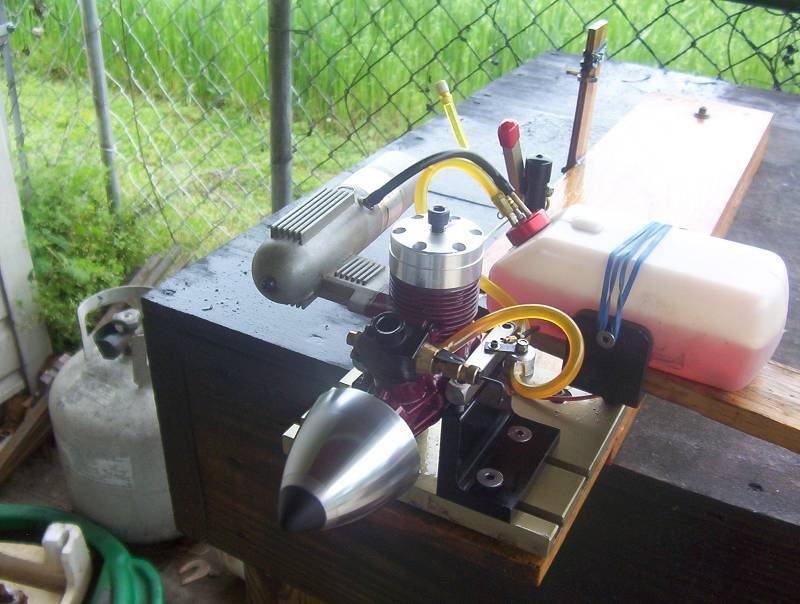
Here is a thread I started years ago called 50 Diesel Mostly: Diesel .50s (mostly) as can clearly be seen, some were better conversions than others
The OS LA 65 below turned a Bolly Clubman 13.5 x 8 at 9,300, this head was made by A. J. Coholic in Canada
The PAW 60 turned the Bolly Clubman 13.5 x 8 at 7,500
The head on the Irvine 53 above was a Davis Diesel proof of concept head for our military to burn Jet-A in them, it Ran fine on Davis ABC mix., the 53 was the king of the 50 size engine. An Air Force guy came to our flying field at Fort Belvoir and was shocked that I had it.
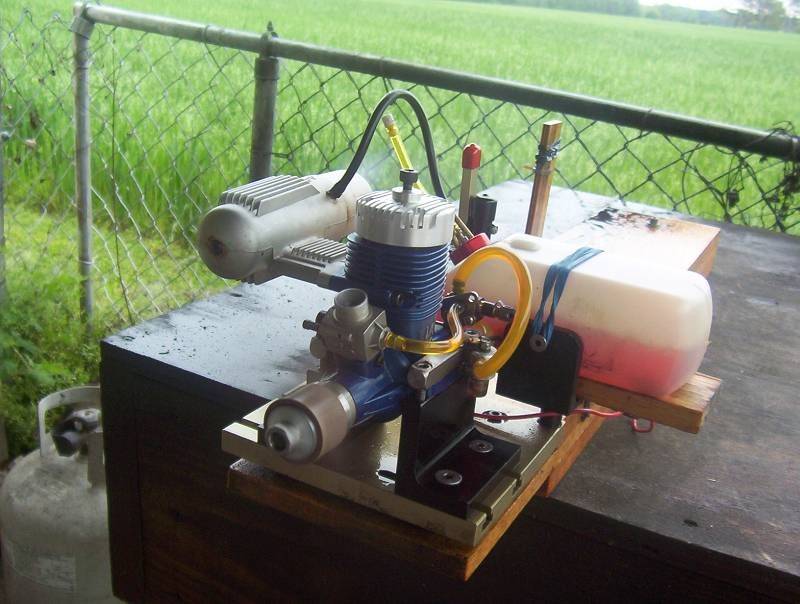
A surprisingly powerful Diesel conversion, an OS LA 65
Disappointing Diesel, a PAW 60
Last edited by 1200SportsterRider; 11-26-2025 at 02:58 AM. Reason: Add content
11-26-2025 | 07:05 AM
#5203

Senior Member
My Feedback: (3)
Military + Jet A + Small 2-stroke = Drones?
I'm surprised this conversion is not more common with Fox, since fabbing a head button would be so much easier than an entire head assy.
I've posted this before, but in my case I went the other way on my first Eagle IV 60. It had run on the test stand without issues as I at least started the break-in and tune, but three dead sticks with fried plugs in a row on the maiden flights finally clued me in there may be some deeper issue.
That was proven once the head was removed as the aft third of the piston had burnt away to below the ring. It had not eroded through the skirt yet, the reason there was no obvious loss of compression.
Since my own error by running 15%, was pleasantly surprised by no warranty pushback when sent in for repair. I assume since they had already come up with a modded head button to allow for higher nitro they may have seen a lot more of the same across their bench.
In the interim between my test stand runs and maiden I had acquired another identical 60 NIB and thought it would at least provide a basis for some home testing. I fabbed up 3 buttons with different chamber shapes and lowered compression and recorded my runs to see which performed the best.
NOTE: Would have to search my much earlier posting since a Windows update wiped out all my media and no amount of rebuilding will find the original pics of the 3 buttons to post again here.
Meanwhile, Fox advised me my engine had been repaired and test run with the updated button at no cost. I had requested an extra for that second engine and when arrived it was virtually identical to my own best performing. I have been running it ever since, (sold the first 60 and have that second NIB, along with the 74 and the other 2 buttons, set aside in my engine cabinet).
ps. Dave, you look to have quite a lot more experience with this than anyone else can ask: Did you find the diesel run hotter or cooler? One thing I learned when in AME school, and later flying helis powered by the Allison, (now R/R) and other turbines, was Avgas had less energy density than Jet A, but, oddly enough, burned much hotter.
pps. During winter ops, (that could get down to -55F) we switched to Jet B, which contained 1/3 Avgas, the only way to light off in those cold temps. At that mix there was no flight manual restriction on how long we could run with it.
I'm surprised this conversion is not more common with Fox, since fabbing a head button would be so much easier than an entire head assy.
I've posted this before, but in my case I went the other way on my first Eagle IV 60. It had run on the test stand without issues as I at least started the break-in and tune, but three dead sticks with fried plugs in a row on the maiden flights finally clued me in there may be some deeper issue.
That was proven once the head was removed as the aft third of the piston had burnt away to below the ring. It had not eroded through the skirt yet, the reason there was no obvious loss of compression.
Since my own error by running 15%, was pleasantly surprised by no warranty pushback when sent in for repair. I assume since they had already come up with a modded head button to allow for higher nitro they may have seen a lot more of the same across their bench.
In the interim between my test stand runs and maiden I had acquired another identical 60 NIB and thought it would at least provide a basis for some home testing. I fabbed up 3 buttons with different chamber shapes and lowered compression and recorded my runs to see which performed the best.
NOTE: Would have to search my much earlier posting since a Windows update wiped out all my media and no amount of rebuilding will find the original pics of the 3 buttons to post again here.
Meanwhile, Fox advised me my engine had been repaired and test run with the updated button at no cost. I had requested an extra for that second engine and when arrived it was virtually identical to my own best performing. I have been running it ever since, (sold the first 60 and have that second NIB, along with the 74 and the other 2 buttons, set aside in my engine cabinet).
ps. Dave, you look to have quite a lot more experience with this than anyone else can ask: Did you find the diesel run hotter or cooler? One thing I learned when in AME school, and later flying helis powered by the Allison, (now R/R) and other turbines, was Avgas had less energy density than Jet A, but, oddly enough, burned much hotter.
pps. During winter ops, (that could get down to -55F) we switched to Jet B, which contained 1/3 Avgas, the only way to light off in those cold temps. At that mix there was no flight manual restriction on how long we could run with it.
Last edited by Cougar429; 11-26-2025 at 07:09 AM.
12-01-2025 | 02:36 AM
#5205
They run cooler because the combustion process is complete before the exhaust port opens, a glow engine run at night with no muffler will have a blue flame standing at the exhaust port because the combustion process is incomplete. The Diesel exhaust on the other hand will have sparks exiting the exhaust because for the most part the carbon build up on the piston is migratory. A layer will form on the piston head but little build up. Over compressing a Diesel conversion will overheat them though.
12-01-2025 | 04:53 AM
#5206


One of my first cars was a 1930 Ford Model A.
Purchased from the original owner, it had been sitting since 1947. The owner was a pretty sharp old German tool and die maker. He had a one gallon gasoline can hanging from the radiator support rods. It went to a two way select valve that was operated from inside the car. The other side went to the cars fuel tank, in the cowl which at the time he would fill with kerosene rather than gasoline.
He would start the car on gasoline and once warmed up, switch over to kerosene. Easier to get and it delivered better mileage.
Very convenient as well since the Ford’s Holley carb had a main needle adjustment knob inside the car. The ignition timing control was also manually set by a lever on the steering column.
He burned very little precious gasoline during the war. The crude old Ford made that possible.
Purchased from the original owner, it had been sitting since 1947. The owner was a pretty sharp old German tool and die maker. He had a one gallon gasoline can hanging from the radiator support rods. It went to a two way select valve that was operated from inside the car. The other side went to the cars fuel tank, in the cowl which at the time he would fill with kerosene rather than gasoline.
He would start the car on gasoline and once warmed up, switch over to kerosene. Easier to get and it delivered better mileage.
Very convenient as well since the Ford’s Holley carb had a main needle adjustment knob inside the car. The ignition timing control was also manually set by a lever on the steering column.
He burned very little precious gasoline during the war. The crude old Ford made that possible.
12-01-2025 | 07:18 AM
#5207
Senior Member
My Feedback: (3)
For those with knowledge and experience, I apologize ahead of time. The teacher gene is presenting itself again, hoping to pass along what I know somewhere down the line...........
That may be true of the exhaust itself, but not sure if the case with the combustion process INSIDE the chamber during the ignition phase.
Most I/C engines will spit flame out a bare port, (I used to watch this in the Ford engine test cells quite often - Right before the call to go in and clean up their remains when they blew up, but that's another story).
Mixture, as well as valve and ignition timing are key to that part of the SUCK, SQUEEZE, BANG, BLOW process. The former is called a stoichiometric ratio; that means as close to the perfect amount of fuel is present, ie. not too rich or lean. Valve timing, which considers not only when in the cycles they are open, but for how long and includes overlap: when both are open at the same time. This is in part to allow for the energetic exhaust flow to help pull in more intake charge. Of course, there is a compromise here since this relationship depends on how well both the intake and exhaust systems are designed and that, like any musical instrument, is RPM dependent. In olden days this timing and overlap were fixed, set up in an attempt to get the most power and performance in a desired RPM range. In our 2-stroke engines this is in the size and height of our intake and exhaust ports and is where you would see expert "Modders" show their skill.
Currently, along with ignition timing and mixture, auto engine control systems can actively control both intake and exhaust valve timing on the fly, (unfortunately this adds quite a bit to the complexity and cost, as well as presents a most common failure point).
So, valve timing is important, but can be strangled if breathing is restricted. MANY hundreds of hours of testing and design have gone into intake and exhaust system flow, valve placement and combustion chamber design, all to optimize atomization, (the process of reducing the fuel particulate size down as small as possible and mixing it UNIFORMLY throughout the combustion chamber).
NOTE: For anyone interested, an extreme example of this can be found in the story of the F1 engine used in the first stage of the Apollo Saturn V
In the end that can be the show stopper to how lean you can go before things start to go drastically wrong. Fortunately, with computational fluid dynamics, good computer modelling and other means a lot of that can be worked out before ever casting metal, (or plastic).
A bit of an aside here: There has to be enough fuel to present a flame front that burns at a fixed and controlled rate, where igniting each molecule of fuel takes heat away from the combustion process behind it. Counter-intuitively, too LITTLE fuel can actuall cause the process to heat up too much. Not only is this where a lot of pollutants produced, but that overheating can mean the process becomes uncontrolled. In the worst case the fuel self-ignites and/or the flame front is turbulent and too violent, (overstressing internals). Increasing compression ratio magnifies this and is in fact how diesel engines can ignite without an external system.
As another aside, diesel ignition is in itself violent since the heating and ignition usually occur at once, rather than as a flame front, meaning the physical stresses on internals are much higher. I was actively in the industry when GM decided to try and make their venerable 350 into a diesel. You can imagine how well it went when they tried - without any reinforcing - to take an engine designed for compression ratios in the low teens and increase that above 20:1,
Back in the 80s I had a second business prototyping, installing, testing and certifying alternate fuel systems, and my friend, (and member of our club) was head of Chrysler's entire alternate fuel program. My full size Jeep was my flagship advertising medium and took 2 years to complete, (including my own design digital dash and 4-wheel disk brakes) Part of that effort was spent simply getting a mechanical distributor to follow the completely different ignition curve required.
Anyway, the point of all this is, regardless of fuel, the basics of good breathing, proper mixture and ignition timing are still relevant.
ps. I remember the first time under a Mazda Rx 7. The heat shielding ran all the way to the back bumper! Only then did I remember the reports on the OS rotary engine. It was 30 sized, but even if able to spin over 17K, it burned fuel like a 60. I imagine like its full-size brethren, most of that was still combusting on the way out the exhaust.
pps. This brings up what I hope is my final aside: I have built a few YS 120s, most from boxes of loose bits, and was surprised to learn there is little information available regarding anyone converting these supercharged engines to diesel. Imagine this would require a lot of experimentation simply to find compatible fuel system components, since the diaphragms, O-rings and seals definitely aren't.
The other thing is: would it be worth the effort and risk. Yes, they are fuel hogs for t heir size, but this is in comparison to their power output. I was thinking the whole purpose of diesel conversions now is to reduce consumption, but it also allows to spin a much larger diameter prop at lower RPMs. At some point the internal physical stresses will be pushing close to the limits, making this an effort of diminishing returns. I already built an OS Gemini 160 from two wrecks, the first having thrown one of the early gen rods out the side. OS usually is better than that, but they are on the third completely different version, in both materials and design. A bit of an expensive mistake.
O/K. Caffeine is kicking in, so back to our regularly scheduled program...............Beuller...................Be uller............
They run cooler because the combustion process is complete before the exhaust port opens, a glow engine run at night with no muffler will have a blue flame standing at the exhaust port because the combustion process is incomplete
Most I/C engines will spit flame out a bare port, (I used to watch this in the Ford engine test cells quite often - Right before the call to go in and clean up their remains when they blew up, but that's another story).
Mixture, as well as valve and ignition timing are key to that part of the SUCK, SQUEEZE, BANG, BLOW process. The former is called a stoichiometric ratio; that means as close to the perfect amount of fuel is present, ie. not too rich or lean. Valve timing, which considers not only when in the cycles they are open, but for how long and includes overlap: when both are open at the same time. This is in part to allow for the energetic exhaust flow to help pull in more intake charge. Of course, there is a compromise here since this relationship depends on how well both the intake and exhaust systems are designed and that, like any musical instrument, is RPM dependent. In olden days this timing and overlap were fixed, set up in an attempt to get the most power and performance in a desired RPM range. In our 2-stroke engines this is in the size and height of our intake and exhaust ports and is where you would see expert "Modders" show their skill.
Currently, along with ignition timing and mixture, auto engine control systems can actively control both intake and exhaust valve timing on the fly, (unfortunately this adds quite a bit to the complexity and cost, as well as presents a most common failure point).
So, valve timing is important, but can be strangled if breathing is restricted. MANY hundreds of hours of testing and design have gone into intake and exhaust system flow, valve placement and combustion chamber design, all to optimize atomization, (the process of reducing the fuel particulate size down as small as possible and mixing it UNIFORMLY throughout the combustion chamber).
NOTE: For anyone interested, an extreme example of this can be found in the story of the F1 engine used in the first stage of the Apollo Saturn V
In the end that can be the show stopper to how lean you can go before things start to go drastically wrong. Fortunately, with computational fluid dynamics, good computer modelling and other means a lot of that can be worked out before ever casting metal, (or plastic).
A bit of an aside here: There has to be enough fuel to present a flame front that burns at a fixed and controlled rate, where igniting each molecule of fuel takes heat away from the combustion process behind it. Counter-intuitively, too LITTLE fuel can actuall cause the process to heat up too much. Not only is this where a lot of pollutants produced, but that overheating can mean the process becomes uncontrolled. In the worst case the fuel self-ignites and/or the flame front is turbulent and too violent, (overstressing internals). Increasing compression ratio magnifies this and is in fact how diesel engines can ignite without an external system.
As another aside, diesel ignition is in itself violent since the heating and ignition usually occur at once, rather than as a flame front, meaning the physical stresses on internals are much higher. I was actively in the industry when GM decided to try and make their venerable 350 into a diesel. You can imagine how well it went when they tried - without any reinforcing - to take an engine designed for compression ratios in the low teens and increase that above 20:1,
Back in the 80s I had a second business prototyping, installing, testing and certifying alternate fuel systems, and my friend, (and member of our club) was head of Chrysler's entire alternate fuel program. My full size Jeep was my flagship advertising medium and took 2 years to complete, (including my own design digital dash and 4-wheel disk brakes) Part of that effort was spent simply getting a mechanical distributor to follow the completely different ignition curve required.
Anyway, the point of all this is, regardless of fuel, the basics of good breathing, proper mixture and ignition timing are still relevant.
ps. I remember the first time under a Mazda Rx 7. The heat shielding ran all the way to the back bumper! Only then did I remember the reports on the OS rotary engine. It was 30 sized, but even if able to spin over 17K, it burned fuel like a 60. I imagine like its full-size brethren, most of that was still combusting on the way out the exhaust.
pps. This brings up what I hope is my final aside: I have built a few YS 120s, most from boxes of loose bits, and was surprised to learn there is little information available regarding anyone converting these supercharged engines to diesel. Imagine this would require a lot of experimentation simply to find compatible fuel system components, since the diaphragms, O-rings and seals definitely aren't.
The other thing is: would it be worth the effort and risk. Yes, they are fuel hogs for t heir size, but this is in comparison to their power output. I was thinking the whole purpose of diesel conversions now is to reduce consumption, but it also allows to spin a much larger diameter prop at lower RPMs. At some point the internal physical stresses will be pushing close to the limits, making this an effort of diminishing returns. I already built an OS Gemini 160 from two wrecks, the first having thrown one of the early gen rods out the side. OS usually is better than that, but they are on the third completely different version, in both materials and design. A bit of an expensive mistake.
O/K. Caffeine is kicking in, so back to our regularly scheduled program...............Beuller...................Be uller............
Last edited by Cougar429; 12-01-2025 at 07:21 AM.
12-01-2025 | 10:54 AM
#5208
I always considered the YS to be easy on fuel at similar power settings 
Save for one 160!Gemini (I have run 120, 160 and the 300) mine were built up from baskets as well.
The only rod failure I had was with the one and only “new” 160, and it was a bronze rod. Replaced the rods in that engine with a pair of aluminum rods and gave the engine to a friend about 20 years ago. AFAIK they are still holding their own. Oil matters on the aluminum rods, revs kill the bronze vesions IMHO.
Save for one 160!Gemini (I have run 120, 160 and the 300) mine were built up from baskets as well.
The only rod failure I had was with the one and only “new” 160, and it was a bronze rod. Replaced the rods in that engine with a pair of aluminum rods and gave the engine to a friend about 20 years ago. AFAIK they are still holding their own. Oil matters on the aluminum rods, revs kill the bronze vesions IMHO.
12-02-2025 | 02:59 AM
#5209
Ab0ve I pictured an Irvine 53 with the prototype head, here is the latest head produced, it had annular fins. This belongs to good friend in Australia, (fiery)

Turning a 11.3 x 7.7 Bolly at the rpm shown.
Turning a 11.3 x 7.7 Bolly at the rpm shown.
Last edited by 1200SportsterRider; 12-02-2025 at 05:42 AM. Reason: Make correction
12-02-2025 | 05:02 AM
#5210
Remember buying brand new Irvine .40s at the Toledo RC Expo for right around $50 back in the 1980s. I was putting them on everything.
My son still has a .25 car engine brand new, in the box.
My son still has a .25 car engine brand new, in the box.
The following users liked this post:
HangarRash (12-02-2025)
12-09-2025 | 08:54 PM
#5211

Picked this one up recently in NOS condition, a Fox .29 R/C cross scavenge engine.
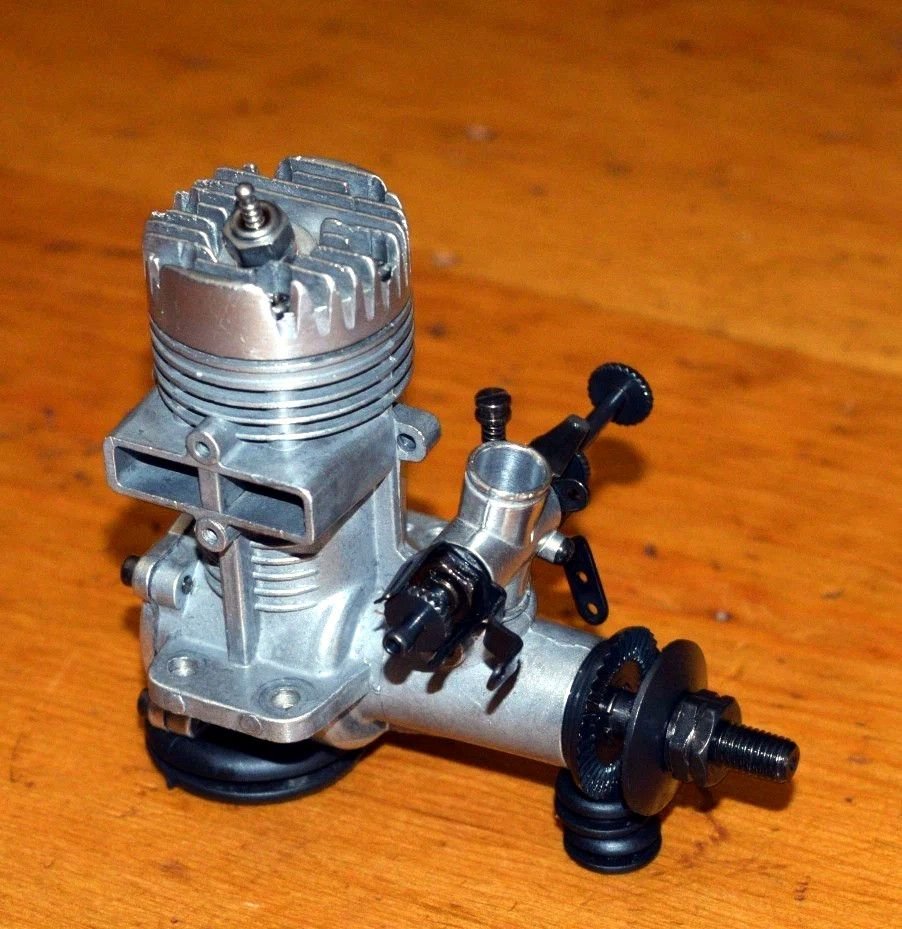
Recent EBay purchase, a Fox .29 R/C - right side view.
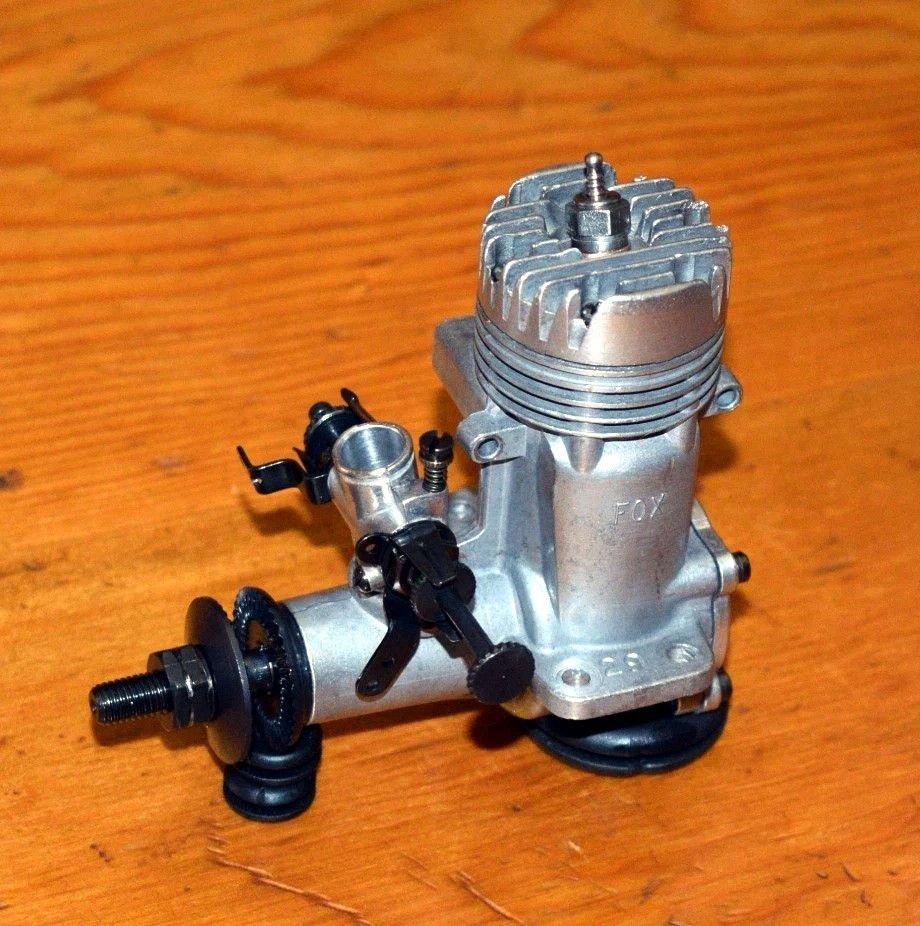
Recent EBay purchase, a Fox .29 R/C - left side view.
Recent EBay purchase, a Fox .29 R/C - right side view.
Recent EBay purchase, a Fox .29 R/C - left side view.
The following users liked this post:
HangarRash (12-10-2025)
12-10-2025 | 06:41 AM
#5212

My Feedback: (157)
I acquired a Fox .29 RC just like the one pictured. No matter what I did, I could not get it to run. It would start, running very rough and unable to throttle up, while spitting fuel out of the carburetor, then quit.
After trying many, many things, I finally took the engine apart and discovered the sleeve had been installed 180 degrees wrong... exhaust ports on intake, and visa versa!
The engine appeared to have never been run, so it is a mystery to me as to HOW this might have happened? Since Fox test ran all engines at the factory, again I wondered HOW..?
Anyway, after correctly positioning the cylinder sleeve, the engine started and ran very well.
After trying many, many things, I finally took the engine apart and discovered the sleeve had been installed 180 degrees wrong... exhaust ports on intake, and visa versa!
The engine appeared to have never been run, so it is a mystery to me as to HOW this might have happened? Since Fox test ran all engines at the factory, again I wondered HOW..?
Anyway, after correctly positioning the cylinder sleeve, the engine started and ran very well.
12-10-2025 | 06:43 AM
#5213
Senior Member
My Feedback: (3)
Interesting find. A bit before my time so went looking for info.: These were apparently sold through the 60s - 70s. The reports show a pretty well developed carb for that gen.
Any manual? From what I found it ran a max up to 5% nitro, so would likely avoid anything higher.
Also, looks pre-Schnuerle. With the offset plug would think that is the case.
Also, with those bosses and lack of exhaust baffle it appears there should be a muffler option. Would be interested in what that looked like. Found pics of one with a home made dual stack, but no muffler yet.
Any manual? From what I found it ran a max up to 5% nitro, so would likely avoid anything higher.
Also, looks pre-Schnuerle. With the offset plug would think that is the case.
Also, with those bosses and lack of exhaust baffle it appears there should be a muffler option. Would be interested in what that looked like. Found pics of one with a home made dual stack, but no muffler yet.
12-10-2025 | 11:56 PM
#5214
I acquired a Fox .29 RC just like the one pictured. [...] After trying many, many things, I finally took the engine apart and discovered the sleeve had been installed 180 degrees wrong... exhaust ports on intake, and visa versa! [...] Anyway, after correctly positioning the cylinder sleeve, the engine started and ran very well.
Interesting find. A bit before my time so went looking for info.: These were apparently sold through the 60s - 70s. The reports show a pretty well developed carb for that gen. Any manual? From what I found it ran a max up to 5% nitro, so would likely avoid anything higher. Also, looks pre-Schnuerle. With the offset plug would think that is the case. Also, with those bosses and lack of exhaust baffle it appears there should be a muffler option. Would be interested in what that looked like. Found pics of one with a home made dual stack, but no muffler yet.
This .29 R/C has the newer muffler mount lugs on each side of the exhaust port toward the rear. Fox made this change as the above and below mounting system in the middle of the exhaust port was weak, easier to damage the engine in a crash. So this .29 was one of the later ones. This photo for the .25 is probably the muffler that the .29 used:
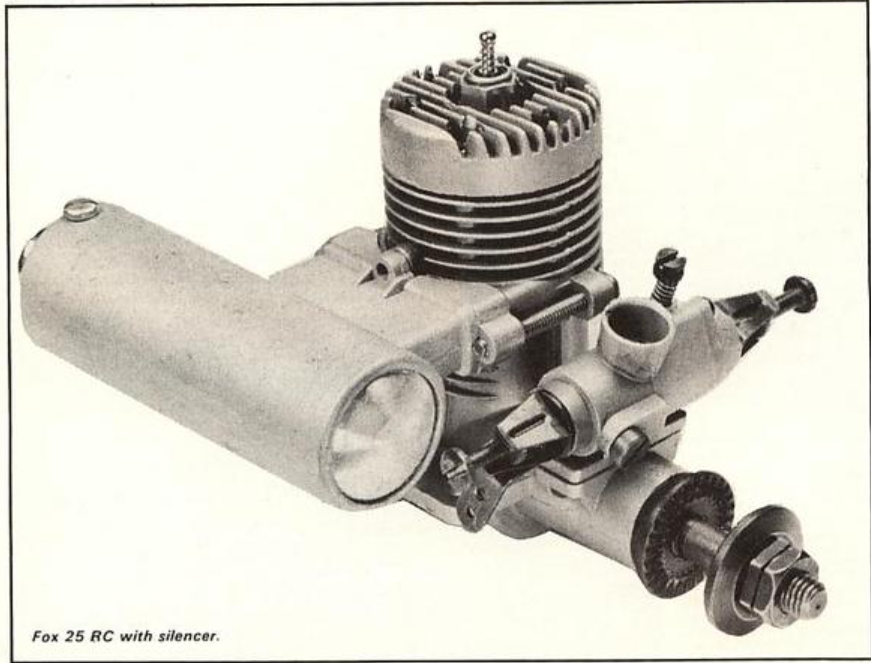
From Jan-1982 Aeromodeller Magazine, Fox .25 R/C Engine Review by Peter Chinn obtained from https://sceptreflight.com/Model%20En...2025%20RC.html
Sceptre Flight Engine Tests does not have an article on this particular Fox .29. It's carburetor is a little earlier than the MK-X that is on my .25. My guess is the Fox .29 R/C from the 1970's, probably the last of the series. My Fox .25 R/C has the later single piece cast aluminum streamlined shaped muffler.
I don't have a manual for the .29 R/C, else I would scan and share it.


