


How do you Tach?
 09-26-2007 | 06:31 PM
#1
Thread Starter
Senior Member
Joined: Jan 2006
Posts: 176
Likes: 0
Received 0 Likes
on
0 Posts
From: Waterbury,
CT
 How do you Tach?
I have a tach I use for my fixed wing. I assume it will work for the copter.
But how do you physically do it? Do you clamp the heli down? Does some poor slob get elected to hold it while you're checking?
I've read that clamping is not a good idea as oscillations can shred a chopper. What is the safe way to do this?
But how do you physically do it? Do you clamp the heli down? Does some poor slob get elected to hold it while you're checking?
I've read that clamping is not a good idea as oscillations can shred a chopper. What is the safe way to do this?
 09-26-2007 | 07:19 PM
#2

Senior Member
Joined: Dec 2006
Posts: 247
Likes: 0
Received 0 Likes
on
0 Posts
From: Elk Grove,
CA
RE: How do you Tach?
Clutchbob,
I spin mine up on the ground and get it so it's just light on the gear but stays down. I just hold the tach right over the blades. Then I pitch it negitive to see what happens. Yes, it makes me a little nervouse. Yeah, there are probley better ways to do it.
As far as clamping it down... don't. I learned the hard way. The gear snapped off and it took control of my living roon and then got smashed in to pieces...
I spin mine up on the ground and get it so it's just light on the gear but stays down. I just hold the tach right over the blades. Then I pitch it negitive to see what happens. Yes, it makes me a little nervouse. Yeah, there are probley better ways to do it.
As far as clamping it down... don't. I learned the hard way. The gear snapped off and it took control of my living roon and then got smashed in to pieces...
09-26-2007 | 07:30 PM
#3
Senior Member
Joined: Jun 2007
Posts: 220
Likes: 0
Received 0 Likes
on
0 Posts
From: McKinney,
TX
RE: How do you Tach?
If you were afraid of accidentally taking off, you could program one of the idle-up modes you're not using with a flat pitch curve at a very slightly negative pitch (to keep it on the ground) and a linear throttle curve.
09-26-2007 | 11:20 PM
#4
Thread Starter
Senior Member
Joined: Jan 2006
Posts: 176
Likes: 0
Received 0 Likes
on
0 Posts
From: Waterbury,
CT
RE: How do you Tach?
If you were afraid of accidentally taking off, you could program one of the idle-up modes you're not using with a flat pitch curve at a very slightly negative pitch (to keep it on the ground) and a linear throttle curve.
09-27-2007 | 09:03 AM
#5


My Feedback: (6)
RE: How do you Tach?
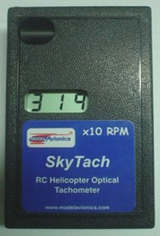
The SAFE way of measuring head speed on a helicopter is to do it optically.
Get youself one of these:
[link]http://www.modelavionics.com/tach.asp[/link]
You look thru a window and match the headspeed and read the number on the face of the device. I don't even leave my chair at the flying field when my buddy asks me to measure the headspeed on his helis.
Here is a picture:
Rafael
Get youself one of these:
[link]http://www.modelavionics.com/tach.asp[/link]
You look thru a window and match the headspeed and read the number on the face of the device. I don't even leave my chair at the flying field when my buddy asks me to measure the headspeed on his helis.
Here is a picture:
Rafael
09-27-2007 | 12:05 PM
#7
Senior Member
Joined: Aug 2006
Posts: 145
Likes: 0
Received 0 Likes
on
0 Posts
From: escondido,
CA
RE: How do you Tach?
No matter what you do, taching in ground effect is not the same as what is happening in clean air. So why bother. Theoretically, you know the rpm per volt of the motor and the gear ratio so if you really have a need to be a rocket scientist, do the math. If not, just go fly!
09-27-2007 | 02:50 PM
#8
My Feedback: (6)
RE: How do you Tach?
ORIGINAL: rlsloan
My advice is don't bother. Of what practical use is the data?
My advice is don't bother. Of what practical use is the data?
I like to set-up my Trex to a certain RPM and leave it there. I do this checking the temperature of the motor, battery and speed control. If any one of them gets too hot, I back down the headspeed. Longevity is the name of the game.
I do the same thing on my nitros and gasser. Fuel engines can be overreved and you run the possibility of damaging the internal components of the engine. Understanding where the peak performance of an engine / motor is, will prevent it from damaging itself.
When a helicopter explodes in your face because you were running too high of a headspeed you will understand the use of the data. I know some people are running 3000 rpms on TRex 450's and metal heads. Go too far over the limit on a bigger helicopter's plastic head and you will remember this thread.
Rafael
09-27-2007 | 03:14 PM
#9
Member
Joined: May 2006
Posts: 50
Likes: 0
Received 0 Likes
on
0 Posts
From: Elverum, NORWAY
RE: How do you Tach?
I have a couple of those Eagle Tree inflight data loggers. They add a little bit of extra weight to the heli, but I think it's worth it. With one of those you can see what happends at every point of your flying. It logs pack voltage and amp draw, and with with some periferals you can log rpm (optical, magnetic or brushless sensor), temp, air speed, height or servo amp draw. togheter with a vid of your flying, you can really learn something about how you treat your heli/battery while actually flying.
09-28-2007 | 02:57 PM
#10
Senior Member
Joined: Sep 2006
Posts: 303
Likes: 0
Received 0 Likes
on
0 Posts
From: Cape Town, SOUTH AFRICA
RE: How do you Tach?
I use one of those tachos' as well. I spool up and hold it under the main rotor blades facing up with the pitch at very slightly negative. Since I fly only in governor mode the headspeed should be the same at all times.
I think a tachometer is a must. It's the only reliable way to see what YOUR motor/pinion combination is producing.
I think a tachometer is a must. It's the only reliable way to see what YOUR motor/pinion combination is producing.
09-29-2007 | 09:54 PM
#11

Senior Member
Joined: Jan 2007
Posts: 475
Likes: 0
Received 0 Likes
on
0 Posts
From: Cape Coral,
FL
RE: How do you Tach?
ORIGINAL: Rafael23cc
When a helicopter explodes in your face because you were running too high of a headspeed you will understand the use of the data. I know some people are running 3000 rpms on TRex 450's and metal heads. Go too far over the limit on a bigger helicopter's plastic head and you will remember this thread.
Rafael
ORIGINAL: rlsloan
My advice is don't bother. Of what practical use is the data?
My advice is don't bother. Of what practical use is the data?
When a helicopter explodes in your face because you were running too high of a headspeed you will understand the use of the data. I know some people are running 3000 rpms on TRex 450's and metal heads. Go too far over the limit on a bigger helicopter's plastic head and you will remember this thread.
Rafael
Well - Here's a little something that will illustrate exactly what Rafael is talking about - You can see what overspeeding your rotors can really do. All of the damage happened in the air, and was strictly due to excessive head speed.
04-19-2008 | 11:01 PM
#12

Senior Member
Joined: Apr 2003
Posts: 370
Likes: 0
Received 0 Likes
on
0 Posts
From: Phenix City,
AL
RE: How do you Tach?
one way to keep your heli down to check rotor speed in all ranges is to have a metal ruler go over both sides of the skids and have bricks on each side of the ruler to hold the heli down, this will keep the heli from lifting when you want to check the rpms @ points 4 and 5 on the throttle.
04-20-2008 | 11:31 AM
#13
Senior Member
Joined: May 2007
Posts: 1,325
Likes: 0
Received 0 Likes
on
0 Posts
From: GARDEN CITY,
KS
RE: How do you Tach?
Optical tachs are more expensive but You can tach Your heli from a safe distance and they are ACCURATE! !
Another plus is that someone else can tach it from underneath while in hover or just flying around from any angle. You just press the shutter speed button up or down until the blades look like they are stationary.
I bought a 29.99 sensor type and the instructions specifically say that the Sun has to be shining to take an accurate reading from the sensor and You have to be very close. Needless to say, I don't use it.
Gary
Another plus is that someone else can tach it from underneath while in hover or just flying around from any angle. You just press the shutter speed button up or down until the blades look like they are stationary.
I bought a 29.99 sensor type and the instructions specifically say that the Sun has to be shining to take an accurate reading from the sensor and You have to be very close. Needless to say, I don't use it.
Gary


